This global sourcing checklist walks buyers through supplier vetting for transformer and cable accessories — the step most procurement teams skip before issuing an RFQ.
A distribution transformer accessory that fails a factory acceptance test rarely fails because of a bad drawing. More often, it fails because the supplier selected during sourcing could not consistently reproduce what the drawing specified. Procurement teams typically focus diligence on the request for quotation stage — voltage class, current rating, BIL — and treat the supplier relationship itself as a secondary concern to resolve once terms are agreed. That sequencing creates risk: a specification can be perfectly written and still arrive as a mismatched or under-tested product if the supplier behind it was never properly qualified.
The Cost of an Unvetted Supplier Relationship
Field experience across multiple sourcing cycles shows a consistent pattern: problems traced back to unvetted suppliers rarely surface at the quotation stage. They surface at factory acceptance testing, or worse, after a unit has already been installed and energized. A 15 kV cold shrink termination batch that passes visual inspection but was never routine-tested to its full electrical spec can pass incoming inspection and still fail within the first year of service. Re-sourcing after a failed batch typically adds 4–8 weeks to a project timeline, on top of any warranty or replacement costs — delays that compound when the failure is discovered mid-installation rather than during pre-shipment inspection.
Where Vetting Sits in the Sourcing Timeline
Vetting answers “will this supplier consistently deliver what they claim, batch after batch” — a distinct and earlier question than the RFQ’s “can this supplier make what I need on paper.” The two processes complement each other: a technically complete RFQ filters for capability, while vetting filters for reliability. Skipping vetting and moving straight from a promising quotation to a purchase order is the single most common reason procurement teams end up re-qualifying a second supplier mid-project, a cost that dwarfs the time vetting itself requires.
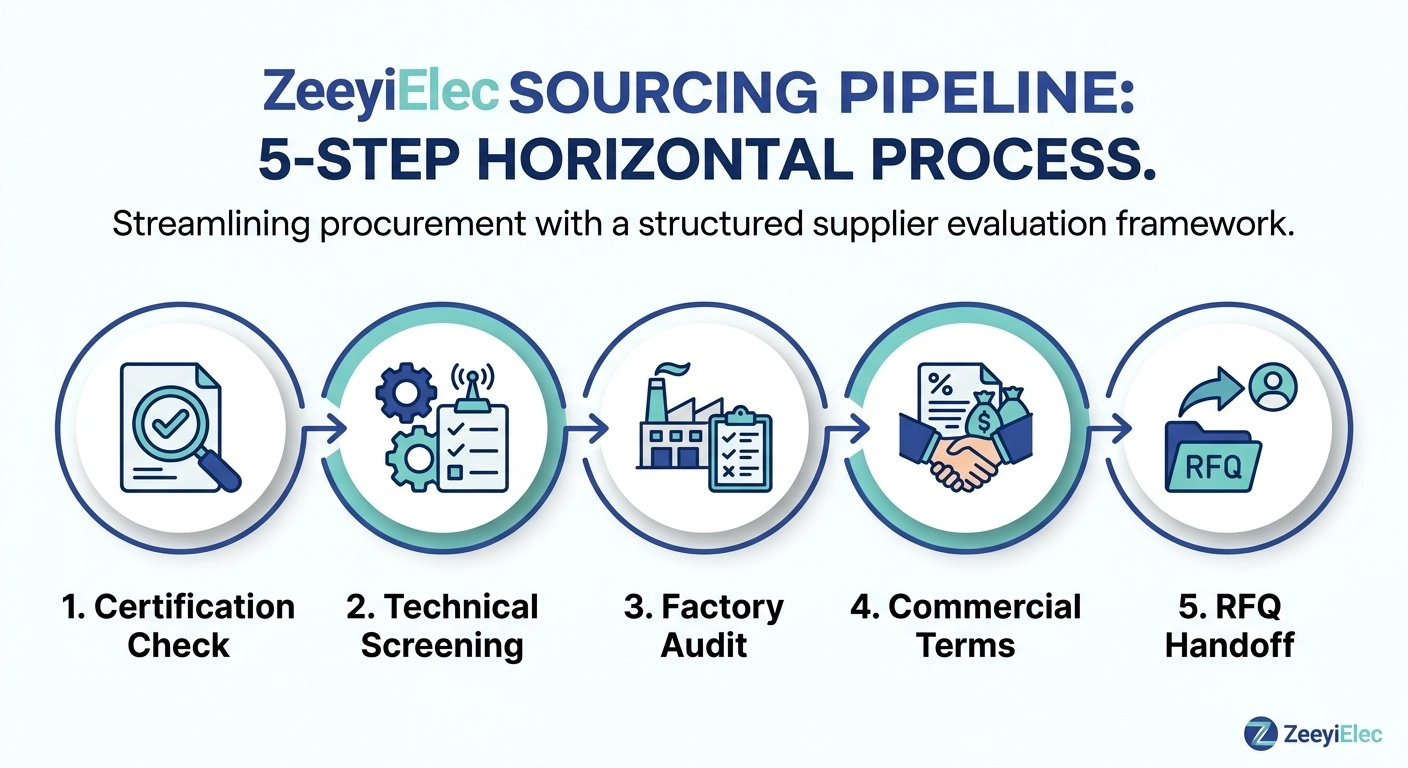
This global sourcing checklist walks through the vetting sequence: certification verification, technical capability screening, factory audit expectations, commercial term clarification, and communication red flags — before a project ever reaches the RFQ or export documentation stage.
Certification and Standards Verification: What to Check Before Shortlisting
Certifications tell a buyer what a supplier claims to be capable of; they do not by themselves confirm that every shipped unit meets that claim. Certification verification belongs at the top of the vetting checklist because it filters out a large share of unqualified suppliers before any technical or commercial negotiation begins.
Company-Level Certifications (ISO9001, CE, RoHS)
ISO9001 confirms a documented quality management system is in place, not that any specific product passed testing — treat it as a baseline filter rather than proof of product performance. CE marking and RoHS compliance matter primarily for shipments destined for the EU market; a supplier quoting confidently on CE compliance for a non-EU order is not disqualifying, but it is worth asking directly whether the certificate actually applies to the product family being quoted, since certificates are sometimes issued at the company level rather than per product line.
Product-Level Test Reports (Type Test vs Routine Test)
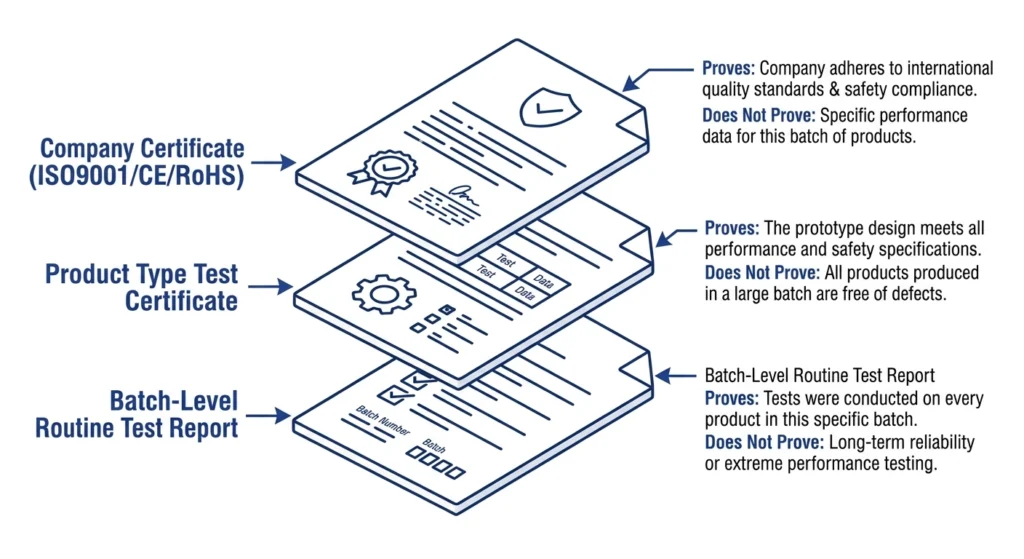
This is where vetting saves the most downstream cost. A type test validates a design once, under worst-case conditions; a routine test verifies that an individual production batch conforms to that validated design. A supplier who can produce a type test certificate but not routine test records for the specific batch shipping against a purchase order has only proven the design works — not that the units in the container do. For medium-voltage bushings and cable accessories, request routine test data covering dielectric withstand and partial discharge levels for the actual production lot, not a reference sample from an earlier run. For a deeper breakdown of this distinction, see ZeeyiElec’s Type Test vs Routine Test: What Buyers Need to Verify.
Cross-Referencing Cited Standards Against the Product Family
Suppliers occasionally cite a standard that governs a related but different product family — for example, a transformer-level standard cited in place of an accessory-specific one. IEC 60137 governs bushings specifically, distinct from the base transformer standard IEC 60076, and a quotation citing only the latter for a bushing order has left the accessory-level dielectric and mechanical requirements unverified. IEC 60137 sets lightning impulse withstand voltage (BIL) values that scale with a bushing’s rated voltage class (Um), and for bushings with Um above 72.5 kV, dry lightning impulse testing is required as a routine test rather than only a type test — buyers should request the exact table reference and Um class from the supplier’s type test certificate rather than assume a single BIL figure applies across voltage classes. For the full standard text, see the IEC 60137 listing on the IEC Webstore.
[Expert Insight]
A certificate naming the wrong test lab accreditation body is a faster red flag than a missing certificate — it suggests the document may have been reused from a different order.
Ask for the routine test report tied to the specific batch number on the shipping mark, not a generic report from the product catalog.
Company-level ISO9001 and product-level type test certs answer different questions — never treat one as a substitute for the other.
Company-level, type-test, and batch-level routine-test certificates verify three distinct claims and are not interchangeable during supplier qualification.
Technical Capability Screening: Matching Supplier Claims to Product Physics
Certification confirms a supplier follows a process. Technical screening confirms the supplier understands the physics behind what they manufacture — and that distinction shows up quickly in how precisely, or vaguely, they answer follow-up questions about their own datasheets.
Sanity-Checking Voltage Class, BIL, and Current Rating Claims
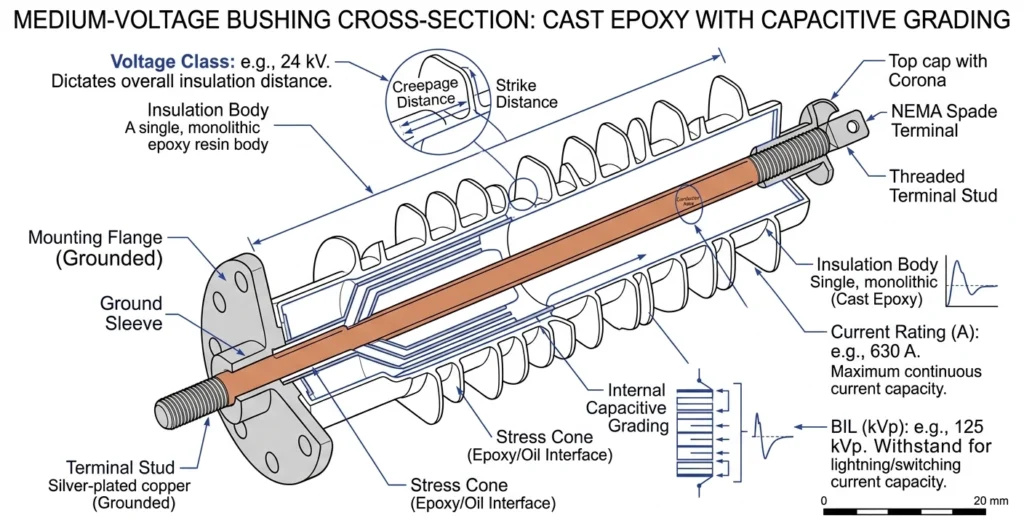
A datasheet listing a voltage class without a matching, internally consistent BIL figure is worth questioning before shortlisting. For a medium-voltage bushing rated in the 12 kV–36 kV class, BIL typically scales with voltage class rather than sitting at a flat value across the range — a supplier quoting the same BIL figure across multiple voltage classes on the same product line is a signal to ask for clarification rather than assume a typo.
For low-voltage bushings, current rating commonly falls between 600 A and 5000 A depending on transformer kVA rating, while the rated voltage sits at 1.2 kV or 3.0 kV. A supplier quoting a current rating above roughly 5000 A on a standard HTN or porous-resin bushing without specifying a custom conductor cross-section warrants a direct technical question, since I²R heating at that current level typically requires a larger terminal stud or forced-cooling consideration.
Material Claims That Warrant Follow-Up Questions (Epoxy, HTN, Porcelain, EPDM/LSR)
Material terminology is where under-qualified suppliers most often blur distinctions that matter in service. “Epoxy” alone does not specify a formulation — cycloaliphatic and bisphenolic epoxy systems behave differently under UV and tracking exposure, and a supplier who cannot name which formulation they use, or substitutes “resin” as a catch-all term across bushing wells and bushings interchangeably, has likely not engineered the material choice deliberately. The same applies to cold shrink cable accessories: liquid silicone rubber (LSR) and EPDM have different elastic memory and temperature performance, and a supplier unable to state which one is used in a given kit is a screening flag, not a minor gap.
Requesting Design Documentation vs Marketing Datasheets
A one-page marketing datasheet is not a substitute for a dimensional drawing or a material data sheet. Field experience shows that suppliers confident in their own engineering will readily share creepage distance figures, terminal thread specifications, and material grade sheets on request; suppliers who deflect this toward “standard specifications available on inquiry” are frequently reselling or lightly modifying another manufacturer’s design rather than engineering it themselves — not automatically disqualifying, but it changes what level of customization and technical support to expect.
Cross-checking voltage class, BIL, and current rating claims against physical bushing dimensions helps confirm supplier technical claims before shortlisting.
Factory Audit and Production Process Verification
Documentation review filters out suppliers who cannot produce paperwork. A factory audit filters out suppliers whose paperwork does not match what actually happens on the production floor — a gap more common than buyers expect, particularly with suppliers who subcontract part of their production without disclosing it.
On-Site Audit vs Remote/Video Audit Trade-Offs
An on-site audit remains the most reliable verification method, particularly for first-time suppliers or orders above a project’s typical trial-order threshold, but travel cost and schedule constraints make it impractical for every sourcing decision. A remote or video audit — a scheduled walkthrough of the production line, testing lab, and warehouse via live video call — is a reasonable substitute for smaller trial orders, provided the buyer controls the walkthrough route rather than accepting a pre-recorded promotional video.
In-Process QC Checkpoints to Request
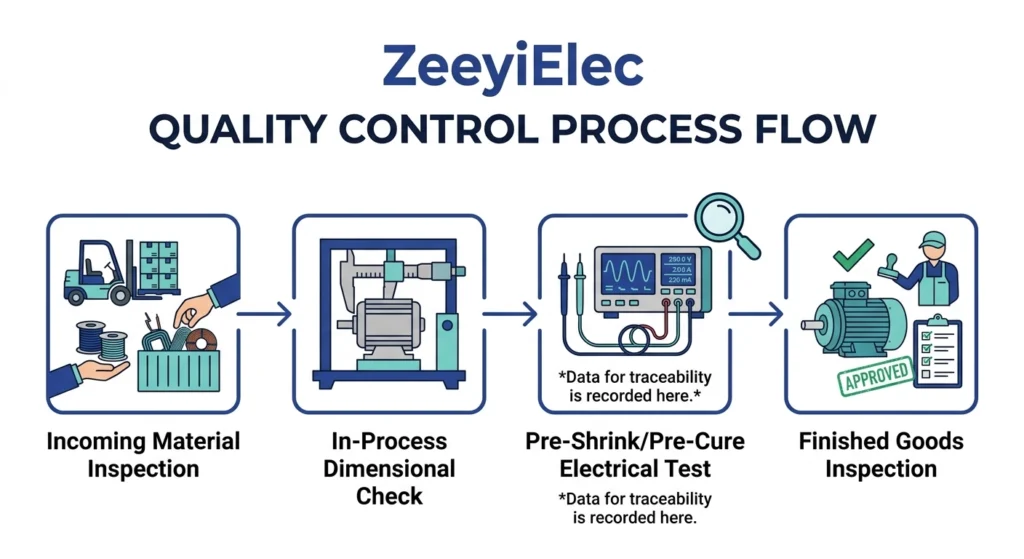
A supplier’s finished-goods inspection report tells a buyer almost nothing about where a defect actually originated. Request visibility into in-process checkpoints instead — incoming raw material inspection, dimensional checks after molding or machining, and pre-shrink electrical testing for cable accessories before the kit is packaged. For heat shrink cable accessories specifically, ask whether shrinkage ratio is verified per batch rather than per product design; a typical recovery ratio spec of 3:1 to 4:1 can drift outside tolerance if raw material lots vary, and a supplier who only checks this at type-test stage rather than per production run is carrying batch-to-batch risk the buyer will inherit.
Raw Material Traceability Requests
Traceability back to raw material batch is the audit item most often skipped by buyers and most revealing when a field failure investigation later needs to isolate root cause. Ask whether the supplier can trace a shipped unit’s insulation material, conductor stock, or elastomer batch back to a specific incoming material lot — a capability that separates suppliers with mature quality systems from those assembling from whatever stock is on hand that week.
[Expert Insight]
Insist on a buyer-directed walkthrough route during remote audits — a supplier choosing what to show on camera reveals less than one following the buyer’s checklist.
Ask for shrinkage-ratio verification data by batch, not by product design, on heat shrink kits.
Raw material traceability is the single most-skipped audit item — and the most useful one during a later failure investigation.
A four-stage in-process audit sequence — incoming material, dimensional check, pre-shrink test, finished goods — captures traceability data at each stage.
Sample Policy, MOQ, and Lead Time Clarification
Certification and factory audit findings answer whether a supplier can produce a qualified product. Sample policy, minimum order quantity, and lead time answer whether the commercial terms actually fit the project timeline — three levers commonly clarified too late, after a buyer has already anchored a schedule around an incomplete quote.
Sample Approval Loop Timing
A quoted lead time and a realistic delivery date are not the same number if the sample approval loop was never accounted for. Sample production for a standard cable accessory kit or bushing typically takes 2–3 weeks, and the buyer’s own review and sign-off cycle adds further time on top of that. Ask explicitly whether a quoted lead time starts from purchase order date or from sample approval date; suppliers occasionally quote from the more favorable of the two without stating which.
MOQ Flexibility Signals
A rigid, non-negotiable MOQ stated without qualification is often less informative than how a supplier responds when a buyer asks about a smaller trial quantity. Suppliers confident in their production economics will frequently offer a reduced trial MOQ at a modest per-unit premium for a new buyer relationship; a supplier who refuses any flexibility on a first order, even at a higher unit price, may be signaling that their production line is not set up for smaller batch runs.
Lead Time Components Buyers Often Overlook
A single lead-time figure on a quotation typically bundles several distinct intervals: raw material procurement, production run time, in-house testing, and pre-shipment inspection scheduling. For medium-voltage bushings and switchgear-related accessories, production lead time alone commonly falls in the 3–6 week range depending on order volume, but a buyer who does not separately ask about testing and inspection scheduling can find an extra 1–2 weeks added after the piece appears “finished” on the factory floor.
Communication, Quotation, and Documentation Red Flags
Communication red flags are the final layer of this global sourcing checklist before commercial terms are finalized.
Certification, factory audits, and commercial terms are structured checks a buyer actively runs. Communication patterns are passive signals that surface over the course of normal correspondence — often the earliest available warning, appearing weeks before a technical or commercial issue would otherwise become visible.
Quotation Inconsistencies Worth Questioning
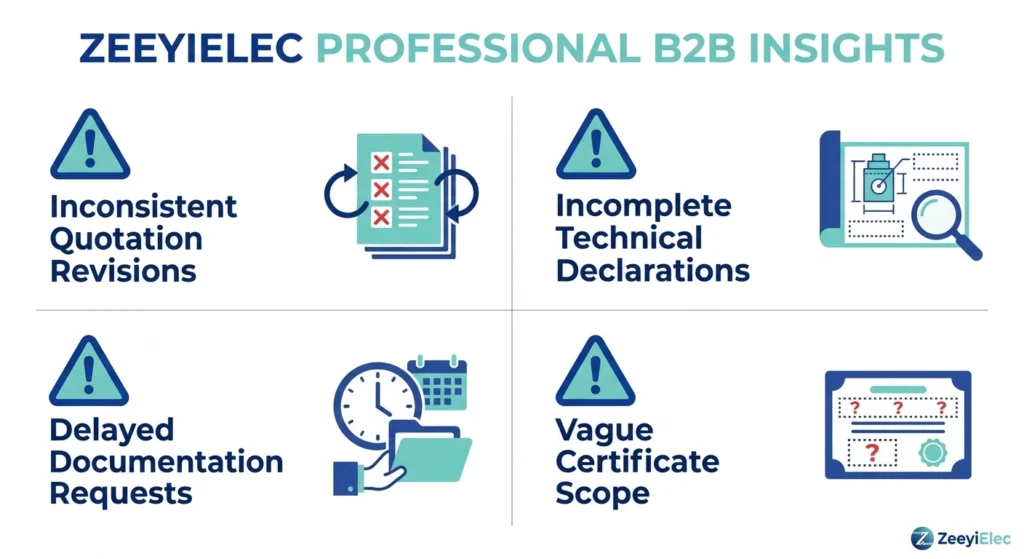
A quotation that changes a technical parameter between revisions without the buyer having requested that change is worth a direct follow-up before proceeding. A current rating shifting from 630 A to 800 A on a loadbreak switch quote between the first and second draft, with no note explaining why, suggests the quote was copied from a different product line. Similarly, a quotation that omits BIL or voltage class entirely while still stating a firm price is incomplete in a way that should delay commitment — a valid MV accessory quotation states voltage class, current rating, and BIL as baseline declarations, not optional detail.
Documentation Gaps That Predict Later Problems
A supplier who is slow or evasive about sharing routine test data, material certificates, or dimensional drawings during vetting rarely becomes more forthcoming once a purchase order is signed and leverage shifts toward the supplier. Field experience across sourcing cycles shows this pattern holds consistently: documentation friction before the deposit is paid predicts documentation friction at factory acceptance testing, when the buyer has far less negotiating room.
Inconsistent quotations, incomplete declarations, delayed documentation, and vague certificate scope are early warning signs worth investigating before commitment.
From Vetting to Purchase Order: Next Steps in the Sourcing Workflow
Once a supplier clears this global sourcing checklist, sourcing moves into the technical RFQ stage — where the RFQ is drafted and the supplier’s cited standards are matched line-by-line against project requirements. This is a deliberate handoff: vetting confirms who to work with, while the RFQ confirms exactly what to order from them.
For transformer accessories, that next step is covered in ZeeyiElec’s Transformer Accessories RFQ Checklist, which walks through the nameplate data, voltage class, and BIL parameters a complete RFQ requires. For cable accessories, the equivalent resource is the Cable Accessories RFQ Checklist, covering termination and joint specification by voltage class and conductor size.
Browse ZeeyiElec’s full Transformer Accessories range or Cable Accessories range for product family specifications, and once a shortlist is qualified, share target specs and drawings directly — ZeeyiElec’s team responds with technical feedback and quotation support for OEM/ODM and distributor projects.
Frequently Asked Questions
How long does supplier vetting typically take for transformer or cable accessory sourcing?
Vetting generally spans two to four weeks depending on whether audits are conducted remotely or on-site, and whether certification documents require translation or third-party verification.
Is a factory audit necessary for every new supplier?
An audit is most warranted for first-time suppliers or large-volume orders, while smaller trial orders from suppliers with verifiable third-party certifications may proceed with a lighter documentation-only review.
What certifications should a transformer accessory supplier hold at minimum?
ISO9001 for quality management is a baseline expectation, with CE and product-specific type-test certificates required depending on the destination market’s regulatory requirements.
How do I verify a supplier’s test reports are genuine?
Cross-check the certificate number and issuing lab against the lab’s public registry when available, and compare the tested product family and ratings against what is actually being quoted.
What’s a reasonable sample lead time before committing to a bulk order?
Sample production and approval commonly takes two to four weeks for standard accessory families, though custom dielectric or mechanical configurations can extend this window.
What are the most common red flags during supplier communication?
Inconsistent technical answers across email threads, reluctance to provide traceable certification numbers, and quotations that omit standards compliance details are frequent early warning signs.
yoyo shi
Yoyo Shi writes for ZeeyiElec, focusing on medium-voltage accessories, transformer components, and cable accessory solutions. Her articles cover product applications, technical basics, and sourcing insights for global electrical industry buyers.




 English
 한국어
한국어 العربية
 Español
 हिन्दी
 தமிழ்
தமிழ் Deutsch (Sie)
 Français
 Português do Brasil
 Русский