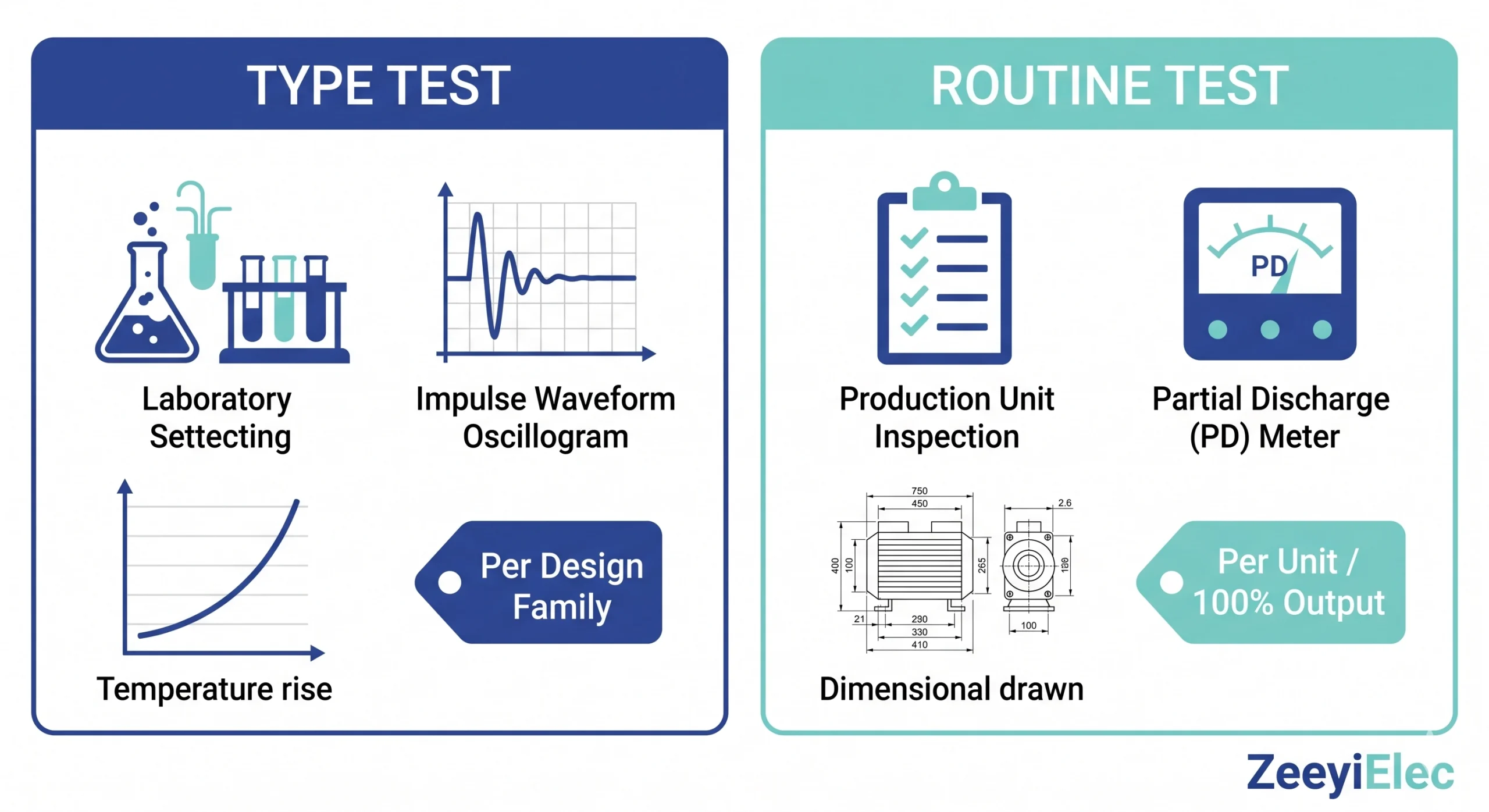
What is the difference between a type test and a routine test for transformer accessories? Type tests (also called design qualification tests) validate that a product design performs reliably under worst-case electrical, thermal, and mechanical conditions, conducted once per design family. Routine tests verify that every individual production unit matches that validated design, conducted on 100% of output before shipment.
Why the Type Test / Routine Test Distinction Matters to Buyers
Procurement teams regularly receive test certificates without a clear framework for evaluating what those documents actually prove. A type test certificate and a routine test certificate are not interchangeable, they answer fundamentally different questions, and conflating them is one of the more consequential specification gaps in electrical accessory procurement.
A type test answers: does this product design perform under defined worst-case conditions? Results apply to every unit subsequently manufactured to the same design. A routine test answers: does this specific unit conform to that validated design? It is unit-specific evidence and cannot be extrapolated across a batch.
Procurement Decision Stage Mapping
Test Category
What It Validates
When to Request It
Applies To
Type Test
Design-level performance proof
Pre-qualification / tender stage
Product family
Routine Test
Individual unit conformance
Pre-shipment / FAT hold point
Each unit or batch
Special Test
Project-specific parameters
Written into purchase order
Per contract
For transformer accessories such as medium-voltage bushings and tap changers, a design change, even a dimensional tolerance revision can invalidate an existing type test record. A common procurement error is specifying “IEC test certificates required” without distinguishing between the two categories. In one utility project, a contractor accepted routine test certificates for a 25 kV bushing order assuming design qualification was covered. No type test had been requested; a utility hold-point review identified the gap, and archived records revealed an unannounced design change 18 months prior, a 3-week delay followed.
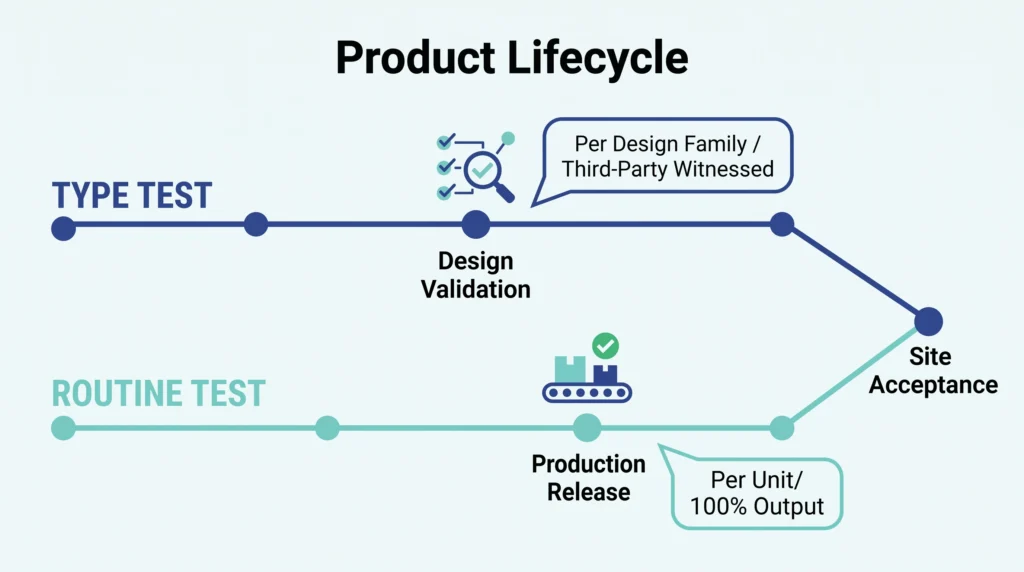
Two-lane product lifecycle timeline illustrating that type tests occur at the design validation phase while routine tests apply at the production release stage, converging at site acceptance.
What a Type Test Actually Covers: The Physics Behind Each Test
Each test in the type qualification sequence targets a specific failure mechanism that routine inspection cannot detect.
Temperature Rise Test
Resistive and dielectric losses generate heat during sustained operation. The temperature rise test quantifies heat distribution under continuous rated load. For oil-immersed transformer bushings, acceptance criteria typically limit top-oil temperature rise to 60 K above ambient and winding hot-spot rise to 65 K under ONAN cooling, in accordance with IEC 60076-2:2011 Clause 4 and Table 1 (temperature rise limits for oil-immersed transformers). Cellulose insulation life approximately halves for every 6–8 °C of sustained over-temperature, which is why this test belongs exclusively to the type record and cannot be replicated on production units.
Dielectric Type Tests: Lightning Impulse, Switching Impulse, and Applied Voltage
Three dielectric stress profiles appear in service. Applied voltage tests (power-frequency, typically 2 × Um + 1 kV for 60 seconds) verify bulk insulation integrity. Lightning impulse tests apply a standardised 1.2/50 µs waveform at rated BIL, for a 15 kV class MV bushing, BIL typically ranges from 95–110 kV peak depending on the applicable standard system (IEC or ANSI/IEEE). Switching impulse tests (250/2500 µs) apply to 36 kV class and above, simulating circuit breaker transients.
A bushing passing applied voltage may still fail under impulse if electrode geometry concentrates field stress at a defect the lower-frequency test did not excite. Buyers specifying medium voltage bushings should confirm that all three dielectric test categories appear in the type test report.
Short-Circuit Withstand Test
Electromagnetic forces between conductors scale with the square of fault current. For a 630 kVA, 11 kV distribution transformer, prospective short-circuit current at the terminals can exceed 8,000–12,000 A for durations up to 2 seconds. The short-circuit withstand test applies this stress to a prototype unit; because it is potentially destructive, it is conducted once per design family. Post-test records should include pre- and post-test winding resistance and impedance measurements confirming no degradation. IEC 60076-5 governs short-circuit withstand requirements for power transformers.
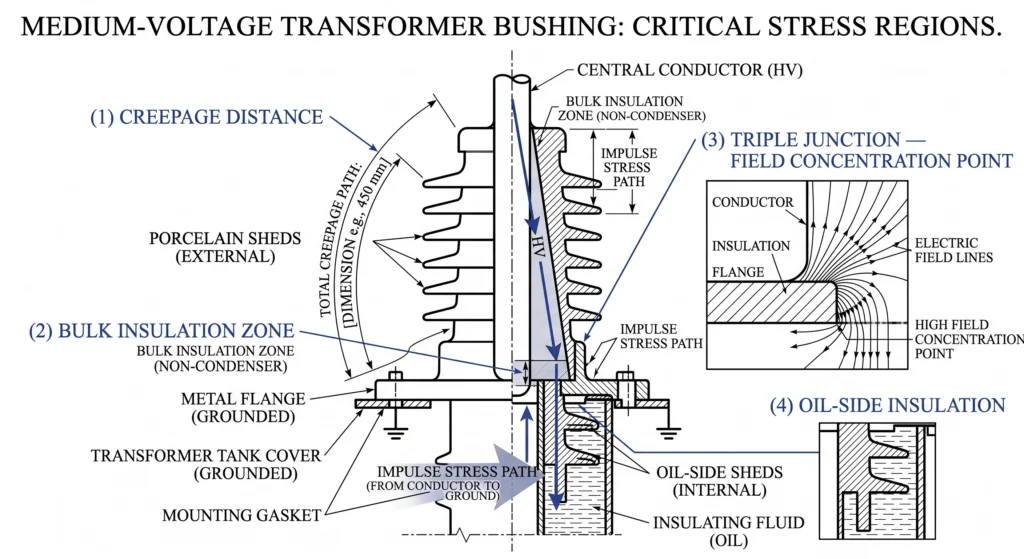
Vertical cross-section of a medium-voltage transformer bushing illustrating creepage distance, bulk insulation zone, electric field concentration at the triple junction, and impulse stress path from conductor tip to grounded flange.
[Expert Insight] — Type Test Scope Gaps to Watch
A type test for 15/25 kV class does not cover 36 kV class, even on physically similar bushings.
Impulse waveform oscillograms must appear in the report, a missing oscillogram is grounds to reject the certificate.
Short-circuit withstand reports should include both pre- and post-test impedance values, not just a pass statement.
What a Routine Test Covers: The Unit-Level Verification Checklist
Electrical Routine Tests
Power-frequency voltage withstand is the core electrical routine test.
For medium-voltage accessories in the 8.7/15 kV class, partial discharge is measured concurrently, with acceptance typically set below 300 pC at 1.1 × U0, in accordance with IEC 60076-3:2013 Clause 10.9 (routine test, partial discharge measurement for power transformers). Winding resistance is measured per unit and compared against the design reference, deviations exceeding ±2% warrant investigation before release. Voltage ratio and polarity checks apply to tap changers, confirming each tap position delivers the correct turns ratio within ±0.5% of nominal.
Mechanical and Visual Routine Tests
Dimensional verification confirms critical interface dimensions, mounting flange diameter, creepage distance, conductor length, and thread specification, against the approved drawing. For bushing well inserts and fuse assemblies, dimensional non-conformance is the most common cause of field incompatibility and is entirely detectable at this stage. Sealing integrity checks and nameplate data verification complete the mechanical checklist.
What Routine Tests Do Not Cover
Routine testing excludes impulse withstand, temperature rise, and short-circuit withstand. A complete routine test certificate does not confirm that a unit can survive a 110 kV BIL lightning impulse, that evidence lives only in the type test record. Watch for certificates where partial discharge is recorded only as “PASS” without a numerical value; a compliant record should show the measured result, the test voltage, and the instrument calibration reference.
How to Read and Cross-Verify a Type Test Certificate
Step 1–3: Identity and Accreditation Verification
Start with the issuing laboratory. Confirm accreditation under the ILAC Mutual Recognition Arrangement, the ILAC database is publicly searchable by laboratory name. Accreditation scope must explicitly cover the product category and voltage class being tested. Then confirm the test date against the supplier’s design freeze declaration, and verify that the standard edition cited matches your procurement specification.
Step 4–5: Parameter Mapping to Your Order
Map the test specimen’s rated parameters to your order. For cold shrink cable accessories, confirm the conductor cross-section range tested encompasses your project cable size — typically 50 mm² to 630 mm² depending on the feeder rating.
Verify that the BIL tested matches your insulation coordination requirement. For a 15 kV class system with Um = 17.5 kV (IEC), the minimum expected BIL is 95 kV peak; for a 36 kV class system, 170 kV peak minimum. A certificate showing only 95 kV impulse withstand is not valid for a 36 kV class application, regardless of commercial labelling.
Step 6–7: Red-Flag Patterns
Reject or escalate certificates that reference a “similar product” without a formal similarity assessment; that omit impulse waveform oscillograms; or that originate entirely from a manufacturer’s internal laboratory without third-party witness. In one 15 kV bushing commissioning case, an internal test certificate was accepted at procurement. Pre-energisation PD testing revealed three of twelve units exceeding 800 pC, well above the 300 pC acceptance threshold and instrument traceability records were absent. Replacement and retest added 19 days to the commissioning programme.
[Expert Insight] — Certificate Review in Three Minutes
Accreditation check: search the ILAC database by laboratory name before opening the test data pages.
BIL mapping: write the project Um and minimum required BIL on the certificate cover page before filing.
If oscillograms are missing, request them specifically, they are part of the test record, not a supplementary document.
Comparison Table: Type Test vs Routine Test — Side-by-Side Buyer Reference
Ten-Parameter Buyer Reference
Parameter
Type Test
Routine Test
Scope
Per design family
Per production unit — 100%
Frequency
Once; repeated after design change
Every unit before shipment
Destructive potential
Yes — some tests damage specimen
No — unit released if passed
Certificate portability
Covers all conforming units
Unit-specific, non-transferable
Buyer verification trigger
Tender / pre-qualification stage
Pre-shipment / FAT hold point
Applicable to transformer accessories
Yes — all categories
Yes — all categories
Applicable to cable accessories
Yes — by voltage class
Yes — per kit or reel
Partial discharge
Design qualification stage
100% production measurement
Temperature rise
Type test only
Not applicable
Impulse withstand
Type test only; oscillograms required
Not applicable
For projects combining 15 kV and 36 kV equipment, maintain separate type test records per voltage class across both cable accessories and transformer accessories. IEC 60137 governs acceptance and test methods for bushings above 1 000 V, defining both type and routine test requirements in structured clauses, confirm which edition your supplier’s certificate references.
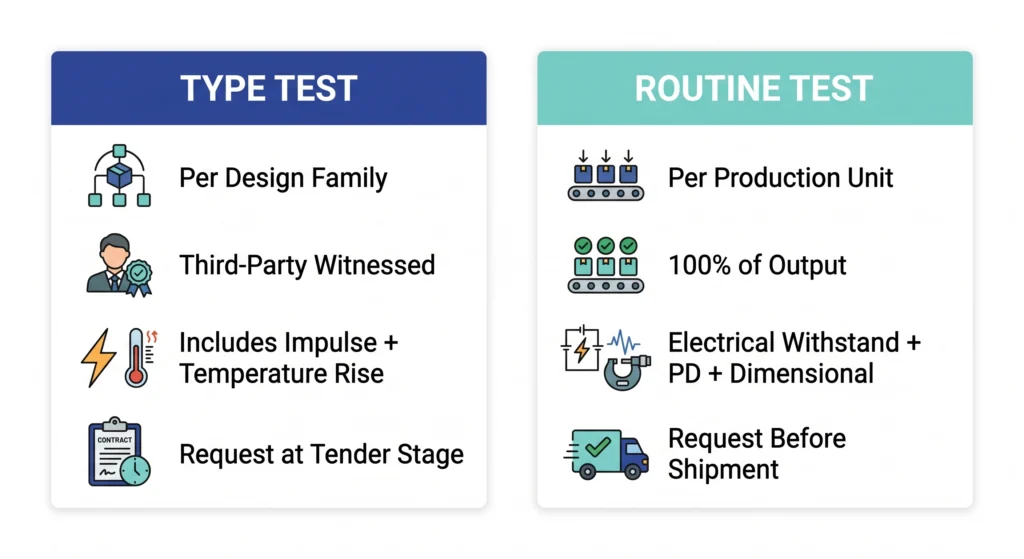
Split-card summary comparing type test and routine test across four key buyer parameters: scope, witness requirement, test coverage, and recommended procurement action stage.
Field Realities: What Happens When Buyers Skip Verification
Field Case 1 — Off-Circuit Tap Changer: Outdated Type Test
A contractor procuring off-circuit tap changers for a 33-unit distribution transformer replacement programme received a type test certificate from an accredited laboratory, dated 11 years before the order, with no design change declaration. Incoming dimensional audit found that contact gap dimensions had been revised twice since the test: current production measured 3.2 mm against the type-tested 4.0 mm, with direct implications for the dielectric withstand the certificate claimed to validate. Full retest required 6 weeks and delayed four transformer installations.
Field Case 2 — Cold Shrink Terminations: Missing Voltage Class Coverage
A substation upgrade covering 11 kV and 33 kV cables received complete routine test certificates for every kit, no type test documentation was requested. Eight months post-energisation, three terminations on the 33 kV circuits failed under switching transients. Investigation confirmed type test evidence existed for the 8.7/15 kV class only. Replacement, cable recutting, and re-jointing across three circuits consumed approximately 14 field crew days and required a planned customer outage.
Risk Matrix: Certificate Gap vs Consequence
Certificate Gap
Transformer Accessories
Cable Accessories
Severity
No type test
BIL and temperature rise unverified
Impulse withstand unverified
Critical
Type test outdated — design changed
Depends on change scope
Material ageing properties may differ
Significant
Routine test missing
Dimensional and PD risk
Latent PD defects undetected
Significant
PD recorded as pass/fail only
Trend analysis impossible
Latent defect cannot be excluded
Moderate
Both cases share the same root cause: procurement specifications that required “IEC test certificates” without distinguishing categories, age criteria, or voltage class scope. Tightening that language before the purchase order is issued remains the most cost-effective control available.
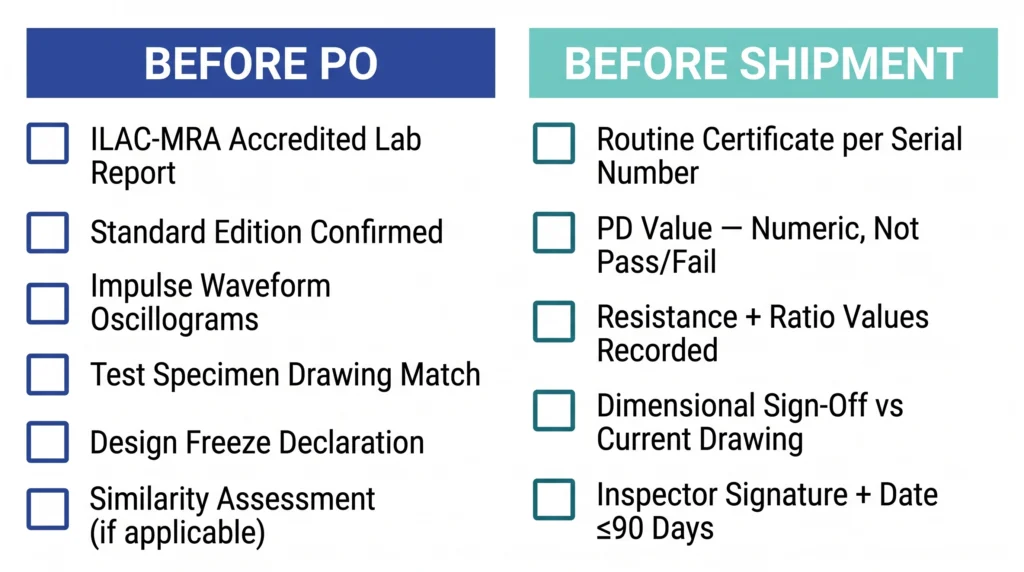
Buyer’s Verification Checklist: Documents to Request Before PO Release
Two document packages constitute a complete test record. Requesting both before purchase order release costs nothing; discovering gaps after shipment costs project schedule.
Type Test Package — Request Before Order Confirmation
Type test report from ILAC-MRA accredited third-party laboratory
Standard edition and clause reference confirmed against current specification
Impulse waveform oscillograms for all applicable voltage classes
Test specimen drawing with dimensions matching current order configuration
Supplier declaration confirming no design change since test date
Similarity assessment document if certificate references an “equivalent” product
Routine Test Package — Request Before Shipment Release
Routine test certificate per unit with serial number traceability to shipping documents
PD measurement recorded as a numerical value with test voltage stated, not binary pass/fail
Winding resistance and voltage ratio values recorded against reference tolerances
Dimensional verification sign-off against current approved drawing revision
Inspector name, signature, and test date within 90 days of shipment
Printable two-column verification checklist mapping required type test documentation to the pre-order stage and routine test documentation to the pre-shipment release stage for electrical accessory procurement.
ZeeyiElec provides full type test and routine test documentation packages for transformer accessories and cable accessories, including third-party witnessed reports on request. Contact the technical team to confirm certificate scope before your next order.
What is the difference between a type test and a routine test for transformer accessories?
A type test validates that a product design meets performance requirements under worst-case electrical, thermal, and mechanical conditions, conducted once per design family, with results covering all units subsequently manufactured to that design. A routine test verifies that each individual production unit conforms to the validated design, covering electrical withstand, partial discharge, and dimensional checks on 100% of output.
Do I need both a type test certificate and a routine test certificate when procuring MV bushings?
Yes — type test evidence confirms the design is qualified for the voltage class, while routine test evidence confirms your specific units were manufactured correctly; accepting only one document leaves a measurable gap in quality assurance. Most IEC-compliant project specifications require both documents as separate line items before factory acceptance.
How old can a type test certificate be and still be valid?
There is no universal expiry date, but most buyers and utilities apply a practical limit of 5–10 years and require a supplier declaration confirming no design change has occurred since the test. If the manufacturer has modified materials, dimensions, or insulation class since the original test, a new type test is required regardless of the certificate date.
What partial discharge level should I accept on a routine test certificate for MV cable accessories?
For medium-voltage terminations and joints in the 10–35 kV class, a PD level not exceeding 10–20 pC at 1.0 × U₀ is generally considered acceptable, though exact values depend on the system voltage class and the applicable product standard. Buyers should specify the maximum acceptable PD value numerically in the RFQ rather than relying on supplier defaults.
Can a manufacturer’s internal laboratory issue valid type test certificates?
Internal laboratory reports can be technically valid if the laboratory holds independent accreditation, but most utility and EPC project specifications require type tests to be conducted or witnessed by a third-party accredited laboratory. Verify accreditation status against the ILAC-MRA signatory list before accepting internal documentation.
Which transformer accessories require type testing?
Medium-voltage bushings, off-circuit tap changers, loadbreak switches, and current-limiting fuses each fall under applicable IEC product standards that define required type tests, including impulse withstand, applied voltage, and in some cases short-circuit or mechanical endurance tests. Confirm which standard and edition applies to each product category in your procurement specification.
What should I do if a supplier cannot provide a type test certificate for my required voltage class?
Treat the absence of a type test certificate for the project voltage class as a disqualifying condition unless the supplier provides a documented similarity assessment showing a tested design at a higher voltage class fully covers the application. Accepting accessories without voltage-class-specific type test evidence transfers design validation risk entirely to the buyer.
yoyo shi
Yoyo Shi writes for ZeeyiElec, focusing on medium-voltage accessories, transformer components, and cable accessory solutions. Her articles cover product applications, technical basics, and sourcing insights for global electrical industry buyers.





 English
 한국어
한국어 العربية
 Español
 हिन्दी
 தமிழ்
தமிழ் Deutsch (Sie)
 Français
 Português do Brasil
 Русский