Choosing the right MV bushings for coastal environments starts with understanding why contamination causes progressive insulator failure in the first place.
Why Contamination Causes MV Bushing Failure
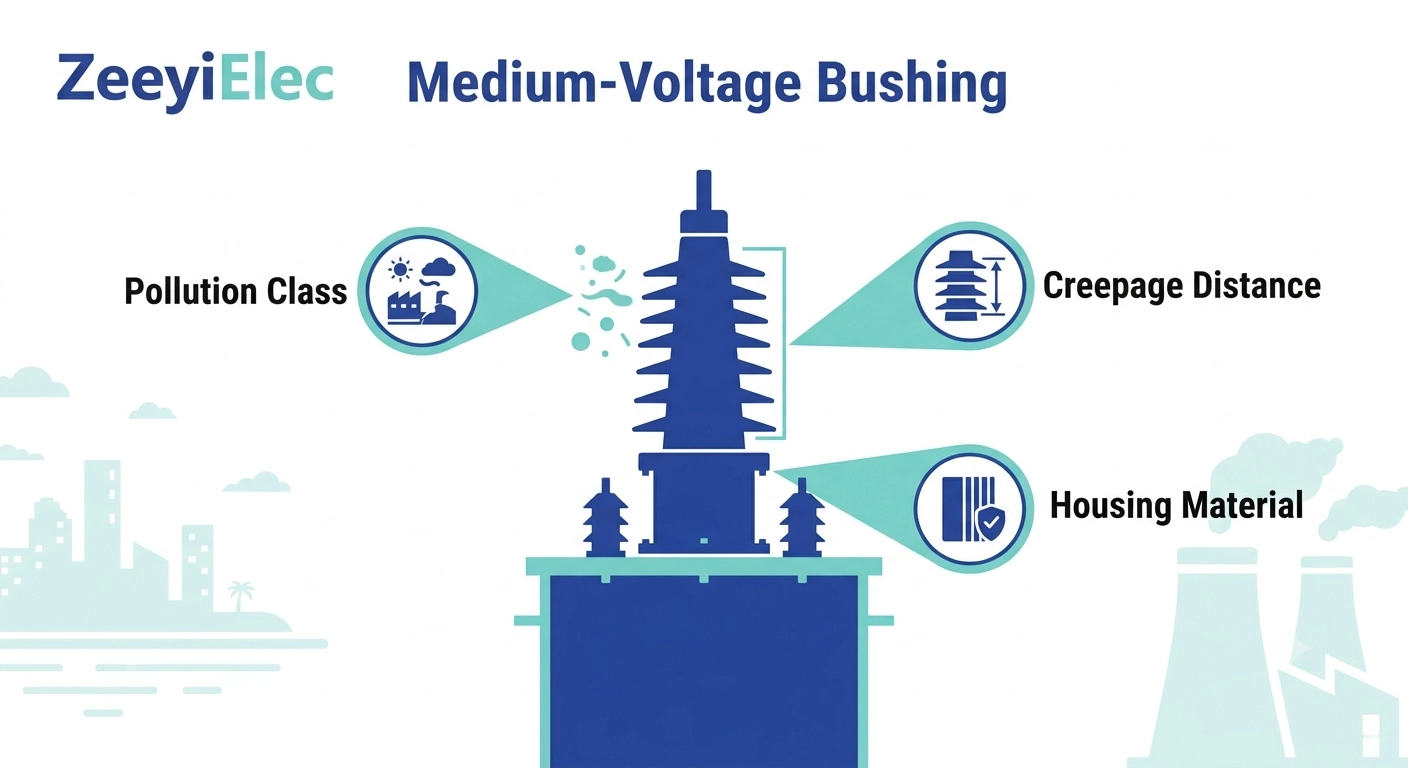
A medium-voltage bushing rarely fails from a single overvoltage event. Failure is usually progressive: accumulated surface contamination interacts with humidity to create a conductive path across an insulator that was designed to keep the surface non-conductive. Understanding this mechanism is the starting point for any environmental selection decision, since the material and creepage choices covered later in this guide are direct responses to the physics described here.
How Surface Contamination Leads to Flashover
Under dry conditions, most airborne contaminants — salt deposits, cement dust, industrial particulates — sit on the bushing surface without conducting meaningful current, since dry salt and dust have relatively high resistivity. The failure sequence begins when fog, dew, or light rain wets that layer without washing it away. The wetted contamination film becomes conductive, and leakage current begins to flow along the surface rather than through the surrounding air.
As leakage current concentrates in narrower sections of the wetted film, localized heating dries those sections first, creating dry bands. The remaining voltage across the insulator then redistributes almost entirely across these dry bands, producing localized electric field stress that can exceed 3 kV/cm – 5 kV/cm at the band edge, well above the threshold needed to sustain small surface discharges.
Repeated dry-band arcing gradually carbonizes the insulator surface (for organic materials like silicone or epoxy) or erodes the glaze (for porcelain), extending a conductive track until it bridges enough of the creepage path to cause flashover.
The Role of Moisture in Activating Leakage Current
This distinction matters because the two mechanisms address different physical failure modes, and it’s the basis for the site pollution severity (SPS) evaluation methodology set out in IEC TS 60815-1, which governs ESDD/NSDD-based site classification; the resulting SPS class then feeds into the creepage-distance dimensioning tables in IEC TS 60815-2 (ceramic/glass) and IEC TS 60815-3 (polymer insulators).
Dry-band arcing rarely announces itself audibly at low pollution levels — early signs are visual (faint tracking lines), not electrical alarms.
A bushing that “looks fine” after a dry season can already carry partial tracking damage invisible until the next wet cycle.
Clearance failures and creepage failures look similar from a distance but call for entirely different fixes — don’t diagnose one as the other from a photo alone.
IEC 60815 Pollution Classes and Creepage Distance Requirements
Once contamination is understood as a surface-conduction problem, selection becomes a matter of sizing the insulator’s creepage path against the expected pollution severity of the installation site. IEC 60815 organizes this into pollution severity classes, which map site conditions to a minimum specific creepage distance, expressed in mm/kV of highest system voltage.
Pollution Severity Classes (Light to Very Heavy)
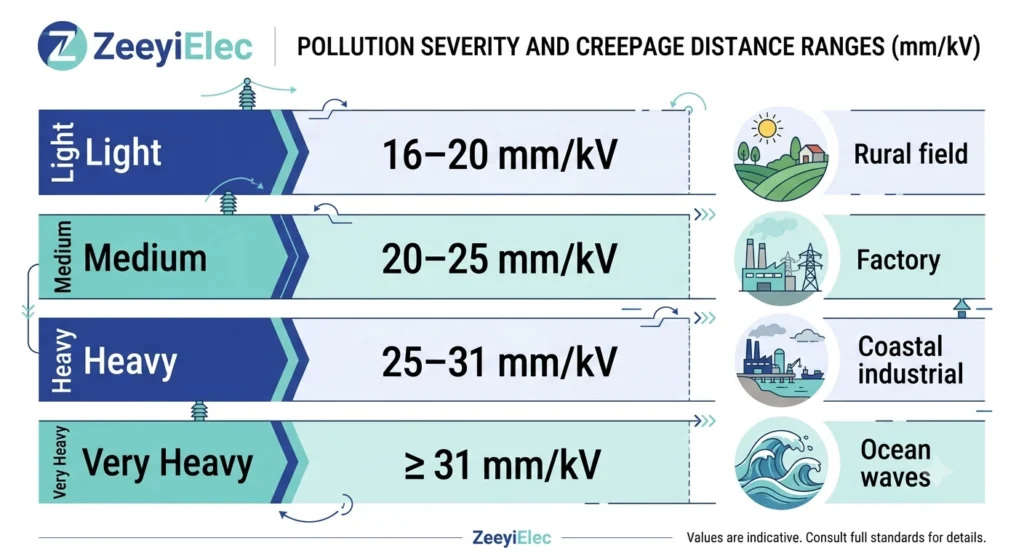
IEC 60815 pollution severity classes—Light, Medium, Heavy, and Very Heavy—map directly to minimum specific creepage distance requirements in mm/kV.
Sites are generally grouped as follows, with specific creepage distance increasing at each tier:
Light Pollution
Rural or low-density areas away from coastlines and industry, typically requiring around 16 mm/kV–19 mm/kV.
Medium Pollution
Areas with moderate industrial activity or agricultural burning, and coastal zones several kilometers inland.
Heavy Pollution
Industrial areas with significant particulate emission, or coastal sites within roughly 1 km–3 km of the shoreline exposed to strong winds.
Very Heavy Pollution
Direct marine exposure, salt spray zones, or heavy industrial sites with conductive dust, often requiring specific creepage distance of 31 mm/kV or higher.
These bands are guidance ranges rather than fixed universal values — actual site classification should be confirmed against a pollution severity survey rather than assigned by category label alone.
Converting Site Data into Required Creepage Distance
To size a bushing’s total creepage distance, the specific creepage figure (mm/kV) is multiplied by the system’s highest voltage, Um, in kV. For a 24 kV-class MV bushing installed in a heavy pollution zone with a specific creepage requirement of around 25 mm/kV, the resulting minimum total creepage distance works out to roughly 600 mm — a figure that directly shapes shed profile and insulator length in the product datasheet.
Field pollution surveys — measuring ESDD or using directional dust deposit gauges over several months — remain the most reliable way to confirm which class actually applies, since satellite-based coastal distance estimates can understate contamination severity in areas with prevailing onshore winds or nearby industrial emitters running in parallel with salt exposure (IEC 60815 pollution severity classification).
This creepage sizing logic connects directly to material selection, since the same target creepage distance can be achieved through different shed geometries depending on whether porcelain, silicone, or epoxy is specified.
Material Selection: Porcelain vs. Silicone Rubber vs. Epoxy
Achieving a target creepage distance is only half the selection problem — the insulating material determines how that creepage path behaves once contamination and moisture are present. The three dominant options for MV bushings in polluted or coastal service each trade off differently between hydrophobic performance, mechanical durability, and maintenance demand.
Porcelain: Proven but Maintenance-Heavy
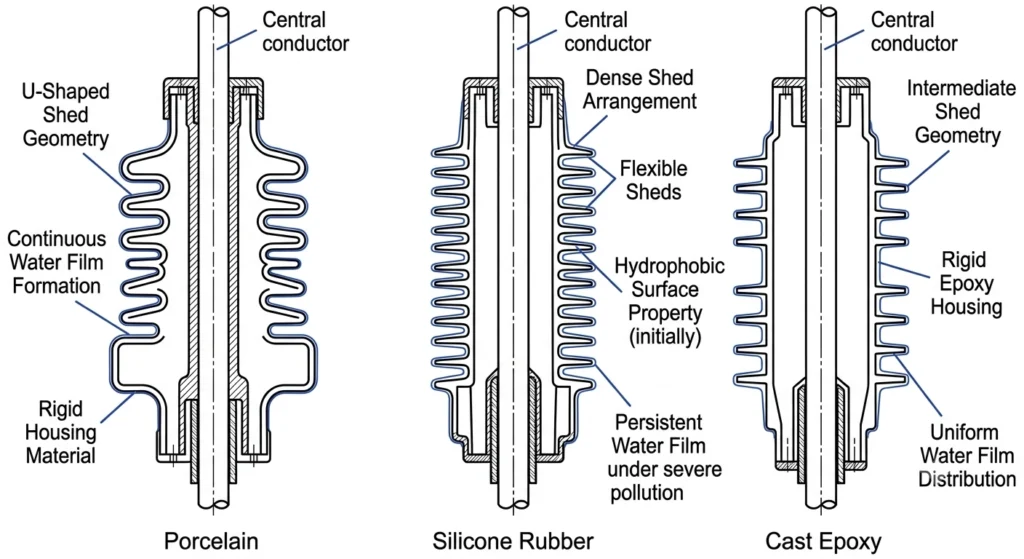
Cross-sectional comparison of porcelain, silicone rubber, and epoxy bushing housings, illustrating shed profile differences and surface contamination film behavior under wet conditions.
Glazed porcelain remains a long-serving option for MV bushings, offering strong mechanical strength and UV resistance over a typical service life of 25 years–40 years. Its surface, however, is naturally hydrophilic — water spreads into a continuous film rather than beading, so contamination wets uniformly and leakage current can establish more readily. In heavy or very-heavy pollution classes, porcelain-based bushings generally rely on extended creepage profiles (deep sheds) and a scheduled washing program to stay within safe leakage margins.
Silicone Rubber: Hydrophobicity Recovery
Silicone rubber housings exhibit hydrophobicity — surface tension causes moisture to bead rather than film — which limits the continuous conductive path contamination can form. A distinguishing property of silicone is hydrophobicity transfer and recovery: low-molecular-weight silicone polymers migrate to the surface and can encapsulate contaminants, restoring water-repellent behavior even after weeks of exposure without cleaning. This generally reduces washing frequency compared to porcelain in the same pollution class, though the recovery rate slows as the material ages and the reservoir of migrating polymer depletes over a service life more commonly rated at 20 years–30 years.
Cast Epoxy: Indoor and Moderate-Exposure Fit
Outdoors, standard cast epoxy lacks the shed geometry and hydrophobic surface needed for heavy pollution service, so coastal or industrial outdoor use typically requires supplementary silicone coating or housing rather than bare epoxy — a distinction worth confirming at RFQ stage rather than assuming from a general “epoxy” spec label, since outdoor pollution performance for cast epoxy is not governed by a single unified IEC clause and varies by manufacturer formulation.
Field replacements on retrofit projects often reveal that a bushing specified years earlier for “medium” pollution no longer matches site reality after nearby land-use changes.
Expert Insight
Silicone’s hydrophobic recovery isn’t permanent — factor in polymer depletion when planning bushing replacement cycles near the end of rated life.
Bare cast epoxy outdoors in coastal service is one of the most common under-specification mistakes seen at re-quotation stage.
When comparing quotes, confirm whether “silicone” refers to a full silicone housing or a silicone coating over porcelain/epoxy — performance and cost differ significantly.
Coastal and Marine Salt-Fog Considerations
Coastal exposure creates a distinct contamination pattern that differs from inland industrial pollution — salt-fog deposition is wind-driven, directional, and closely tied to distance from the shoreline, which makes generic “coastal” specification less reliable than a site-specific pollution survey.
Salt Deposition Patterns Near Coastlines
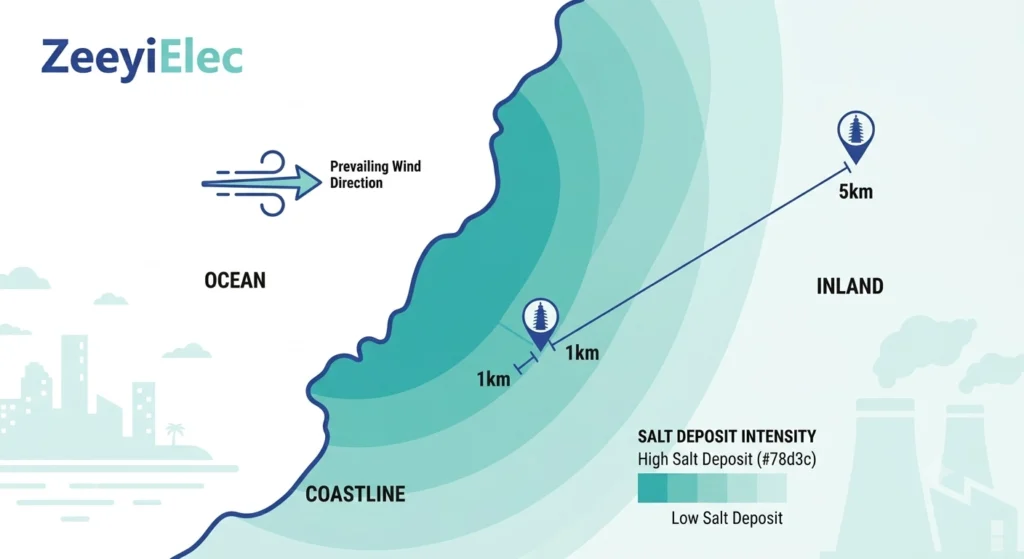
Salt-fog deposition intensity decreases with distance from the shoreline, with prevailing wind direction driving asymmetric ESDD accumulation on windward bushing surfaces.
Salt-fog concentration typically falls off sharply with distance inland — installations within roughly 500 m of breaking surf often see markedly higher ESDD readings than sites just 2 km–3 km further inland, even along the same coastline. Prevailing wind direction matters as much as raw distance: a bushing mounted on the windward side of an enclosure or structure can accumulate visibly heavier salt deposits than an identical unit on the leeward side, because salt aerosol is carried and deposited directionally rather than settling uniformly. Elevation above sea level and exposure to direct surf spray versus filtered fog further separate “very heavy” from merely “heavy” pollution classification on paper.
Field Observations from Coastal Installations
In coastal substation retrofits, a recurring pattern is bushings specified to a generic “heavy pollution” datasheet class showing dry-band arcing marks within 12 months–18 months of energization, concentrated specifically on the windward shed faces rather than distributed evenly around the insulator — a sign that the original site survey underestimated directional salt loading rather than that the material itself was defective. This kind of asymmetric wear is difficult to predict from distance-to-shore alone and generally only shows up once the unit has been in service through at least one full wet-season cycle.
Where prevailing wind and surf exposure push a site toward the upper end of the very-heavy classification, engineers commonly combine silicone rubber housings with supplementary creepage extension — pushing specific creepage distance toward 31 mm/kV–35 mm/kV — rather than relying on material change alone. Confirming actual salt deposition through a short-term ESDD monitoring period before final bushing order remains more reliable than applying standard class ranges directly, since two sites at similar shore distance can carry materially different contamination loads depending on local wind funneling and terrain shielding.
Industrial and Heavy Pollution Environments
Industrial pollution differs from coastal salt-fog in composition and behavior, but produces the same underlying failure path — a conductive film forming under wet conditions. Sites near cement plants, chemical processing facilities, or heavy manufacturing corridors often combine several contamination sources at once, which complicates pollution-class assignment more than a single-source coastal site.
Dust and Cement Particulate Buildup
Cement and mineral dust deposits are typically alkaline and hygroscopic, meaning they actively draw moisture from humid air rather than requiring direct rainfall or fog to become conductive. Sites within roughly 1 km–2 km of active cement or aggregate processing operations frequently register non-soluble deposit density (NSDD) values well above what a generic “heavy” pollution class assumes, since NSDD measures the particulate load separately from the soluble salt component captured by ESDD. A bushing sized only against ESDD data in this environment can be under-rated even if the salt-equivalent reading looks moderate, because the particulate layer itself increases surface conductivity once wetted, independent of salt content.
Chemical/Industrial Emission Exposure
Chemical processing sites — fertilizer plants, refineries, and similar facilities — introduce a different variable: airborne emissions can be acidic or reactive with certain insulator materials, in addition to contributing to the conductive contamination film. Field reports from petrochemical-adjacent substations describe accelerated surface erosion on silicone housings exposed to sustained hydrocarbon or acidic vapor, showing measurable surface roughening within roughly 3 years–5 years of service, faster than the same material typically shows in a pure salt-fog environment. This doesn’t necessarily rule out silicone rubber, but it does mean the housing formulation and any supplementary coating should be checked against the specific chemical exposure profile rather than assumed compatible by default.
Where multiple contamination sources overlap — a coastal industrial park, for example — the effective pollution class should be assigned using whichever severity indicator (ESDD or NSDD) produces the higher creepage requirement, not an average of the two. This kind of mixed-source site is also where procurement teams most often under-specify, since a generic RFQ line item rarely captures both variables — a gap covered in more detail in ZeeyiElec’s MV bushing RFQ template.
Maintenance and Washing Programs to Extend Service Life
Even correctly specified bushings accumulate contamination over time, so a maintenance and washing program is what keeps the installed creepage margin from being consumed faster than the design anticipated. The washing method and interval depend on pollution severity, material type, and whether the equipment can be safely de-energized for service.
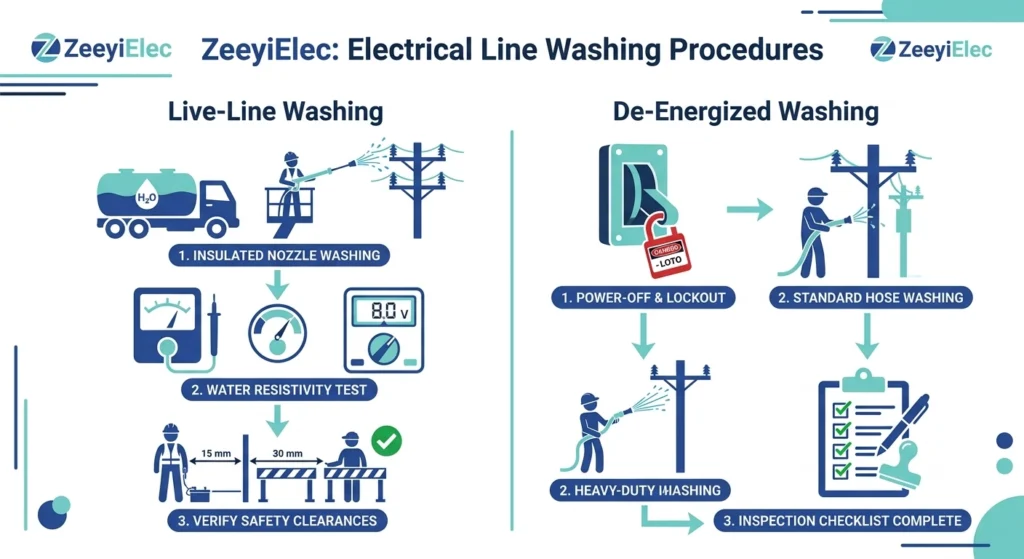
Live-Line vs. De-Energized Washing
Live-line washing avoids an outage but requires controlled water resistivity, while de-energized washing allows direct cleaning without flashover risk during service.
De-energized washing allows direct water or low-pressure cleaning without concern for flashover during the process itself, and is generally preferred where a maintenance outage window is available.
Live-line washing — using demineralized water through insulated washing equipment — lets utilities avoid an outage but requires strict control of water resistivity (commonly specified above 3,000 Ω·cm–5,000 Ω·cm for MV applications) and safe spray distance from energized parts, since conductive wash water itself can initiate a flashover path during the cleaning operation.
Silicone rubber housings generally tolerate live washing well due to their hydrophobic recovery, while aged porcelain with heavy carbon tracking may need de-energized inspection first to confirm the surface hasn’t already degraded past the point where washing alone restores adequate performance.
Inspection Intervals by Pollution Class
Washing and inspection frequency should scale with pollution class rather than follow a fixed calendar across an entire fleet. Light-pollution sites often go 12 months or longer between scheduled washes, while very-heavy coastal or industrial sites may require quarterly washing or more frequent visual inspection, particularly following the first wet season after commissioning, when early dry-band arcing marks are easiest to catch before they progress to tracking. A recurring field lesson from bushing well and insert maintenance programs is that visual inspection alone tends to miss early-stage tracking on the underside of sheds, where deposits accumulate out of direct sightline — a reason some coastal utilities have shifted to periodic infrared thermography as a supplementary check rather than relying on washing schedules alone.
Selecting the Right MV Bushing for Your Site
Selecting MV bushings for coastal environments comes down to three linked decisions: correctly classifying the site’s pollution severity, sizing creepage distance against that classification rather than a generic voltage-class default, and matching material — porcelain, silicone rubber, or epoxy — to the specific contamination profile, whether that’s salt-fog, cement dust, or chemical emission. Getting any one of these wrong tends to surface not at commissioning, but 12 months–36 months into service, once the first full wet season has tested the margin.
For projects spanning multiple voltage classes or mixed coastal-industrial exposure, a documented pollution survey (ESDD/NSDD readings) submitted alongside the RFQ generally produces a more accurate bushing specification than relying on distance-from-shore estimates alone.
ZeeyiElec supports MV bushing selection across 12 kV–52 kV voltage classes, with ANSI, DIN, and epoxy interface options engineered for varying pollution severity requirements, as part of a broader transformer accessories and cable accessories portfolio. Review the full Complete Selection Map for Transformer Accessories for creepage and material guidance across the full accessory range, or share site pollution data directly for tailored bushing recommendations and RFQ support.
Frequently Asked Questions
What creepage distance is needed for a coastal MV bushing?
Coastal sites typically fall into IEC 60815 heavy or very-heavy pollution classes, so specific creepage distance generally needs to run higher than inland installations, with the exact figure depending on salt-fog intensity and distance from shore — always confirmed against site pollution survey data, not assumed by proximity alone.
Is silicone rubber better than porcelain for polluted environments?
Silicone rubber generally performs better in heavy pollution because its hydrophobic surface sheds contaminated moisture films, reducing leakage current buildup, though porcelain remains viable where washing programs are already established and mechanical robustness is prioritized.
How often should MV bushings be washed in coastal areas?
Washing frequency depends on local salt deposition rate and material type, ranging from a few times per year in moderate coastal exposure to more frequent cycles near heavy surf or industrial-coastal overlap zones — site contamination monitoring should guide the actual interval rather than a fixed calendar.
Can epoxy bushings be used in coastal environments?
Cast epoxy bushings are typically better suited to indoor or moderately exposed coastal applications, since outdoor epoxy generally needs supplementary coatings or sheds to match the creepage performance of silicone or heavily profiled porcelain in direct salt-fog exposure.
What is the difference between light and heavy pollution classes under IEC 60815?
Light pollution classes assume minimal industrial or coastal influence with lower required creepage distance, while heavy and very-heavy classes apply to sites with sustained salt, industrial, or agricultural contamination and require proportionally greater creepage distance and often different material selection.
Does RTV coating eliminate the need for higher creepage distance?
RTV silicone coatings can improve hydrophobic performance on existing porcelain bushings, but they supplement rather than replace correct creepage sizing — under-specified base insulators in severe pollution zones still carry elevated flashover risk even when coated.
yoyo shi
Yoyo Shi writes for ZeeyiElec, focusing on medium-voltage accessories, transformer components, and cable accessory solutions. Her articles cover product applications, technical basics, and sourcing insights for global electrical industry buyers.





 English
 한국어
한국어 العربية
 Español
 हिन्दी
 தமிழ்
தமிழ் Deutsch (Sie)
 Français
 Português do Brasil
 Русский