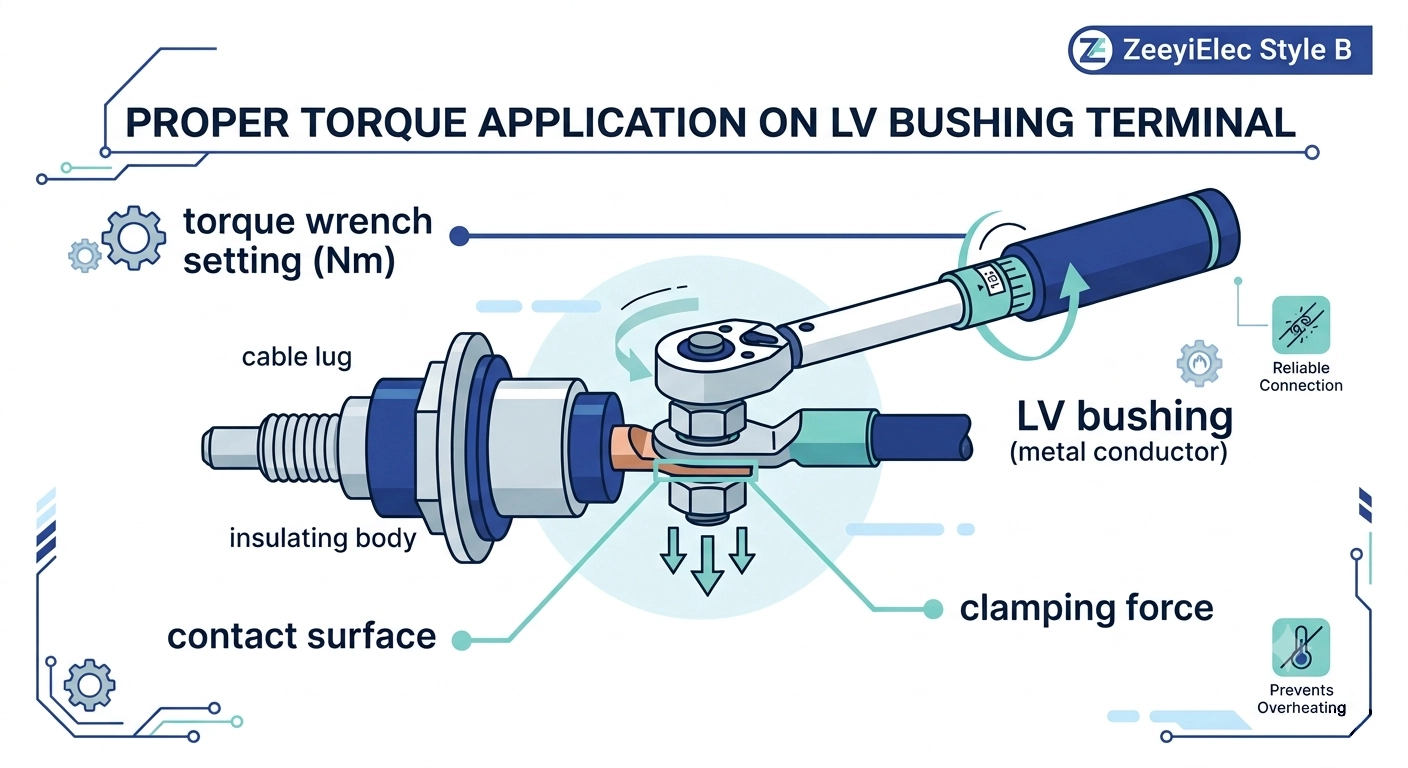
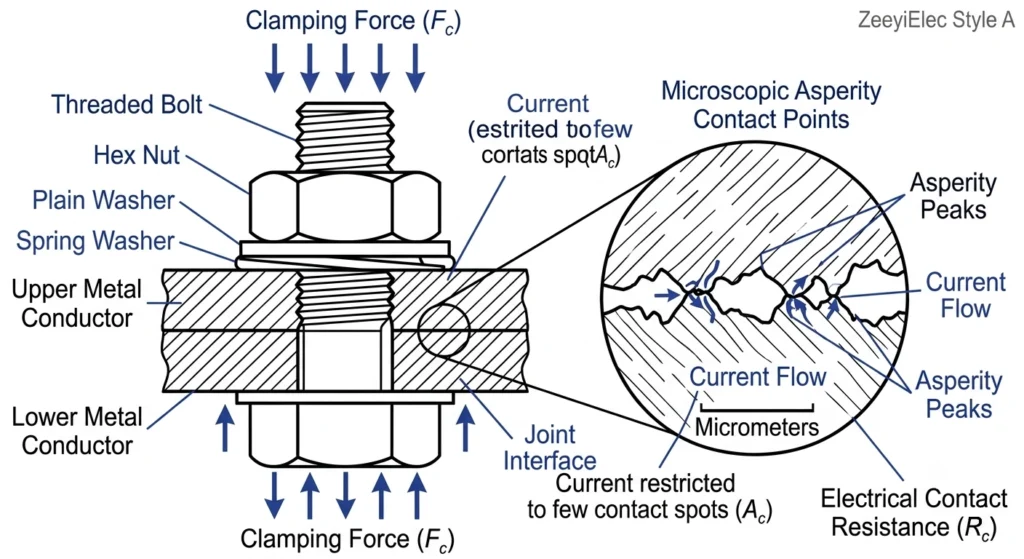
LV bushing installation torque is the single most important variable in long-term terminal performance — more than conductor cross-section, it determines how much mechanical pressure holds the mating surfaces together. Contact resistance at a bolted joint is governed by the real area of metal-to-metal contact, and that area expands as clamping force increases — up to the point where the material begins to yield. This is why torque specification isn’t an arbitrary installation formality; it’s the primary lever installers have over long-term electrical performance at the joint, whether for a standalone LV bushing or as part of ZeeyiElec’s broader transformer accessories range.Contact pressure at the terminal interface determines the real area of metal-to-metal contact and resulting resistance.
Contact Pressure and Electrical Resistance
At the microscopic level, even a machined terminal surface is rough, and current only flows through the small points where the two surfaces truly touch — the “a-spots.” Adequate torque flattens these asperities and increases effective contact area, lowering contact resistance. Field experience on LV bushing commissioning consistently shows connections torqued to specification measuring contact resistance in the low micro-ohm range, while under-torqued joints on the same terminal size can measure several times higher, well before any visible sign of a loose connection appears.
A properly torqued LV bushing terminal typically exhibits contact resistance below 50 μΩ, whereas a joint torqued to less than 60% of specification can exceed 150–200 μΩ depending on surface finish and lug material.
Why LV Terminals Are More Torque-Sensitive Than MV
LV bushings generally use smaller stud diameters — often in the M8 to M10 range — compared to the larger M12–M16 studs common on MV bushing terminals. Smaller studs mean a narrower torque tolerance window: the same absolute torque error represents a larger percentage deviation from target clamping force, and this varies somewhat by manufacturer and bushing series. This makes precise torque control on LV terminals more consequential per unit of installer error, even though the absolute torque values involved are lower than on MV equipment.
Torque error matters more on small studs — a 2 Nm miss on an M8 stud is proportionally larger than the same miss on an M12
Contact resistance, not visible tightness, is the real pass/fail signal at commissioning
Dry vs. lubricated thread condition changes what “correct” torque means for the same clamping force
Consequences of Under-Torquing and Over-Torquing
Torque errors in either direction produce distinct failure signatures, and recognizing which pattern is developing helps field teams intervene before a connection fails in service. Both failure paths tend to be progressive rather than immediate — a marginally torqued LV bushing terminal can operate for months before symptoms become measurable.
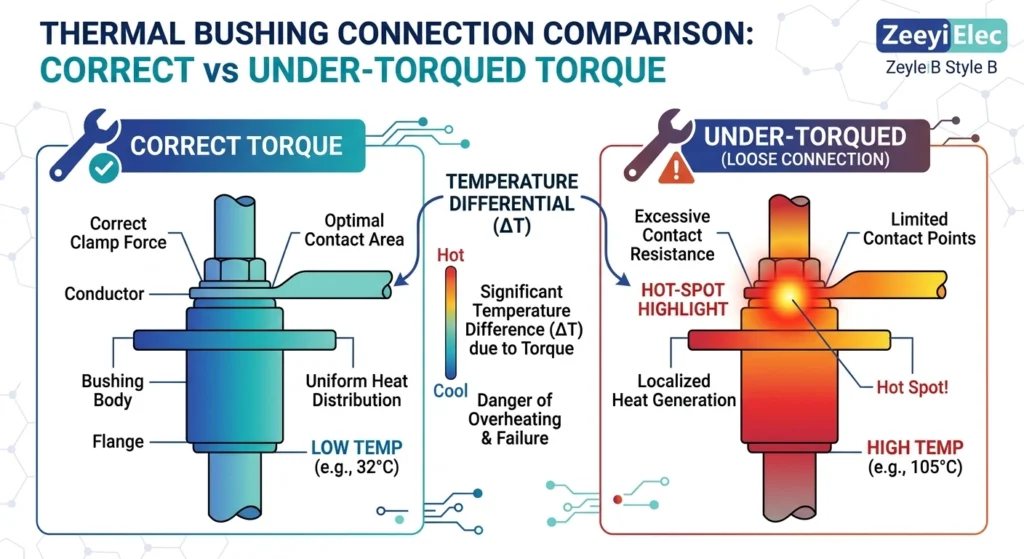
Under-torqued terminals show measurably elevated temperature differentials compared to correctly torqued connections on the same bushing set.
Under-Torque Failure Path
An under-torqued connection starts with elevated contact resistance, which generates localized I²R heating at the joint. That heat accelerates oxide formation on the contact surfaces, further raising resistance in a self-reinforcing cycle. In field troubleshooting on LV distribution equipment, this pattern often first shows up as a temperature rise of 15–30°C above ambient at the terminal during thermal scanning, well before the connection is loose enough to detect by hand. Left unaddressed, thermal cycling from load variation can loosen the joint further, eventually leading to arcing and terminal burning.
Over-Torque Failure Path
Over-torquing carries a different risk profile. Exceeding specified torque — particularly on smaller M8 studs common to LV terminals — can strip threads, deform the lug flange, or crack a cast terminal boss. On bushings where the terminal stud is integral to the insulator body, excessive torque can also transmit mechanical stress into the porcelain or epoxy housing, creating a risk of hairline cracking that may not be visible until a later dielectric test flags a weak point. Unlike under-torque failures, over-torque damage is often present at installation rather than developing gradually, which is why witnessing the tightening step during commissioning is a more reliable catch than relying on later thermal inspection alone.
Both failure modes underscore why torque verification belongs in the commissioning checklist rather than being treated as a one-time installation step.
Torque Range Considerations by Bushing Terminal Size
Torque values for LV bushing terminals are determined primarily by stud diameter and lug material, not by voltage class alone. Manufacturers publish specific torque tables for their terminal hardware, and installers should always work from that documentation rather than a generic figure.
Torque Range Considerations by Stud Size
Exact torque values vary by manufacturer, stud material, and thread condition, so installers should always reference the specific terminal hardware datasheet for the bushing being installed rather than applying a generic figure. As a general orientation, LV bushing terminal hardware in the M8–M12 range typically falls within a moderate torque band suited to preventing both under-clamping and thread damage — but the governing number should come from the product’s own installation documentation.
Exact torque specifications differ by stud size, material, and thread lubrication condition. Always confirm the correct Nm value against the specific bushing terminal hardware datasheet before installation rather than relying on a generic range.
Material-Dependent Adjustments
Copper lugs tolerate the specified torque range with minimal long-term relaxation, since copper’s mechanical properties keep clamping force relatively stable through thermal cycling. Aluminum lugs behave differently — aluminum is prone to cold-flow (creep) under sustained clamping pressure, meaning the joint can lose a measurable percentage of clamping force over the first weeks of service even when torqued correctly at installation. For aluminum-lug LV bushing terminals, this is the underlying reason many specifications call for a scheduled retorque check rather than a single tightening event, and why Belleville washers or similar spring elements are sometimes specified on aluminum terminal connections to maintain clamping force despite creep.
For terminal hardware selection across the broader LV and MV bushing range, see ZeeyiElec’s low voltage bushings product series.
Step-by-Step Installation and Torque Verification Procedure
Getting LV bushing installation torque right depends as much on preparation and sequencing as on the final wrench setting. A structured procedure reduces the variability that leads to both under- and over-torque failures on LV bushing terminals.
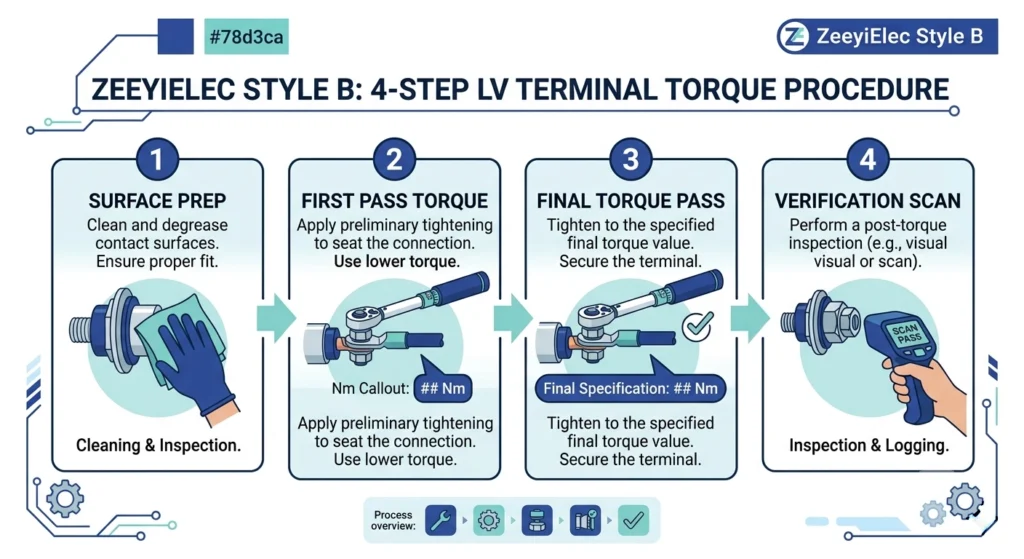
A staged tightening sequence with post-installation verification reduces variability in terminal contact performance.
Pre-Installation Surface Prep
Contact surfaces should be clean, free of oxide film, and — for aluminum lugs — treated with an appropriate joint compound before mating. Skipping surface prep is one of the more common field shortcuts that leads to elevated contact resistance even when torque is applied correctly afterward.
Torque Application Sequence
Using a calibrated torque wrench, hardware should be tightened to roughly 50–60% of target torque on the first pass, then brought to full specification on a second pass. This staged approach seats the lug evenly and avoids over-stressing one side of the connection, which is a particular risk on multi-bolt terminal pads.
Post-Installation Verification
A retorque check during commissioning, combined with an infrared thermal scan under initial load, confirms the connection is performing as expected before the equipment is placed into unattended service.
Getting torque specifications matched to your specific bushing terminal hardware is easier with the manufacturer’s own reference data. ZeeyiElec’s engineering team can provide terminal torque specification sheets and support technical RFQs across both transformer accessory and cable accessories product lines — reach out through the transformer accessories selection guide to get started.
Commissioning Checks and Field Diagnosis of Torque-Related Issues
Torque-related contact issues rarely announce themselves clearly at commissioning — they tend to surface as subtle deviations that require deliberate checking rather than casual inspection. Building torque verification into the commissioning sequence catches most issues before energization exposes them under load.
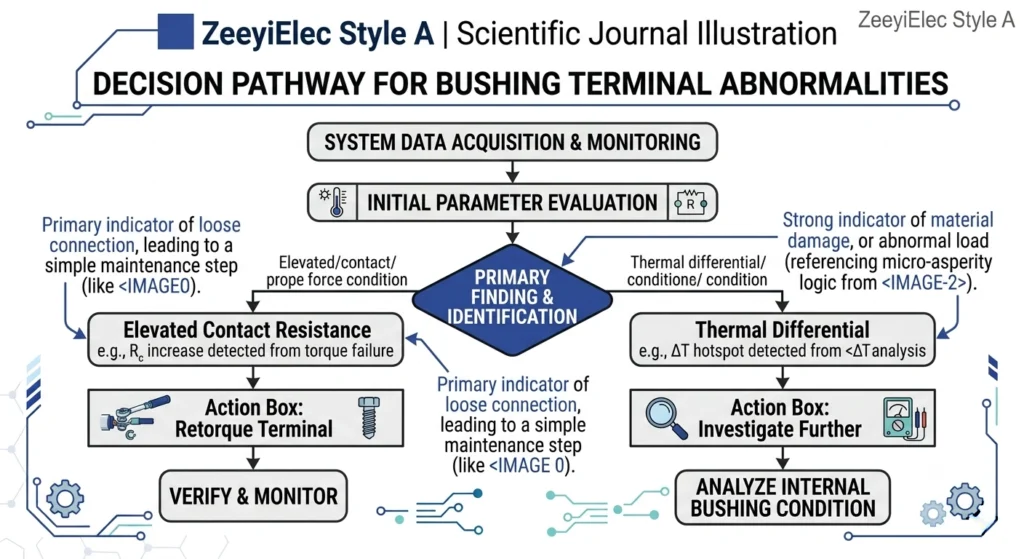
Field symptoms during commissioning can be traced to specific torque-related causes to guide corrective action.
Signs of Loose Contact During Commissioning
The most reliable early indicator is a contact resistance measurement above expected baseline — typically anything exceeding roughly 100 μΩ on an LV bushing terminal warrants investigation rather than assumption that it will resolve under load. Infrared thermal scanning under initial energization is a useful secondary check, since a temperature differential of even 10–15°C between an otherwise identical terminal pair on the same bushing set often points to a torque discrepancy rather than a load imbalance. Checking one terminal against its otherwise-identical neighbor is often more diagnostic than relying on an absolute temperature threshold, since ambient and loading conditions vary between sites.
A contact resistance reading exceeding ~100 μΩ, or a thermal differential of ≥10°C between comparable terminals, should trigger a retorque and recheck before the bushing is accepted into service.
When to Escalate to Full Bushing Replacement
A simple retorque resolves most under-torque cases when caught early. However, if thermal or resistance readings remain elevated after a correctly executed retorque, the issue may have progressed beyond the terminal connection itself — for example, oxide damage to the contact surface or early-stage insulator stress from a prior over-torque event. In these cases, continuing to rely on the existing terminal risks a field failure under load, and replacement of the bushing — rather than repeated retorquing — is the more defensible path, particularly on equipment where downtime cost outweighs the marginal cost of the component.
[Expert Insight]
Compare a terminal against its own neighbor on the same bushing set — it’s a more reliable check than an absolute temperature number
A retorque that doesn’t resolve elevated readings signals damage beyond the connection, not a need to retorque again
Build retorque checks into the commissioning schedule, not just the initial installation step
Standards and Authority References for Torque Practice
Torque practice for electrical terminal connections isn’t arbitrary field convention — it traces back to established guidance on bolted electrical connections, even though individual bushing manufacturers issue their own hardware-specific torque tables layered on top of that general guidance.
Relevant IEEE/IEC Guidance on Terminal Connections
IEEE 837 governs qualifying permanent connections used in substation grounding, and while it’s not a direct torque specification for bushing terminals, its underlying principle — that connection integrity must be verified under thermal cycling rather than assumed from installation torque alone — informs why commissioning-stage retorque and thermal checks are standard practice rather than optional add-ons.
Manufacturer torque tables generally take precedence over generic standard guidance in practice, since they account for the specific stud material, thread pitch, and lug design used on that bushing line. Cross-referencing both — the general principle from IEEE/IEC guidance and the specific values from the manufacturer’s datasheet — gives installers the most reliable basis for torque decisions in the field.
What torque should be used for LV bushing terminal connections?
Torque values typically fall in the 15–55 Nm range depending on stud size, but the exact figure should always follow the manufacturer’s torque table for that specific terminal, since lug material and thread condition change the correct setting.
What happens if an LV bushing terminal is under-torqued?
Reduced contact pressure raises contact resistance at the joint, which generates localized heating that accelerates oxidation and can progress to arcing if the connection isn’t caught and corrected during commissioning.
Can over-torquing damage a bushing terminal?
Yes — excessive torque can strip threads, deform the lug, or transmit mechanical stress into the bushing’s insulator body, and this type of damage is often present at installation rather than developing gradually like an under-torque failure.
How often should bushing terminal torque be rechecked after installation?
A retorque check is commonly performed during initial commissioning and again after the first thermal cycle or load period, since aluminum lugs in particular can lose clamping force through creep in the early weeks of service.
Do copper and aluminum lugs need different torque handling?
Yes — aluminum lugs are more prone to cold-flow under sustained pressure and typically need closer adherence to specified torque plus scheduled rechecks, while copper connections hold clamping force more consistently over time.
What’s the best way to verify torque is correct after installation?
A calibrated torque wrench confirms the mechanical setting, but pairing it with a contact resistance measurement or infrared thermal scan under initial load gives a more direct read on actual electrical performance at the joint.
When should a loose-feeling terminal be retorqued versus flagged for replacement?
A single retorque is usually sufficient if it resolves elevated resistance or thermal readings, but if those readings persist after a correctly executed retorque, the underlying damage likely extends beyond the connection and replacement should be considered.
yoyo shi
Yoyo Shi writes for ZeeyiElec, focusing on medium-voltage accessories, transformer components, and cable accessory solutions. Her articles cover product applications, technical basics, and sourcing insights for global electrical industry buyers.




 English
 한국어
한국어 العربية
 Español
 हिन्दी
 தமிழ்
தமிழ் Deutsch (Sie)
 Français
 Português do Brasil
 Русский