A transformer check valve allows insulating oil to move in the intended direction through a forced-oil cooling circuit while resisting flow back toward a stopped pump or another branch. It opens and closes in response to the pressure difference across its moving element. Unlike an isolation valve, it is not a manually selected shut-off point or a substitute for a safe maintenance boundary.
The selection question is broader than pipe diameter. An engineer needs the circuit drawing, pump operating range, oil properties, pressure and temperature conditions, connection dimensions, permitted installation orientation and an agreed leakage criterion. This guide explains how a transformer check valve works, compares the two designs in ZeeyiElec’s range and turns those inputs into a reviewable enquiry.
What Does a Transformer Check Valve Do?
Prevent reverse flow in a pumped oil circuit
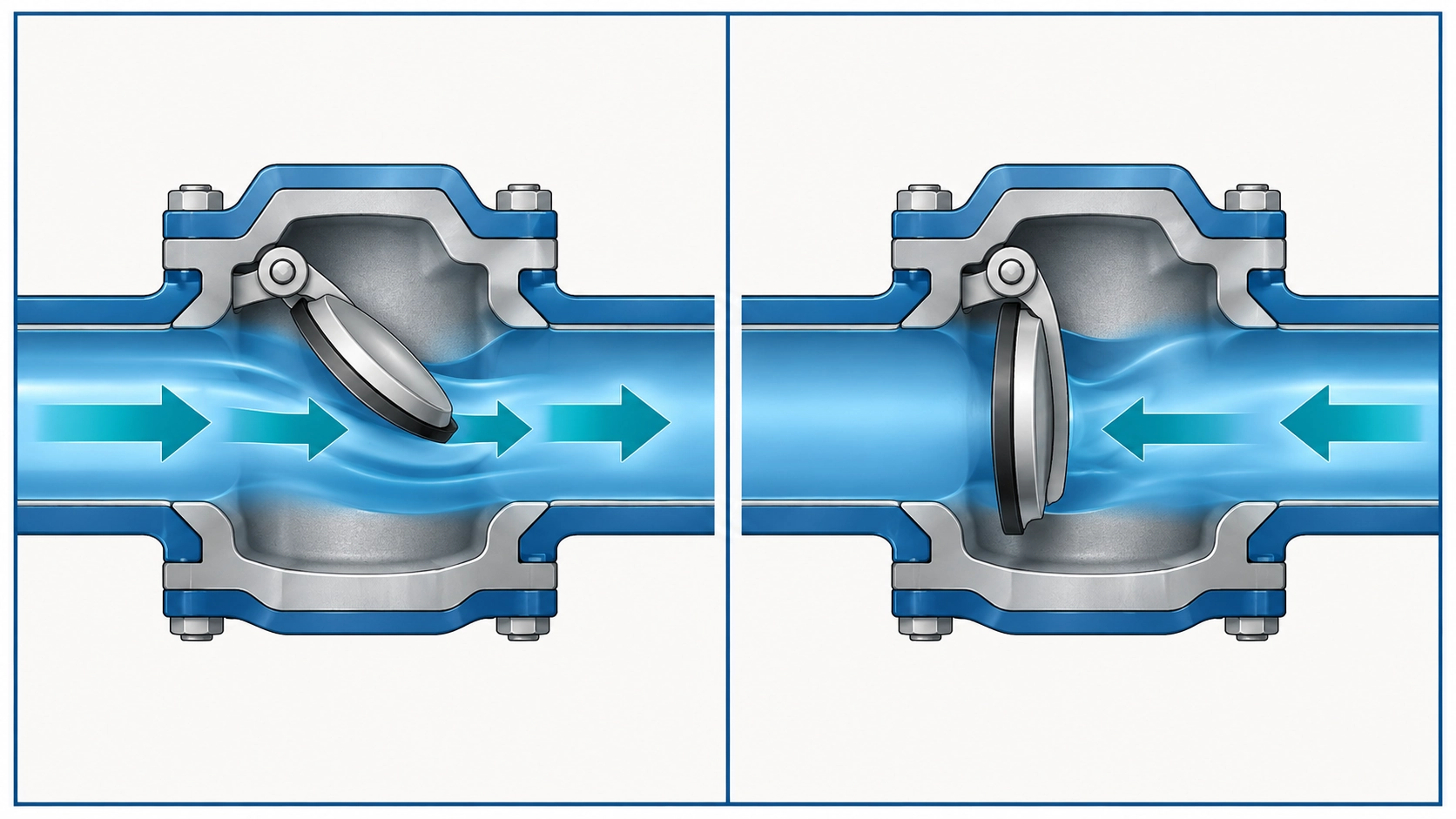
Forced-oil cooling moves heated insulating liquid through an external cooling path. A transformer check valve is commonly considered at a pump discharge or another location where reverse flow could occur when a pump stops or another path remains pressurized. Forward differential pressure moves the plate or disc away from its seat. As the differential falls or reverses, the closure element returns toward the seat and restricts the reverse path.
The actual location must come from the approved transformer cooling schematic. The valve does not establish the direction of flow by itself: the piping arrangement and pump duty do. Its body flow arrow, if supplied, must agree with that drawing. A reversal in the schematic or a change in pump sequence can change the duty seen by the valve, even if its nominal size stays the same.
Conceptual one-way flow illustration; actual closing behavior depends on the selected valve and oil-circuit conditions.
Know what the valve cannot promise
A transformer check valve restricts reverse flow; it is not normally the device used to positively isolate a line for opening, draining or maintenance. Closed-seat leakage depends on construction, differential pressure, liquid, temperature and the acceptance test specified for the selected valve. Do not assume zero leakage from the words “non-return.” Likewise, a transformer check valve alone cannot remove all pump-trip transients. The cooling-system designer must review the pump, pipework, controls and valve dynamics together.
This functional boundary matters in an RFQ. If the project requires an isolation point, name that separately on the circuit drawing. If it requires a measurable reverse-leakage limit, state the test conditions. The broader transformer accessories range includes components with other duties; the transformer valve functions guide distinguishes directional flow control from isolation and service access. A generic request for a “check valve for transformer oil” leaves the requirements unresolved.
Which Transformer Check Valve Types Are Available?
Dual-plate designs
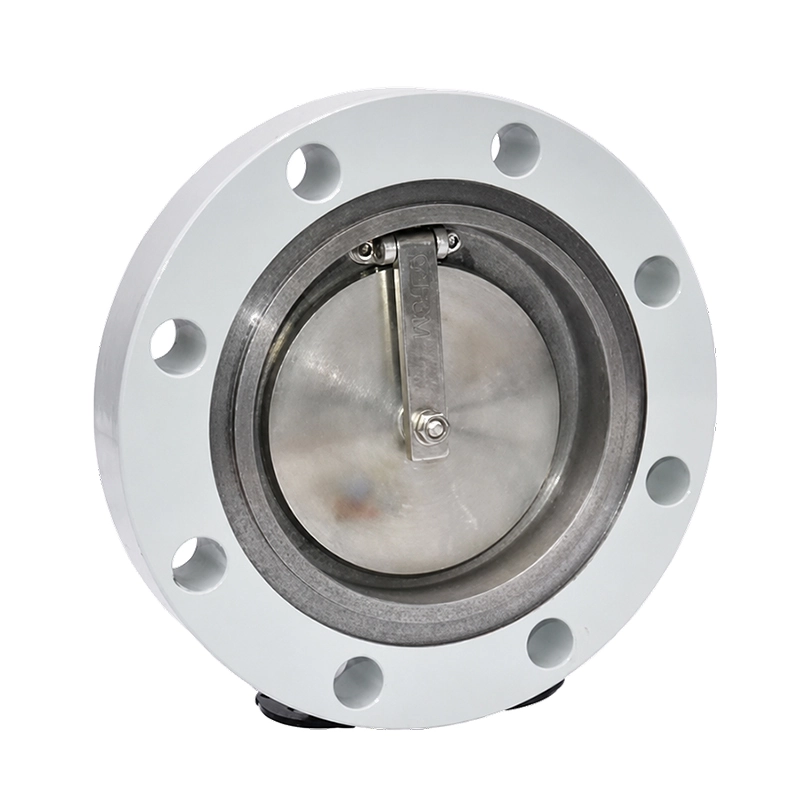
ZeeyiElec lists a dual-plate design with wafer and flanged connection options. Two hinged plates open under forward flow and close as that flow decays or reverses. The compact wafer form can fit between specified mating flanges, but “wafer” does not make flange drilling, gasket arrangement or required bolting universal. Review the exact connection drawing rather than assuming all valves with the same DN will fit.
The product range lists carbon steel, stainless steel and bronze as material options for dual-plate valves. Those are available configurations, not a claim that every material is available in every size or with every seat and connection. Ask which wetted components, springs, pins, seat and seals belong to the quoted build. The selected assembly must be reviewed for the specified insulating liquid and service temperature.
ZeeyiElec product photograph showing a dual-plate check valve. Confirm materials, size and connection details for the quoted configuration.
Single-disc swing designs
ZeeyiElec also lists a flanged single-disc swing design. Forward flow moves one hinged disc away from the seat; falling flow or reverse pressure returns it toward closure. The flanged body may suit a different piping interface from a wafer type. It can also have a different face-to-face length, weight, opening characteristic and pressure loss. None of those should be inferred from the photograph.
The disc’s movement and gravity can make installation orientation significant. Do not transfer an orientation approval from a dual-plate model to a swing model, or from one size to another. Request the installation drawing and permitted orientations for the exact part number, including any hinge-axis requirement. A valve that fits mechanically but does not open fully at the minimum operating flow is not an acceptable selection.
ZeeyiElec product photograph showing a single-disc swing check valve. The image alone does not establish orientation or operating limits.
Compare complete assemblies, not type names
Dual plate and single disc describe closure arrangements, not guaranteed performance rankings. One candidate may offer a shorter installation envelope while another offers a preferred connection or maintenance arrangement. Neither name proves lower pressure loss, faster closing or tighter shut-off in the intended oil circuit. Those comparisons need model-specific data under relevant operating conditions.
For an early transformer check valve shortlist, compare the documented opening requirement, pressure loss over the pump’s operating range, flow direction, permitted orientation, reverse-leakage criterion, materials, connection drawing and available test evidence. Keep unresolved fields open. Selecting on nominal size and a type label alone can conceal a mismatch with the pump or enclosure.
How Do You Select a Check Valve for Transformer Oil?
Establish the flow range and pump behavior
Record the normal and minimum expected oil flow, pump discharge pressure, possible parallel-pump arrangements and what happens during a start, stop or power loss. A transformer check valve needs sufficient forward differential to reach a stable open condition. If it repeatedly opens and closes near minimum flow, the moving element can chatter and wear. If it offers excessive resistance, the cooling circuit may lose flow available to carry heat away.
Ask for the selected model’s opening behavior and pressure-loss information with the relevant oil properties and temperature range. Water-based catalogue curves may require engineering interpretation before use with insulating oil. The calculation belongs to the cooling-system designer; this article cannot assign a universal cracking pressure or maximum pressure drop to every transformer check valve.
Confirm the liquid and pressure envelope
For the transformer check valve, identify the specified insulating liquid, temperature range, operating pressure, possible reverse differential and any vacuum or oil-processing condition that can reach the installed valve. A positive-pressure rating does not independently verify vacuum suitability. Confirm the complete assembly, including seat, spring, gaskets and fasteners, for the stated conditions. If the project has special fluid compatibility requirements, request written material evidence rather than relying on a body-material label. For mineral-oil projects, the IEC 60296 mineral insulating oil specification helps identify the liquid requirements; confirm the valve assembly’s compatibility for that specified oil.
Separate three acceptance questions: can the body and joints withstand the specified pressure; does the assembly avoid external leakage; and how much reverse leakage across the closed seat is allowed? These are not interchangeable tests. State the test direction, medium, differential pressure, duration and acceptance criterion in the procurement documents, then ask which evidence the supplier can provide.
Match the connection and orientation
For the transformer check valve enquiry, give the pipe size and the full connection standard. For flanged or wafer designs, verify mating flange drilling, sealing face, gasket, bolt length, thickness and available face-to-face space. Review support and installation clearance as well as nominal bore. A product photo can help identify a family, but it cannot establish dimensional interchangeability.
The flow arrow and permitted orientation must match the as-built circuit. In a horizontal line, hinge position may matter; in a vertical line, direction of flow and closure assist may matter. Use only the orientation approved for the exact valve. Do not rotate the body to solve a clearance problem without checking the maker’s drawing and the effect on disc travel.
Compare pump duty, configuration, connection, orientation and acceptance documents before approving a transformer check valve.
What Should an RFQ and Drawing Review Include?
Send a circuit package with the enquiry
A useful enquiry identifies the transformer check valve location on the oil-cooling schematic and marks the intended forward-flow direction. Include pump data or a defined flow range, liquid specification, pressure and temperature envelope, pipe size, connection details, orientation and available space. If a parallel pump, bypass or automatic changeover exists, show those branches so the reverse-flow duty can be understood.
Ask the supplier to identify the offered design, model, materials and drawing revision. The transformer check valve quotation should state which connection, seat, spring and seal arrangement is included, whether mating gaskets or fasteners are included, and which documents will accompany shipment. For a replacement, include the existing valve’s nameplate or record, controlled drawings and measurements rather than requesting a match from an image alone.
The ZeeyiElec transformer valves range is a starting point for available dual-plate and single-disc swing configurations. The transformer valves selection guide explains how to compare valve families by duty. This article concentrates on the check valve’s one-way-flow task and its pump-circuit requirements; the product-specific quotation must resolve the final configuration.
Check evidence before approval
During transformer check valve drawing review, compare the circuit arrow with the valve marking, piping dimensions with the assembly drawing and pump flow range with the valve’s opening and pressure-loss information. Confirm material and liquid compatibility, permitted mounting orientation, seat-leakage requirement, pressure integrity and planned inspection records. A document for a similar size or construction is not evidence for the exact quoted assembly unless the supplier explains its applicability.
For example, two valves might both be described as DN100 check valves while one is a wafer dual-plate unit and the other a flanged swing unit. They cannot be substituted on the basis of DN alone: connection envelope, installation clearance, opening behavior and test scope may all differ. This is a hypothetical comparison, not a ZeeyiElec field case or a statement of specific product dimensions.
Agree how the supplied transformer check valve will be identified at receipt and how deviations will be approved. The approved drawing and model reference should follow the order through inspection and handover. Keep installation and operating instructions with the cooling-system records so a future technician does not have to infer flow direction from an old photograph.
Common Questions About Transformer Check Valves
Is a transformer check valve the same as an isolation valve?
No. A check valve responds automatically to flow conditions to restrict reverse flow. It should not be assumed to provide the positive isolation required to open or service a liquid line. Define any separate isolation requirement on the approved circuit drawing.
Where is a check valve normally placed in a forced-oil system?
It is commonly considered at the pump outlet or another branch where reverse flow could occur. The exact location, direction and arrangement must be set by the transformer cooling-system drawing and pump operating sequence.
Which is better: dual plate or single disc swing?
Neither is universally better. Compare the exact models for minimum-flow opening, pressure loss, reverse-leakage requirement, permitted orientation, connection envelope, materials and service evidence in the intended oil circuit.
Can a wafer check valve replace a flanged swing check valve of the same DN?
Not by nominal size alone. Confirm flange and gasket interfaces, face-to-face space, bolting, flow behavior, orientation and acceptance criteria using controlled drawings before approving a replacement.
Does a check valve stop every reverse-flow transient?
No universal claim is justified. Closing dynamics depend on valve construction and the pump and piping system. Review the full circuit for pump-trip behavior and pressure transients; obtain model-specific information where that risk matters.
What information should be sent for a check valve quotation?
Send the cooling-circuit drawing, flow direction and range, pump conditions, insulating liquid, pressure and temperature envelope, pipe connection, installation orientation, quantity and required test and documentation scope. Ask for the exact model and drawing revision.
The best transformer check valve choice is the one that fits the verified cooling circuit, not merely the photographed product family. Use the approved schematic and documented operating conditions to compare alternatives, then close every connection, performance and evidence question before release.
yoyo shi
Yoyo Shi writes for ZeeyiElec, focusing on medium-voltage accessories, transformer components, and cable accessory solutions. Her articles cover product applications, technical basics, and sourcing insights for global electrical industry buyers.








 English
 한국어
 العربية
 Español
 हिन्दी
 தமிழ்
 Deutsch (Sie)
 Français
 Português do Brasil
 Русский