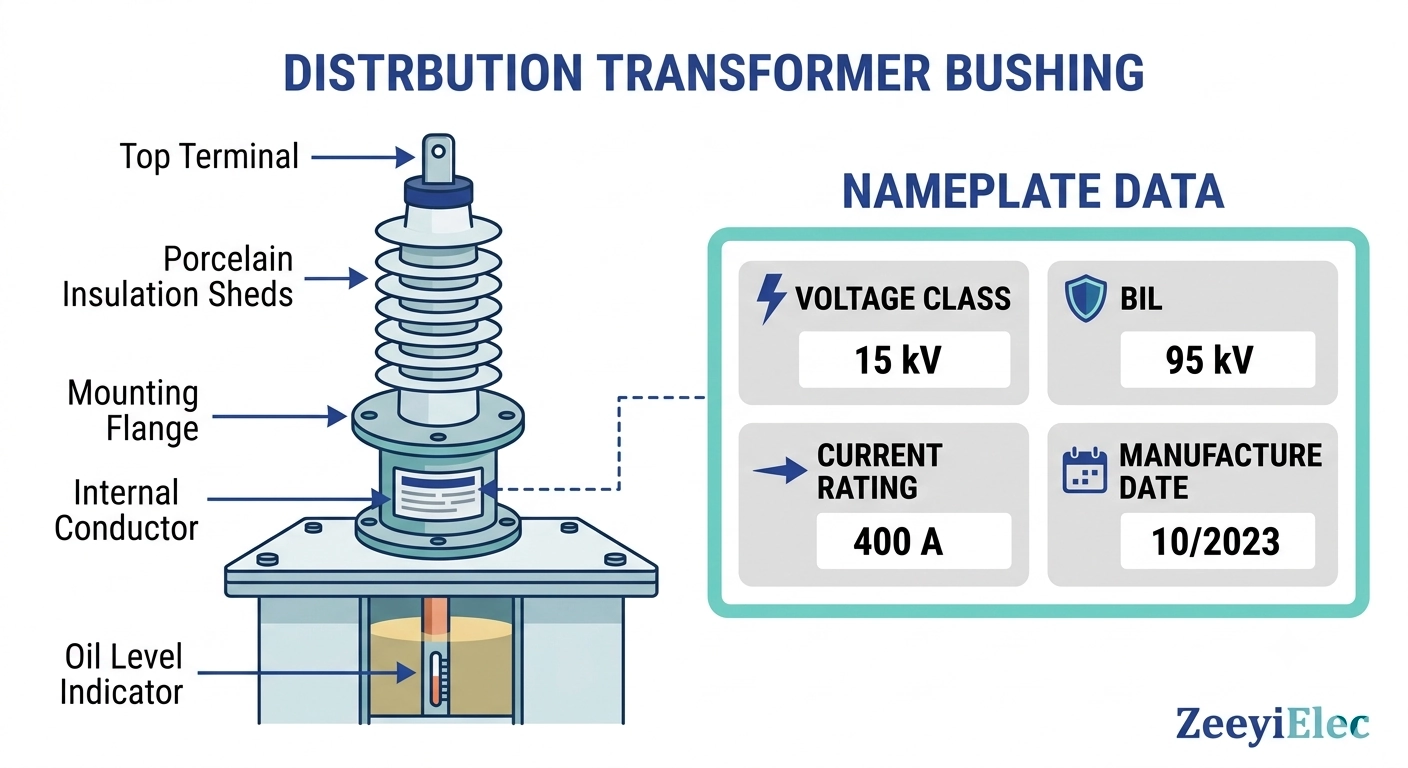
A bushing nameplate is the manufacturer-affixed plate carrying the electrical, dimensional, and traceability data needed to confirm a medium-voltage bushing matches its application — voltage class, current rating, BIL, and manufacture batch, all without disassembling the unit. Field engineers rely on it during incoming inspection, commissioning, and replacement.
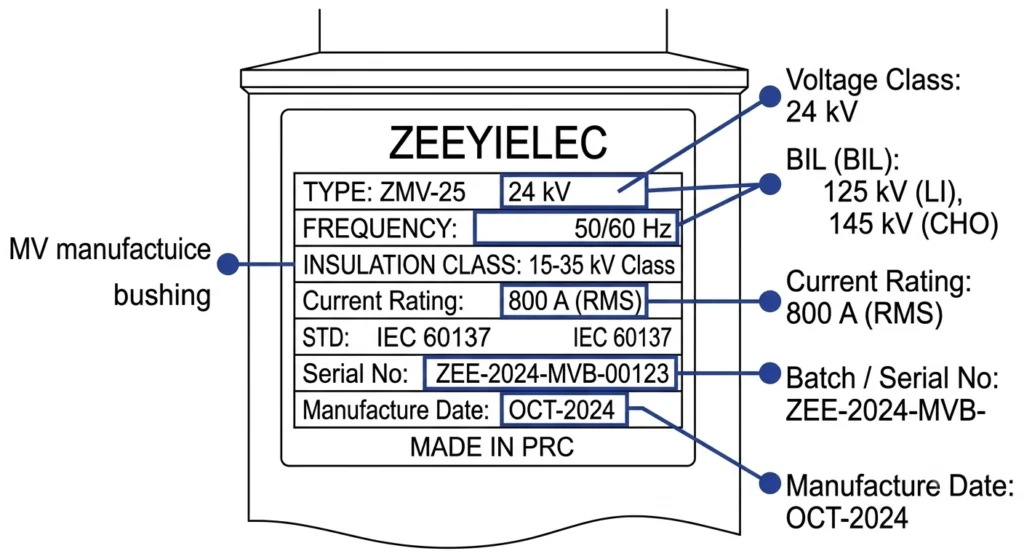
Figure 1. Annotated nameplate layout identifying voltage class, current rating, BIL, and manufacture date fields.
Why Nameplate Accuracy Affects Installation and Compliance
Misreading a nameplate value has direct downstream consequences. A bushing rated for 25 kV installed on a system requiring 35 kV insulation coordination will pass initial energization but risks flashover under transient overvoltage. Procurement teams typically cross-reference current ratings — commonly 200 A to 3150 A for medium-voltage bushings — against the transformer’s rated load current before approving a replacement, since an undersized rating leads to accelerated thermal aging at the contact interface.
Where the Data Plate Is Typically Mounted
Placement varies by bushing family. On porcelain MV bushings, the plate usually sits on the mounting flange near the base, staying accessible after tank-wall installation. On low-voltage secondary bushings, it’s often smaller and closer to the terminal stud, which can make it harder to read once busbar connections are in place — a detail field technicians note when planning inspection access.
The three fields engineers check first are rated voltage class, BIL (Basic Impulse Level), and continuous current rating. Each governs a different aspect of electrical performance, and confusing one for another is a common source of specification errors.
Rated Voltage Class (kV)
Voltage class defines the maximum system voltage the bushing is designed to operate on continuously, commonly 15 kV, 25 kV, or 35 kV for distribution-class MV bushings. This is not the transformer’s operating voltage — it represents the insulation system’s rated withstand capability, including margin for switching transients and normal fluctuation.
BIL / Impulse Withstand Voltage
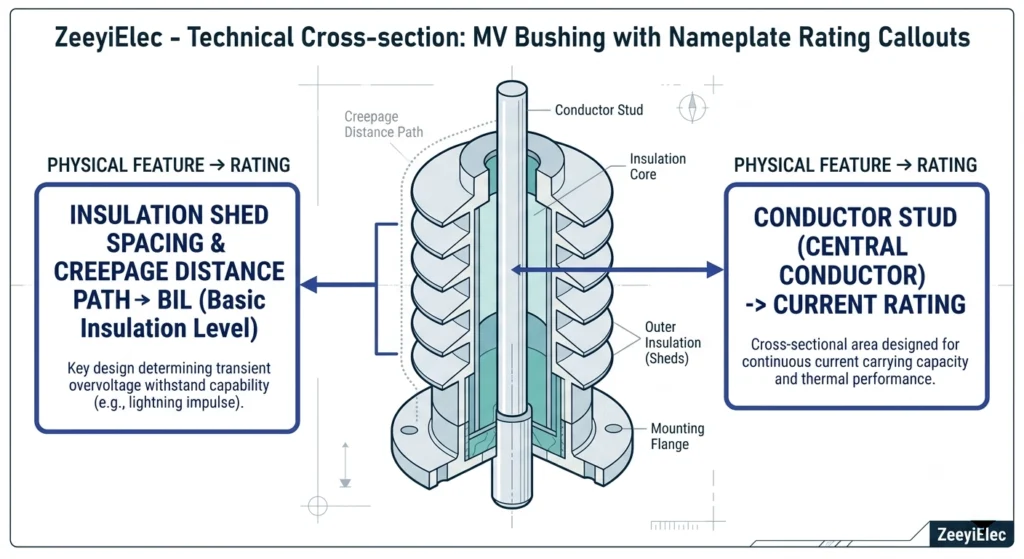
BIL indicates the peak impulse voltage the insulation can withstand without flashover, expressed in kV crest. A 15 kV class bushing commonly carries a BIL of 95 kV to 110 kV, while a 35 kV class unit may reach 150 kV to 200 kV. This parameter matters most during lightning or switching surge events, and it must be coordinated with the transformer’s overall insulation coordination scheme — mismatched BIL between a replacement and the original design is a documented cause of premature dielectric failure in the field.
Figure 2. Cross-section view linking nameplate ratings to physical insulation shed and conductor dimensions.
Continuous Current Rating (A)
Continuous current rating specifies the maximum current the conductor can carry without exceeding thermal limits at rated ambient temperature, typically 200 A on smaller bushing-well interface units up to 3150 A on high-current families. Exceeding this rating — even briefly during load growth or fault conditions outside protection coordination — accelerates conductor and seal aging.
Per IEEE 386, separable connector and bushing well interface systems are evaluated against continuous current withstand at rated ambient, with temperature rise generally held to ≤65°C above a 40°C ambient reference for standard classes.
[Expert Insight]
Voltage class and BIL both appear as kV values — read the label context, not just the number, to avoid confusing them.
Current rating should sit at or above the transformer’s rated load current, not just match it.
When two fields seem inconsistent, trust dimensional measurement over a worn digit.
Cross-referencing these three fields against transformer design documents remains the fastest way to confirm compatibility, particularly for Bushing Well & Inserts replacement scenarios where original datasheets aren’t on hand.
Material and Insulation Codes on the Nameplate
Beyond electrical ratings, most plates carry an abbreviation for the insulation material system used, since it affects mechanical strength, contamination resistance, and expected service life outdoors versus indoors.
Porcelain (ANSI/DIN) Markings
Porcelain-insulated bushings are typically marked with a family designation tied to the standard system they follow — ANSI-style units reference creepage distances and shed profiles distinct from DIN-style units. Creepage distance for standard-duty 15 kV class porcelain bushings commonly falls in the 380 mm to 450 mm range, increasing toward 550 mm or more for heavy-duty, contaminated-environment ratings. Field engineers in coastal or industrial-pollution zones often check this figure first, since inadequate creepage distance is a recurring root cause in flashover incidents.
Epoxy/Resin Interface Codes
Epoxy and resin-cast bushings use a different marking convention, often indicating resin type rather than a shed-profile code. These materials are common on bushing well interfaces and lower-voltage secondary bushings, where compact dimensions matter more than long creepage paths. Typical continuous operating temperature for epoxy-resin insulation falls around a 105°C to 130°C class, depending on formulation.
Where a plate shows only a resin class letter without a decoded reference table, technicians should treat the code as [VERIFY STANDARD: manufacturer-specific resin classification] rather than assume equivalence across suppliers, since resin formulations aren’t as universally standardized as porcelain creepage distances under IEC 60815.
Confirming material compatibility matters especially when sourcing replacements across suppliers, since dimensional and thermal characteristics can differ even within the same nominal voltage class.
Standards References and Manufacturer Traceability
Beyond electrical and material data, a plate usually carries a standard reference code and a batch or serial identifier — useful for procurement traceability, warranty claims, and confirming a replacement is truly equivalent to the original.
ANSI vs. DIN vs. IEC Marking Conventions
Nameplates from ANSI-compliant manufacturers typically reference American dimensional and creepage standards, while DIN-marked units follow European mounting flange and shed profile conventions. IEC 60815 defines creepage distance requirements by pollution severity class instead, with minimum specific creepage distance rising from roughly 16 mm/kV in light-pollution environments to 31 mm/kV or more in very-heavy-pollution zones. In practice, the marking convention tells a procurement engineer which mounting flange bolt pattern to expect — mismatching a DIN-flange bushing into an ANSI-pattern well is a recurring fitment error in emergency field replacements.
Batch/Serial Number and Manufacture Date Codes
The batch or serial number, paired with a manufacture date code, lets a supplier trace raw material lot, production line, and quality-test records for a specific unit — the field most often referenced during warranty disputes or failure investigations. Manufacture date alone doesn’t indicate degraded performance, but bushings sitting in uncontrolled storage for 3–5 years or longer before installation warrant a visual and dielectric check before energization, since gasket and seal materials can age even in an unused unit.
Field Verification — Reading Worn or Damaged Nameplates
Plates degrade in service. Outdoor porcelain bushings exposed to UV, moisture cycling, and surface contamination for 10–15 years or more frequently show faded stamping or corroded tags, and field technicians regularly encounter units where the voltage class or current rating is only partially legible.
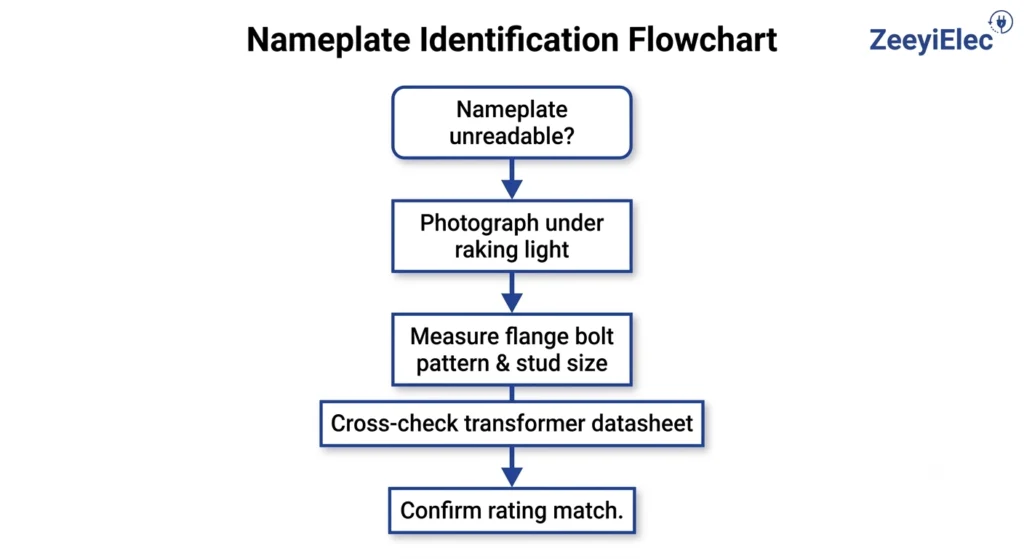
Figure 3. Step-by-step verification flow for confirming bushing ratings on a worn or illegible nameplate.
Step-by-Step: Confirming Ratings When the Plate Is Unreadable
Photograph the plate under raking light — a low-angle flashlight beam often reveals stamped characters that flat lighting hides.
Measure physical dimensions: flange bolt circle diameter, overall bushing length, and conductor stud size, since these often narrow the voltage class and current family even without legible text.
Check the transformer’s original nameplate or data sheet, which frequently lists installed bushing specs separately.
If dimensions suggest a 15 kV or 25 kV class unit but current rating remains unclear, cross-reference against the transformer’s rated load current.
In one recurring field scenario, technicians replacing a bushing on a 25-year-old transformer found the plate reduced to a faint outline; measuring the flange bolt pattern against the Medium Voltage Bushings family specs narrowed the match to a 25 kV, 200 A configuration before ordering.
Cross-Checking Against Datasheets and Purchase Records
Where available, purchase order records, prior test certificates, or the transformer manufacturer’s bill of materials provide the most reliable confirmation. Relying solely on visual estimation risks selecting a bushing with insufficient BIL or current margin — an error that may not surface until the next lightning-related transient or peak load event.
[Expert Insight]
Raking light reveals faint stamping better than direct overhead light.
Flange bolt pattern and stud diameter often narrow the match even with zero legible text.
Storage age over 3–5 years flags gasket/seal inspection, not just electrical re-verification.
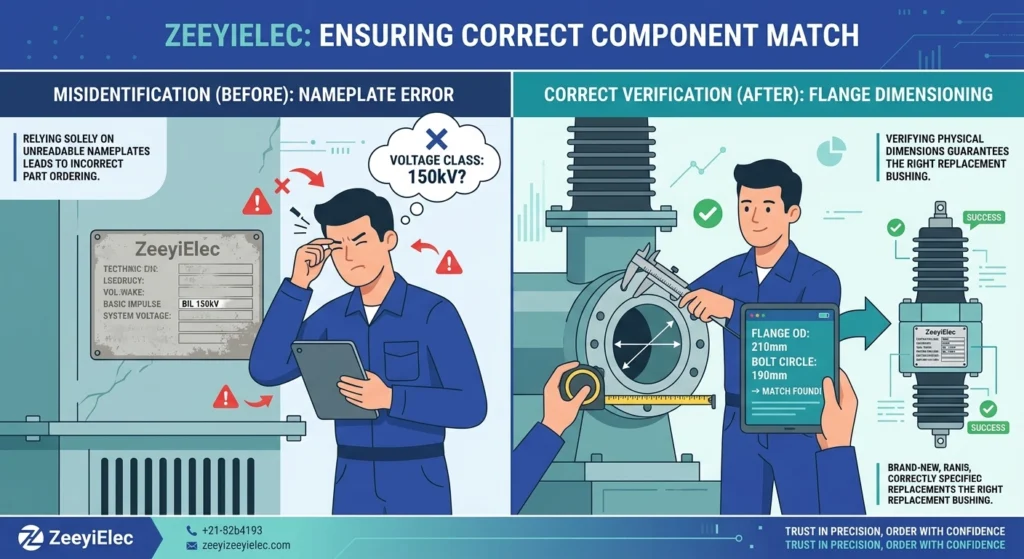
Even experienced field crews misread plates under time pressure. The most frequent error is confusing voltage class with BIL — both appear as kV values in similar font sizes, and a technician scanning quickly can mistake a 95 kV BIL figure for a 95 kV voltage class, which doesn’t exist in standard MV bushing ranges and should immediately flag a misread.
Case: Voltage Class Misread During Emergency Replacement
In one documented scenario, a crew replacing a failed bushing under outage-restoration pressure ordered a 35 kV class unit based on a misread BIL figure rather than the actual 25 kV voltage class stamped nearby. The mismatch wasn’t caught until the replacement’s flange dimensions didn’t align with the existing bushing well, delaying restoration by several hours. Double-checking both fields against the transformer’s own nameplate before ordering would have prevented the delay.
Figure 4. Case comparison showing how a misread BIL value led to an incorrect voltage class replacement order.
Request Technical Verification Support from ZeeyiElec
When a plate is ambiguous, worn, or inconsistent with expected dimensions, cross-checking with a manufacturer’s technical team can prevent a costly mismatch. ZeeyiElec’s engineering support team assists with bushing identification using photos, dimensional measurements, or partial data for Cable Accessories and transformer accessory replacement projects — request a technical verification consultation before placing a reorder.
Frequently Asked Questions
What does BIL mean on a bushing nameplate?
BIL (Basic Impulse Level) indicates the impulse withstand voltage the bushing can tolerate, typically ranging from 95 kV to 250 kV depending on voltage class, and it must match the transformer’s insulation coordination requirements.
How do I know the voltage class of my bushing from the nameplate?
The voltage class is usually printed directly (e.g., 15 kV, 25 kV, 35 kV) near the top of the plate, though on older or worn units it may require cross-referencing current rating and physical dimensions against manufacturer documentation.
What is the current rating field used for?
The current rating, commonly 200 A to 3150 A for MV bushings, tells you the maximum continuous current the bushing can carry without exceeding thermal limits, which must align with the transformer’s load requirements.
Can I replace a bushing if the nameplate is illegible?
Yes, but only after cross-checking physical dimensions, mounting flange size, and insulation material against technical documentation or the original purchase order, since guessing ratings risks improper fit or electrical mismatch.
What’s the difference between ANSI and DIN nameplate markings?
ANSI-marked bushings typically reference American porcelain and creepage standards, while DIN-marked bushings follow European dimensional and insulation conventions, so the marking style often indicates which mounting family the bushing belongs to.
Does the manufacture date on a nameplate affect performance?
The manufacture date mainly supports traceability and warranty verification rather than indicating a performance change, though very old units may warrant a visual inspection for insulation degradation before reuse.
Where can I verify uncertain nameplate standard references?
When a standard clause isn’t fully legible or verifiable on-site, cross-check against the transformer’s original specification sheet, the accessory supplier’s technical documentation, or contact the manufacturer directly for confirmation.
yoyo shi
Yoyo Shi writes for ZeeyiElec, focusing on medium-voltage accessories, transformer components, and cable accessory solutions. Her articles cover product applications, technical basics, and sourcing insights for global electrical industry buyers.





 English
 한국어
한국어 العربية
 Español
 हिन्दी
 தமிழ்
தமிழ் Deutsch (Sie)
 Français
 Português do Brasil
 Русский