Understanding the Anatomy of a Medium Voltage Bushing
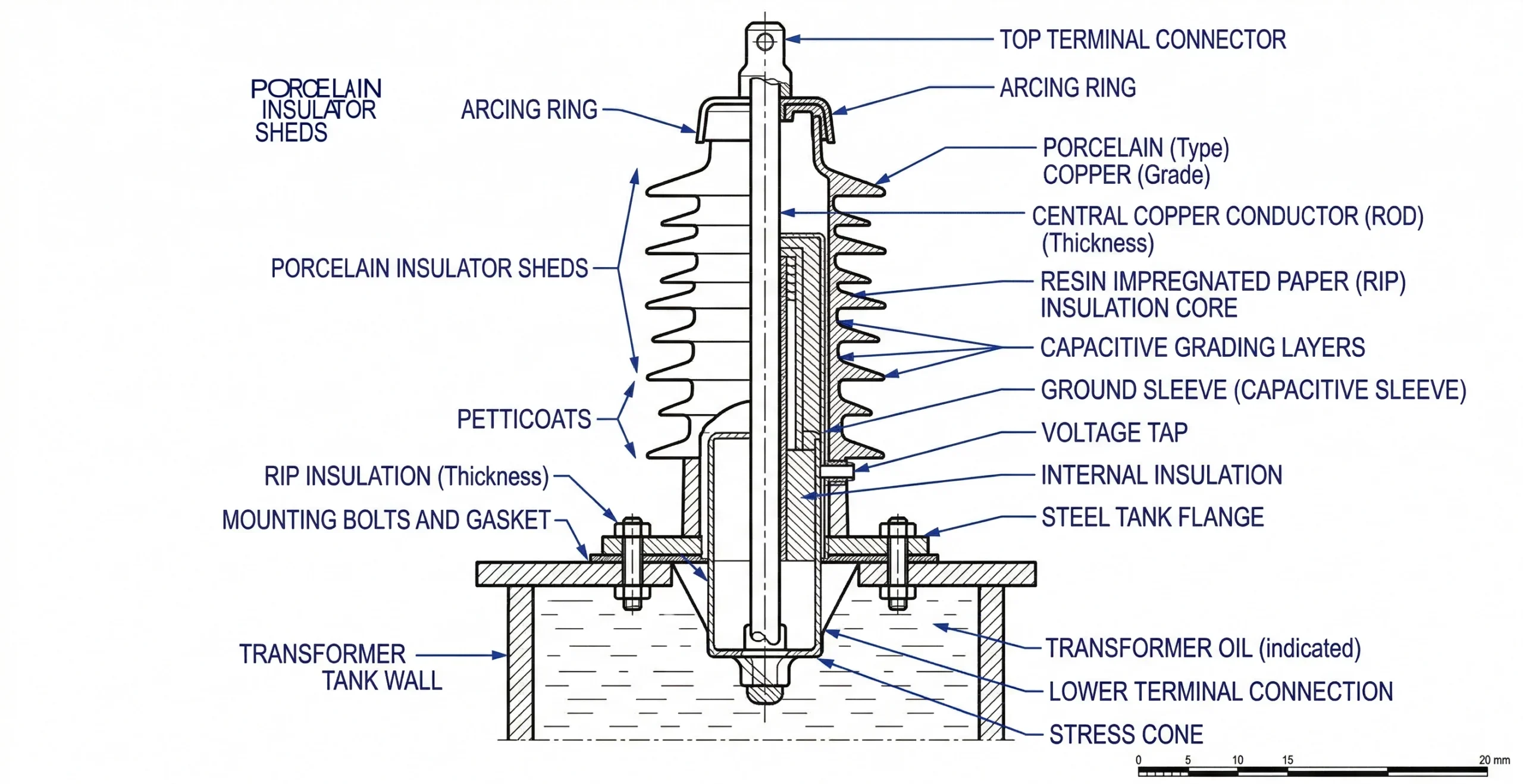
A medium voltage transformer bushing is an insulated pass-through component installed on the transformer tank wall to safely transfer current between internal windings and external circuits. Bushings bridge internal insulation with external connections, acting as the critical interface that prevents the high-voltage live conductor from shorting to the grounded metal casing. When evaluating medium voltage bushings for a distribution project, engineers must recognize that these components are highly engineered dielectric systems designed to manage intense electrical stress fields over a 25 to 40-year lifespan.
The Central Conductor
The core of the bushing is the central conductor, typically manufactured from high-conductivity copper or aluminum, which carries the load current from the active part of the transformer to the grid. In distribution applications, the required current rating spans a broad spectrum, generally from 55A up to 3150A. The cross-sectional area of this central rod or tube dictates the component’s thermal capacity and its ability to withstand short-circuit forces without mechanical deformation.
To ensure long-term reliability and prevent the premature aging of surrounding transformer oil or solid insulation, the operational temperature rise of the conductor must be strictly managed. Specifications often require that the temperature rise ΔT ≤ 65°C above the ambient temperature under maximum continuous load conditions.
The Dielectric Housing and Flange
Surrounding the current-carrying conductor is the insulating housing. The physical dimensions and dielectric strength of this housing must scale according to the system’s voltage class, typically ranging from 12kV to 52kV for medium voltage networks. The external geometry features alternating sheds designed to maximize the creepage distance, a critical factor for preventing surface tracking in contaminated environments. The mounting flange serves as the mechanical anchor. In field operations, degraded gaskets at this interface are a primary cause of moisture ingress and dielectric breakdown. For structural testing requirements, professionals rely on international standards such as IEC 60137 for insulated bushings.
Standard Systems: ANSI vs. DIN vs. EN Specifications
When sourcing transformer accessories for international projects, selecting the wrong standard compromises dielectric integrity and results in a physical mismatch at the transformer tank flange. In practical projects, medium voltage bushings are selected by standard system (ANSI or DIN) to ensure seamless integration.
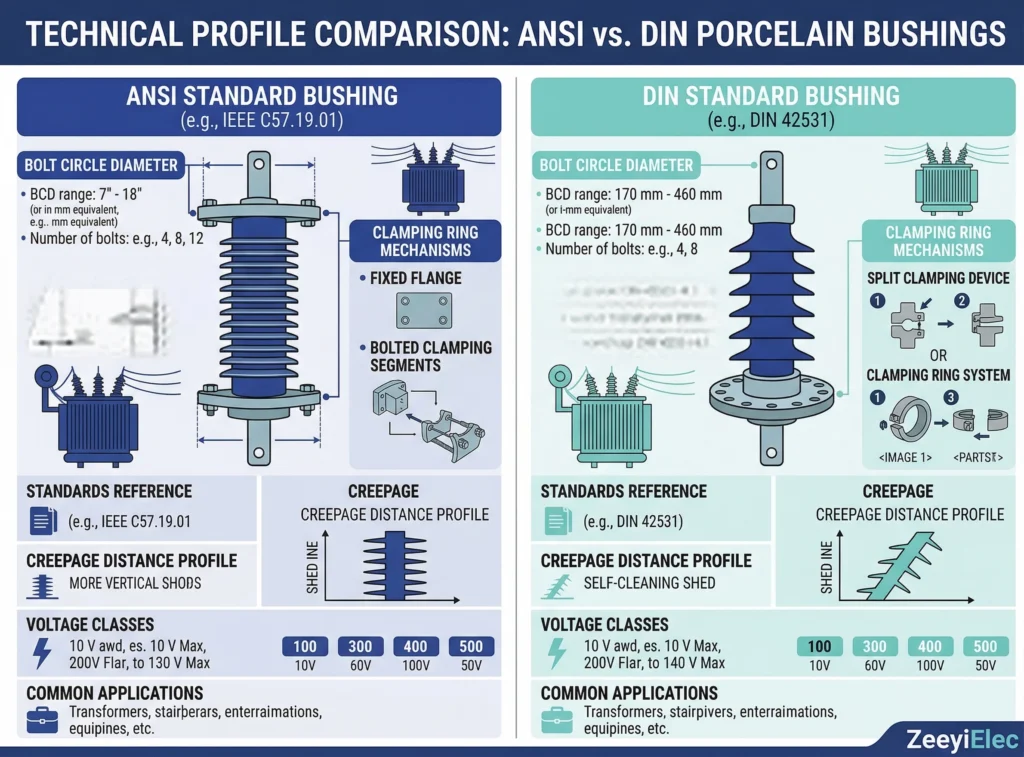
FIG-01:Comparative physical profiles highlighting the distinct flange and shed designs of ANSI versus DIN standard medium voltage bushings.
ANSI Standard Porcelain Bushings
ANSI standard bushings dominate the North American grid and regions following IEEE frameworks. These designs feature specific bolt circle diameters, threaded stud configurations, and robust porcelain profiles tailored for heavy-duty applications in accordance with standards like IEEE C57.19.01. Retrofitting an ANSI bushing onto a non-ANSI tank is notoriously difficult due to fundamental differences in gasket seating. They are widely specified for 15kV, 25kV, and 35kV class transformers.
DIN Standard Porcelain Bushings
DIN standards serve as the dimensional blueprint for Europe, the Middle East, and Asia. DIN bushings are visually distinct, often utilizing a simpler clamping ring mechanism with a central draw-rod fastening system. This modularity makes it easier for maintenance crews to replace the internal rod or external porcelain without draining the bulk of the transformer oil.
EN/IEC Compliant Designs
While ANSI and DIN dictate physical dimensions, EN and IEC standards—specifically IEC 60137—govern electrical testing. An EN/IEC compliant unit must pass rigorous verification tests for partial discharge, thermal stability, and basic impulse insulation level (BIL) regardless of its physical profile.
Standard EN/IEC applications generally require a minimum creepage distance of 16 mm/kV to 20 mm/kV for clean environments, whereas heavy industrial or coastal pollution zones strictly demand specific creepage of ≥ 31 mm/kV to prevent surface tracking and flashovers.
[Expert Insight] Standard Selection Diagnostics
Always verify the bolt circle diameter (BCD) and flange aperture before approving a bushing replacement. A 2mm discrepancy guarantees an oil leak.
Do not mix DIN-standard internal components with ANSI-standard external housings; the mechanical stress distribution will be fundamentally flawed.
Ensure factory acceptance testing (FAT) explicitly cites IEC 60137 or IEEE C57.19.01 depending on the target region.
Porcelain Insulation Bushing Types (The Top 5)
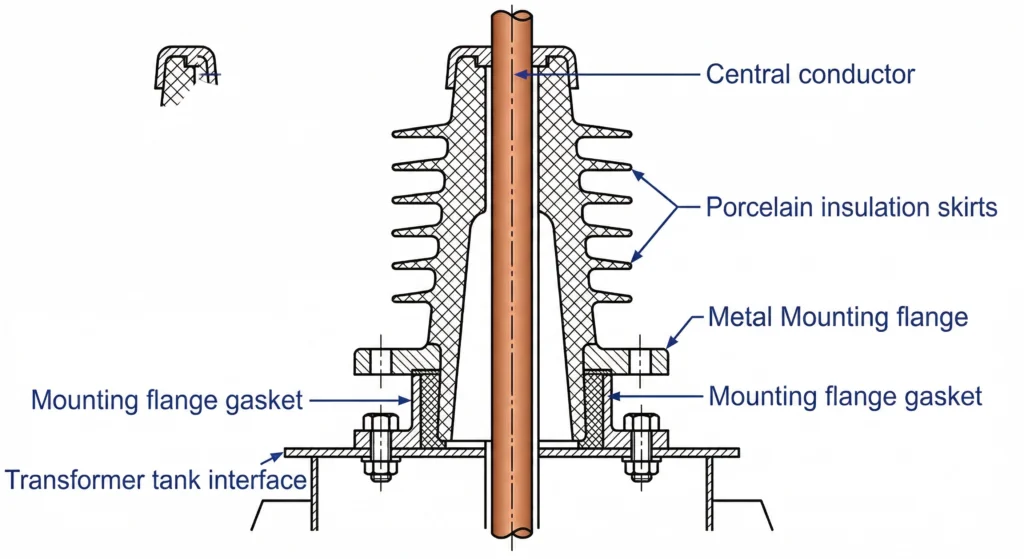
Porcelain remains the traditional backbone of transformer dielectric systems, prized for its field durability and resistance to environmental weathering. Porcelain is highly resistant to surface tracking and UV degradation, making it the default choice for outdoor installations.
FIG-02:Internal anatomy of a standard porcelain medium voltage bushing, illustrating the current-carrying rod, dielectric housing, and mounting flange.
1. ANSI Two-Piece Porcelain Bushings
Commonly specified for North American distribution networks, the two-piece design allows field crews to replace a damaged upper porcelain skirt without unsealing the main transformer tank. These are typically selected for the 15kV to 35kV voltage classes.
2. ANSI One-Piece Solid Porcelain Bushings
Utilized for hermetically sealed applications, the one-piece solid construction minimizes gasketed interfaces. Reducing potential failure points significantly lowers the risk of oil leaks, making them highly reliable for critical 15kV and 25kV nodes.
3. DIN Standard 12kV-24kV Bushings
Serving as the workhorse across European and international grids, these bushings feature the characteristic DIN clamping ring mechanism. This standardized approach simplifies procurement for 12kV to 24kV transformers.
4. DIN Standard 36kV-52kV High-Creepage Bushings
Engineered for the upper limits of the medium voltage spectrum, these bulkier bushings feature highly contoured sheds to maximize surface tracking resistance.
For high-pollution environments, these extended sheds are designed to achieve a specific creepage distance of ≥ 31 mm/kV across the 36kV to 52kV insulation barrier.
5. Specialized High-Current Porcelain Bushings (Up to 3150A)
Larger step-down units demand massive internal conductors capable of transferring up to 3150A. The porcelain housing is substantially wider to accommodate heavy copper or aluminum rods and manage thermal expansion.
These components must be selected to ensure that the interface temperature rise remains ΔT ≤ 65°C even under peak load cycles.
Epoxy Resin and Composite Bushing Types (The Next 5)
Modern distribution networks increasingly specify advanced polymer technologies. Epoxy resin and composite materials offer significant advantages in shatter resistance and dimensional precision, simplifying field installation and lowering mechanical stress on the tank flange.
6. Indoor Epoxy Resin Cast Bushings
Favored for indoor switchgear and dry-type transformers, standard epoxy resin cast bushings offer excellent mechanical strength. However, because standard epoxy formulations lack UV stability, application is strictly limited to indoor or shielded environments.
When polymer bushings are required outdoors, cycloaliphatic epoxy formulations are mandatory. Standard indoor epoxies suffer severe surface tracking in sunlight, whereas cycloaliphatic blends maintain their hydrophobicity and dielectric strength over decades.
8. Plug-in Type Epoxy Bushings (for Switchgear Interface)
Serving as the primary mating point for separable connectors, these are frequently specified with bushing well & inserts to create an insulated, touch-safe interface. As a critical insulated well component for distribution transformer applications, this provides a secure foundation for the bushing and allows field crews to quickly connect underground cables without exposing live conductors.
9. Composite Silicone Rubber Bushings
Combining a fiberglass-reinforced epoxy core with a molded silicone rubber housing, this hybrid approach offers immense mechanical cantilever strength and superior pollution performance.
Composite designs are typically 30% to 50% lighter than their porcelain equivalents, making them easier to handle while providing excellent performance in contaminated environments.
For the upper threshold of the medium voltage spectrum, bulk solid insulation cannot adequately manage electrical fields. Capacitive graded bushings incorporate finely spaced conductive foils within the solid epoxy matrix.
This internal capacitive grading evenly distributes electrical stress, ensuring the maximum radial electric field stress remains ≤ 3.0 kV/mm, preventing partial discharge inception.
[Expert Insight] Polymer Handling and Installation
Never clean a silicone composite bushing with aggressive hydrocarbon solvents; this destroys the hydrophobic surface layer and encourages tracking.
Epoxy cast bushings require strict adherence to manufacturer torque specifications on the mounting flange. Over-torquing leads to micro-cracking in the resin base.
Keep indoor epoxy bushings in original UV-shielded packaging until the day of installation to prevent premature degradation from ambient warehouse lighting.
Sizing and Selection Logic: Voltage (12kV–52kV) and Current (55A–3150A)
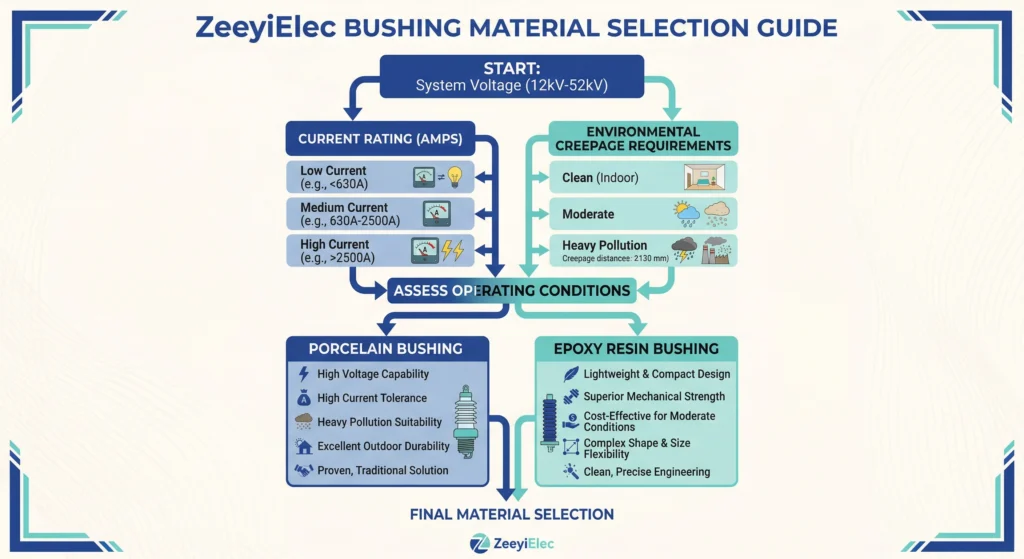
FIG-03:Systematic selection matrix for determining the correct medium voltage bushing based on system voltage, current rating, and environmental pollution levels.
Selecting the correct medium voltage bushing requires a systematic evaluation of both dielectric and thermal parameters to ensure survival against transient overvoltages and peak load cycles. The stakes for getting this right are remarkably high. Industry data indicates that 15–25% of transformer outages trace back to accessory malfunction rather than core or winding defects. Similarly, in field assessments across 150+ industrial installations, improper accessory selection accounts for approximately 35% of cable system failures within the first five years of operation.
Compounding these field failure rates, incomplete specifications account for approximately 40% of accessory mismatches and costly change orders during transformer installation projects. Underspecifying a transformer bushing directly risks catastrophic dielectric breakdown, making systematic selection logic critical.
Core Specification Parameters
Parameter Category
Standard Range / Options
Selection Driver
Voltage Class
12kV – 52kV
System nominal voltage and Basic Insulation Level (BIL) requirements.
Current Rating
55A – 3150A
Transformer maximum continuous load + 10-20% thermal safety margin.
Interface Standard
ANSI, DIN, or Epoxy/EN
Regional grid compliance and transformer tank mechanical flange design.
Dielectric Material
Porcelain, Epoxy Cast, Composite
Installation environment (indoor/outdoor) and UV exposure limits.
Creepage Distance
16 mm/kV to ≥ 31 mm/kV
Site altitude and environmental pollution severity (e.g., coastal salt fog).
Matching Voltage Class and Basic Insulation Level (BIL)
The voltage class dictates physical dimensions, but the Basic Insulation Level (BIL) is the ultimate metric of dielectric resilience. A 24kV distribution system must withstand high-energy lightning impulses without flashing over.
A standard 24kV bushing is often specified with a BIL of 125kV or 150kV. In areas with high isokeraunic levels, field engineers strictly mandate the higher 150kV BIL to prevent the ΔV stress from puncturing the solid insulation.
Calculating Current Rating and Thermal Capacity Requirements
The core selection logic requires calculating the maximum full-load current of the transformer winding and adding a safety margin—typically 10% to 20%—to accommodate temporary overload conditions.
If thermally undersized, I2R losses will generate excessive internal heat, accelerating flange gasket embrittlement. For heavy-duty step-down applications exceeding 2000A, specify components with robust thermal expansion joints.
Installation Environments and Field Conditions
Even precisely specified components fail prematurely if environmental realities are ignored. Because bushings bridge internal insulation with external connections, they are uniquely exposed to operational extremes.
Coastal and High-Pollution Areas
In coastal or heavy industrial zones, conductive pollutants mix with moisture to create localized leakage currents across the insulation interface.
Engineers must select high-creepage profiles, ensuring specific creepage is ≥ 31 mm/kV. For a nominal 35kV system, this equates to over 1085 mm of total surface distance along the sheds.
High-Altitude Installations
The dielectric strength of air decreases at higher elevations, reducing external insulation performance. Standard medium voltage components are typically rated up to 1000 meters above sea level.
For installations exceeding this threshold, the bushing’s external arcing distance must be derated by approximately 1% for every 100 meters above the 1000 m baseline.
Indoor Switchgear vs. Outdoor Substation Constraints
Outdoor substation transformers demand UV-resistant porcelain or cycloaliphatic epoxy. Indoor switchgear environments prioritize compact footprints and dead-front safety, frequently pairing specialized plug-in epoxy bushings with cold shrink cable accessories to create a reliable connection. Cold shrink cable accessories are pre-expanded silicone insulation components used for medium-voltage cable terminations and joints. Applying standard indoor epoxy outdoors is a critical engineering error.
Engineering Support and Model Selection Guidance
Selecting the optimal transformer interface requires balancing physical constraints with strict dielectric performance standards. As a specialized engineering manufacturer of cable accessories and distribution components, the ZeeyiElec technical team provides direct support to assist engineers with precise model matching and custom specifications.
To prevent the common procurement delays associated with incomplete data—which drive the 40% accessory mismatch rate during installation projects —we offer detailed technical evaluations of your distribution network projects. Whether your utility application requires standard 15kV components or heavy-duty step-down interfaces rated up to 3150A, our team helps verify that the physical profile, creepage distance, and electrical performance align perfectly with your tank design.
For drawing reviews, OEM/ODM parameter matching, or export documentation guidance, contact our technical team at https://www.zeeyielec.com/contact/.
Frequently Asked Questions
What is the typical field lifespan of a porcelain MV bushing?
Porcelain medium voltage bushings typically offer a functional service life of 25 to 40 years under standard utility operating conditions. This lifespan can be significantly reduced by severe environmental contamination, poor flange gasket maintenance, or repeated transient voltage spikes exceeding their BIL limits.
How do engineers decide between ANSI and DIN standard bushings?
The choice between ANSI and DIN standards is primarily dictated by regional grid compliance and the mechanical design of the transformer tank flange. ANSI profiles are mandatory for North American utility projects and IEEE-based grids, whereas DIN standard components are standard across European and numerous international distribution networks.
What are the most common causes of bushing failure in the field?
Industry data indicates that 15–25% of transformer outages trace back to accessory malfunction rather than core or winding defects. Field data shows bushing failures are most commonly caused by moisture ingress through degraded flange seals, lightning-induced overvoltages that puncture the solid insulation, or severe surface contamination leading to external tracking and flashovers.
Can standard epoxy bushings be installed in outdoor transformers?
No, standard indoor-rated epoxy formulations will quickly chalk and fail structurally if exposed to direct sunlight and outdoor weather. Outdoor installations strictly require cycloaliphatic epoxy resin, which is chemically formulated to resist UV degradation and surface tracking over long-term exposure.
How is the current rating determined for a distribution bushing?
Current ratings, ranging from 55A to 3150A, are determined by the maximum continuous load the central conductor can carry without exceeding the allowed temperature rise (typically ΔT ≤ 65°C) of the insulating material. Engineers generally specify a rating with a 10% to 20% safety margin above the transformer’s maximum load.
How does high altitude affect bushing performance selection?
Because the dielectric strength of air decreases at higher elevations, the bushing’s external insulation performance drops. For installations above 1000 meters, engineers must derate the external arcing distance by approximately 1% for every 100 meters, often requiring a higher voltage class bushing to maintain safe operation.
yoyo shi
Yoyo Shi writes for ZeeyiElec, focusing on medium-voltage accessories, transformer components, and cable accessory solutions. Her articles cover product applications, technical basics, and sourcing insights for global electrical industry buyers.





 English
 한국어
한국어 العربية
 Español
 हिन्दी
 தமிழ்
தமிழ் Deutsch (Sie)
 Français
 Português do Brasil
 Русский