TIEC standards for transformer accessories vary by component — a bushing, a tap changer, a fuse assembly, and a loadbreak switch are each qualified against their own standard, separate from the transformer’s own IEC 60076. This matters at procurement: a purchase order citing only the transformer standard leaves accessory-level dielectric, mechanical, and interruption requirements unspecified, which is the gap that produces mismatched test certificates later in a project.
Why one transformer standard isn’t enough
The base transformer standard sets system-level parameters: insulation levels, temperature rise limits, general construction. A distribution transformer in the 100 kVA–2500 kVA range typically operates within a winding temperature rise limit around 65 K — a figure from the general transformer standard, not any accessory document. That figure says nothing about bushing creepage distance (the shortest surface path between conductive parts across insulation), loadbreak switch operating-cycle life, or fuse interrupting current. Those sit in separate, device-specific standards, which is why accessory RFQs citing only the transformer standard routinely come back incomplete.
How this map is organized
The sections below group standards by product family — bushings, switching/protection devices, and cable accessories — so a procurement engineer can go directly to the standard relevant to the component at hand. The Transformer Accessories product line covers where these families live physically: bushings, bushing wells, fuse assemblies, switches, and tap changers, each with its own standard once base transformer requirements are satisfied.
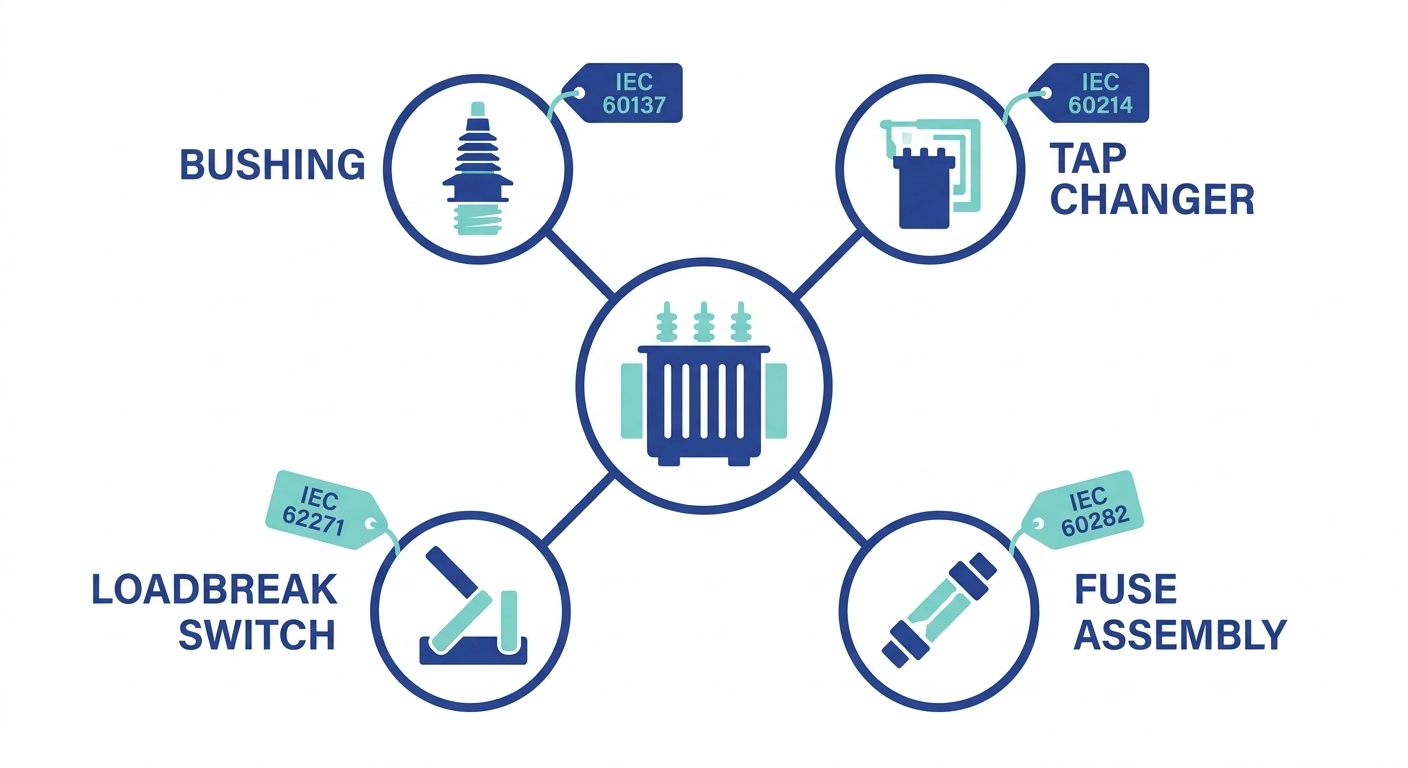
System diagram positioning the IEC 60076 transformer standard against accessory-specific standards for bushings, tap changers, switches, and fuses.
IEC 60076 as the Base Standard — Where Accessory-Specific Standards Take Over
IEC 60076 is the foundational standard for power transformers, and its scope sets the boundary past which accessory-specific standards take over — the point where an RFQ or drawing review needs a second, component-level citation.
IEC 60076 series scope
The IEC 60076 series addresses the transformer as a system: general requirements (IEC 60076-1: Power Transformers – General Requirements), temperature rise (Part 2), and insulation levels with dielectric tests (Part 3). A distribution transformer specified under this series typically carries a Basic Impulse Level (BIL) in the 95 kVp–170 kVp range for 15 kV–25 kV class equipment, and that figure becomes the reference point accessory standards must then match.
Where the handoff point sits
IEC 60076 defines what the transformer as a whole must withstand — it doesn’t specify bushing torque, tap changer contact cycles, or fuse interrupting time. Once a system parameter like BIL is set under 60076, the accessory standard takes it as an input and applies its own test regime. A bushing matched to a 125 kVp BIL system, for example, is qualified against the bushing standard’s own impulse withstand test, not re-tested under 60076.
[Expert Insight]
A drawing package citing only the transformer standard for a bushing line item is the most common trigger for a supplier clarification cycle before manufacturing starts.
Ask suppliers to state both the system BIL source and the component’s own qualification standard on one datasheet.
Treat the transformer standard as an input value, not the qualifying document, for any accessory.
Bushing Standards — IEC 60137 and Related Clauses
IEC 60137 is the standard most commonly cited for high-voltage bushings, governing dielectric, thermal, and mechanical qualification as a standalone component, separate from the transformer it mounts on.
IEC 60137: scope and what it governs
IEC 60137 specifies the bushing’s minimum nominal creepage distance as a baseline component requirement. The pollution-severity classification that determines how much that baseline must be increased for a given site — coastal, industrial, or heavy contamination environments — is defined separately in the IEC 60815 series, which bushing specifications reference alongside IEC 60137 rather than duplicate.
Type test vs routine test
Type tests (dielectric withstand, temperature rise, mechanical strength) are performed once per design; routine tests (power-frequency withstand, dimensional checks) run on every production unit before shipment. A type test certificate confirms the design family is sound — it doesn’t substitute for the routine test report on the specific batch shipping against a purchase order.
Where LV bushing practice diverges
Low-voltage bushings, rated below 1 kV and commonly serving 600 A–5000 A secondary-side current, fall largely outside IEC 60137’s scope, since that standard addresses dielectric stress management that only becomes significant above 1 kV. LV bushing qualification instead draws on low-voltage and thermal performance references, reflecting that LV bushing failures in the field are driven mainly by sustained I²R heating at the terminal interface rather than impulse dielectric events.
Heat at a bolted LV bushing terminal follows I²R heating, where current density Δ across the contact interface — not applied voltage — drives long-term thermal performance.
Switching and Protection Device Standards — Tap Changers, Loadbreak Switches, Fuses
Three switching and protection device families sit on a distribution transformer, each qualified against its own IEC standard rather than a shared document.
IEC 60214: off-circuit tap changers
IEC 60214 covers tap changers, split into off-circuit (de-energized) and on-load types, with off-circuit the relevant variant for most distribution transformers. It specifies mechanical endurance testing — commonly several thousand no-load operating cycles — plus dielectric withstand for the tap selector. A typical off-circuit tap changer for 15 kV–35 kV class equipment carries a 63 A–125 A current rating.
IEC 62271 series: loadbreak switches
Loadbreak switches on pad-mounted or oil-immersed transformers are typically referenced against IEC 62271-103, the part of the IEC 62271 series covering alternating current switches and switch-disconnectors for their switching function, applicable to voltages above 1 kV up to 52 kV for both indoor and outdoor installations. This governs making/breaking capacity, mechanical endurance, and dielectric withstand for the switch itself. Where a switch is integrated into a fuse-switch combination rather than functioning as a standalone switching device, IEC 62271-105 applies instead — a distinction worth confirming on the RFQ, since a switch procured as a standalone device and one procured as part of a fuse-combination assembly are qualified under different parts of the same series.
IEC 60282: high-voltage fuses
IEC 60282 addresses expulsion-type fuses (such as Bay-O-Net assemblies) and current-limiting fuses in separate parts, since the two clear faults through different mechanisms. A current-limiting fuse for distribution-class service is typically tested across a fault current range extending well beyond 20,000 A, verifying interruption within a fraction of a cycle before peak let-through energy becomes damaging. Coordination between an expulsion fuse and a backup current-limiting fuse depends on both being qualified under their respective parts of the same standard — a mismatched part-number citation on either is a recurring source of coordination review delays.
[Expert Insight]
Fuse coordination reviews stall most often when the expulsion fuse and backup current-limiting fuse cite different IEC 60282 parts without a cross-reference note.
A switch’s mechanical endurance rating and a tap changer’s cycle rating aren’t interchangeable — check each device’s governing standard separately.
For ratings near the top of a device’s class, confirm the cited standard’s test sequence actually covers that rating.
Reference table linking three switching and protection device families to their governing IEC standard and primary test focus.
Cable and transformer accessories are governed by separate standard families for most of their scope, but at the bushing well interface, both apply simultaneously.
Standards for cold shrink and heat shrink terminations
Cable termination and joint kits for medium-voltage cable, typically 8.7/15 kV to 26/35 kV class, are qualified against IEC 60502-4, which specifies type-test requirements for accessories on cables in this voltage range, with detailed test methods referenced in IEC 61442. Partial discharge (PD — localized electrical discharge that doesn’t fully bridge the insulation, a leading indicator of insulation degradation) is typically verified at 2×U₀ (twice the cable’s phase-to-earth rated voltage) rather than at rated voltage alone. A heat shrink termination in this voltage range is typically tested to a PD limit held below 5–10 pC at the specified test voltage.
Where the standards overlap
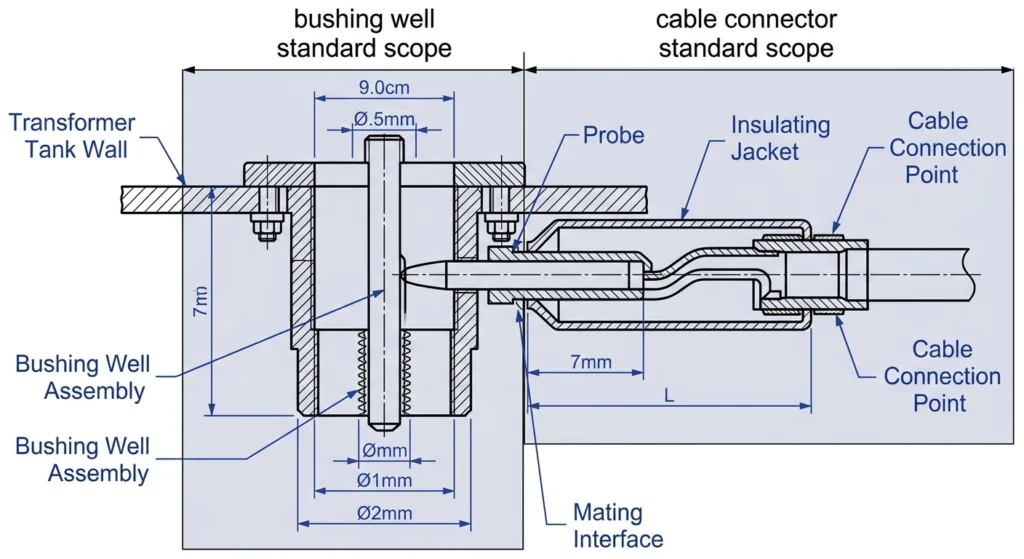
A bushing well on the transformer tank wall receives a separable cable connector — a loadbreak or deadbreak elbow — governed by cable accessory interface standards, while the well itself is a transformer accessory under bushing-adjacent requirements. A 200 A loadbreak elbow terminating into a 15 kV–35 kV class bushing well must satisfy both the cable connector’s interface geometry standard and the well’s own insulation and creepage requirements — the interface where citation gaps most often produce a physical mismatch discovered on site rather than at drawing review.
Cross-section of a bushing well interface where transformer accessory and cable accessory standard scopes overlap simultaneously
Where Standard Citation Gaps Actually Surface in the Field
A missing or mismatched standard citation rarely stops a project at RFQ stage — it surfaces later, at factory acceptance testing or the customs desk, once correcting it costs more.
Factory acceptance testing
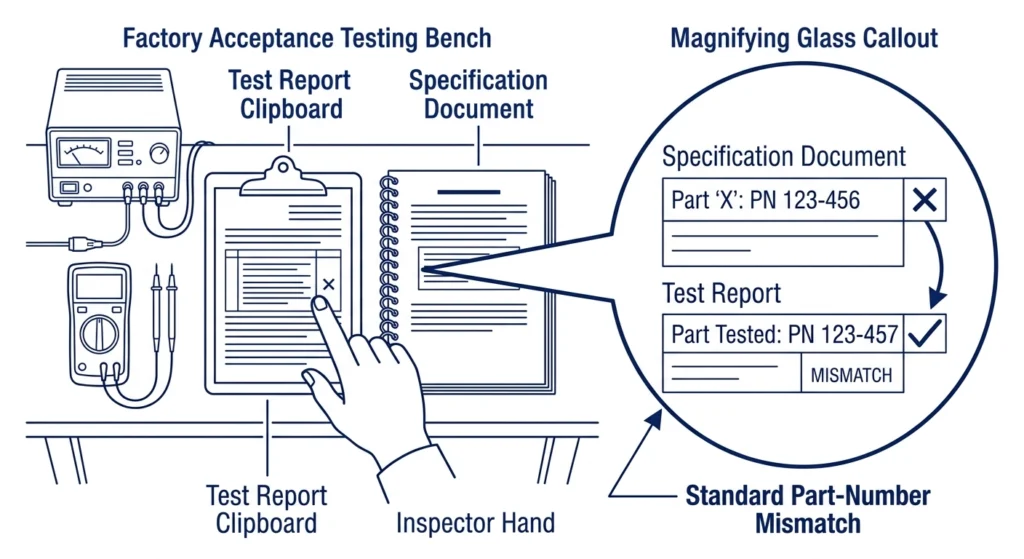
A common pattern: a purchase order cites a general standard without a part number, the supplier tests against their own default interpretation, and the FAT witness finds the test report cites a different edition than expected. Even when dielectric performance is sound — a 25 kV class bushing tested to 125 kVp BIL — the FAT can stall if the report’s citation doesn’t match the specification, since the acceptance criteria being verified aren’t technically the ones required. This is a documentation mismatch, not necessarily a product defect, but it holds up sign-off the same way a real nonconformance would.
Export documentation
The same gap reappears in export paperwork. A commercial invoice or technical certificate with inconsistent standard citations across fuse, bushing, and switch line items can trigger a customs technical review, adding days to a couple of weeks depending on the port. The fastest prevention is confirming every accessory-specific citation on the export certificate matches, part-for-part, the standard on the original purchase order.
Factory acceptance testing scene showing an inspector cross-checking a test report’s standard citation against the purchase specification.
Getting Standard Citations Right at RFQ Stage
Stating the exact standard part number — not just the standard family — against each accessory line item is the single most effective step in avoiding a FAT rejection or customs hold later.
What to state in an RFQ
Each accessory line item should carry its own citation: bushing standard and BIL, fuse standard and interrupting class, switch standard and endurance rating, tap changer standard and current rating. Where the exact part number is uncertain, “per applicable IEC standard, part to be confirmed by supplier” is preferable to omitting the reference entirely.
What IEC standard applies to transformer bushings?
Transformer bushings are primarily governed by the IEC 60137 series, covering dielectric, thermal, and mechanical requirements across voltage classes; the exact part depends on whether the bushing is oil-immersed, dry-type, or a specific insulation material, so citing the specific part number matters more than the standard family alone.
Is IEC 60076 enough to specify a transformer accessory?
No — IEC 60076 covers the transformer itself, including insulation and temperature rise, while bushings, tap changers, fuses, and switches each fall under their own accessory-specific standard, so citing only IEC 60076 typically leaves critical accessory parameters unspecified.
What standard governs off-circuit tap changers?
Off-circuit (de-energized) tap changers are commonly referenced against the IEC 60214 series, addressing mechanical and electrical performance, though the applicable part can vary depending on whether the device is on-load or off-load rated.
Which IEC standard covers loadbreak switches on distribution transformers?
Loadbreak switches are typically referenced against parts of the IEC 62271 switchgear series, with the specific part depending on voltage class and whether the switch is oil-immersed or gas-insulated.
Do cable accessories and transformer bushings share the same standards?
Not directly — cable accessories and transformer bushings are governed by separate standard families, but at interface points like bushing wells, both sets of requirements can apply simultaneously, so procurement documents for that interface often need to cite both.
Why does a factory acceptance test sometimes reject a component with a valid test certificate?
This usually happens when the certificate references a different standard part or edition than the purchase order specified, even if the underlying test data is technically sound, which is why matching the exact citation at RFQ stage matters as much as the test result.
How many days can a customs hold add if standard citations are inconsistent?
An inconsistent or incomplete standard citation across a shipment’s certificates can add anywhere from a few days to a couple of weeks to clearance, depending on the port and the reviewing authority’s familiarity with the cited standard family.
yoyo shi
Yoyo Shi writes for ZeeyiElec, focusing on medium-voltage accessories, transformer components, and cable accessory solutions. Her articles cover product applications, technical basics, and sourcing insights for global electrical industry buyers.






 English
 한국어
한국어 العربية
 Español
 हिन्दी
 தமிழ்
தமிழ் Deutsch (Sie)
 Français
 Português do Brasil
 Русский