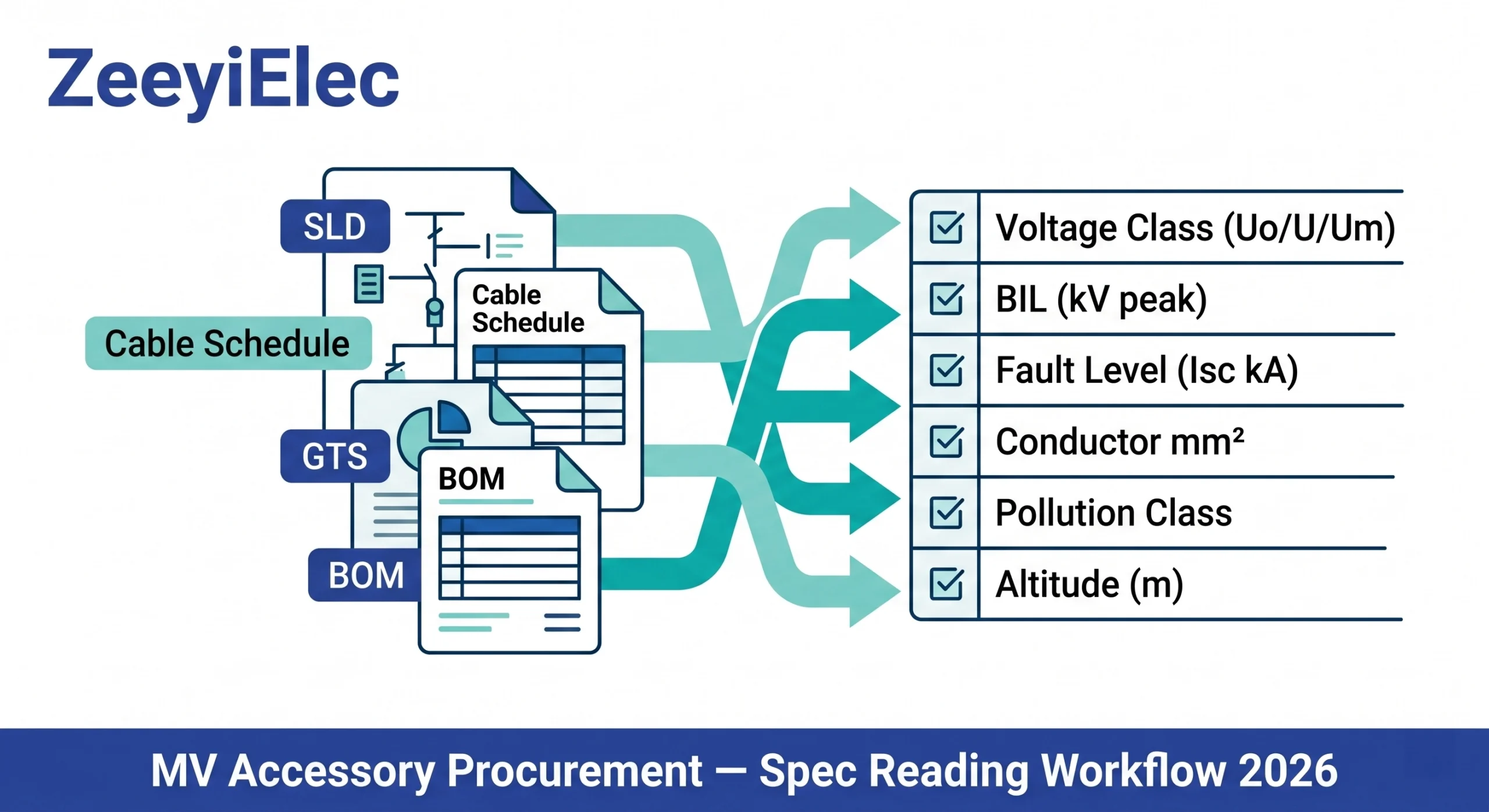
Pour lire correctement les spécifications d'un projet d'accessoire moyenne tension, il faut extraire six groupes de paramètres - classe de tension, niveau de défaut, dimensions du conducteur, conditions environnementales, BIL et conformité aux normes - de quatre couches de documents distinctes avant de lancer un appel d'offres. L'omission d'un seul de ces groupes entraîne l'échec de l'acceptation des accessoires sur le site, quelle que soit la qualité de fabrication.
Les équipes chargées des achats ont l'habitude de traiter le cahier des charges d'un projet comme un filtre de produit, un document qui limite le choix de l'article du catalogue à commander. Ce cadrage est la première erreur. Une spécification de projet est un document système : elle codifie simultanément l'architecture de tension, le comportement en cas de défaillance, l'exposition à l'environnement et les contraintes d'installation. Les données de terrain montrent régulièrement que 30-40% des rejets de sites sont dus à des spécifications incomplètes ou mal interprétées plutôt qu'à des défauts de fabrication.
La chaîne de défaillance de l'écart de spécification
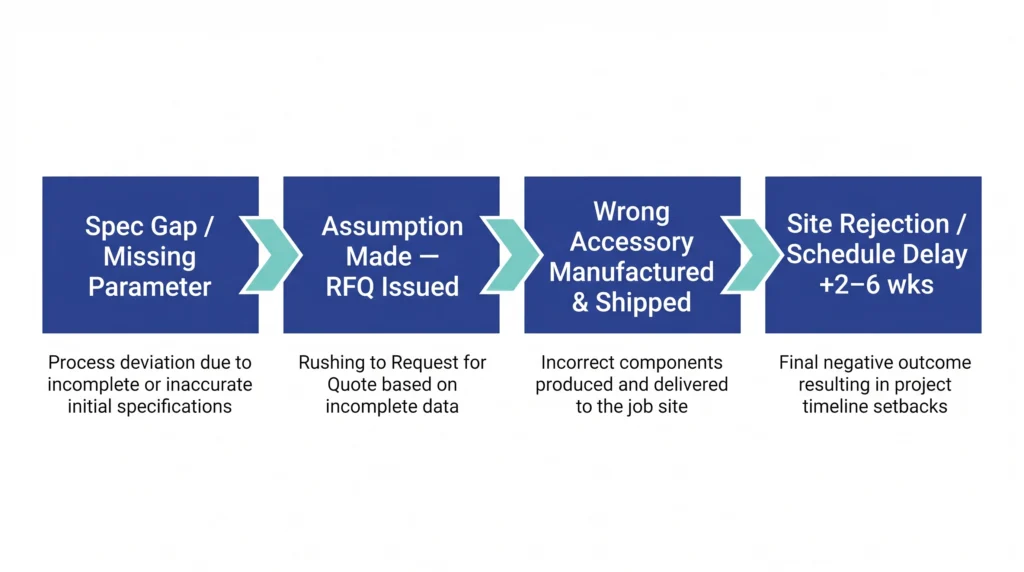
Le modèle de défaillance suit une séquence prévisible. Un paramètre des spécifications est ambigu ou manquant. L'équipe chargée des achats émet une hypothèse raisonnable. L'accessoire est fabriqué et expédié. Au cours des essais de réception en usine ou, pire, après l'installation sur site, l'inadéquation fait surface. À ce stade, le cycle de remplacement ajoute 2 à 6 semaines au calendrier du projet, en fonction du délai de livraison de l'article corrigé.
Un cas récurrent sur le terrain : un kit de terminaison rétractable à froid de 15 kV spécifié pour un conducteur de 95 mm² arrive sur le site pour un câble de 150 mm². Tous deux se situent dans la plage de tension “10-35 kV” indiquée dans la spécification technique générale, mais la tolérance du diamètre intérieur de la gaine thermorétractable est dimensionnée pour une géométrie de 95 mm². L'accessoire ne peut pas être installé correctement. La section du conducteur était indiquée dans l'annexe de la nomenclature des câbles, une section que de nombreux ingénieurs d'approvisionnement n'ouvrent jamais.
La chaîne de défaillance de l'écart de spécification : un paramètre manquant ou mal interprété se propage à travers l'hypothèse, la fabrication et l'expédition avant de faire surface sous la forme d'un rejet de site qui ajoute 2 à 6 semaines au calendrier du projet.
Anatomie d'un dossier de spécification de projet pour les accessoires MV
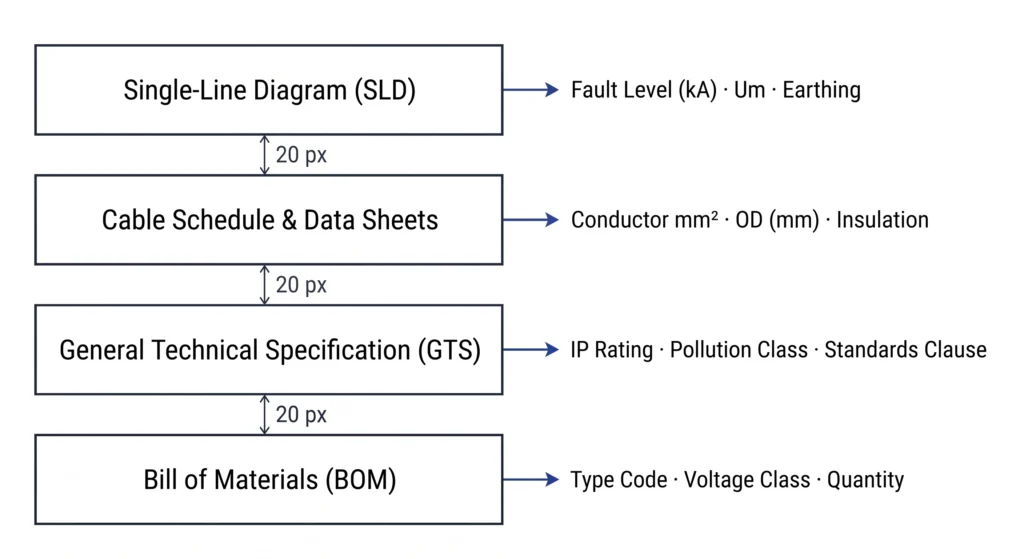
Aucun document ne contient à lui seul tous les paramètres nécessaires à l'acquisition correcte des accessoires MV. La spécification est répartie entre au moins quatre types de documents, chacun contenant des informations que les autres ne reproduisent pas. Les ingénieurs qui ne lisent que la spécification technique générale - la couche la plus souvent consultée - passent régulièrement à côté des données dimensionnelles, des niveaux de défaillance et des paramètres environnementaux qui se trouvent dans d'autres documents.
Diagrammes à ligne unique (SLD)
Le SLD est la principale source de paramètres électriques au niveau du système. Extraire : la tension du système (Um nominale et maximale), la configuration de la mise à la terre du neutre (mise à la terre solide, mise à la terre par résistance ou neutre isolé) et le niveau de défaut potentiel au point d'alimentation, généralement exprimé en kA symétriques. Pour les applications de transformateurs de distribution, les niveaux de défaut au niveau du bus MT sont généralement compris entre 5 kA et 31,5 kA, une fourchette qui détermine directement la sélection du calibre d'interruption des fusibles.
Schémas de câblage et fiches techniques
La nomenclature des câbles contient des paramètres dimensionnels et matériels qui déterminent la compatibilité physique. Extraire la section du conducteur (mm²), le matériau d'isolation (XLPE ou EPR), la construction de l'écran d'isolation et le diamètre extérieur nominal avec la bande de tolérance. Les kits de terminaisons rétractables à froid et à chaud sont dimensionnés pour des gammes spécifiques de conducteurs et de diamètres totaux. Un kit conçu pour des conducteurs de 95-240 mm² ne s'installera pas correctement sur un câble de 300 mm², même si la classe de tension correspond.
Spécifications techniques générales (STG)
Les STG définissent le cadre des normes contractuelles : quelle publication de la CEI régit les essais d'acceptation, quelle classe de température s'applique et de quelle catégorie environnementale relève l'installation. Pour les terminaisons de câbles MT en extérieur, le STG spécifie généralement l'indice IP, généralement IP65 pour les installations extérieures étanches, et les exigences en matière de résistance aux UV.
Nomenclature et liste des équipements
La nomenclature fournit les codes de type, les quantités et parfois les numéros de référence du fabricant. Recouper les désignations des classes de tension de la nomenclature avec le DLV. Les divergences entre ces deux documents sont plus fréquentes que prévu dans les projets où la nomenclature a été créée au début et où le DLV a été révisé plus tard.
Un dossier de spécification de projet pour l'acquisition d'accessoires MV comprend quatre couches de documents distinctes, chacune contenant des groupes de paramètres qui ne se chevauchent pas et qui sont essentiels pour la vérification de la compatibilité des accessoires.
[Expert Insight] - Ce que les ingénieurs en approvisionnement expérimentés vérifient en premier lieu
Recouper la classe de tension de la nomenclature avec la date de révision actuelle du SLD. Les incohérences sont les plus fréquentes lorsque le SLD a été mis à jour après l'émission de la nomenclature.
Les tolérances du diamètre extérieur des câbles sont rarement vérifiées au stade de l'appel d'offres ; elles déterminent l'adaptation de la rétraction à froid de manière plus fiable que la seule classe de tension.
Lorsque les STG font référence à une étude environnementale plutôt que d'indiquer directement une classe de pollution, il convient de traiter cette référence comme une demande de document obligatoire avant d'émettre un poste de l'appel d'offres.
Un dossier de spécifications sans étude du niveau de défaillance est incomplet. Il s'agit d'une demande formelle de clarification et non d'une supposition.
Décodage de la classe de tension et des paramètres d'isolation
La classe de tension est le paramètre qui apparaît le plus souvent dans les documents d'achat d'accessoires MT et qui est le plus souvent mal interprété. La confusion provient de la notation : les dossiers techniques, les normes CEI et les catalogues d'accessoires utilisent chacun des expressions de tension différentes pour ce qui est en principe le même système. Les réconcilier avant de lancer un appel d'offres permet d'éviter la catégorie d'incompatibilité d'accessoires la plus courante.
Notation Uo/U/Um et ce que chaque valeur contrôle
La désignation de la tension CEI suit un format à trois valeurs : Uo/U(Um). Uo est la tension nominale à fréquence industrielle entre le conducteur et la terre - la valeur qui contrôle l'épaisseur de l'isolation et l'exigence de résistance phase-terre. U est la tension nominale entre les conducteurs. Um est la tension maximale du système, définissant la limite supérieure de fonctionnement continu que l'accessoire doit supporter sans dégradation.
Les désignations réalistes des réseaux de distribution suivent des étapes standard. Les valeurs courantes dans la fourniture d'accessoires MT sont les suivantes : 6/10(12) kV, 8,7/15(17,5) kV, 18/30(36) kV et 26/35(40,5) kV. Un kit de terminaison spécifié pour Um = 17,5 kV n'est pas interchangeable avec un appareil classé Um = 12 kV, même si tous deux sont vaguement décrits comme “moyenne tension” dans le langage non technique des marchés publics.
Référence de l'autorité : IEC 60071-1 régit les principes de coordination de l'isolation et définit la relation entre Um et les niveaux de résistance requis pour la sélection de l'équipement.
Vérification croisée de la BIL avec le catalogue des accessoires
Le niveau d'isolation aux impulsions de base (BIL) est exprimé en kV de crête et représente la tension d'impulsion à laquelle l'accessoire doit résister sans embrasement ni perforation. Les dossiers techniques des projets indiquent un BIL requis ; les catalogues d'accessoires indiquent une tension nominale de résistance aux impulsions. Ces deux valeurs doivent correspondre ou la valeur du catalogue doit être supérieure à l'exigence de la spécification.
Pour un système de classe 15 kV (Um = 17,5 kV), la BIL standard est généralement comprise entre 95 et 110 kV en crête. Pour un système de classe 35 kV (Um = 40,5 kV), la BIL atteint couramment 170-200 kV en crête. La spécification d'un kit de terminaison avec une BIL de 95 kV sur un système nécessitant 110 kV crée un risque de défaillance latente qui peut ne pas apparaître jusqu'au prochain événement de foudre ou transitoire de commutation.
Les équipes d'approvisionnement qui travaillent à partir d'anciennes nomenclatures reportent parfois une entrée BIL de 95 kV dans un projet où l'étude de coordination de l'isolation mise à jour spécifie 110 kV. La vérification de la BIL par rapport au document de coordination de la protection actuelle, et non par rapport à la seule nomenclature, permet de détecter ce problème avant la fabrication.
Classe de tension Référence d'alignement
Classe de tension du système
Um (kV)
BIL typique (kV crête)
Vérification du catalogue des accessoires
Classe 10 kV
12
75-95
Confirmer l'impulsion nominale ≥ 95 kV
Classe 15 kV
17.5
95-110
Confirmer l'impulsion nominale ≥ 110 kV
Classe 30 kV
36
150-170
Confirmer l'impulsion nominale ≥ 170 kV
Classe 35 kV
40.5
170-200
Confirmer l'impulsion nominale ≥ 200 kV
La référence croisée de ce tableau avec la tension d'impulsion nominale du projet GTS et du catalogue d'accessoires permet d'éliminer l'erreur de classe de tension la plus fréquente dans les cas suivants accessoire de câble moyenne tension l'approvisionnement. Pour les accessoires côté transformateur, y compris les douilles et les assemblages de fusibles, la même logique Um et BIL s'applique. guide de sélection des accessoires pour transformateurs pour la cartographie de la classe de tension spécifique à la bague.
Lecture des paramètres de protection et de défaut pour les accessoires de transformateurs
La classe de tension détermine si un accessoire peut fonctionner dans le système. Les paramètres de défaut déterminent s'il peut protéger le transformateur en cas de problème. Les deux groupes de paramètres sont obligatoires ; aucun ne se substitue à l'autre.
Niveau de défaut (Isc) - Le paramètre le plus mal interprété
Le courant de défaut potentiel, abrégé Isc, est indiqué en kA symétriques sur le SLD, généralement au niveau de la barre omnibus MT. Pour les applications de transformateurs de distribution, les valeurs réalistes vont de 5 kA à l'extrémité d'une longue ligne rurale à 31,5 kA au niveau d'un bus de sous-station directement alimenté par un grand transformateur de réseau. Un fusible limiteur de courant (CLF) calibré pour 20 kA symétriques installé sur un bus avec un courant de défaut potentiel de 31,5 kA n'éliminera pas le défaut en toute sécurité.
L'erreur de lecture se produit lorsque les équipes d'approvisionnement confondent le courant de défaut prospectif avec le courant de passage après le fonctionnement de la CLF. La sélection des accessoires doit faire référence à la valeur prospective, c'est-à-dire à la condition la plus défavorable à laquelle le fusible doit survivre et s'interrompre.
Valeur nominale en kVA du transformateur et courant primaire pour le dimensionnement des fusibles
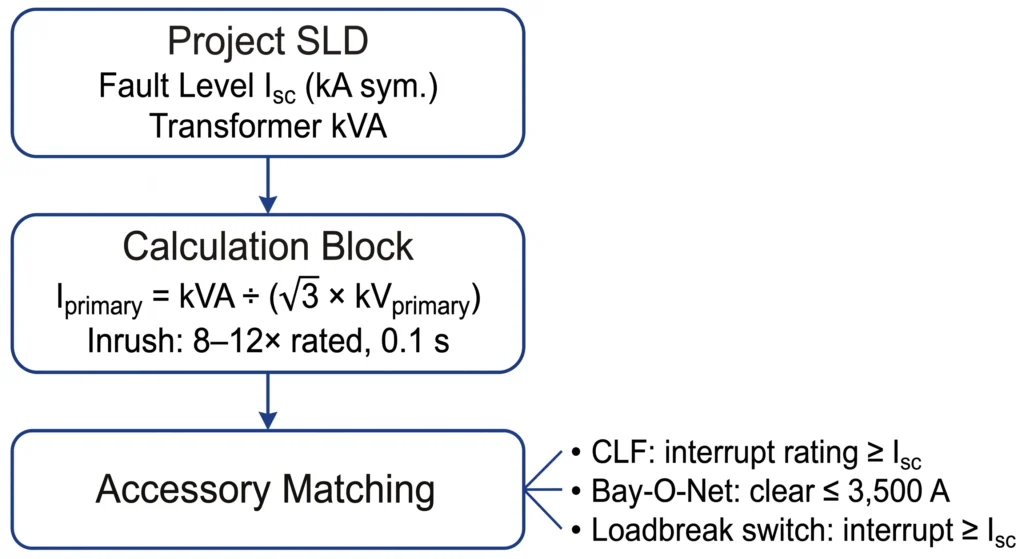
La sélection des fusibles commence par la détermination du courant primaire nominal à partir de la valeur nominale du kVA et de la tension primaire : Iprimaire = kVA ÷ (√3 × kV)primaire) pour les transformateurs triphasés. Un transformateur triphasé de 500 kVA sur un primaire de 15 kV produit environ 19,3 A de courant primaire nominal. Une unité de 1 000 kVA sur la même tension produit environ 38,5 A. Les fusibles limiteurs de courant doivent être dimensionnés pour transporter le courant nominal en continu tout en restant sélectifs contre les appels de courant typiquement 8-12× le courant nominal pour des durées allant jusqu'à 0,1 seconde lors de la mise sous tension du transformateur.
Lorsque le multiplicateur d'appel de courant ne figure pas dans le document de passation de marché, la pratique technique considère que 10× le courant nominal à 0,1 s est un point de départ prudent pour la coordination du temps de fusion minimal de la CLF. Le rapport d'essai du transformateur doit confirmer le profil d'appel de puissance réel avant de finaliser la sélection des fusibles pour la protection contre les incendies. protection des transformateurs de distribution.
Service d'interruption de l'interrupteur en fonction du niveau de défaillance
Les interrupteurs à coupure de charge ont deux valeurs nominales distinctes qui doivent chacune être vérifiées : la valeur nominale du courant de charge continu et la capacité d'interruption en cas de défaut. Un interrupteur dont le courant continu est de 630 A et la capacité d'interruption de défaut de 10 kA n'est correctement utilisé que si le courant de défaut potentiel ne dépasse pas 10 kA. Si le dossier technique indique 12,5 kA, l'interrupteur est sous-dimensionné pour les défauts, quelle que soit sa marge de courant de charge.
Les dossiers techniques indiquent parfois les puissances de coupure des appareillages de commutation en MVA plutôt qu'en kA. Convertir en utilisant : Isc (kA) = MVAfaute ÷ (√3 × kVsystème). Pour un niveau de défaut de 250 MVA sur un système de 15 kV : Isc = 250 ÷ (1,732 × 15) ≈ 9,6 kA symétrique. Toujours convertir en kA avant de comparer avec les valeurs nominales d'interruption des accessoires.
Pour les assemblages de fusibles Bay-O-Net utilisés en coordination avec les CLF, le dossier technique doit également indiquer le courant de défaut maximal que l'élément Bay-O-Net est censé éliminer, généralement en dessous de 3 500 A, les niveaux de défaut plus élevés étant gérés par la CLF de secours. Les Série d'assemblage de fusibles Bay-O-Net page couvre en détail les paramètres de coordination des interruptions.
L'extraction des paramètres de défaut suit une chaîne de dépendance en trois étapes : le niveau de défaut prospectif et la kVA du transformateur sont extraits du SLD, convertis en courant primaire et en enveloppe d'appel, puis mis en correspondance avec la capacité d'interruption du CLF, la capacité d'effacement du Bay-O-Net et le service de défaut de l'interrupteur de coupure de charge.
[Expert Insight] - Vérifications des paramètres de défaillance qui empêchent le rejet du site
Il faut toujours vérifier si le niveau de défaut indiqué dans le dossier technique se situe au niveau du bus HT ou au niveau du secondaire du transformateur ; ces niveaux diffèrent considérablement et une référence erronée produit un fusible sous-dimensionné.
Le multiplicateur d'appel est rarement indiqué explicitement dans les spécifications des transformateurs de distribution ; 10× à 0,1 s est une hypothèse de travail prudente, mais il faut demander le rapport d'essai de l'usine du transformateur pour les unités de plus de 1 000 kVA.
La coordination Bay-O-Net et CLF exige que les deux dispositifs soient spécifiés ensemble - l'acquisition de l'un sans confirmation de la limite d'interruption de l'autre crée une lacune en matière de protection.
Lecture des conditions d'environnement et d'installation
Les paramètres électriques déterminent si un accessoire est compatible avec le système. Les paramètres environnementaux déterminent s'il survivra au site. Un kit de terminaison dont la classe de tension et le BIL sont corrects tombera en panne prématurément si sa ligne de fuite est sous-dimensionnée par rapport au niveau de pollution, ou si sa rigidité diélectrique n'est pas déclassée pour une installation en haute altitude. Ces conditions apparaissent dans les dossiers techniques, souvent dans des annexes que les équipes chargées de la passation des marchés considèrent comme des lectures de fond plutôt que comme des objectifs d'extraction obligatoires.
Déclassement d'altitude
La plupart des accessoires MT font l'objet d'essais de type à des altitudes allant jusqu'à 1 000 m au-dessus du niveau de la mer. Les sites situés au-dessus de ce seuil nécessitent soit une confirmation explicite du fabricant que l'accessoire est conçu pour l'altitude d'installation, soit la sélection d'un accessoire avec un BIL plus élevé que ne l'exige l'étude de coordination de l'isolation de base.
Une correction couramment appliquée réduit la capacité de tenue diélectrique d'environ 1% par 100 m au-dessus de 1 000 m. Un site à 2 000 m comporte un déclassement diélectrique de 10% par rapport aux conditions d'essai de type au niveau de la mer. Un kit de terminaison avec un BIL nominal de 110 kV crête au niveau de la mer fonctionne à une tenue équivalente d'environ 99 kV crête à 2 000 m en dessous de l'exigence de 110 kV si aucun rehaussement n'est appliqué.
Un projet de sous-station à 1 800 m d'altitude spécifiait des terminaisons rétractables à froid de 15 kV utilisant des valeurs BIL standard au niveau de la mer. La clause relative à l'altitude figurait dans l'annexe C du SGT et n'a pas été examinée lors de la préparation de l'appel d'offres. Les accessoires sont arrivés avec un BIL de 110 kV ; des kits de remplacement avec une valeur d'altitude confirmée par le fabricant ont été obtenus avant la mise sous tension, ce qui a ajouté trois semaines au calendrier. La clause était présente ; elle n'a pas été lue.
Degré de pollution et distance de fuite
Extraire la classe de pollution de la section environnementale du SMT, et non du SLD. Les SLD contiennent rarement des données sur la pollution. Lorsque le SGT fait référence à une étude environnementale du site plutôt que d'indiquer une classe directement, demandez le document d'étude avant de lancer l'appel d'offres.
Les niveaux de gravité de la pollution selon la CEI correspondent à des lignes de fuite spécifiques minimales : la pollution lumineuse (classe I/II) nécessite environ 16 à 20 mm par kV d'Um; la pollution moyenne (classe III) requiert 25 mm/kV ; la pollution industrielle lourde ou côtière (classe IV) requiert 31 mm/kV ou plus. Pour un accessoire de classe 35 kV (Um = 40,5 kV) dans un environnement de classe IV, la ligne de fuite minimale atteint 40,5 × 31 ≈ 1 255 mm, une exigence qui élimine les articles du catalogue standard et nécessite une confirmation explicite de la part du fournisseur.
Désignation et indice de protection IP pour l'intérieur et l'extérieur
Les terminaisons rétractables à froid pour l'extérieur nécessitent des formulations de silicone résistantes aux UV et une géométrie résistante aux intempéries. Les terminaisons thermorétractables pour l'extérieur nécessitent des couches d'étanchéité en mastic revêtues d'adhésif au point d'entrée du câble. L'indice de protection IP, généralement IP54 pour les environnements extérieurs abrités et IP65 pour les environnements exposés, confirme la norme d'étanchéité à laquelle l'accessoire doit satisfaire. Pour le choix de la technologie dans les environnements extérieurs, le série d'accessoires pour câbles rétractables à froid couvre les paramètres de résistance aux UV et de plage de température d'installation qui interagissent directement avec la classification environnementale du site.
Le processus de lecture des spécifications des accessoires MV - étape par étape
Les données nécessaires à l'acquisition d'accessoires MV sont réparties entre plusieurs documents, rédigées selon différentes conventions de notation et parfois contredites entre les révisions des documents. La séquence suivante en six étapes permet d'extraire les paramètres par ordre de dépendance, chaque étape produisant des résultats qui informent la suivante.
Étape 1 - Localiser la désignation de la tension principale
Ouvrez d'abord le SLD. Identifier la tension du système au format Uo/U(Um). Si le SLD n'indique qu'une tension nominale, faites un renvoi au GTS pour confirmer Um. Enregistrez les trois valeurs et signalez toute divergence entre l'étiquette de tension de l'EDL et les révisions de la classe de tension du SGT, en mettant fréquemment à jour l'une sans l'autre.
Étape 2 - Extraire le niveau de défaut et la méthode de mise à la terre
À partir du programme de protection SLD ou de l'étude de niveau de défaut annexée, enregistrez l'Isc prospectif en kA symétrique et la méthode de mise à la terre du neutre. Ces deux valeurs combinées déterminent la classe d'isolation requise pour les accessoires côté transformateur et le seuil d'interruption pour la sélection des fusibles et des interrupteurs. Si le niveau de défaut est indiqué en MVA, convertir en kA avant de poursuivre.
Étape 3 - Extraction des données du plan de câblage
Extraire la section du conducteur (mm²), le matériau d'isolation, le type de construction de l'écran et le diamètre extérieur nominal avec tolérance. Comparez-les au tableau de compatibilité dimensionnelle du fabricant d'accessoires et non au seul tableau des classes de tension. Un câble XLPE de 150 mm² et un câble EPR de 150 mm² de la même classe de tension peuvent nécessiter des kits de terminaison différents en raison de différences de diamètre extérieur de l'isolant de 2 à 4 mm.
Étape 4 - Cartographier les conditions environnementales
À partir de la section environnementale du SGT et de toute fiche technique de site annexée, enregistrer : l'altitude du site en mètres, la classe de pollution, la désignation intérieur/extérieur et l'indice de protection IP. Appliquer la logique de déclassement de l'altitude si l'élévation du site dépasse 1 000 m. Signaler les désignations de pollution de classe IV ou côtière pour la confirmation de la distance de fuite étendue.
Étape 5 - Vérification croisée du BIL et de la ligne de fuite par rapport au catalogue des accessoires
Après avoir calculé Um, l'exigence BIL et la ligne de fuite, vérifiez simultanément les trois valeurs par rapport au catalogue : la tension nominale de tenue aux chocs respecte ou dépasse la BIL spécifiée ; Um nominale respecte ou dépasse Um du système ; la ligne de fuite spécifique respecte ou dépasse l'exigence relative à la classe de pollution. Les trois valeurs doivent être satisfaites. Une conformité partielle est une non-conformité pour les accessoires MT ayant fait l'objet d'un essai de type.
Étape 6 - Signaler les lacunes et soulever les points à clarifier dans le cadre de l'appel d'offres
Tout paramètre qui ne peut être confirmé à partir des documents disponibles devient un point de clarification obligatoire avant l'émission de l'appel d'offres. Lacunes courantes : niveau de défaut non indiqué sur le SLD, altitude non spécifiée dans le GTS, diamètre extérieur du câble indiqué sans tolérance, BIL non mis à jour après la révision de l'étude de coordination de l'isolation. Documentez chaque lacune de manière explicite dans la note de couverture de l'appel d'offres.
Pour une référence de paramètre consolidée alignée sur ce flux de travail, le fichier Aide-mémoire sur les spécifications CEI pour l'achat d'accessoires couvre les groupes de paramètres des accessoires de câbles et de transformateurs dans un format prêt à l'emploi.
Les erreurs les plus courantes en matière de lecture de spécifications et les moyens de les éviter
Les erreurs de lecture des spécifications suivent des schémas reconnaissables. Les cinq mêmes erreurs se retrouvent dans tous les projets, quels que soient leur ampleur, leur situation géographique et le niveau d'expérience de l'équipe chargée de la passation des marchés.
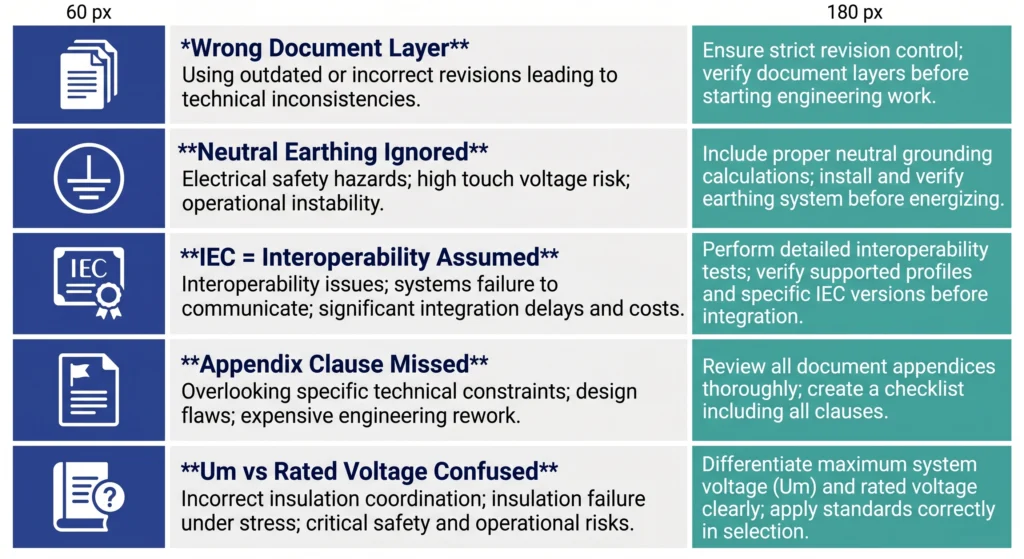
Erreur 1 - Lire la tension du système à partir de la mauvaise couche de documents
La concordance entre la plaque signalétique du transformateur, l'étiquette de tension SLD et la désignation Uo/U(Um) du schéma de câblage n'est pas garantie, en particulier dans les projets où les documents ont été produits à différents stades de la conception. La désignation Uo/U(Um) de la nomenclature des câbles est la valeur de contrôle pour la classe d'isolation des accessoires. Un système nominal de 10 kV sur un réseau à neutre isolé nécessite des accessoires pour une tension phase à phase complète lors d'un défaut monophasé, et non la classe de mise à la terre solide où Uo = 5,8 kV.
Erreur 2 - Ignorer la configuration de la mise à la terre du neutre
La méthode de mise à la terre du neutre est enregistrée sur le SLD, souvent sous la forme d'un petit symbole au point neutre du transformateur. Les systèmes de neutre solidement mis à la terre, mis à la terre par résistance et isolés requièrent des valeurs Uo différentes pour la même tension nominale, un oubli qui est à l'origine d'une part disproportionnée de l'incompatibilité des accessoires dans les projets internationaux.
Erreur 3 - Traiter la conformité à la CEI comme une confirmation d'interopérabilité
Un accessoire certifié selon les normes CEI et un dossier technique faisant référence aux normes CEI ne produisent pas automatiquement une combinaison compatible. Les normes CEI définissent des méthodes d'essai et des seuils de performance minimaux, et non l'interchangeabilité dimensionnelle entre les fabricants ou la compatibilité avec une construction de câble spécifique. La conformité confirme un seuil de performance ; elle ne confirme pas l'adaptation au site.
Erreur 4 - Absence de clauses relatives à l'altitude et à la pollution dans les annexes
Les conditions environnementales sont contractuellement contraignantes lorsqu'elles sont mentionnées dans n'importe quelle section du dossier technique, y compris les annexes distribuées séparément des STG principales.
Le passage de la classe de pollution II à la classe III fait passer la ligne de fuite minimale requise d'environ 20 mm/kV à 25 mm/kV d'Um. Pour un accessoire de classe 35 kV (Um = 40,5 kV), cela représente une augmentation de la ligne de fuite minimale de 810 mm à 1 012 mm, une différence qui sépare les articles du catalogue standard des variantes à profil étendu.
Erreur 5 - Confusion entre Um et tension nominale dans la correspondance avec le catalogue
Les catalogues d'accessoires indiquent la tension nominale de manière incohérente : certains mentionnent la tension nominale du système, d'autres l'Um, d'autres encore la chaîne de désignation complète de la CEI. Confirmez toujours la convention utilisée dans le catalogue avant de remplir la commande. En cas d'incertitude, demandez le certificat d'essai de type CEI complet de l'accessoire, qui mentionnera explicitement Um dans les conditions d'essai.
Cinq erreurs récurrentes de lecture des spécifications - de la recherche de documents de tension incorrects à la confusion de la notation du catalogue - chacune assortie d'une action corrective unique applicable avant la soumission de l'appel d'offres.
Que faire après avoir lu le cahier des charges ? - La voie de l'action en matière de marchés publics
Une lecture complète des spécifications produit un ensemble de paramètres, et non un bon de commande. Les valeurs extraites - classe de tension, niveau de défaut, section de conducteur, conditions environnementales et exigence de BIL - doivent être transférées dans un appel d'offres structuré avant qu'un fournisseur puisse établir un devis précis. Une liste non structurée produit un devis qui ne peut être validé par rapport au dossier technique.
Les deux points d'échec les plus courants à ce stade sont l'omission d'un paramètre et l'inadéquation du format. Une documentation structurée de l'appel d'offres permet d'éliminer ces deux problèmes. Pour l'achat d'accessoires de transformateur : traversées, changeurs de prises, ensembles de fusibles et interrupteurs de rupture de charge, le cadre de transfert des paramètres est couvert dans le document Liste de contrôle pour les accessoires de transformateurs. Pour les kits de terminaison et de jonction de câbles, le cadre équivalent se trouve à l'adresse suivante Liste de contrôle de l'appel d'offres pour les accessoires de câbles. Les deux listes de contrôle correspondent directement aux six groupes de paramètres couverts par cet article.
Soumettez vos paramètres extraits à l'équipe d'ingénieurs de ZeeyiElec pour la mise en correspondance des accessoires, la confirmation du catalogue et l'établissement d'un devis. La réponse technique est fournie sans obligation. Contactez l'équipe à zeeyielec.com/contact.
Questions fréquemment posées
Quel est le paramètre le plus important à extraire des spécifications d'un projet MV pour la sélection des accessoires de câble ?
La désignation de la tension (Uo/U/Um) et la section du conducteur sont les deux points de départ non négociables. Si l'on se trompe d'une classe de tension, on obtient un accessoire totalement incompatible, et si le diamètre du conducteur est incorrect, le kit de terminaison ne peut pas être installé physiquement, quelle que soit la puissance électrique.
Comment trouver le niveau de défaillance dans un document de spécification de projet ?
Le niveau de défaut (Isc en kA symétrique) est généralement indiqué dans l'étude de coordination de la protection ou sur le schéma unifilaire près du jeu de barres. S'il est absent, demandez-le formellement avant de lancer un appel d'offres, car il contrôle directement les valeurs nominales d'interruption des fusibles et la sélection du service de défaut de l'interrupteur.
Que signifie BIL dans la spécification d'un accessoire de transformateur, et comment le faire correspondre ?
Le BIL (Basic Impulse Insulation Level) est exprimé en kV crête et représente la capacité de résistance aux impulsions de l'accessoire pour un système de classe 15 kV. Un BIL typique de 95-110 kV crête doit être confirmé par rapport à la tension d'impulsion nominale du catalogue de l'accessoire avant de passer commande.
Pourquoi la méthode de mise à la terre influe-t-elle sur le choix de l'accessoire MT pour une même tension nominale ?
La mise à la terre du neutre détermine la tension phase-terre (Uo) sur un réseau isolé ou mis à la terre à haute impédance. Un défaut monophasé élève Uo au niveau de la tension phase-phase, ce qui nécessite des accessoires conçus pour une classe de tension supérieure à celle d'un système solidement mis à la terre et de tension nominale identique.
En quoi l'altitude du site influe-t-elle sur le choix de l'accessoire MV que je dois spécifier ?
Au-dessus d'une altitude d'environ 1 000 m, la rigidité diélectrique de l'air diminue progressivement, ce qui nécessite soit un accessoire à indice BIL plus élevé, soit une confirmation écrite par le fabricant de l'acceptation du déclassement en fonction de l'altitude. La correction spécifique dépend de l'altitude, de la géométrie de l'isolation et du type d'accessoire.
Quand dois-je formuler une demande formelle de clarification au lieu d'émettre une hypothèse de passation de marché ?
Demandez une clarification si l'un des cinq paramètres suivants est manquant ou ambigu : niveau de défaut (kA), méthode de mise à la terre du neutre, altitude du site supérieure à 1 000 m, classe de pollution ou diamètre extérieur du câble. Le fait de partir d'hypothèses sur l'un de ces paramètres entraîne une forte probabilité d'incompatibilité des accessoires.
Quelle est la différence entre Um et tension nominale dans un catalogue d'accessoires ?
Um est la tension maximale continue du système que l'accessoire doit supporter, alors que la “tension nominale” d'un catalogue peut faire référence à la classe nominale plutôt qu'à Um. Il faut toujours vérifier que Um de l'accessoire satisfait ou dépasse directement Um du projet, car l'étiquette de la tension nominale ne suffit pas à le confirmer.
yoyo shi
Yoyo Shi écrit pour ZeeyiElec, en se concentrant sur les accessoires de moyenne tension, les composants de transformateurs et les solutions d'accessoires de câbles. Ses articles couvrent les applications des produits, les bases techniques et les perspectives d'approvisionnement pour les acheteurs de l'industrie électrique mondiale.




 English
 한국어
한국어 العربية
 Español
 हिन्दी
 தமிழ்
தமிழ் Deutsch (Sie)
 Français
 Português do Brasil
 Русский