Une interface de puits de traversée est la limite d'assemblage normalisée où un puits de traversée monté sur un transformateur et un insert de traversée amovible s'emboîtent pour former une connexion étanche, électriquement continue et démontable. Les deux moitiés doivent s'aligner sur le même plan d'interface : si l'alignement est correct, la connexion est étanche et diélectriquement fiable ; s'il est incorrect, aucune autre spécification de la fiche technique n'a d'importance.
Qu'est-ce qu'une interface de puits à manchon ?
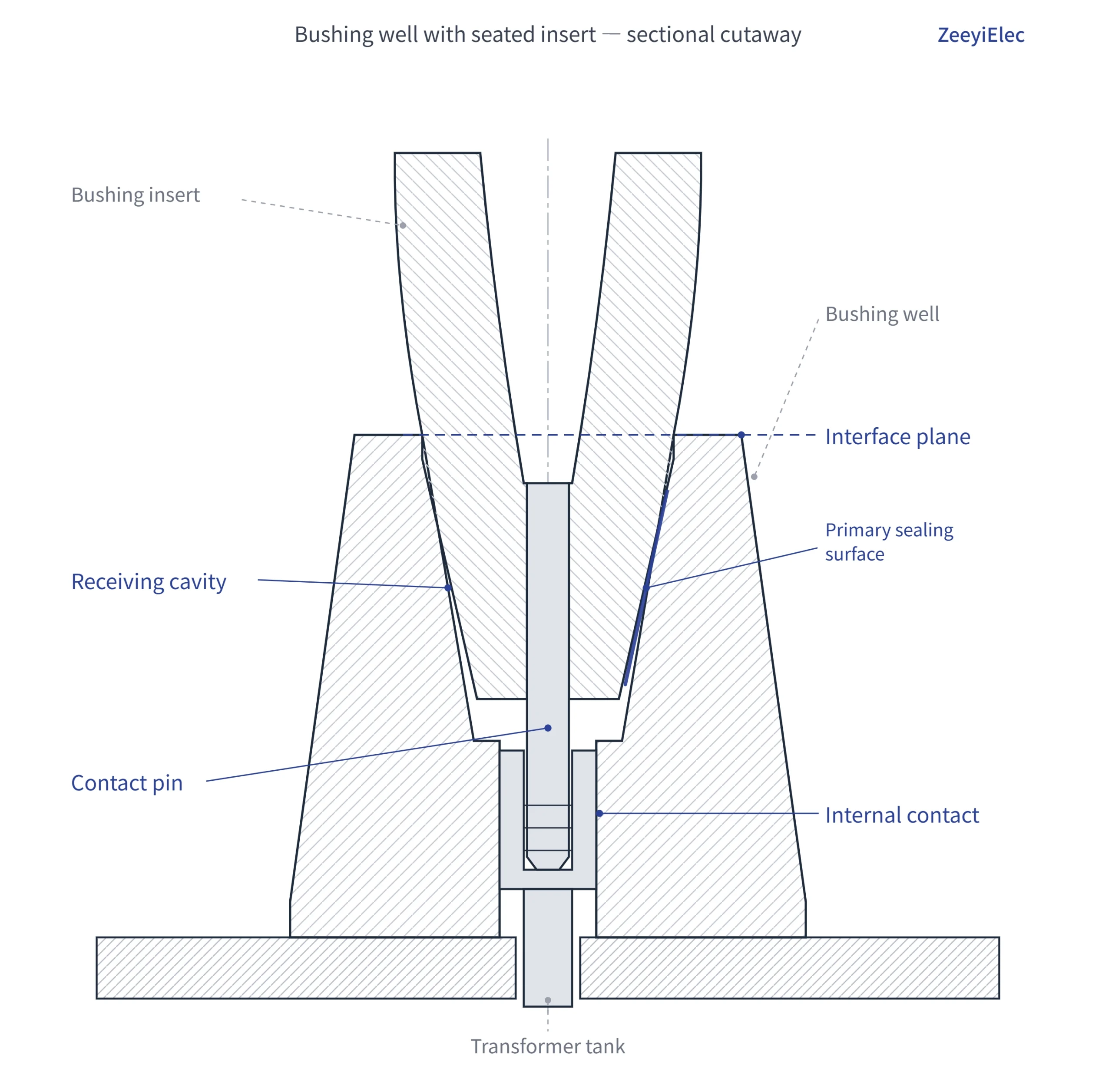
Dans un transformateur de distribution, le puits de traversée est l’élément fixe solidaire de la paroi du réservoir, tandis que l’insert de traversée (ou connecteur séparable) est la partie qui se raccorde au câble. Ils appartiennent à la même famille de connecteurs isolés séparables ; c’est pourquoi c’est la conformité dimensionnelle — et non la marque — qui détermine s’ils s’assemblent correctement. Cette interface est particulièrement courante dans la classe de courant continu de 200 A, pour les classes de tension de réseau de 15, 25 et 35 kV.
Les deux moitiés qui s'emboîtent
Le logement fournit la cavité de réception, le contact interne et la surface d’étanchéité principale. L’insert fournit la broche de contact, la surface d’étanchéité correspondante et le blindage semi-conducteur qui assure la continuité du blindage sur toute la longueur du joint. Trois éléments doivent fonctionner de concert : la géométrie qui détermine l’ajustement, les surfaces qui assurent l’étanchéité et le chemin de blindage qui contrôle les contraintes électriques. Un logement conçu pour une classe d’interface rejettera physiquement — ou pire, acceptera partiellement — un insert appartenant à une autre classe.
Pourquoi le mot “ interface ” est-il le mot clé ?
Une erreur courante consiste à définir un puits de douille uniquement en fonction de la tension, puis à supposer que n’importe quel insert de 200 A s’y adaptera. Le détail déterminant est la désignation de l’interface, qui définit la profondeur de la cavité, l’engagement des broches de contact et le diamètre de la surface d’étanchéité comme un ensemble coordonné. Le remplacement par une moitié non compatible modifie le champ de contrainte diélectrique de manière imprévisible.
Si vous définissez le périmètre d'un projet, commencez par le Série de douilles et d'inserts pour les données relatives aux classes d'interface et aux notations, et utiliser la catégorie plus large gamme d'accessoires pour transformateurs pour vérifier que le côté de la douille correspond à la même classe.
Les dimensions qui doivent correspondre — En un coup d'œil
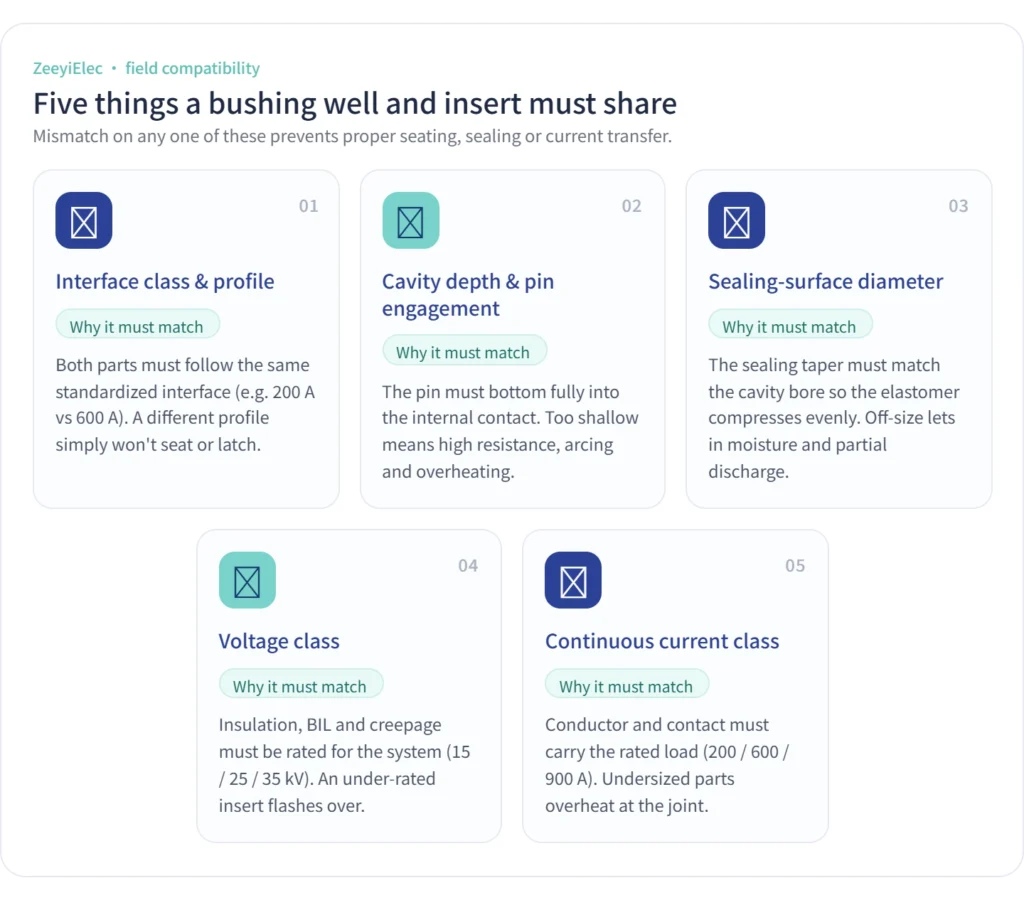
La conformité de l’interface est régie par un ensemble coordonné de cotes, et non par un simple chiffre. La référence déterminante est la désignation de l’interface, qui définit la manière dont la cavité du boîtier et l’insert s’emboîtent, de sorte que l’ajustement, l’étanchéité et les contraintes électriques restent tous conformes à l’intention de conception. En Amérique du Nord, cette famille d’interfaces est définie par la norme IEEE Std 386-2016, qui établit les caractéristiques nominales et les caractéristiques de construction interchangeables pour les systèmes de connecteurs isolés séparables destinés aux réseaux de distribution d’une tension nominale comprise entre 2,5 kV et 35 kV et d’un courant nominal inférieur ou égal à 900 A. Consultez le champ d’application à l’adresse Fiche de l'IEEE Standards Association relative à la norme IEEE 386.
Les cinq paramètres qui doivent correspondre entre un puits de douille et un insert : classe d'interface, profondeur de la cavité, diamètre de la surface d'étanchéité, classe de tension et classe de courant.
Tableau des paramètres obligatoires
Paramètres
Ce qu'il contrôle
Classe/portée réaliste
Pourquoi cela doit correspondre
Classe/profil d'interface
Géométrie d'accouplement globale
Classe 200 A ou 600 A
Un profil non adapté empêche l'enfoncement ou ne permet qu'un enfoncement partiel
Profondeur de la cavité et engagement de la broche
Pression de contact et continuité
Définir par classe d'interface
Un temps de contact court augmente la résistance de contact et l'échauffement local
Diamètre de la surface d'étanchéité
Ajustement serré étanche
Définir par classe d'interface
Les terrains trop petits ou trop grands compromettent l'étanchéité à l'humidité
Classe de tension
Épaisseur d'isolation, distance de fuite
15 / 25 / 35 kV
Assure la coordination des lignes à haute tension (BIL), généralement de 95 à 150 kV
Classe de courant continu
Capacité thermique
200 A en continu (valeur typique)
Une utilisation excessive accélère le vieillissement thermique
Comment les paramètres interagissent entre eux
Ces cinq éléments ne sont pas indépendants les uns des autres. La classe d’interface regroupe en effet la profondeur de la cavité, l’engagement des broches et le diamètre de la surface d’étanchéité en une seule désignation ; ainsi, le choix de la classe permet généralement de déterminer les dimensions mécaniques en une seule étape. Les classes de tension et de courant viennent ensuite s’ajouter en tant que critères électriques. Lorsqu’une fiche technique ne précise pas la classe d’interface, il convient de considérer ces deux éléments comme non vérifiés plutôt que comme interchangeables : la similitude visuelle entre des interfaces de 200 A a déjà induit en erreur plus d’une équipe de mise en service.
Géométrie des interfaces et surfaces d'étanchéité — Pourquoi ces chiffres existent-ils ?
Chaque dimension indiquée sur le schéma d'interface remplit une fonction physique : maintenir la connexion du conducteur, empêcher la pénétration de l'humidité et contrôler le champ électrique. C'est pourquoi le remplacement par une pièce « quasi-équivalente » est risqué, et pas seulement imparfait.
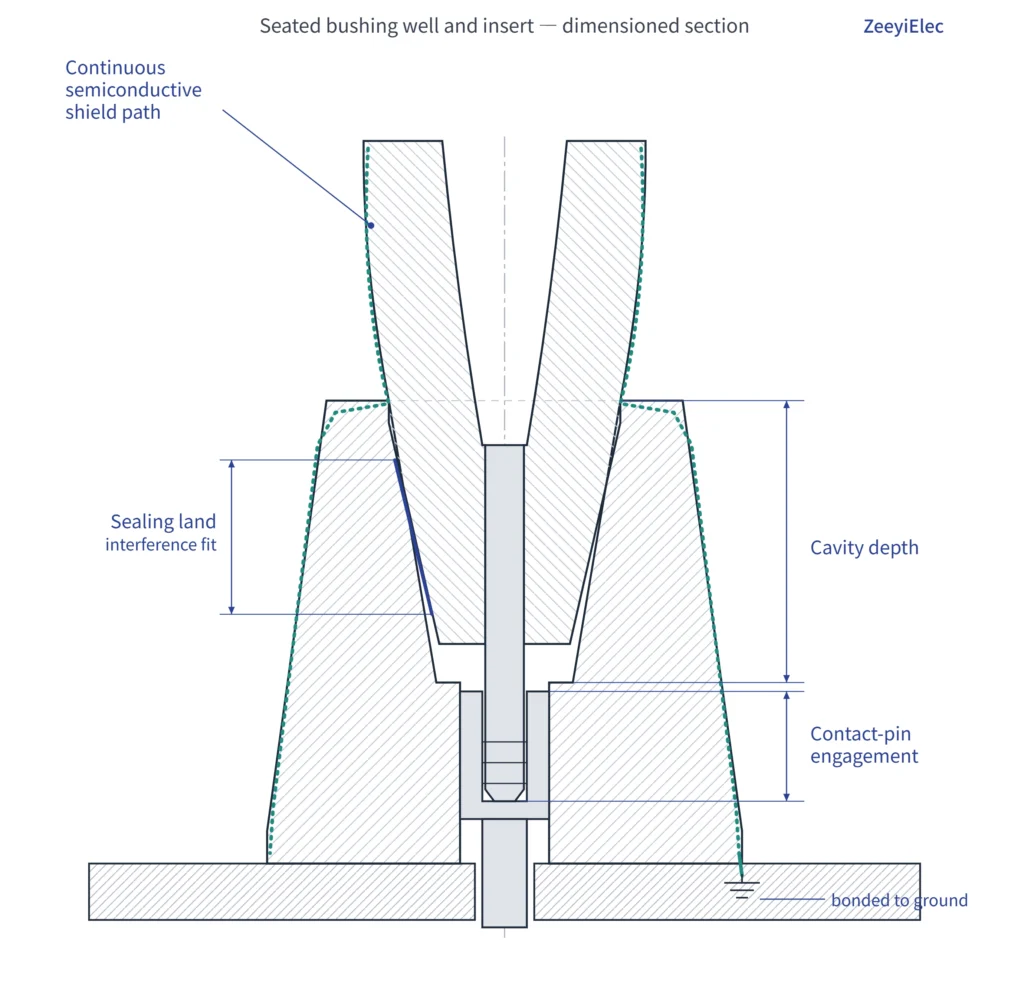
Coupe transversale d'une interface amovible assemblée, indiquant la profondeur d'engagement des broches de contact, l'ajustement serré de la plage d'étanchéité et le blindage semi-conducteur traversant le joint.
Profondeur de la cavité et engagement de la broche de contact
La profondeur de la cavité et la longueur de la broche de contact de l'insert sont adaptées de manière à ce que la broche s'enfonce complètement dans le contact interne du puits. Un engagement complet garantit une résistance de contact faible et stable, ainsi qu'un transfert de courant uniforme dans la classe de courant continu de 200 A. Lorsque l'engagement est insuffisant, la surface de contact diminue et l'échauffement localisé augmente.
Une interface séparable correctement enclenchée présente généralement une résistance de contact de l'ordre de quelques centaines de micro-ohms (entre 100 et 300 μΩ) ; un enclenchement partiel ou mal aligné peut multiplier cette valeur par plusieurs, concentrant ainsi l'échauffement dû à l'effet I²R au niveau du contact et accélérant le vieillissement thermique.
Surface d'étanchéité et ajustement serré
La surface d'étanchéité est dimensionnée pour assurer un ajustement serré délibéré entre l'élastomère de l'insert et le puits de forage, garantissant ainsi l'étanchéité du raccord, que ce soit en installation enterrée ou sur socle. Si le diamètre d’étanchéité est incorrect — ne serait-ce que d’une fraction de millimètre, parce que les deux moitiés proviennent de classes d’interface différentes —, le joint soit ne se comprimera pas suffisamment pour empêcher l’eau de pénétrer, soit sera soumis à une contrainte supérieure à celle prévue lors de sa conception.
Continuité du blindage semi-conducteur au niveau de l'interface
Un connecteur séparable est un dispositif entièrement blindé et à « face morte » ; la couche semi-conductrice doit donc rester électriquement continue lorsqu'elle passe de l'insert au puits. La géométrie est conçue pour préserver l'intégrité de ce blindage et garantir l'uniformité du champ.
Un blindage continu permet de maintenir les décharges partielles à un faible niveau : on s'attend généralement à ce que des interfaces de 15 à 35 kV bien conçues présentent des décharges partielles de l'ordre de ≤ 3 pC à la tension nominale. Une inadéquation géométrique qui interrompt le blindage entraîne un renforcement local du champ, à l'origine de la décharge, première étape menant à la formation de traînées et, à terme, à la rupture diélectrique.
[Avis d'expert] Trois vérifications physiques à effectuer avant de faire confiance à une interface
Vérifiez que les logements des goupilles sont bien enfoncés jusqu'à la butée — il ne doit pas y avoir d'écart visible au niveau de l'épaulement.
Vérifiez que la surface d'étanchéité ne présente pas de salissures, d'entailles ou de traces de lubrifiant sur une surface non prévue à cet effet.
Vérifiez que le blindage/écran est intact sur toute la longueur du raccord avant de le recouvrir.
Si l'un de ces trois éléments suscite un doute, considérez l'interface comme non vérifiée.
Compatibilité entre les classes de tension et les classes de courant
Une fois la classe d'interface mécanique confirmée, deux critères électriques permettent de déterminer si la paire est adaptée au système : la classe de tension et la classe de courant continu. Les deux moitiés — ainsi que les appareils auxquels elles sont raccordées — doivent être compatibles.
Classe de tension correspondante (15/25/35 kV)
Les puits de traversée et les inserts sont proposés dans différentes classes de tension, le plus souvent 15, 25 et 35 kV pour les installations de distribution. La classe définit l’épaisseur de l’isolation, la distance de fuite et la tension de claquage nominale (BIL). Un insert de classe 15 kV monté dans un puits de classe 25 kV peut s’emboîter mécaniquement, mais l’ensemble restera alors sous-isolé. La pratique prudente consiste à choisir le puits, l’insert et les accessoires de câble raccordés dans une seule et même classe de tension. À proximité d’une limite de classe, le Guide de sélection des traversées « LV » et « MV » aide à orienter la décision.
Classe de courant continu correspondante (200 A)
Les interfaces séparables s’articulent autour de classes de courant standard : la classe 200 A (coupure en charge) est prédominante pour les puits de traversées de distribution et les inserts, tandis que la classe 600 A est utilisée pour les connexions à usage intensif. La classe 200 A définit la conception thermique du contact et de l’élastomère qui l’entoure. Un fonctionnement prolongé au-delà du courant continu nominal accélère le vieillissement thermique ; la classe de courant de l’insert doit donc être égale ou supérieure à la charge continue du circuit, en prévoyant une marge pour les variations de température ambiante et les cycles de charge.
Lorsque le choix est également limité par le côté de la douille
Le puits vient buter contre l'interface de la traversée du transformateur de l'autre côté. Si la traversée relève d’une autre famille de normes, le choix du puits doit s’y conformer. Les exigences en matière d’isolation des traversées sont régies par la norme CEI 60137 pour les traversées isolées d’une tension nominale supérieure à 1 000 V, et par les familles de normes ANSI/IEEE en Amérique du Nord ; il convient donc de vérifier à quelle norme l’appareil se conforme avant de fixer le puits. Le gamme de traversées de moyenne tension montre en quoi les interfaces ANSI et DIN diffèrent à ce niveau — une différence qui se répercute directement sur le choix entre le puits et l'insert.
Réalités de terrain — Position assise, contamination et symptômes liés à un décalage
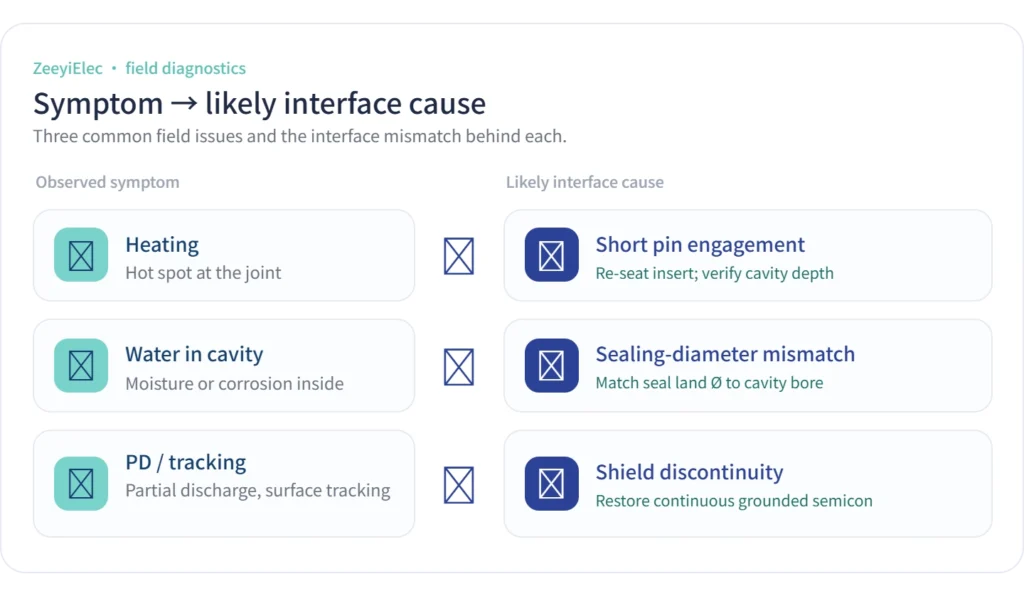
Les problèmes d'interface se manifestent rarement dès l'installation. Ils apparaissent des semaines, voire des mois plus tard, sous forme de surchauffe, d'humidité ou de décharges partielles ; il est donc dans l'intérêt des équipes de repérer toute interface défaillante avant la mise sous tension.
Un schéma de diagnostic sur le terrain établissant un lien entre les symptômes courants — surchauffe, présence d'eau dans la cavité, décharge partielle — et la cause probable liée à l'interface qui se cache derrière chacun d'entre eux.
Position incomplète et engagement partiel
Le problème le plus courant sur le terrain concerne un insert qui semble installé mais qui n’est pas complètement en place. Sur un poste de distribution monté sur socle, un coude démontable qui semblait bien en place à la main s’est avéré, après vérification, à environ 6 mm de l’engagement complet ; le raccord devenait sensiblement chaud sous charge, ce qui correspond à une surface de contact réduite. Un engagement partiel peut faire grimper la température du contact de 20 à 40 °C au-dessus de la température ambiante à pleine charge — ce qui suffit à provoquer un vieillissement prématuré de l’élastomère environnant. Assurez-vous que l’insert est en place jusqu’à ce que la butée de fin de course indiquée par le fabricant soit atteinte et vérifiez le verrouillage audible ou tactile plutôt que de vous fier uniquement au toucher.
Pénétration d'humidité et contamination de surface
L'ajustement serré d'étanchéité ne fonctionne que sur des surfaces propres et intactes. Lors d'un contrôle de mise en service, le suivi lumineux sur un insert de 25 kV a permis de déterminer que la présence de grains de sable sur la surface d'étanchéité avait rompu l'étanchéité à l'eau et laissé pénétrer de l'humidité. Une contamination, un lubrifiant mal appliqué ou un élastomère ébréché compromettent tous l'étanchéité, même lorsque les dimensions sont correctes. Gardez la cavité obturée jusqu’au montage, n’appliquez que le mastic d’étanchéité spécifié et inspectez les deux surfaces sous un bon éclairage avant l’assemblage.
À quoi ressemble un décalage dimensionnel lors de la mise sous tension ?
Un véritable problème d'incompatibilité de classe — un insert de 200 A forcé dans un profil d'interface différent — se traduit généralement par un composant qui ne s'emboîte pas complètement, une force d'assemblage anormalement élevée ou un écart visible au niveau de l'épaulement. Comme les conséquences peuvent aller de l’absence de symptôme immédiat à une défaillance en l’espace de quelques mois, un couple non conforme ou non vérifié doit être considéré comme non apte au service.
En règle générale, si la force d'emboîtement semble anormale ou si l'épaulement ne s'emboîte pas, arrêtez l'opération. Une interface séparable qui ne s'emboîte pas correctement doit être considérée comme incompatible jusqu'à ce que la classe et la classification de l'interface des deux moitiés aient été vérifiées par rapport aux fiches techniques.
[Avis d'expert] Les habitudes qui permettent d'éviter les défaillances des interfaces à un âge avancé
Conservez les cavités des capuchons et les inserts jusqu'au moment du montage.
Enfoncez-le jusqu'à la butée, puis vérifiez à nouveau que l'épaulement est bien fermé.
Enregistrez les valeurs relevées au mégohmmètre lors de la mise en service afin de disposer d'une référence.
Si vous constatez par la suite que le coude est chaud, considérez cela comme un problème d'interface et non comme un défaut du câble.
Vérification de la compatibilité des interfaces avant la mise sous tension
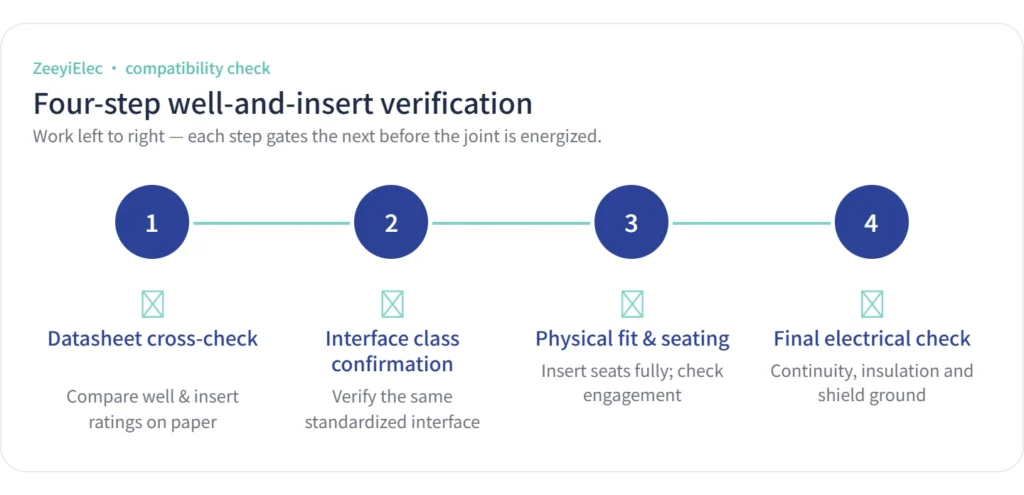
La compatibilité est d'abord vérifiée sur le papier, puis sur le terrain. Une séquence courte et rigoureuse permet de détecter les incompatibilités tant que leur correction reste peu coûteuse.
Une séquence de pré-mise sous tension en quatre étapes : vérification de la fiche technique, confirmation de la classe d'interface, ajustement physique et mise en place, puis contrôle électrique final.
Vérification administrative (avant la mobilisation de l'équipe)
Étape 1 — Vérifiez les fiches techniques. Assurez-vous que la douille, l'insert/connecteur et l'accessoire de câble raccordé indiquent tous la même classe de tension (15, 25 ou 35 kV) et la même classe de courant (généralement 200 A). Un champ d’interface vide ou ambigu signifie que la compatibilité n’a pas été vérifiée et que les composants ne sont pas compatibles.
Étape 2 — Vérifiez la désignation de l'interface. Assurez-vous que la classe d'interface indiquée correspond bien sur les deux moitiés, plutôt que de la déduire à partir d'une photo. Si une fiche technique ne la mentionne pas, demandez une confirmation écrite avant la livraison. Considérez cela comme une étape incontournable : aucune livraison ne doit être effectuée sur le site tant que la classe d'interface n'a pas été confirmée sur les deux moitiés.
Vérification sur site (lors de l'installation et de la mise en service)
Étape 3 — Ajustement physique et mise en place. Ajustez l'insert à la main, vérifiez qu'il n'y a pas de force d'ajustement anormale, puis mettez-le en place jusqu'à ce que la butée soit atteinte. Un jeu visible est un signe qu'il faut arrêter l'opération.
Étape 4 — Vérification électrique finale. Une fois l'installation terminée, vérifiez le bon fonctionnement de l'ensemble à l'aide des tests de pré-mise sous tension prévus dans le projet.
Un contrôle classique avant mise sous tension consiste à vérifier la continuité du blindage et la résistance d’isolement à l’aide d’un mégohmmètre à une tension de 2,5 à 5 kV CC ; on s’attend alors à obtenir une valeur nette et stable (généralement ≥ 1 000 MΩ pour une interface MT en bon état, bien que les limites d’acceptation doivent respecter les spécifications du projet). Une valeur instable ou trop faible indique la présence d'humidité ou un défaut de pose, et pas nécessairement un problème au niveau du câble.
Les équipes qui considèrent l'étape 2 comme une étape incontournable passent beaucoup moins de temps par la suite à diagnostiquer des « coudes chauds » et la présence d'eau dans la cavité — des problèmes qui remontent presque toujours à une hypothèse d'interface que personne n'a vérifiée.
Choisissez correctement l'interface entre le puits de douille et l'insert
La plupart des défaillances d’interface sont des non-conformités aux spécifications détectées trop tard — et ce sont aussi les plus faciles à éviter, car les informations nécessaires tiennent sur une seule ligne d’un appel d’offres. Lorsque vous commandez un puits de traversée et un insert, indiquez les trois paramètres qui déterminent la compatibilité : la désignation de la classe d’interface, la classe de tension (15, 25 ou 35 kV) et la classe de courant continu (généralement 200 A). Ajoutez-y la section du câble raccordé et la norme relative à la traversée de l’appareil, et un fournisseur pourra confirmer une compatibilité réelle plutôt que de se contenter d’une supposition basée sur un numéro de modèle.
Si l’un de ces éléments est inconnu, c’est la discussion qu’il faut avoir avant de passer commande — et non après, lorsqu’un technicien se présente sur le chantier lors de la mise en service. Un bref échange technique dès le départ permet d’éviter des semaines de diagnostic sur le terrain par la suite.
L'équipe d'ingénieurs de ZeeyiElec est en mesure d'adapter l'interface « puits et insert » à votre transformateur et à votre câble, et de vous fournir la fiche technique dont votre processus d'assurance qualité a besoin. Lancez une étude technique portant sur la série de puits et d'inserts de traversées, ou, si votre projet couvre également le côté terminaison de câble de cette même interface séparable, la gamme d'accessoires pour câbles indique la partie correspondante. Indiquez la classe d'interface, la tension et l'intensité nominale, et vous obtiendrez une réponse vérifiée quant à la compatibilité, plutôt qu'une simple supposition.
Questions fréquemment posées
Quelles dimensions doivent correspondre entre le logement d'une douille et l'insert de cette douille ?
Le profil de l'interface d'accouplement, la profondeur d'engagement des broches de contact, le diamètre de la surface d'étanchéité, la classe de tension et la classe de courant continu doivent tous être conformes ; les valeurs exactes dépendent de la classe d'interface choisie et des caractéristiques nominales du système. Il convient donc de vérifier les deux moitiés par rapport à leurs fiches techniques avant de passer commande.
Un insert de douille de 200 A peut-il s'adapter à n'importe quel logement de douille ?
En règle générale, cela n'est possible que si les deux composants partagent la même classe d'interface et la même tension nominale, car un insert de 200 A est conçu pour une interface à connecteur séparable spécifique ; le fait de mélanger les classes d'ampérage ou d'interface empêche généralement un enfichage correct. Il convient donc de vérifier les caractéristiques nominales des deux composants.
Les interfaces des douilles sont-elles normalisées d'un fabricant à l'autre ?
La gamme d'interfaces à connecteurs séparables est largement normalisée, ce qui permet souvent un raccordement entre différentes marques au sein d'une même classe ; toutefois, les tolérances, les détails d'étanchéité et le blindage peuvent encore varier. Il est donc toujours recommandé de vérifier l'ajustement physique et la mise en place avant la mise sous tension.
La classe de tension a-t-elle une incidence sur les dimensions de l'interface entre la traversée et le puits ?
La classe de tension (généralement 15, 25 ou 35 kV) influe sur l'épaisseur de l'isolation et la distance de fuite, ce qui peut modifier les dimensions globales et l'interface nominale ; le choix d'un puits et d'un insert appartenant à la même classe de tension constitue la solution de base la plus sûre.
Que se passe-t-il si les dimensions du logement de la douille et de l'insert ne correspondent pas ?
Un mauvais raccordement peut entraîner un enfichage incomplet, une contrainte diélectrique accrue, une infiltration d'humidité ou la formation de sillons électriques, avec des conséquences pouvant aller de l'absence totale de symptômes lors de l'installation à une défaillance en l'espace de quelques mois ; par conséquent, les paires non conformes ne doivent pas être mises sous tension.
Comment puis-je vérifier la compatibilité avant l'installation ?
Vérifiez sur les deux fiches techniques que la classe d'interface, la tension et l'intensité nominale correspondent, puis procédez à une vérification de l'ajustement physique et de la mise en place sur site ; la confirmation finale doit reposer sur la désignation de l'interface indiquée par le fabricant plutôt que sur une simple similitude visuelle.
L'interface « bushing well » est-elle identique à celle d'un connecteur séparable ?
Ils appartiennent à la même gamme de connecteurs isolés séparables et partagent la même logique d'interface, mais le « well » est le composant fixe monté sur le transformateur, tandis que l'« insert » est la moitié complémentaire ; la compatibilité dépend toujours de la correspondance entre la classe d'interface et la puissance nominale.
yoyo shi
Yoyo Shi écrit pour ZeeyiElec, en se concentrant sur les accessoires de moyenne tension, les composants de transformateurs et les solutions d'accessoires de câbles. Ses articles couvrent les applications des produits, les bases techniques et les perspectives d'approvisionnement pour les acheteurs de l'industrie électrique mondiale.





 English
 한국어
한국어 العربية
 Español
 हिन्दी
 தமிழ்
தமிழ் Deutsch (Sie)
 Français
 Português do Brasil
 Русский