Bei Verteilungstransformatoren ist die Schnittstelle der Durchführungsbuchse einer der am stärksten beanspruchten und zugleich am wenigsten sichtbaren Zuverlässigkeitsfaktoren im System. Im Außenbereich ist die Dichtung gleichzeitig UV-Strahlung, Temperaturschwankungen und Verschmutzungen ausgesetzt. Dieser Leitfaden behandelt, wie Feuchtigkeit an die Schnittstelle gelangt, wodurch die Dichtung beschädigt wird, wie man eine Dichtung auswählt und einbaut und wie man das Eindringen von Feuchtigkeit verhindert, bevor ein Austausch erforderlich wird.
Was eine Bushing-Well-Schnittstelle ist und wo die Dichtungsgrenze verläuft
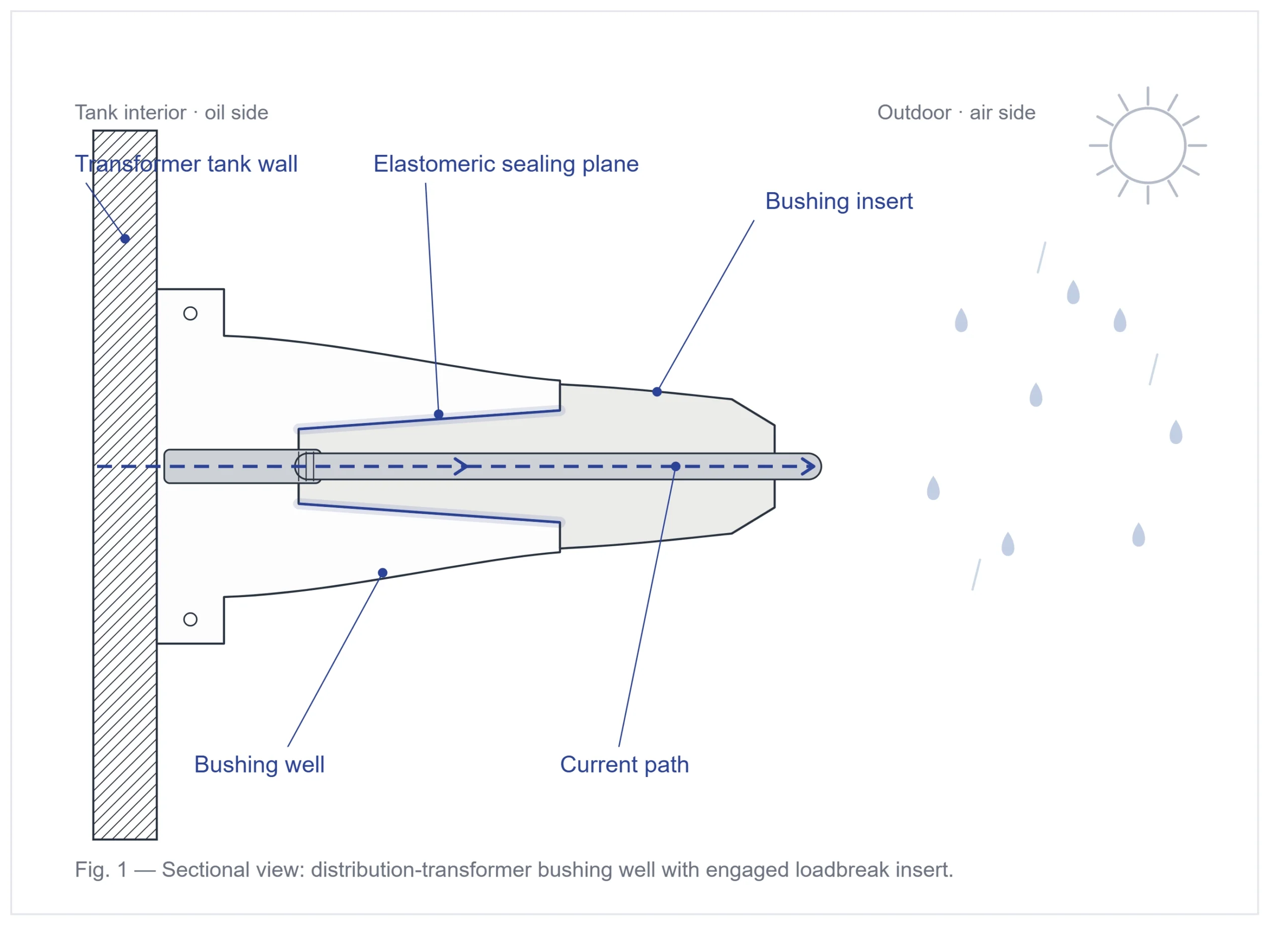
Eine Durchführungsschnittstelle ist die Passfläche zwischen einer am Transformator angebrachten Durchführungsbuchse und dem darin aufgenommenen Lasttrenn- oder Deadfront-Einsatz. Die Dichtungsebene ist der elastomere Kontaktbereich an der Öffnung des Durchführungsschachts, an dem eine Außendichtung verhindern muss, dass Feuchtigkeit in den unter Spannung stehenden Strompfad gelangt. Diese Geometrie ist von Bedeutung, da Dichtungsprobleme an einer Stelle entstehen, die nach dem Einrasten des Einsatzes nicht mehr sichtbar ist.
Der Brunnen und seine Befestigungsvorrichtung
Der Durchgang ist das feststehende, am Transformator montierte Gehäuse, das über einen Gewinde- oder Flanschanschluss am Tank verschraubt ist; üblicherweise in den Spannungsklassen 15/25 kV und 15/25/35 kV mit einer Dauerbelastbarkeit von 200 A. Es handelt sich um die primärisolierte Durchführung; der Einsatz und seine Dichtung ermöglichen die Wartung dieser Durchführung von außen.
Der Einsatz und die Elastomer-Schnittstelle
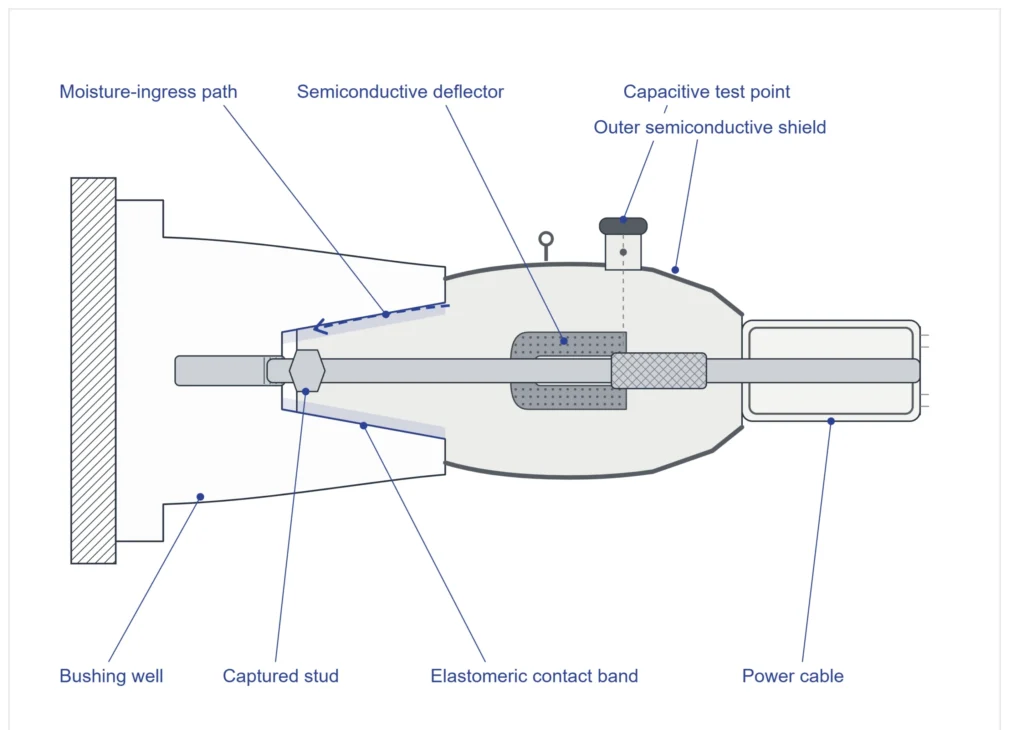
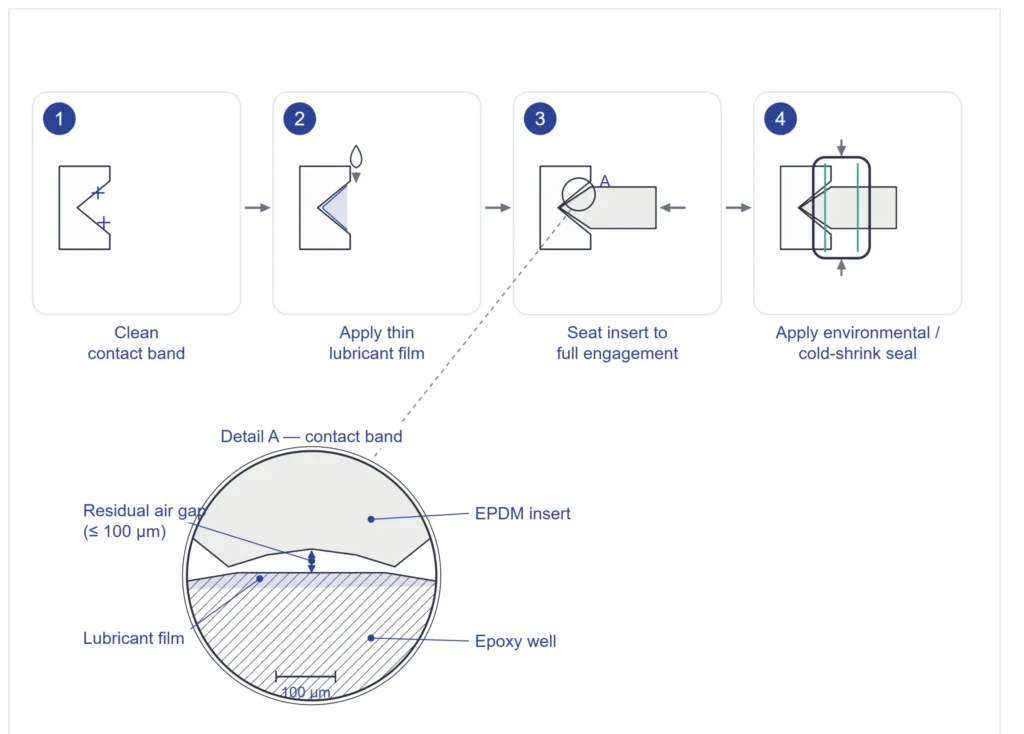
Der Einsatz wird in die Vertiefung gesteckt und durch einen Presssitz zwischen zwei EPDM- oder Silikonoberflächen gehalten. Dieser Presssitz bildet die Dichtung. Das Kontaktband ist nur wenige Millimeter breit, und ein dünner Film aus einem speziell dafür vorgesehenen Silikonschmiermittel sorgt dafür, dass es luftfrei einrastet. Über dasselbe Band gelangt Feuchtigkeit hinein, sobald sich das Elastomer entspannt.
Warum sich die dielektrische Spannung an der Grenzfläche konzentriert
An der Schnittstelle treten zudem die höchsten elektrischen Belastungen auf, sodass Feuchtigkeit dort doppelt schädlich ist.
An einer Schnittstelle der 25-kV-Klasse kann das Radialfeld über dem Elastomer in der Nähe des Tripelpunkts Werte von bis zu 2 kV/mm erreichen; ein halbleitender Deflektor wird eingesetzt, um den lokalen Gradienten unter Normalbelastung auf etwa ≤ 3 kV/mm zu begrenzen. Ein dünner Feuchtigkeitsfilm erhöht die Oberflächenleitfähigkeit und verschiebt diese Äquipotentialfläche, sodass ein Dichtungsversagen, das bereits eine 0,1–0,5 mm dicke Wasserschicht eindringen lässt, eine Kriechstrombildung auslösen kann, lange bevor die Volumenisolierung beeinträchtigt wird.
Deshalb ist eine ordnungsgemäß geschmierte 200 A – Buchsengehäuse und Einsatzbaugruppe können die Stromzufuhr bestehen, entwickeln jedoch Monate später Feuchtigkeit an den Schnittstellen. Betrachten Sie diese Werte als typische Richtwerte und nicht als feste Grenzwerte.
Querschnitt des Schachts und des Einsatzes, der die elastomere Dichtungsfläche, den halbleitenden Deflektor und das schmale Kontaktband zeigt, entlang dessen Feuchtigkeit wandert, sobald sich die Dichtung lockert.
Wie Feuchtigkeit an die Grenzfläche gelangt (Eindringmechanismen)
Feuchtigkeit dringt nicht in nennenswerten Mengen durch intaktes Elastomer; sie nutzt einige wenige Wege an der Dichtfläche, meist in Kombination.
Temperaturwechsel und der “Atmungseffekt” an der Grenzfläche
Wenn sich die Schnittstelle erwärmt und abkühlt, dehnen sich der eingeschlossene Luftfilm und das Elastomer unterschiedlich stark aus und bewegen so den Kontaktstreifen wie ein Balg mit geringem Volumen.
Bei Außenverteilereinheiten ist eine Temperaturschwankung von ΔT ≈ 30–50 K zwischen der nächtlichen Umgebungstemperatur und der Spitzenlast üblich, und bei jedem Zyklus wird eine geringe Menge feuchter Luft in einen Mikrospalt gesaugt. Über Tausende von Zyklen hinweg sammelt sich Kondensat schneller an, als es wieder verdampfen kann, insbesondere dort, wo die Oberflächentemperatur unter den lokalen Taupunkt fällt.
Druckverformungsrest von Dichtungen und Alterung von Elastomeren
EPDM- und Silikondichtungen verlieren mit der Zeit an Rückstellkraft, was als Druckverformungsrest quantifiziert wird. Eine Dichtung, die mit einer Shore-A-Härte von 40–60 Durometer eingebaut wurde, kann nach längerem Betrieb einen bleibenden Verformungsrest von 20–35% aufweisen, wodurch sich der Anpressdruck verringert, der die Barriere aufrechterhält. UV-Strahlung und Hitze beschleunigen diesen Prozess.
Oberflächenverfolgung und Überbrückung von Verunreinigungen
Ein Film aus Verschmutzungen und Feuchtigkeit überbrückt den Kriechweg, und Leckstrom sowie Teilentladungen können eine Kriechbahn – die selbst porös und hygroskopisch ist – verkohlen, sodass sich Kriechbildung und Eindringen gegenseitig verstärken.
Unvollständiges Einsetzen des Einsatzes und Luftspalten
Die am besten vermeidbare Ursache ist mechanischer Natur. Ein zu tief sitzender Einsatz hinterlässt einen verbleibenden Luftspalt von 100–500 μm über den gesamten Umfang: am ersten Tag noch trocken, nach der ersten feuchten Jahreszeit jedoch zum primären Eindringkanal.
[Expertenmeinung] Die Mechanismen im Zusammenhang betrachten
Atmung und Druckverformungsrest sind zeitabhängig; bei alternden Anlagen ist auch bei einwandfreier Installation damit zu rechnen.
Die Ausbreitung erfolgt durch Kontamination und beschleunigt sich von selbst, sobald sie einmal begonnen hat.
Luftspalten entstehen durch Fehler bei der Installation und lassen sich vollständig vermeiden; sie sind die Ursache für viele Ausfälle in der Anfangsphase.
Umwelteinflüsse im Außenbereich, die die Dichtung angreifen
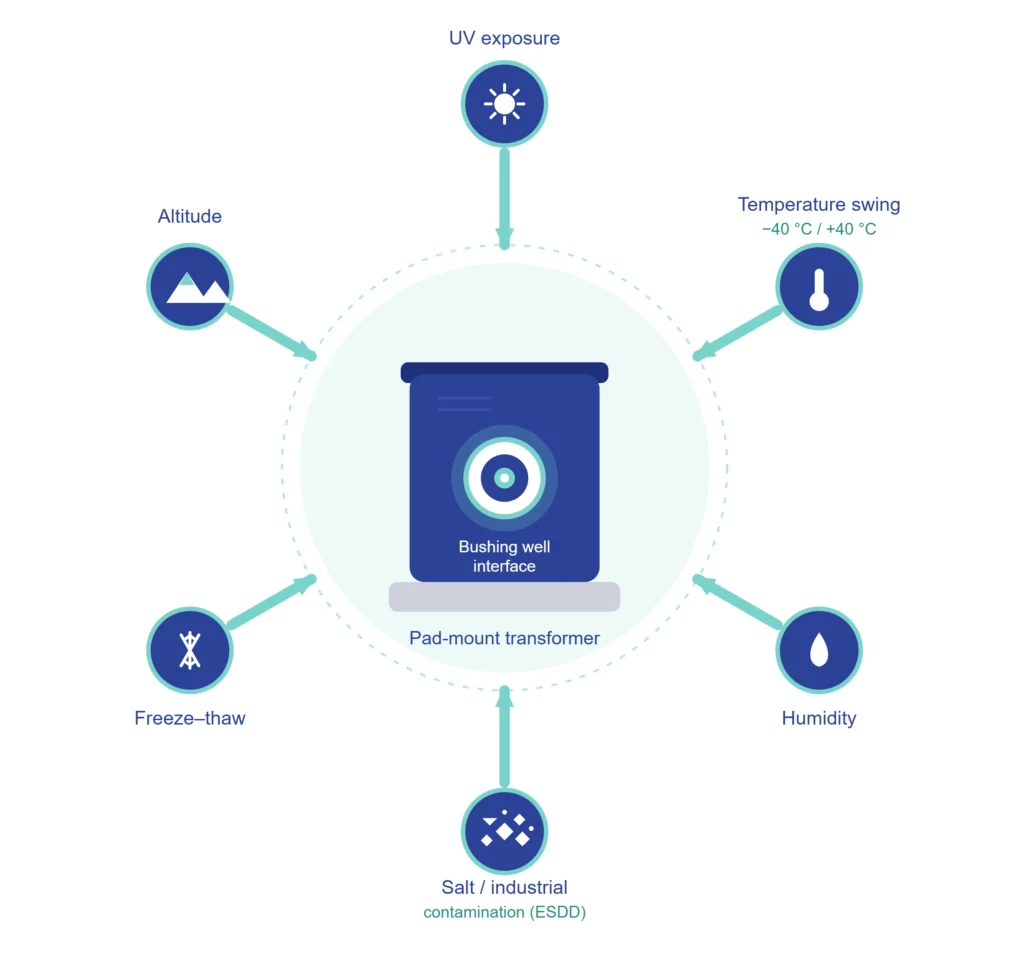
Im Innenbereich altern Dichtungen nur langsam; im Außenbereich hingegen sind sie über die Jahreszeiten hinweg einer Vielzahl von Belastungsfaktoren ausgesetzt. Dichtungen versagen selten aufgrund eines einzelnen Belastungsfaktors, sondern meist aufgrund von zwei oder drei Faktoren, die sich gegenseitig verstärken.
Die maßgebliche Referenz für den Verschmutzungsgrad im Außenbereich ist die Normenreihe IEC 60815, die Standorte anhand der äquivalenten Salzablagerungsdichte von “leicht” bis „sehr stark“ klassifiziert [NORME ÜBERPRÜFEN: Verschmutzungsgradklassen nach IEC 60815 / SPS-Stufen]. Die Kriechstrecken von Durchführungen und die Leistung im Außenbereich werden in der Norm IEEE C57.19.01 behandelt. Die verbindlichen Definitionen der Verschmutzungsklassen finden Sie unter [QUELLENANGABE ERFORDERLICH] – vorgeschlagener Ankertext: „IEC 60815 – Klassifizierung der Verschmutzungsgrade im Außenbereich“.”
Umweltstressor → Abdichtungseffekt
Stressfaktor
Typischer Messbereich
Auswirkung auf die Grenzflächenabdichtung
UV-Strahlung
kontinuierliche Tageslichtbelastung
Oberflächenoxidation und Aushärtung von EPDM; Verlust der Rückstellkraft
Temperaturschwankung
Umgebungsbereich von −40 °C bis +40 °C
Die unterschiedliche Ausdehnung treibt die “atmende” Pumpbewegung an
Luftfeuchtigkeit / Kondensation
RH bis zu ~100% im Morgengrauen
Kondensatfilm, wenn die Oberflächentemperatur unter den Taupunkt fällt
Kontamination (ESDD)
~0,06–0,6 mg/cm² (leicht → stark)
Leitfähige Brückenbildung, Leckstrom, Entstehung von Kriechströmen
Frost–Tau
zyklische 0 °C-Durchgänge
Die Ausdehnung des Eises vergrößert die Mikrospalten am Kontaktstreifen
Höhenlage
Leistungsreduzierung in der Regel oberhalb von 1000 m
Verringerte dielektrische Sicherheitsmarge der Luft um die Grenzfläche herum
Bei einer Inbetriebnahme an der Küste zeigten identische 25-kV-Einsätze, die vorschriftsmäßig eingebaut worden waren, innerhalb von zwei Jahreszeiten Salzspuren an den windzugewandten Einheiten, während die leeseitigen Einheiten sauber blieben – die einzige Variable war die luftgetragene elektrostatische Entladung (ESDD). Die Verschmutzungsklasse beeinflusst die Lebensdauer der Schnittstellen stärker als die Nennspannung; standortspezifische ESDD-Messungen sollten Vorrang vor allgemeinen Annahmen zur Verschmutzungsklasse haben.
Umwelteinflüsse im Außenbereich – UV-Strahlung, Temperaturschwankungen, Feuchtigkeit, Salz- und Industrieverschmutzung, Frost-Tau-Wechsel und Höhenlage – wirken gleichzeitig auf die Schnittstellendichtung ein, wobei der Verschmutzungsgrad oft einen größeren Einfluss auf die Lebensdauer hat als die Nennspannung.
Dichtungsmethoden und -materialien: Auswahlkriterien
Die Auswahl einer Dichtung für den Außenbereich ist eine Frage der richtigen Abstimmung. Die Wahl hängt von der Spannungsklasse, dem Zustand der Oberfläche, der zu erwartenden erneuten Eintauchzeit und dem Verschmutzungsgrad ab.
Elastomerdichtungen (EPDM, Silikon)
Die werkseitige Dichtung dient als Referenz. EPDM ist UV- und ozonbeständig; Silikon behält seine Elastizität in einem Temperaturbereich von −40 °C bis +40 °C. Eine einwandfreie Dichtung weist eine Shore-A-Härte von 40–60 auf und dichtet durch anhaltenden Druck ab. Sie wird bevorzugt für Standard-Einsätze mit 15/25 kV und 15/25/35 kV verwendet, da sie reversibel ist.
Mastix und vor Ort aufzutragende Dichtstoffe
Bei verwitterten, unrunden oder nachgerüsteten Felgen gleicht eine nicht aushärtende Dichtmasse Unebenheiten aus, die das Elastomer nicht überbrücken kann. Sie dient als sekundäre Barriere, nicht als primäre Feuchtigkeitssperre.
Kalt schrumpfende Umweltdichtungen
Bei stark verschmutzten oder hochkontaminierten Einsatzorten sorgt eine Kaltschrumpfmanschette für eine flammenfreie Schutzhülle. Das vorexpandierte Silikon legt sich bei Umgebungstemperatur locker um die Baugruppe und vermeidet so die Hitze eines Brenners, die Epoxidharz-Einbettungen beschädigen könnte. Siehe vorgeexpandierte, kaltschrumpfende Dichtungskomponenten.
Gleitmittel für Grenzflächen und ihre unterstützende Rolle
Schmiermittel ist zwar keine Dichtung, aber für eine Dichtung unverzichtbar.
Ein dünner Film des angegebenen Silikonschmiermittels sorgt dafür, dass sich der Einsatz vollständig einpasst, sodass der verbleibende Luftspalt ≤ 100 μm beträgt, und reduziert die Einpresskraft um etwa das 2- bis 3-fache. Eine übermäßige Anwendung ist kontraproduktiv: Überschüssiges Schmiermittel wandert zur Kriechfläche und kann Verunreinigungen anziehen.
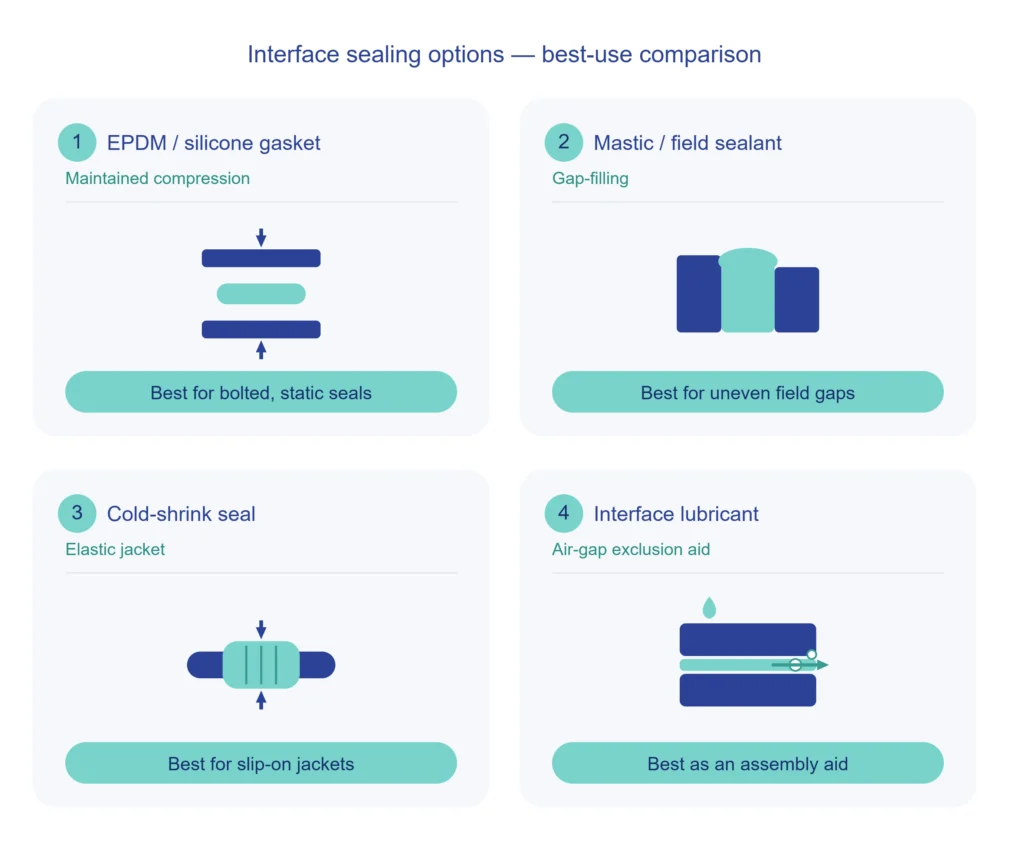
Vergleich verschiedener Dichtungsmethoden
Verfahren
Dichtungsmechanismus
Optimale Verwendung
Wesentliche Einschränkung
EPDM-/Silikondichtung
Konstante Kompression
Standard-Schnittstellen für die Wartung
Verliert an Festigkeit, wenn sich ein Druckverformungsrest bildet
Mastix / Felddichtungsmittel
Spaltenfüllend, nicht aushärtend
Nachrüstung, unregelmäßige Oberflächen
Nur sekundäre Barriere
Kaltschrumpf-Dichtung
Elastischer Radialmantel
Starke Außenluftbelastung / hohe Schadstoffbelastung
Erfordert die richtige Größenauswahl; erhöht den Aufwand beim erneuten Einsteigen
Gleitmittel für Schnittstellen
Hilfe zum Ausschluss von Luftspalten
Alle Sitz-Schnittstellen
Keine eigenständige Dichtung
Vier Dichtungsoptionen im Vergleich hinsichtlich ihrer Funktionsweise und ihres optimalen Einsatzbereichs – von der einfachen Elastomerdichtung über Kaltschrumpfschläuche für stark verschmutzte Einsatzorte bis hin zu Schmiermitteln, die eher als Einlaufhilfe denn als Dichtung dienen.
Vorgehensweise vor Ort: Schritt-für-Schritt-Anleitung zum Abdichten der Schnittstelle
Die meisten Ausfälle von Außenabdichtungen werden bereits bei der Installation durch entsprechende Konstruktionsmaßnahmen verhindert. Die unten aufgeführte Schaltung ist spannungsfrei und geerdet; überprüfen Sie zunächst die Isolierung und legen Sie die Arbeitserdungen an.
Oberflächenvorbereitung und Reinigung
Die Bohrlochmündung und den Einsatz auf Kratzer, Kerben oder verschobene Dichtungen überprüfen; verkohlte Bauteile aussortieren.
Reinigen Sie beide Elastomerflächen ausschließlich mit dem zugelassenen Reinigungstuch – nicht aufgeführte Lösungsmittel lassen EPDM aushärten. Die Kontaktfläche muss trocken und fusselfrei sein.
Überprüfung der Sitzplätze und der Teilnahme einfügen
Tragen Sie eine dünne, gleichmäßige Schicht Silikonschmiermittel auf.
Schieben Sie den Einsatz vollständig ein, bis er deutlich anliegt; bei einer korrekt eingesetzten 200-A-Schnittstelle verbleibt ein Restspalt von ≤ 100 μm.
Bei der Inbetriebnahme einer Pad-Mount-Anlage ließ ein Team, das auf das Schmiermittel verzichtet hatte, einen Einsatz 2–3 mm zu kurz sitzen; die Anlage fuhr zunächst einwandfrei an, nahm dann aber in der folgenden feuchten Jahreszeit Feuchtigkeit auf.
Verleihung des Umweltsiegels
Bei Standard-Einbauorten ist zu überprüfen, ob die Dichtung fest sitzt und keine Fremdkörper eingeklemmt sind.
An stark beanspruchten Stellen sollte die Kaltschrumpfhülse bei Umgebungstemperatur und passend zum Durchmesser des Einsatzes angebracht werden – ohne Brenner.
Überprüfung nach der Installation
Führen Sie vor der Wartung die vereinbarten Prüfungen durch. Die Steckverbinderfamilie unterliegt der Norm IEEE 386 für trennbare, isolierte Steckverbinder mit einer Nennlast von 200 A und einer „Deadfront“-Nennleistung.
Ein praktisches Abnahmekriterium ist ein Isolationswiderstand von ≥ 1000 MΩ bei 25 °C und ein Teilentladungswert innerhalb der Projektgrenze, üblicherweise ≤ 5–10 pC, gemessen bei der vorgeschriebenen Prüfspannung [NORME ÜBERPRÜFEN: Routinemäßiger PD-Abnahmegrenzwert und Prüfspannung für trennbare 200-A-Steckverbinder]. Die Umgebungstemperatur ist zu protokollieren, da die IR-Ergebnisse temperaturempfindlich sind und sich über einen Bereich von 20 °C um ein Vielfaches ändern.
Die Abfolge der Arbeiten bei abgeschaltetem Feld – Reinigen, Schmieren, vollständiges Einrasten und Anbringen der Umgebungsdichtung – beseitigt den umlaufenden Luftspalt, der die Ursache für die meisten Ausfälle durch Feuchtigkeitseintritt in der Anfangsphase ist.
[Expertenmeinung] Drei Überprüfungen, mit denen sich die meisten Frühausfälle verhindern lassen
Überprüfen Sie, ob die Sitze vollständig aufliegen – nicht mit den Augen, sondern mit den Händen: Die kostspielige Lücke ist die, die man nicht sehen kann.
Jedes Mal schmieren; ein trockener Einsatz führt fast zwangsläufig zu einem Umfangsspiel.
Erfassen Sie bei jeder IR-Messung die Umgebungstemperatur, um Trends besser vergleichen zu können.
Inspektion während des Betriebs und Fehlerbehebung bei Feuchtigkeitsproblemen
Nach der Inbetriebnahme wird die Dichtung indirekt überprüft. Durch eine konsequente Routine lassen sich Undichtigkeiten frühzeitig erkennen, sodass die Behebung noch durch eine erneute Abdichtung erfolgen kann. Eine Sichtprüfung alle 1–3 Jahre ist für die meisten Anlagen im Außenbereich ausreichend; an Küstenstandorten oder an verschmutzten Standorten sollte dieses Intervall verkürzt werden.
Visuelle Anzeigen und ihre Bedeutung
Verfärbungen, weiße Kriechspuren und Korrosion am Vorsprung sind die ersten Anzeichen. Kriechspuren sind sowohl ein Symptom für Undichtigkeiten als auch ein Hinweis auf einen neuen Feuchtigkeitspfad.
Elektrische Anzeigen
Trendmessungen sind aussagekräftiger als einzelne Messwerte. Ein sinkender Isolationswiderstand oder zunehmende Teilentladungen deuten auf eine sich verschlechternde Grenzfläche hin, noch bevor dies sichtbar wird.
Ein praktisches Prüfverfahren umfasst den Isolationswiderstand, den Oberflächenleckstrom und die Teilentladung (PD). Ein IR-Ergebnis, das zwischen zwei Prüfungen von > 1000 MΩ auf ≤ 100 MΩ gesunken ist, ein Leckstrom, der an einer zuvor einwandfreien Schnittstelle auf Werte im zweistelligen μA-Bereich ansteigt, oder ein um mehrere pC angestiegener Teilentladungswert – all dies rechtfertigt eine Untersuchung und nicht sofort eine Ausschusserklärung. Führen Sie zunächst einen Wiederholungstest bei der aufgezeichneten Temperatur durch, um dies zu bestätigen.
Anzeichen → Mögliche Ursache → Maßnahme
Beobachtetes Anzeichen
Mögliche Ursache
Konservative Maßnahme
Weiße Spuren
Verunreinigungen + Feuchtigkeitsbrücken
Reinigen, Kriechweg prüfen, Dichtung erneut bewerten
Sinkende IR / steigende PD
Entspannung der Dichtung, Eindringfilm
Erneut prüfen, anschließend die Stromversorgung unterbrechen und die Schnittstelle überprüfen
Korrosion an der Ausbuchtung
Feuchtigkeitsansammlung am Spalt
Strom abschalten, den Zustand prüfen und das Ersatzteil einsetzen
Akustische/sichtbare Entladung
Aufschlüsselung der aktiven Schnittstellen
Außer Betrieb nehmen; nicht aufschieben
In einem Fall auf einem Industriegelände wies eine 25-kV-Schnittstelle erhöhte Teilentladungen und schwache Kriechströme auf. Bei der Demontage im stromlosen Zustand wurden eine gelockerte Dichtung und ein dünner Feuchtigkeitsfilm festgestellt, jedoch keine umfassenden Schäden; durch Reinigung, den Einbau einer neuen Dichtung und das erneute Einsetzen konnten akzeptable Messwerte wiederhergestellt werden, ohne dass die Schachtabdeckung ausgetauscht werden musste – dieselbe Logik wie hier Arbeitsablauf der Fehlerdiagnose im Feld. Ein einzelner niedriger Messwert ist kein endgültiges Urteil, und eine einmalige einwandfreie Inspektion garantiert nicht, dass die Dichtung während der nächsten Verschmutzungssaison hält.
Festlegung einer abgedichteten, für den Außenbereich geeigneten Schnittstelle zwischen Durchführung und Schacht
Die Dichtungsleistung im Außenbereich ist in der Spezifikation festgelegt. Eine Angebotsanfrage, in der die Umgebungsbedingungen ebenso genau definiert sind wie die Nennwerte, ermöglicht es dem Lieferanten, vor der Fertigung die geeignete Mischung, den Kriechweg und den Dichtungstyp auszuwählen.
In Ihrer Angebotsanfrage anzugebende Parameter
Spannungsklasse und BIL – z. B. 15/25 kV oder 15/25/35 kV-Schnittstelle
Dauerstrombelastbarkeit – typischerweise 200 A für Lasttrenn- und Deadfront-Einsätze
Verschmutzungsgrad – ESDD-Wert oder Klasse des Standorts (≈ 0,06–0,6 mg/cm²)
Umgebungsbedingungen – z. B. −40 °C bis +40 °C, zuzüglich der Höhe, falls diese über 1000 m liegt
Standard einfügen, Dichtungsmaterial (EPDM oder Silikon) sowie Angabe, ob eine Kaltschrumpfdichtung erforderlich ist
Terminalkonfiguration und erwarteter Wiedereinstiegs-/Wartungszugang
Durch diese sechs Maßnahmen im Vorfeld lassen sich langwierige Hin- und Her-Diskussionen vermeiden, die den Beschaffungsprozess um Wochen verlängern, und das Risiko verringern, dass eine Dichtung nicht zur jeweiligen Umgebung passt.
ZeeyiElec unterstützt die Auswahl von Schnittstellen und die Überprüfung der Abdichtung im Außenbereich für seine gesamten Angebot an Transformatorenzubehör, sowie für den Kabelabschluss und die Verbindungsabdichtungen entlang der gesamten Länge des Angebot an Kabelzubehör. Teilen Sie uns Ihre Spannungsklasse, Nennstromstärke und die Daten zur Verschmutzung am Standort mit, damit wir eine technische Prüfung durchführen und Ihnen ein Angebot unterbreiten können.
Häufig gestellte Fragen
Warum fallen Bushing-Well-Schnittstellen im Außenbereich häufiger aus als solche im Innenbereich?
Bei Außenanwendungen kommen zusätzlich zur normalen Alterung noch UV-Strahlung, starke Temperaturschwankungen und Luftverschmutzung hinzu, was die Lebensdauer der Dichtungen im Vergleich zu geschützten Geräten um Jahre verkürzen kann – wobei der Unterschied jedoch stärker von der Verschmutzungsklasse und der Installationsqualität abhängt als allein vom Standort.
Wie fest sollte der Sitz eines Buchseneinsatzes sein?
Ein korrekt eingesetzter 200-A-Einsatz sollte fest anliegen, wobei ein Restspalt in der Größenordnung von 100 μm oder weniger zulässig ist; maßgeblich ist jedoch laut Herstellerangaben der vollständige Eingriff, da ein zu flacher Sitz in der Praxis das häufigere Problem darstellt.
Reicht Silikonfett aus, um Feuchtigkeit von der Schnittstelle fernzuhalten?
Nein – ein dünner Schmierfilm erleichtert das Einlaufen und verhindert Luftspalten, stellt jedoch für sich genommen keine Feuchtigkeitsbarriere dar; diese Funktion übernimmt die Elastomerdichtung, und Schmiermittel sollte sparsam aufgetragen werden, um das Anziehen von Verunreinigungen zu vermeiden.
Wann sollte ich eine Kaltschrumpfmanschette über eine Standard-Schnittstelle anbringen?
Kaltschrumpfschläuche kommen in der Regel nur an Standorten mit starker Verschmutzung, in Küstengebieten oder an Orten mit hoher UV-Belastung zum Einsatz, an denen Standarddichtungen nur bedingt geeignet sind, während an sauberen Standorten mit geringer Belastung der zusätzliche Aufwand für den Wiedereinbau in der Regel den Nutzen überwiegt.
Kann eine undichte Buchsenverbindung repariert werden, ohne den Transformator auszutauschen?
Oftmals ja, da die Behebung in der Regel durch Reinigung, den Einbau einer neuen Dichtung und das erneute Einsetzen während eines stromlosen Zeitfensters von etwa 30–90 Minuten pro Schnittstelle erfolgt – sollte jedoch Korrosion an den Führungsschienen oder am Aufsatz vorliegen, ist der Austausch des Schachts oder des Einsatzes die sicherere Lösung.
Yo-Yo-Shi
Yoyo Shi schreibt für ZeeyiElec und konzentriert sich dabei auf Mittelspannungszubehör, Transformatorenkomponenten und Kabelzubehörlösungen. Ihre Artikel behandeln Produktanwendungen, technische Grundlagen und Einblicke in die Beschaffung für Einkäufer der globalen Elektroindustrie.





 English
 한국어
한국어 العربية
 Español
 हिन्दी
 தமிழ்
தமிழ் Deutsch (Sie)
 Français
 Português do Brasil
 Русский