A current limiting fuse is a specialized overcurrent protection device designed to interrupt high-magnitude fault currents within a half-cycle, preventing the current from reaching its destructive peak. In distribution power systems, it acts as the primary defense mechanism—or backup protection—to clear severe internal transformer faults before catastrophic tank rupture or widespread equipment failure occurs.
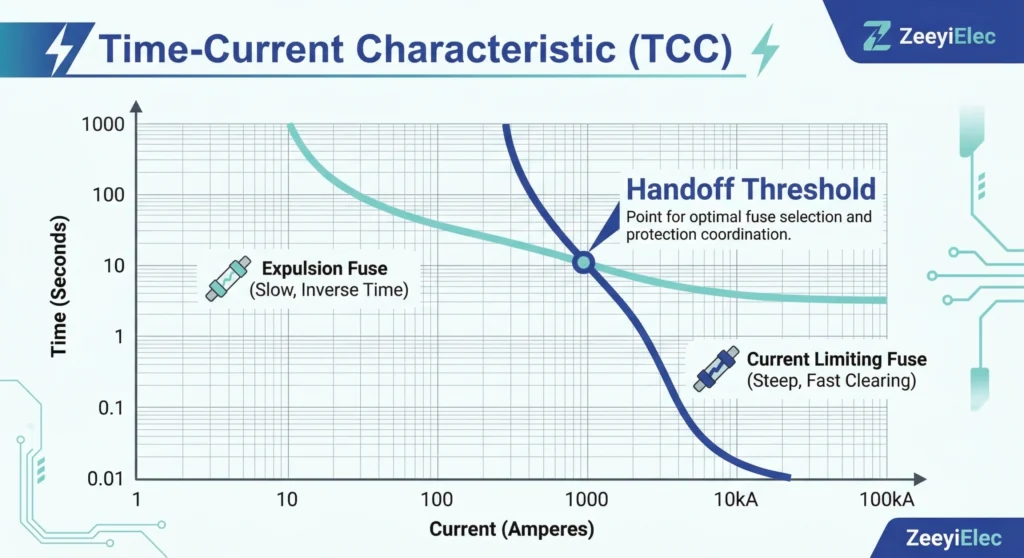
Figure 1: TCC coordination curve illustrating the exact current intersection point where the backup fuse assumes fault-clearing responsibility from the primary expulsion link.
The Role of High Fault Interruption
When a low-impedance fault occurs inside a 15 kV to 35 kV distribution transformer, fault currents can instantaneously spike to 20,000 A or even 50,000 A. If these currents are allowed to flow unimpeded, the resulting thermal and magnetic forces will destroy the core, vaporize the insulating dielectric oil, and potentially rupture the steel tank. A current limiting fuse introduces a high resistance into the circuit almost instantaneously, forcing the fault current to drop to zero well before the natural zero-crossing of the AC sine wave. This precise, microsecond-level action limits the thermal let-through energy (I²t) to a fraction of the prospective fault energy.
How It Differs from Standard Fuses
While basic overcurrent devices wait for the alternating current voltage wave to naturally cross zero to extinguish an electrical arc, a current limiting device actively forces the current down against the system voltage. Standard expulsion fuses—such as typical —operate by melting a metallic link and generating gas from an ablative tube to blow out the arc. They provide excellent, reliable clearing for low-level secondary faults and standard system overloads, typically clearing faults up to 3,000 A.
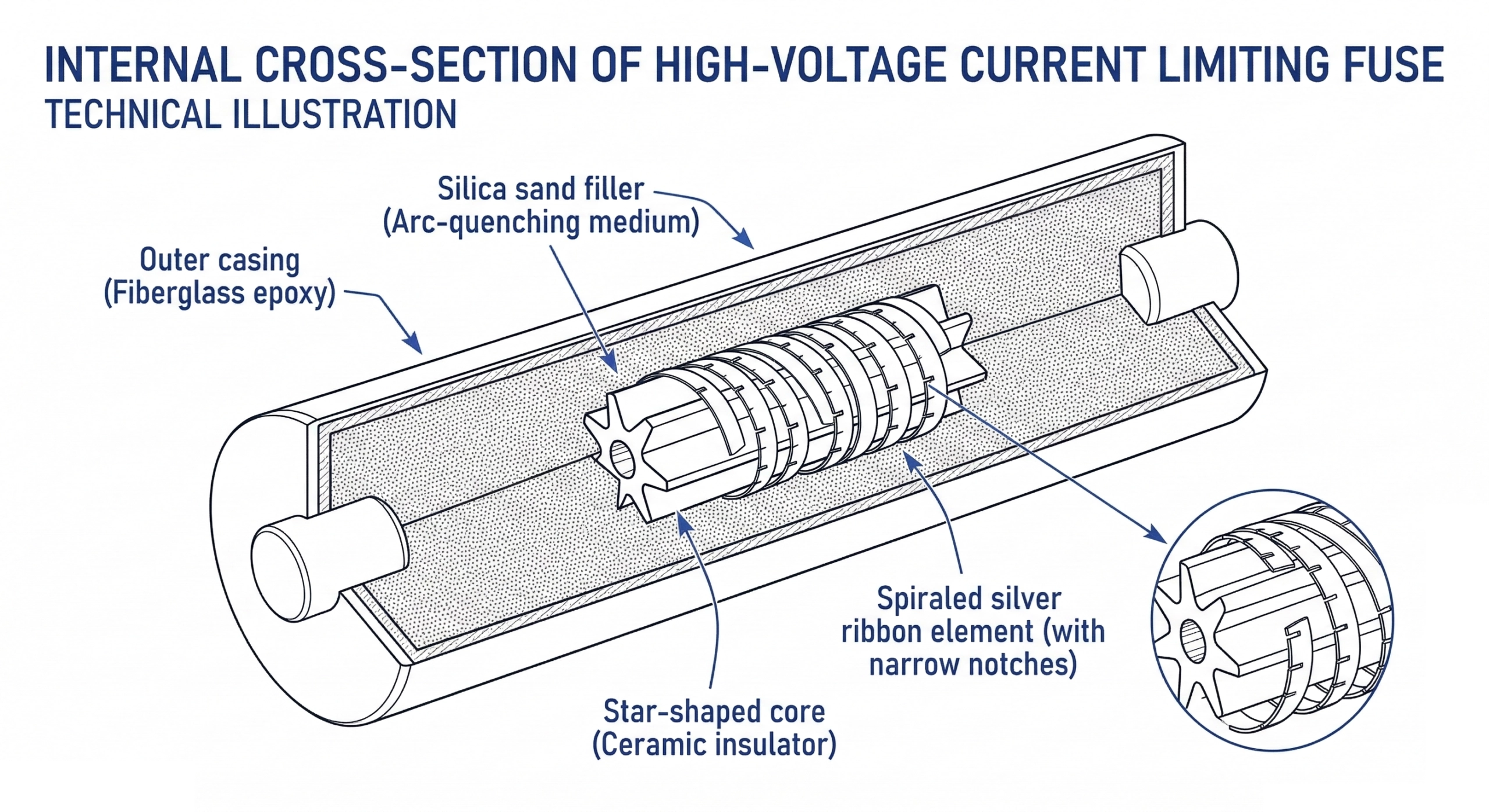
However, expulsion fuses cannot react rapidly enough to safely arrest the massive kinetic energy of a bolted primary fault. A current limiting fuse relies on meticulously engineered silver elements embedded in tightly packed, high-purity silica sand. As excessive current melts the silver, the surrounding sand immediately absorbs the intense arc energy. The outer casing is constructed from high-strength fiberglass-reinforced epoxy or high-alumina ceramic to safely contain the intense internal pressures generated during this phase.
[Expert Insight: Field Diagnostics]
A ruptured fiberglass fuse housing usually indicates the fault current exceeded the device’s maximum symmetrical interrupting rating.
Finding intact fulgurite rock inside an operated casing confirms the fuse successfully absorbed and quenched the internal arc.
Always perform insulation resistance testing on transformer windings after a backup fuse operation, as the event strongly points to an internal dielectric failure rather than a transient external fault.
The Physics of Fault Interruption: How Current Limiting Works
The operation of a current limiting fuse is a highly controlled, rapid thermodynamic event. To effectively arrest massive fault currents before they reach their peak magnitude, the internal architecture relies on precise metallurgical and chemical reactions.
Phase 1: Element Melting and Vaporization
To accommodate sufficient element length within a compact housing, the silver ribbon inside the fuse is typically wound spirally around a star-shaped ceramic or high-temperature polymer core. When a short circuit occurs, this high-purity silver element experiences extreme, instantaneous thermal stress. Because silver has a precise melting point, the engineered notches—specifically narrowed sections of the ribbon designed to exponentially increase localized current density—heat up and melt almost immediately, typically within 1 to 2 milliseconds of the fault initiation.
Phase 2: Arc Resistance and Voltage Generation
Once the narrowed notches melt, the liquid silver vaporizes and expands violently. This rapid phase transition creates multiple electrical arcs in series across the newly formed gaps along the length of the fuse element. As the arc plasma expands, it is physically constrained by the densely packed, high-purity silica (SiO₂) sand filling the fuse body. The sand aggressively cools and compresses the arc column, causing the internal arc resistance to skyrocket to hundreds of ohms (Ω) within microseconds. This massive increase in resistance generates a high arc voltage that actively opposes and exceeds the system recovery voltage. By overpowering the system voltage, the fuse actively drives the rate of change of current (di/dt) downward, preventing the fault from reaching its prospective peak magnitude.
Phase 3: Energy Absorption and Current Zero
As the electrical arc continues to burn through the silver vapor, the extreme thermal energy is entirely absorbed by the surrounding silica sand. The sand melts and fuses with the vaporized metal, solidifying into a highly insulating, glass-like composite material known as fulgurite. This phase transformation permanently quenches the arc and forces the fault current to absolutely zero long before the alternating current’s natural zero-crossing. The predictability and speed of this arc-quenching mechanism form the basis of strict international performance testing [NEED AUTHORITY LINK SOURCE: IEC 60282-1 design specifications for high-voltage current-limiting fuses], ensuring the total energy remains below the catastrophic failure threshold.
Defining “Backup Protection” in Distribution Networks
In distribution power engineering, the term “backup protection” describes a highly coordinated, two-stage sequential protection scheme rather than a redundant, secondary safety net. This architecture pairs a series-connected expulsion fuse with a backup current limiting fuse to secure the transformer across the entire fault current spectrum.
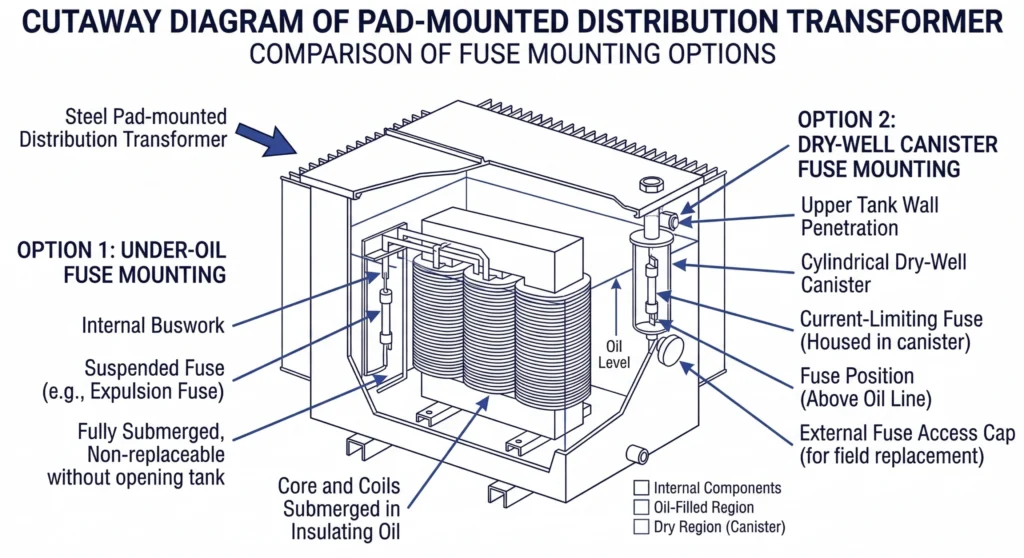
Figure 2: Typical installation locations for backup current limiting fuses within a pad-mounted distribution transformer tank, contrasting under-oil suspension with dry-well canister mounting.
The Limits of Expulsion Fuses
Expulsion fuses excel at clearing low-level, secondary-side faults, standard system overloads, and high-impedance internal faults. They are easily replaceable in the field via hot-stick operation and provide excellent long-term reliability. However, their physical interrupting capability is strictly bound by their design. A standard 15 kV class Bay-O-Net fuse can typically interrupt a maximum fault current of 2,500 A to 3,500 A. If a primary-side bolted fault generates 15,000 A of short-circuit current, the ablative material inside the expulsion fuse cannot generate enough gas pressure to extinguish the arc.
The Current Limiting Handoff Point
The system is designed so that the two fuses share a specific intersection point on their Time-Current Characteristic (TCC) curves. For any fault current below the handoff threshold (e.g., ≤ 3,000 A), the expulsion fuse melts and clears the circuit while the backup fuse remains intact. For any high-magnitude fault exceeding this threshold (e.g., 3,000 A up to 50,000 A symmetrical), the current limiting fuse reacts in less than a half-cycle, isolating the transformer before the expulsion fuse even begins to operate. Proper coordination ensures that the minimum melting I²t of the backup fuse is always strictly greater than the maximum clearing I²t of the expulsion fuse at lower fault levels.
[Expert Insight: Coordination Pitfalls]
Relying solely on nameplate continuous current ratings without properly overlapping the minimum melting and total clearing TCC curves creates a dangerous, unprotected dead zone between 1,000 A and 3,000 A.
Ignoring the thermal limits of the enclosure can lead to improper crossover points; the backup fuse must take over before the expulsion fuse’s physical bursting threshold is reached.
Key Selection Parameters for Current Limiting Fuses
Selecting the correct backup protection is an exercise in matching the fuse’s operational limits to the transformer’s thermal and mechanical withstand capabilities. A mismatch here—often documented in failure reports—results in either nuisance outages during harmless transient inrush or catastrophic failure during a severe fault.
Maximum System Voltage and Recovery Voltage
The rated maximum voltage of the fuse must equal or exceed the maximum line-to-line operating voltage of the distribution network. Because a current limiting fuse actively generates a high arc voltage to force current to zero, this recovery voltage must safely remain below the Basic Impulse Level (BIL) of the transformer insulation system to prevent internal dielectric breakdown.
Continuous Current Rating
The continuous rating defines the maximum current the fuse can carry indefinitely without exceeding its thermal limits. In field applications, the ambient temperature inside a fully loaded, oil-immersed transformer reaches elevated top-oil temperatures. Engineers typically size the continuous rating to accommodate at least 130% to 140% of the anticipated full load to prevent heat-induced degradation.
Interrupting Rating (Symmetrical Amperes)
This parameter defines the absolute maximum prospective short-circuit current the fuse can safely clear without its casing physically rupturing. Modern medium-voltage backup fuses designed for distribution networks typically feature an interrupting rating of 50,000 A symmetrical, ensuring the fuse handles the most severe bolted faults directly at the primary terminals.
Let-Through Energy (I²t)
Let-through energy, expressed as I²t (amperes squared seconds), quantifies the exact amount of thermal energy the fuse permits to flow into the transformer core and windings before the circuit is completely broken. For successful backup protection, the maximum clearing I²t of the downstream expulsion fuse must be strictly ≤ the minimum melting I²t of the current limiting fuse.
Installation Realities: Under-Oil vs. Dry-Well Applications
The operational environment significantly impacts a current limiting fuse’s performance and long-term reliability. In distribution networks, these fuses are integrated directly into the transformer architecture, typically utilizing either under-oil immersion or a dry-well canister system.
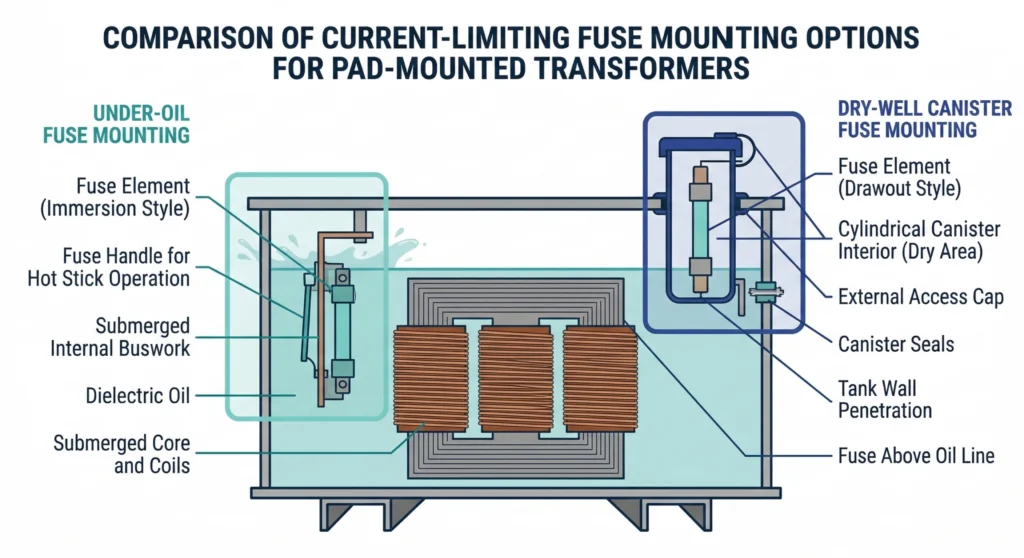
Figure 3: Diagram illustrating typical installation locations for backup current limiting fuses within a pad-mounted distribution transformer, contrasting under-oil suspension with dry-well canister mounting configurations.
Oil-Immersed Fusing Constraints
Under-oil applications immerse the fuse directly into the transformer’s dielectric fluid, which maximizes heat dissipation and allows the fuse to maintain a higher continuous current rating. However, replacing an operated under-oil fuse requires technicians to completely de-energize the transformer, unbolt the tank cover, and manually remove the fuse from the internal buswork. Consequently, under-oil fuses are considered non-expendable components; an operation strongly indicates the transformer core has already failed.
Dry-Well Canister Systems
Dry-well canisters provide an isolated chamber that physically separates the fuse from the transformer oil while maintaining dielectric integrity. The canister is mounted through the transformer tank wall, allowing the fuse to sit inside a dry air pocket where field technicians can safely extract and replace it externally using a hot-stick. Because the dry air environment lacks the superior cooling properties of dielectric oil, engineers must calculate temperature derating factors when specifying the current rating.
Temperature Rise and Derating Factors
Whether submerged or housed in a dry well, ambient temperature within the transformer dictates fuse performance because the internal element is inherently a thermal device. Elevated ambient heat pre-loads the fuse element; if not properly accounted for through engineered derating curves, a fuse operating in high-temperature oil might erroneously melt below its rated current.
Specifying the correct backup protection extends far beyond matching the system voltage. Installing a mismatched fuse—such as applying a 50 A fuse where a 65 A rating is required due to elevated top-oil temperatures—inevitably leads to premature thermal fatigue and costly nuisance tripping. Conversely, oversizing the fuse risks allowing excessive let-through energy (I²t) that can mechanically deform the transformer core during a severe bolted fault.
A reliable distribution network requires holistic protection—from terminating the incoming medium-voltage lines to precisely coordinated fuses securing the transformer internal core. Engineers must ensure precise coordination between the primary expulsion link and the backup current limiting device to guarantee that the transformer survives severe electrical transients without rupturing.
Partnering with an experienced component manufacturer ensures your protection coordination is mathematically sound and field-ready. ZeeyiElec engineers high-performance designed for seamless integration, offering backup fuses, matched Bay-O-Net fuse assemblies, and loadbreak switches rigorously tailored for stable 15 kV to 35 kV network demands.
Frequently Asked Questions
Can a current limiting fuse clear a low-level overload?
No, a backup current limiting fuse is explicitly engineered to clear only high-magnitude bolted faults typically exceeding 2,000 A to 3,000 A. For standard low-level system overloads, a primary expulsion fuse must be wired in series to break the circuit and prevent the backup fuse from sustaining long-term thermal damage.
Why is silica sand used inside current limiting fuses?
High-purity silica sand (SiO₂) acts as the primary arc-quenching medium by rapidly absorbing the intense 5,000°C thermal energy generated when the silver element vaporizes. This extreme heat physically melts the sand into a highly resistive glass-like solid matrix called fulgurite, forcing the fault current to zero within microseconds.
How fast does a current limiting fuse operate?
During a severe short circuit, a medium-voltage current limiting fuse typically melts and clears the fault within 1 to 4 milliseconds, well before the AC sine wave reaches its first peak. This sub-half-cycle speed restricts peak let-through energy (I²t) and prevents mechanical deformation of internal coils.
Do current limiting fuses need to be replaced after a fault?
Yes, because the internal silver ribbon permanently vaporizes and structurally fuses with the surrounding sand matrix, the entire current limiting device is completely expended and cannot be reset. An operated backup fuse indicates a catastrophic internal dielectric breakdown, requiring thorough transformer core testing.
Can I use a current limiting fuse without a Bay-O-Net fuse?
Standard backup current limiting fuses designed for 15 kV to 35 kV pad-mounted distribution transformers must always be paired with a series-connected expulsion fuse. Operating without coordinated low-current protection exposes the backup fuse to sustained moderate overloads, dangerously overheating the casing without interrupting the circuit.
What is the typical continuous current derating factor for under-oil installation?
Engineers typically size the continuous current rating to at least 130% to 140% of the transformer’s maximum continuous load current. This derating margin ensures the heat-sensitive fuse element does not suffer thermal fatigue when submerged in 90°C to 105°C top-oil during peak summer demand.
yoyo shi
Yoyo Shi writes for ZeeyiElec, focusing on medium-voltage accessories, transformer components, and cable accessory solutions. Her articles cover product applications, technical basics, and sourcing insights for global electrical industry buyers.




 English
 한국어
한국어 العربية
 Español
 हिन्दी
 தமிழ்
தமிழ் Deutsch (Sie)
 Français
 Português do Brasil
 Русский