What a Cable Accessory BOQ Is — and How It Differs from an RFQ
A cable accessory Bill of Quantities (BOQ) is a line-item list stating what accessory types are needed, how many of each, and where they apply on a project — it answers “how many” and “which category,” not “what exact specification.” On EPC projects, the BOQ is typically built before final technical selection is locked, often from preliminary route drawings and single-line diagrams rather than approved cable schedules.
What a Bill of Quantities Actually Specifies
A cable accessory BOQ line item usually carries four data points: accessory type (termination, joint, tubing run), voltage class, conductor size range, and quantity. It does not carry testing standards, creepage distance, or manufacturer part numbers — that level of detail belongs one step downstream, in the Request for Quotation (RFQ). A mid-size distribution project might list “35 kV outdoor terminations, 3-core, 95–240 mm² — qty 42,” without yet specifying whether the kit is cold shrink or heat shrink.
Where BOQ Responsibility Ends and RFQ/Spec Responsibility Begins
Once quantities are fixed, the project moves into RFQ territory — confirming Basic Impulse Level (BIL), creepage distance for pollution class, and applicable IEC clauses. Conflating the two documents is a common source of delay: a line item like “42 MV terminations” submitted without spec data usually comes back from the supplier with clarifying questions rather than a firm price, adding a week or more to the cycle. Sequencing BOQ before RFQ avoids that back-and-forth. For the specification layer itself, see ZeeyiElec’s cable accessories RFQ checklist.
Core Line-Item Categories in a Cable Accessory BOQ
A cable accessory BOQ organizes around a small number of functional categories, and keeping these distinct — rather than lumping everything under one “cable accessories” line — is what makes the document usable for pricing and factory allocation.
Terminations (Indoor/Outdoor)
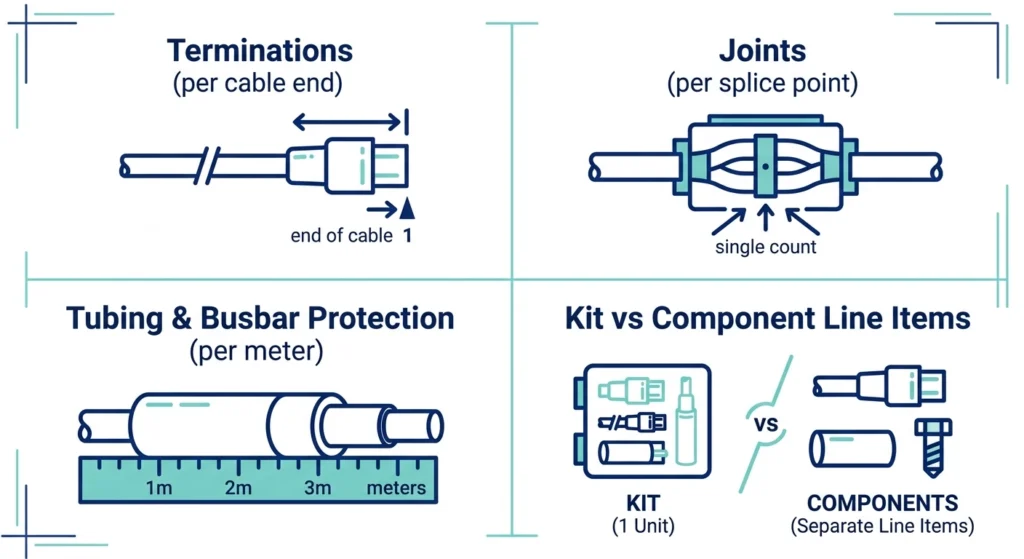
Terminations close off a cable end at a piece of equipment — switchgear, transformer bushing, or motor terminal — and are counted per cable end, not per meter of route. Indoor and outdoor kits differ in creepage design and are rarely interchangeable even at the same voltage class; a 15 kV outdoor termination for a pad-mount transformer and a 15 kV indoor termination for a switchgear cubicle need separate BOQ rows.
Straight-Through and Transition Joints
Joints connect two cable lengths mid-route and are counted by the number of splice points required, which depends on available reel length rather than total route distance alone. A single MV feeder route of 850 m might need zero joints on one continuous reel, or two to three if reel length is limited to roughly 300–500 m per drum.
Insulation Tubing and Busbar Protection
Tubing and busbar insulation cover LV applications inside switchgear or panel enclosures rather than open-route cable runs, and are typically counted by length (meters) or by number of busbar sections rather than by cable end.
Accessory Kits vs. Component-Level Line Items
Some projects specify at kit level (one line item = one complete termination kit); others break kits into components (stress control tube, sealing mastic, ground braid) for separate pricing. Kit-level listing is faster and more common; component-level breakdown is mainly used when a project needs substitutions against an approved materials list.
Cable accessory BOQ line items fall into four functional categories, each counted by a different unit — cable end, route length, or meter run.For the full category-to-application mapping across cold shrink and heat shrink families, see ZeeyiElec’s cable accessories product overview.
[Expert Insight] Category Discipline Pays Off at Quotation
Keep termination, joint, and tubing/busbar as separate line items even when unit counts are small
A generic “cable accessories” line almost always triggers a clarification round with the supplier
Kit-level listing is sufficient for most EPC bids
Reserve component-level breakdown for projects with an approved materials list
Deriving Quantities from Cable Route Data
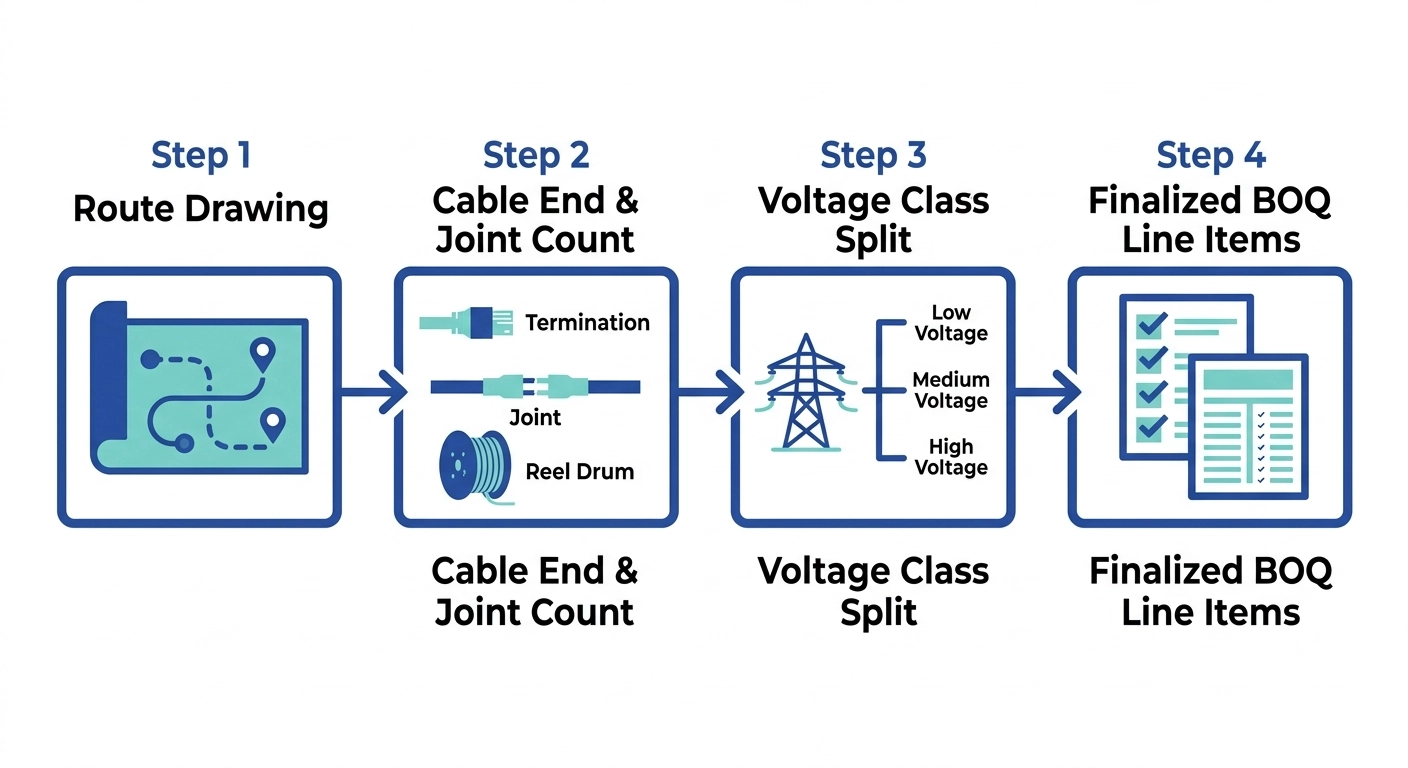
Converting route drawings into BOQ line counts follows a consistent method: identify every cable end first, then work out joint counts from route length against reel length, then apply category-specific rules for tubing and busbar items. Skipping this sequence — guessing joint counts before confirming reel length, for example — is one of the more common sources of takeoff error on multi-site EPC bids.
Counting Terminations by Cable Ends
Every cable has two ends, and each end landing on live equipment needs a termination — so termination count is roughly twice the number of cable runs, adjusted for any ends landing on accessories that don’t need a separate termination (such as a direct bushing well connection). A project with 30 individual MV feeder runs will typically need 60 termination line items before spares are added.
Counting Joints by Route Length and Reel Length
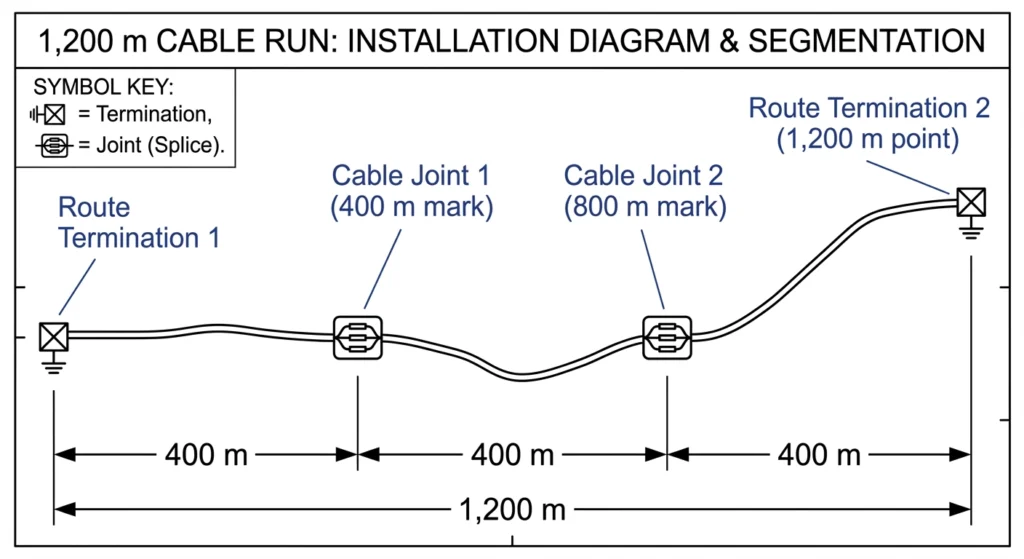
Joint count is a function of total route length divided by standard reel length, rounded up, minus one. Standard MV cable reel lengths commonly fall in the 300 m to 500 m range depending on conductor size and transport weight limits, so a 1,200 m route on 400 m reels would need two intermediate joints. Field experience on underground projects shows this figure often needs a small upward adjustment — typically one additional joint per route — to account for pulling tension limits or duct bank routing that shortens the effective pull length below the reel length.
Site Drawing Inputs Needed Before Takeoff Starts
A reliable takeoff needs four inputs: cable routing plan with distances, single-line diagram identifying every cable end and equipment type, conductor size and voltage class per run, and confirmed reel/drum length from the cable supplier. Missing reel length is the most frequent gap in early-stage BOQs, since it’s a cable-supplier data point rather than something derivable from the route drawing — and its absence forces joint count to default to a rough estimate.
A 1,200-meter MV cable route split across three 400-meter reel segments requires two intermediate joints, illustrating reel-length-based joint counting.
How Voltage Class and Conductor Size Change BOQ Line Items
Voltage class and conductor size don’t usually change how many accessories a BOQ needs — that count comes from cable ends and route length — but they determine how many distinct line items those quantities split into, since a single kit type rarely spans the full range of either parameter.
Voltage Class Breakpoints That Affect Kit Selection
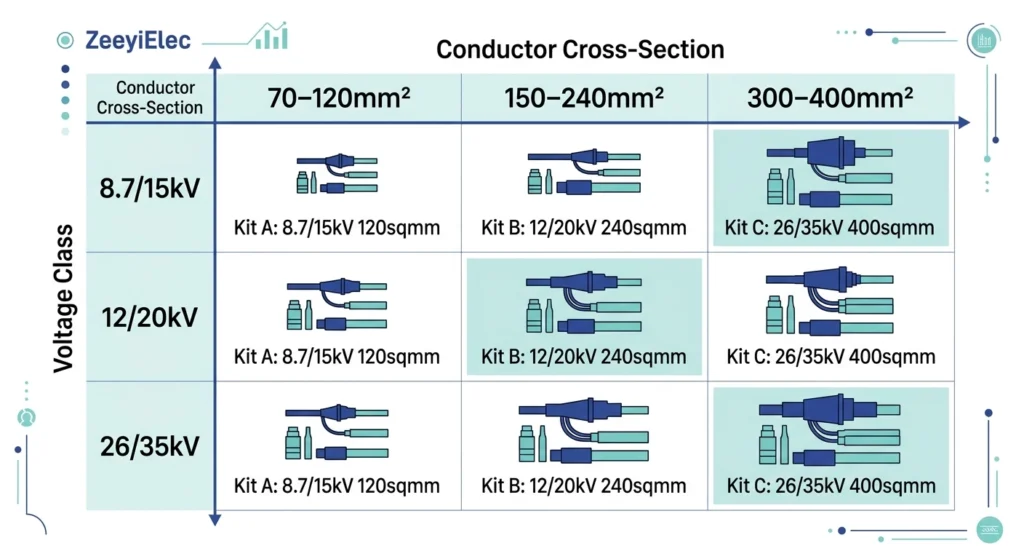
Cable accessory kits are rated across a defined voltage bracket rather than a single value — commonly 8.7/15 kV, 12/20 kV, or 26/35 kV classes for MV cold shrink and heat shrink terminations — and a project spanning multiple voltage levels needs a separate BOQ line for each bracket even if the application (indoor/outdoor termination) is otherwise identical. A project feeding both 15 kV ring-main circuits and a 35 kV incoming feeder cannot consolidate those terminations into one line item, since the kits differ in insulation thickness and creepage design. Test requirements for accessories across these voltage classes are set out in IEC 60502-4:2023, which covers accessories for cables rated 3.6/6 kV up to 18/30 kV, with test methods cross-referenced to IEC 61442. For background on standards mapping, see ZeeyiElec’s IEC specification cheat sheet.
Conductor Cross-Section Ranges and Kit Range Overlap
Most termination and joint kits cover a conductor cross-section range rather than one exact size — typically 70–120 mm² or 150–240 mm² per kit variant — so a project with sizes spread across 95 mm² to 400 mm² will need two or three separate kit-range line items. Where a run’s conductor size sits near a range boundary, field practice specifies the kit whose range comfortably brackets the actual size rather than one at the edge of its tolerance, since edge-of-range fit increases installation difficulty and can affect long-term sealing pressure.
Voltage class brackets and conductor cross-section ranges intersect to define distinct cable accessory kit line items within a project BOQ.
[Expert Insight] Where Voltage/Conductor Splits Get Missed
A mixed-voltage feeder set is the most common trigger for accidental line-item consolidation
Conductor sizes at the edge of a kit’s rated range should move to the next bracket, not be forced to fit
Kit range overlap doesn’t mean interchangeability — insulation thickness still differs
Confirm bracket boundaries with the supplier before finalizing quantities, not after PO issuance
Spares Ratios and Multi-Site EPC Considerations
Spares quantities protect against installation damage, testing failures, and future maintenance access without triggering a re-procurement cycle for a single unit — but the right percentage depends more on site accessibility and project phasing than on a fixed rule.
Typical Spares Ratio Ranges by Project Phase
For a single-site project with straightforward access, spares in the 3% to 5% range per accessory category are common, covering routine handling damage or a failed termination during commissioning tests. Multi-site EPC rollouts — where a replacement might mean shipping to a remote substation weeks after main delivery — often push spares toward 8% to 10%, particularly for terminations and joints that are hard to source individually once the main order has closed.
Adjusting Quantities Across Staggered Delivery Milestones
Phased EPC rollouts — five substations commissioned over 18 months rather than all at once — create a spares problem distinct from single-delivery projects: ordering all spares upfront ties up capital and risks obsolescence if a design change alters conductor size, while ordering per phase adds lead time to each milestone. Concentrating spares procurement at the rollout’s midpoint tends to work better than either extreme, since by then enough installation data exists to see which categories are actually experiencing damage, letting later phases’ ratios adjust based on real consumption. A project with termination damage concentrated in outdoor 35 kV kits during phase one would reasonably raise that line item’s spares percentage for later phases rather than applying a flat ratio across every category.
Common BOQ Errors That Cause Field Shortfalls or Overages
Most cable accessory BOQ errors trace back to a small number of recurring patterns, each producing a predictable downstream cost — a shortfall that stalls installation, or an overage that ties up budget in unused stock.
Undercounting Joints on Non-Straight Routes
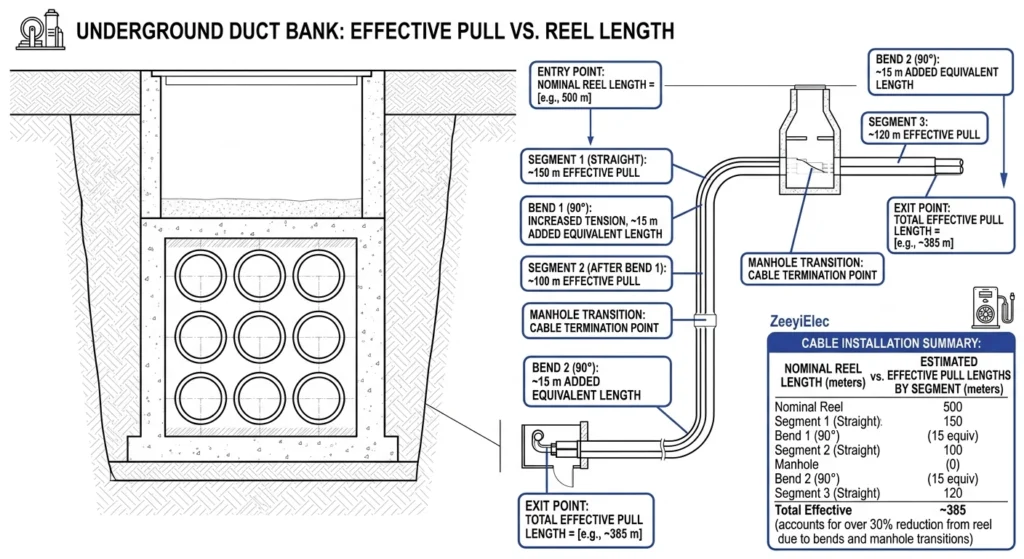
Joint counts derived purely from route length divided by reel length assume a straight, unobstructed pull, but underground routes rarely run that way — duct bank bends, manhole transitions, and road crossings all reduce effective pullable length below the reel’s rated length. A route measured at 900 m on a drawing might only be pullable in three segments of roughly 250 m to 300 m each once bends and pulling tension are accounted for, requiring one more joint than a flat length-over-reel calculation suggests. Field crews encountering this shortfall mid-installation typically resolve it with an emergency single-unit order, which on export projects can add two to four weeks to a schedule that assumed no reorder cycle.
Mixing Voltage Classes Under One Generic Line Item
A line item written as “MV terminations — qty 60” without a voltage bracket looks complete on paper but forces the supplier to request clarification or quote against an assumption — either stalls the RFQ stage that follows. Where a project genuinely spans two voltage classes, collapsing them into a single generic count is a common cause of mismatched delivery.
Duct bank bends and manhole transitions shorten the effective pullable cable length below nominal reel length, increasing required joint count.For a broader view of how installation-stage issues connect back to procurement decisions, see ZeeyiElec’s field failure diagnosis workflow.
Working with Your Supplier to Validate and Finalize the BOQ
A BOQ built from route drawings and voltage class data still benefits from a technical review before moving into RFQ and PO stages — a supplier with manufacturing-level product knowledge will often catch mismatches before they reach the factory floor. This matters especially where cable accessory quantities are quoted alongside separate transformer accessory line items on the same EPC package, since procurement teams frequently source both from a single supplier covering transformer accessories and cable accessories together.
What a Supplier Technical Review Checks Before Quotation
A useful review confirms four things: that voltage class brackets match actual cable ratings rather than nominal system voltage, that conductor size ranges don’t sit at the edge of a kit’s tolerance, that joint counts account for route geometry rather than straight-line distance, and that spares ratios reflect site accessibility for each phase. Sharing the draft BOQ alongside route drawings and a preliminary cable schedule lets a supplier flag gaps in a single review pass rather than through repeated RFQ clarification cycles.
ZeeyiElec supports EPC procurement teams through this validation step for both cable and transformer accessory BOQs — reach out with route data and voltage class breakdown for a technical review before finalizing quantities for quotation.
Frequently Asked Questions
How many spare terminations should be included in a cable accessory BOQ?
Spares ratios commonly range from 3% to 10% of the total termination count, with the actual figure depending on site accessibility, project phase, and how disruptive a future outage would be for replacement.
What’s the difference between a BOQ and an RFQ for cable accessories?
A BOQ lists quantities and line items for pricing and procurement, while an RFQ captures the technical specification data — voltage class, conductor size, standards — needed to confirm the correct product for each line item; EPC projects typically need both, in that order.
Do joints and terminations need separate BOQ line items even on the same cable run?
Yes, because they use different kit types and are counted differently — terminations by cable end, joints by route length divided by available reel length — so combining them into one line item risks under- or over-ordering one or the other.
How does conductor cross-section affect cable accessory BOQ quantities?
It doesn’t usually change the quantity count, but it does change which kit variant occupies each line item, since most cold shrink and heat shrink kits cover a defined cross-section range rather than a single conductor size.
Should a cable accessory BOQ be revised after cable route drawings change?
Yes — any change to route length, cable count, or termination points should trigger a BOQ revision, since quantities are derived directly from those inputs rather than from the original project estimate.
What information does a supplier need to validate a submitted BOQ?
Suppliers typically need voltage class, conductor size and count per line item, indoor/outdoor application, and route length data to confirm quantities and flag any mismatched or ambiguous line items before quotation.
yoyo shi
Yoyo Shi writes for ZeeyiElec, focusing on medium-voltage accessories, transformer components, and cable accessory solutions. Her articles cover product applications, technical basics, and sourcing insights for global electrical industry buyers.





 English
 한국어
한국어 العربية
 Español
 हिन्दी
 தமிழ்
தமிழ் Deutsch (Sie)
 Français
 Português do Brasil
 Русский