Choosing the right cable accessories manufacturers for EPC projects differs from a single substation retrofit purchase — an EPC contract typically bundles multiple voltage classes, multiple sites, and a fixed commissioning date, which shifts evaluation away from unit price and toward supply consistency, documentation completeness, and manufacturing depth. An EPC contract typically bundles multiple voltage classes, multiple sites, and a fixed commissioning date, which shifts evaluation away from unit price and toward supply consistency, documentation completeness, and manufacturing depth. A supplier that performs well on a single 15 kV termination order can still create schedule risk across a 20-site rollout if production capacity, certification scope, or export documentation isn’t built for volume.
What EPC Buyers Should Actually Evaluate in a Cable Accessories Manufacturer
The first filter is whether a manufacturer’s catalog spans the project’s full voltage requirement, not just its headline product.
Voltage Class and Product Scope Coverage
Many suppliers market a 15 kV termination line prominently but only carry joint kits up to 24 kV, forcing a second vendor relationship for the balance of the project. A range covering roughly 8.7/15 kV through 26/35 kV in cold shrink, or 1 kV through 35 kV across a heat shrink termination and joint matrix, indicates a manufacturer can serve mixed-voltage EPC scope without gaps.
Certification and Standards Compliance
ISO 9001 confirms a quality management system exists, but it says nothing about whether a specific accessory family has passed type testing under the relevant product standard. For cable accessories in the 6 kV (Um = 7.2 kV) up to 30 kV (Um = 36 kV) class, the applicable reference is IEC 60502-4, which specifies type test requirements for terminations, joints, and separable connectors, with test methods per IEC 61442. Buyers should request the actual type test report tied to the SKU being quoted, not a general company-level certificate.
OEM/ODM and Custom Engineering Capability
EPC projects sometimes need kit variants outside a manufacturer’s standard catalog — an unusual conductor cross-section or a client-specified branding requirement. Suppliers offering OEM/ODM support can typically accommodate these without a full new product development cycle, but confirming turnaround time for custom variants before contract signature avoids mid-project surprises.
Export Documentation and Logistics Readiness
A manufacturer’s familiarity with commercial invoices, certificates of origin, and test certificate packaging directly affects customs clearance speed. Field experience across export cycles shows suppliers unfamiliar with L/C-specific documentation are a disproportionate source of the two- to three-week port delays that stall EPC commissioning schedules.
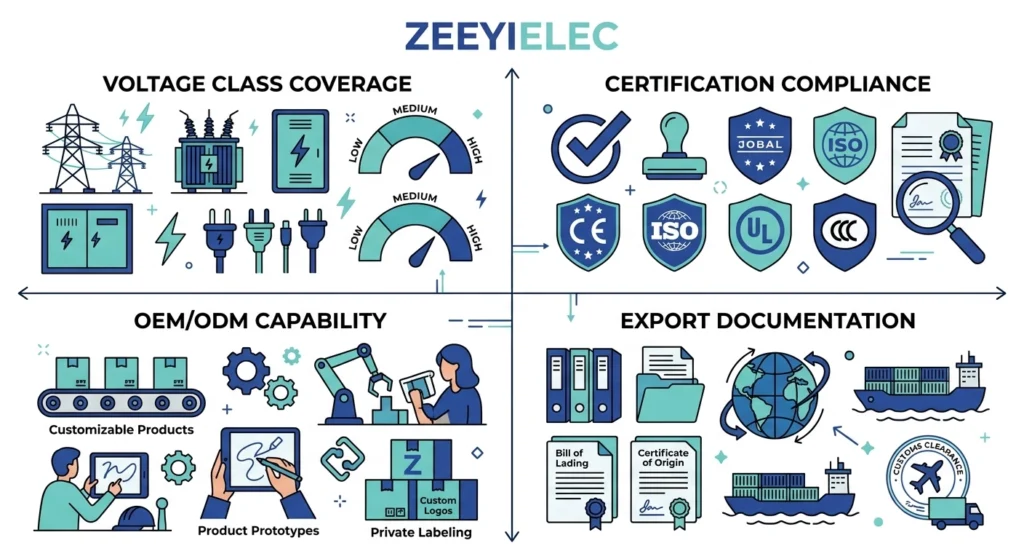
A four-quadrant evaluation framework covering voltage class coverage, certification compliance, OEM/ODM capability, and export documentation readiness for EPC supplier qualification.
[Expert Insight]
A blanket “MV-rated” certificate isn’t proof of compliance at every voltage point in a mixed-class order — check the tested class matches what’s shipping.
OEM turnaround time is a better predictor of EPC schedule risk than catalog breadth alone.
Request the export documentation sample package before PO issuance, not after.
Why Cold Shrink vs Heat Shrink Capability Signals Manufacturing Depth
A manufacturer’s ability to produce both cold shrink and heat shrink accessories — and explain the trade-offs between them — is a reasonable proxy for materials engineering investment rather than assembly-only production. The two rely on entirely different physical mechanisms.
Elastomeric Memory vs Cross-Linked Polymer Systems
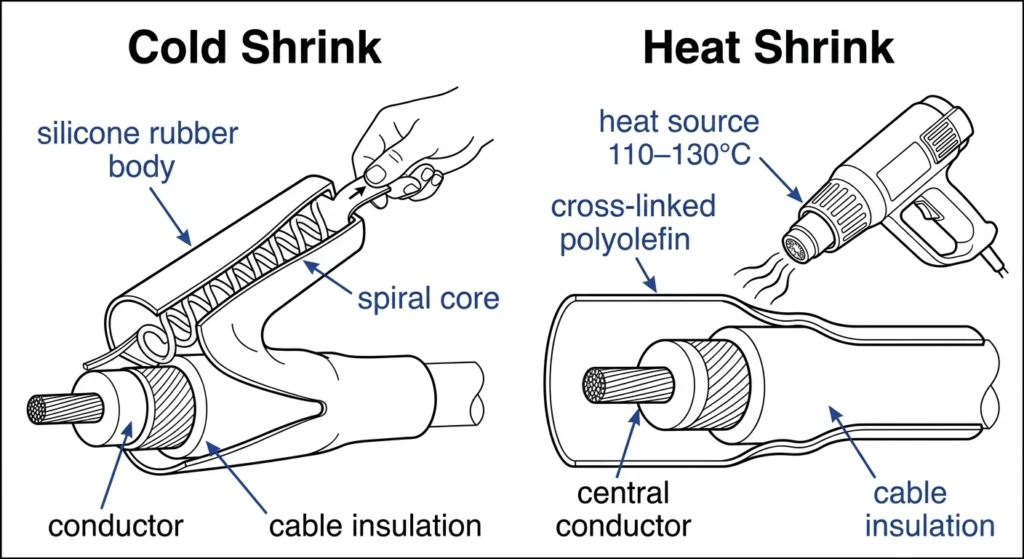
Cold shrink accessories are built from silicone rubber or EPDM, factory-expanded over a removable plastic spiral core. During installation, the core is unwound and the material collapses under its own elastic memory, applying continuous radial pressure without any heat source — attractive for confined vaults or sites where open flame is restricted.
Heat shrink accessories use cross-linked polyolefin, expanded during manufacturing and recovering permanently when heated to an installation temperature typically in the 110°C–130°C range. This produces a tighter, more conformal fit on irregular cable geometries but requires trained crews and controlled heat application — a constraint on hazardous-area sites.
Manufacturers offering both product lines typically specify cold shrink kits across an 8.7/15 kV – 26/35 kV range and heat shrink terminations spanning 1 kV – 35 kV, with a shrink ratio commonly quoted at 3:1 or 4:1 depending on cable outer diameter tolerance.
Why a Full Product Range Signals Engineering Maturity
Projects rarely stay confined to one technology — a switchgear room termination might specify heat shrink for a tighter fit, while an adjacent underground joint pit specifies cold shrink to avoid open-flame permits. A manufacturer producing both in-house generally maintains tighter QC continuity than one outsourcing a line. Per IEC product standards governing cable accessory performance testing, both technologies are expected to meet equivalent electrical stress and sealing requirements — the choice is an installation-conditions decision, not a quality tier.Cross-sectional comparison of cold shrink silicone rubber recovery via spiral core removal versus heat shrink cross-linked polyolefin recovery under applied heat.
Top 10 Cable Accessories Manufacturers for EPC Projects
A defensible “top manufacturers” shortlist for EPC procurement groups candidates by criteria that affect execution — voltage class breadth, documentation reliability, and volume readiness — rather than brand recognition alone.
Manufacturers with Broad Voltage Class Coverage (10kV–35kV+)
EPC projects spanning distribution and sub-transmission interconnects benefit from suppliers whose catalog runs continuously from roughly 10 kV through 35 kV without a gap forcing a second vendor. Manufacturers in this tier typically publish both cold shrink and heat shrink families across that band, with conductor cross-section support extending up to 800 mm². Confirm BIL ratings and creepage distances are documented per voltage class, not quoted as one blanket figure.
Manufacturers Strong in Export Documentation and L/C Compliance
For contracts involving letters of credit, fluency with commercial invoice formatting, certificates of origin, and test-certificate packaging matters as much as the product. Manufacturers with established export departments turn around a complete documentation package within days of shipment readiness, rather than requiring the buyer to chase certificates after the container has left port.
Manufacturers Suited to High-Volume EPC Rollouts
Multi-site EPC projects — 15 to 40 substations on a phased schedule — need a manufacturer whose production capacity and sample-approval process scale without extending lead time linearly. Suppliers in this category often maintain standing inventory on common SKUs (10 kV and 20/24 kV termination kits), keeping typical lead times to a few weeks for standard kits versus considerably longer for fully custom configurations.
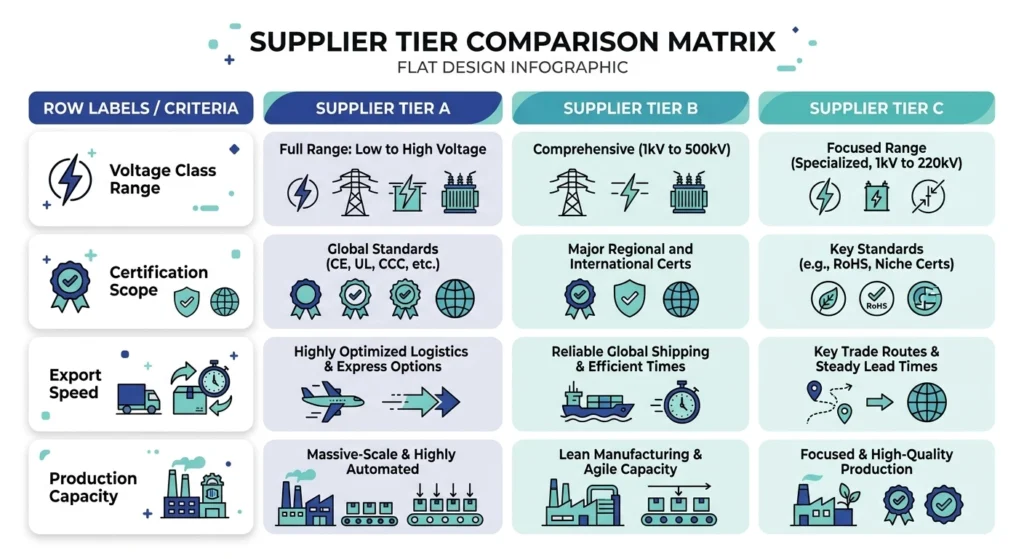
A capability comparison matrix ranking manufacturer tiers by voltage class range, certification scope, export documentation speed, and production capacity.
Certification, Testing, and Standards Compliance Checklist
Certification claims are only useful if verifiable against a specific product SKU and test date, not treated as a blanket company credential.
Type Test vs Routine Test Documentation to Request
A type test validates that a design performs reliably under worst-case electrical, thermal, and mechanical stress, conducted once per design family. A routine test is performed on every production unit or lot before release, confirming the batch matches the validated design. Request both: the type test report for the exact product family, and the routine test record for the actual shipping lot. A type test certificate alone, without a matching routine test record, leaves a traceability gap that surfaces most often at factory acceptance testing.
IEC Reference Points for Cable Accessory Qualification
Qualification testing generally covers partial discharge levels, impulse withstand voltage appropriate to the rated voltage class, and thermal cycling endurance. For a 15 kV class termination, expect documented performance at the corresponding BIL rating, with reports specifying the exact voltage class tested rather than a generic “medium voltage” label.
A complete qualification package should specify test parameters against the rated voltage class — e.g., an 8.7/15 kV cold shrink termination tested at its corresponding BIL, versus a 26/35 kV unit tested at a substantially higher impulse withstand level — since a single generic “MV-rated” certificate does not confirm compliance at every voltage point in a mixed-class EPC order.
Field experience reviewing supplier documentation shows incomplete specifications and missing voltage-class-specific test data account for a meaningful share of site rejections during commissioning.
EPC-Specific Sourcing Realities: MOQ, Lead Time, and Multi-Site Coordination
Sourcing that works for a single substation order can break down once accessories need to reach 10–20 sites on a staggered commissioning schedule.
Sample Approval Loops on Compressed EPC Schedules
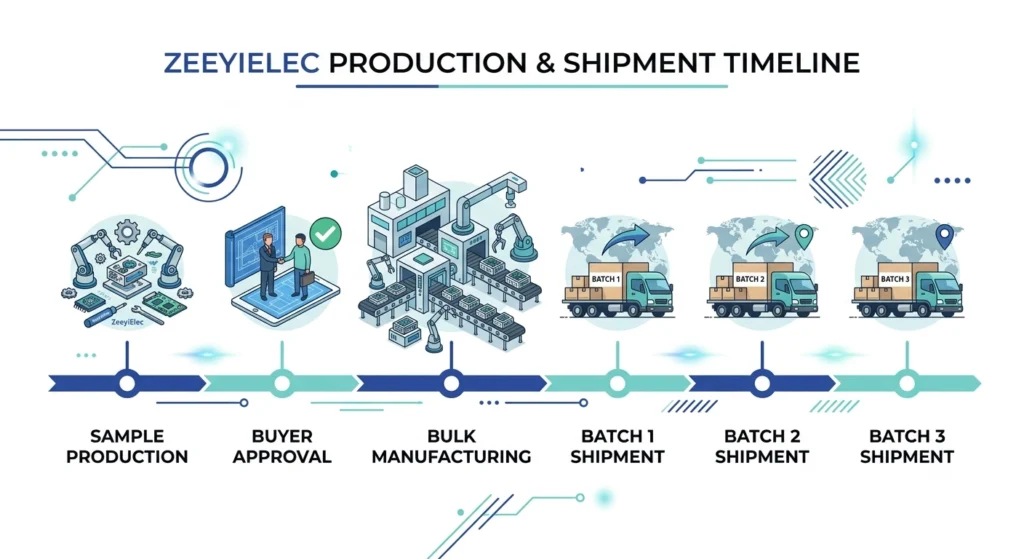
Most manufacturers require sample approval before releasing a bulk run, particularly for non-standard configurations. This loop — sample production, shipment, buyer sign-off, then bulk release — commonly adds two to four weeks to the front end of a project. Confirming sample lead time and MOQ at the RFQ stage, rather than after PO issuance, avoids a late-stage schedule conflict.
Coordinating Staggered Deliveries Across Project Sites
Phased commissioning usually means shipments arrive in batches aligned to each site’s construction milestone. Manufacturers accustomed to split shipments handle this more smoothly, since each partial shipment still needs its own complete documentation set to clear customs independently. A supplier unfamiliar with split-shipment logistics can leave early-commissioning sites waiting on accessories bundled with kits destined for a site months out.
A typical phased EPC delivery plan might stagger shipments across 3–5 batches over a 4–6 month rollout window, with each batch sized to match the voltage class and conductor range needed at that stage of site commissioning.
A phased delivery timeline showing the sample approval loop feeding into three to five staggered bulk shipments across multiple EPC project sites.
[Expert Insight]
The sample approval loop is the most commonly under-scheduled item in EPC cable accessory procurement — build it into the master timeline explicitly.
Split-shipment capability matters more than total lead time on multi-site projects.
Standing inventory on common SKUs shortens the path for non-custom line items.
Common Mismatches and Field Failure Risks When Selecting a Supplier
Choosing a manufacturer on price and headline specs alone tends to surface consequences months later, at commissioning or during early service life, when correction costs far more than it would have at the RFQ stage.
Voltage Class or Conductor-Size Mismatches at Site
A recurring pattern involves accessories ordered against a nameplate voltage without confirming the manufacturer’s actual dimensional tolerance for the cable’s outer diameter. A cold shrink kit can fail to seat correctly if insulation diameter falls outside the kit’s expansion range; heat shrink kits carry a similar risk tied to their fixed shrink ratio, which sets hard bounds on accommodated cable diameter. On multi-site projects sourcing cable from different reels or manufacturers across phases, this risk compounds unless dimensions are re-verified per shipment.
Consequences of Skipping Factory Acceptance Verification
Factory acceptance testing (FAT) confirms the specific batch shipping against a purchase order matches the ordered rating, not just the general product family. Field experience diagnosing early failures shows a disproportionate share trace back not to defective design, but to batches shipped without buyer-witnessed or third-party FAT verification, letting a nameplate-to-PO mismatch reach site undetected. On an EPC project with dozens of kits shipping over months, skipping FAT on even a subset removes the checkpoint most likely to catch a mismatch before it becomes a field failure at energization.
Getting Technical Support and Quotations for Your EPC Project
Evaluating manufacturers on paper narrows the list, but confirming voltage class coverage, certification scope, and export documentation readiness against your specific project still requires a direct technical conversation. Before issuing an RFQ, share the project’s full scope up front: voltage classes involved (e.g., 8.7/15 kV through 26/35 kV), estimated conductor cross-sections up to 800 mm², site count, and the commissioning timeline.
A manufacturer that responds with specifics — actual type test documentation, realistic lead times inclusive of any sample loop, and a clear split-shipment plan — signals the operational readiness an EPC project depends on. A vague or delayed response is itself useful information at the qualification stage.
ZeeyiElec supplies both cold shrink and heat shrink cable accessories across LV and MV voltage classes, with OEM/ODM support and export documentation handled in-house. Share your project’s technical specification and site rollout schedule for a quotation reflecting actual lead times rather than catalog defaults — reach out via [email protected] with your voltage class and volume requirements.
Frequently Asked Questions
How many cable accessory manufacturers should an EPC contractor shortlist before RFQ?
Most EPC procurement teams shortlist 3–5 manufacturers per voltage class, narrowing based on certification match and prior export experience, though larger multi-site projects sometimes carry more for redundancy.
What certifications should a cable accessories manufacturer hold for EPC projects?
Buyers typically look for ISO 9001 quality management certification alongside product-specific type test reports, though the exact certificate set depends on the destination country’s grid code and the project’s contractual specification.
How long does lead time typically run for cold shrink or heat shrink cable accessory orders?
Lead times commonly range from a few weeks for standard catalog kits to several weeks longer for custom-engineered configurations, depending on order volume and whether sample approval is required first.
What’s the difference between a manufacturer and a trading company for cable accessories sourcing?
A manufacturer controls production and testing directly, which generally shortens the RFQ-to-quotation cycle and improves traceability, while a trading company adds a layer of communication that can affect responsiveness on technical clarifications.
Can one manufacturer supply both cold shrink and heat shrink cable accessories for a single EPC project?
Many manufacturers offer both technologies, which can simplify vendor management for mixed-voltage-class projects, though buyers should still verify each product line’s certification independently rather than assuming blanket compliance.
What documentation should EPC buyers request before finalizing a cable accessories supplier?
Typical requests include type test certificates, routine test records for the specific batch, and export documentation samples, since incomplete documentation is a frequent source of customs or commissioning delays.
yoyo shi
Yoyo Shi writes for ZeeyiElec, focusing on medium-voltage accessories, transformer components, and cable accessory solutions. Her articles cover product applications, technical basics, and sourcing insights for global electrical industry buyers.





 English
 한국어
한국어 العربية
 Español
 हिन्दी
 தமிழ்
தமிழ் Deutsch (Sie)
 Français
 Português do Brasil
 Русский