Most Bay-O-Net failures aren’t mysterious once you trace them back — they cluster into a small number of recurring patterns, and each pattern has a specific root cause that’s usually preventable at the design-review or procurement stage, not just the field-service stage. This Bay-O-Net failure casebook walks through seven composite, illustrative scenarios built from common failure patterns across the Bay-O-Net product category — not documented reports from specific customers or projects. The goal is pattern recognition: read the symptom, understand the likely mechanism, and see what upstream decision would have prevented it.
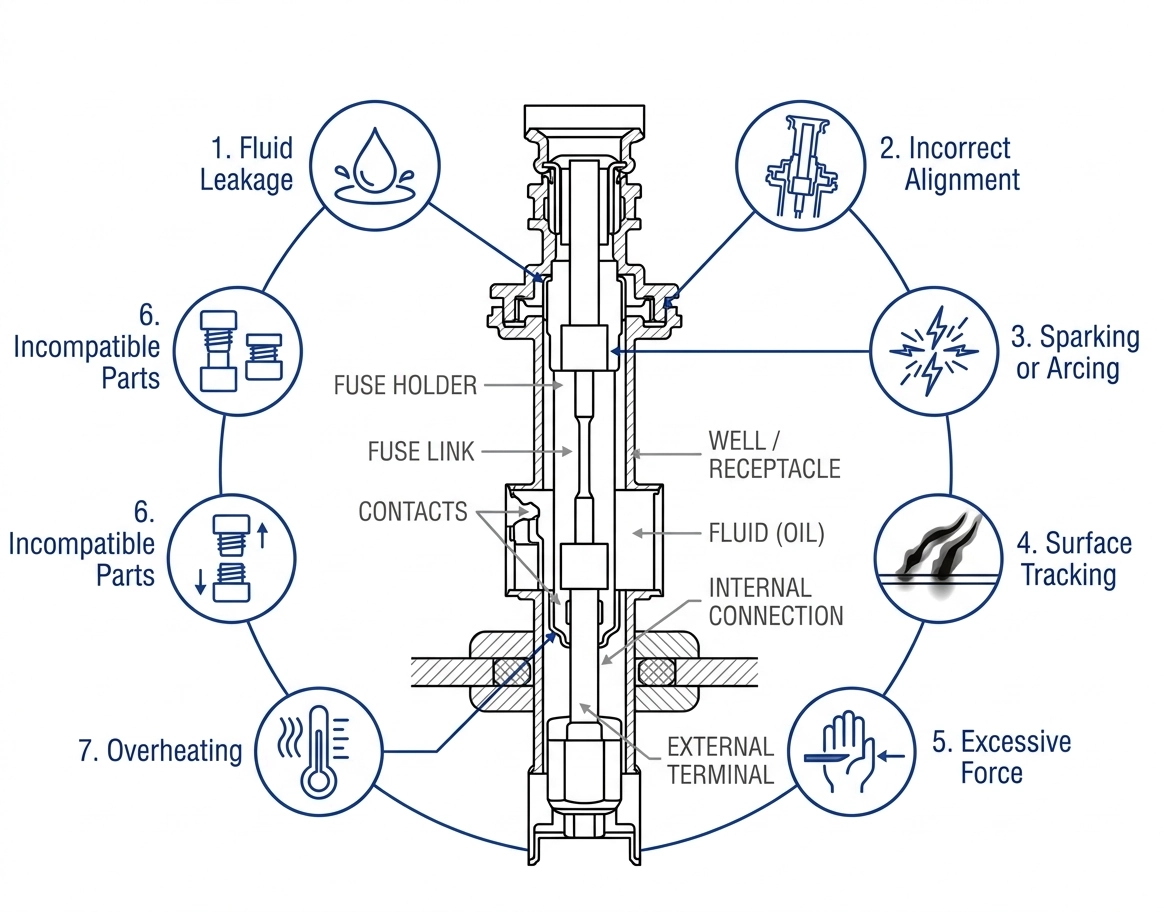
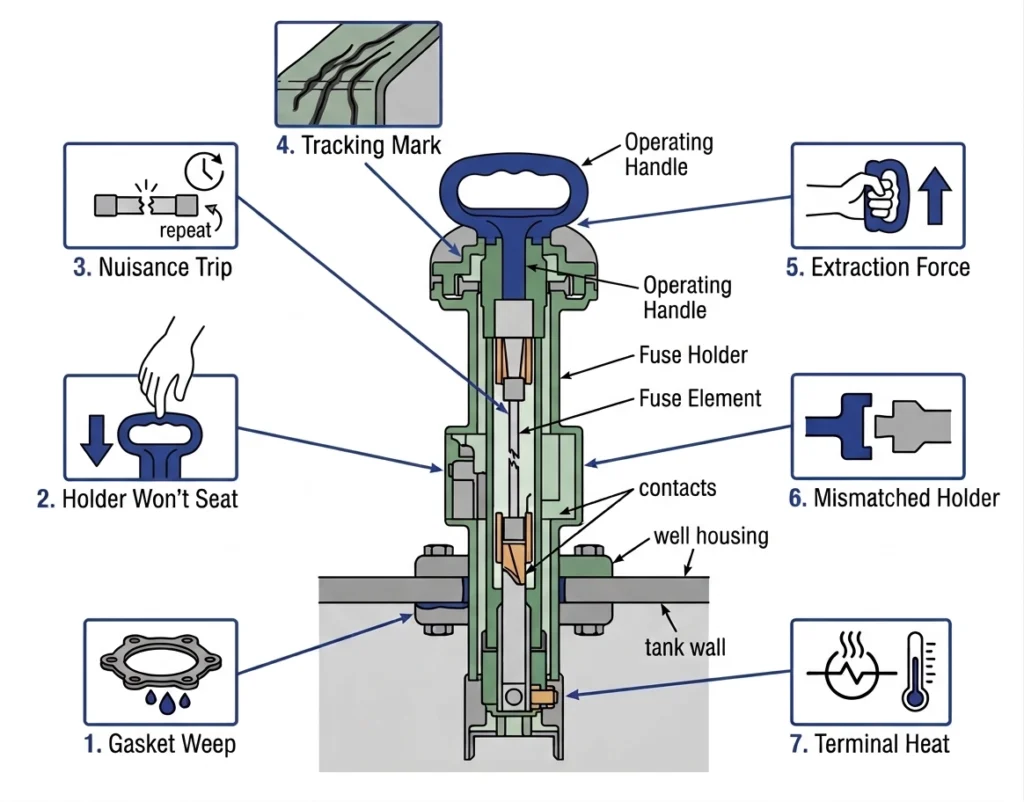
Seven small labeled icons representing each failure scenario arranged around a central Bay-O-Net assembly diagram.
Scenario 1: Flange Gasket Weeping After the First Winter
Symptom: A unit that passed initial commissioning shows oil weeping at the flange after its first full seasonal thermal cycle. Likely cause: Normal gasket compression set during the first thermal cycle wasn’t re-checked with a torque verification pass — a known behavior, not a defect, that becomes a real leak only when left unaddressed. Prevention: Build a first-thermal-cycle torque re-check into the standard commissioning schedule rather than treating commissioning-day torque as final.
Scenario 2: Fuse Holder Won’t Seat Flush
Symptom: A replacement fuse holder stops short of the reference line under normal hand pressure during a routine fuse change. Likely cause: Debris accumulation in the well, or a holder from a slightly different production batch/series than the original well was speced for. Prevention: Verify holder and well series match before ordering replacements, not just voltage class and current rating.
Scenario 3: Repeated Nuisance Fuse Operation at Rated Load
Symptom: A fuse clears under normal load conditions with no external fault event. Likely cause: The fuse current rating was undersized relative to actual load growth on that feeder since original installation — a specification-drift problem, not a fuse defect. Prevention: Re-verify fuse current rating against current (not original) load data whenever a feeder has seen significant load growth.
Scenario 4: Visible Tracking Mark on the Well Housing
Symptom: A branching carbonized mark appears on the external housing surface during a routine visual inspection. Likely cause: Accumulated surface pollution in a higher-severity environment than the site’s pollution class assumed at original design. Prevention: Re-assess site pollution severity periodically rather than treating the original design-time classification as permanent — this is covered in more depth in ZeeyiElec’s related bushing field guidance.
Scenario 5: Fuse Holder Extraction Requires Excessive Force
Symptom: A field crew reports unusual resistance removing a fuse holder for routine replacement, well beyond normal friction. Likely cause: Internal contact misalignment from a prior over-insertion event, or corrosion buildup from long dwell time without a fuse change. Prevention: Don’t force it — document insertion/extraction resistance at every service event so a trend (not just a single hard pull) triggers escalation.
Scenario 6: Mismatched Replacement Holder from a Different Series
Symptom: A holder installed during an emergency outage restoration technically fits the well opening but seats with abnormal play. Likely cause: Emergency stock sourced from a different series than the fleet’s standard, selected under time pressure without series verification. Prevention: This is exactly the failure mode a documented spare-parts standardization strategy is designed to prevent — see ZeeyiElec’s guidance on fleet-wide Bay-O-Net standardization for the procurement-side fix.
Scenario 7: Terminal Overheating Traced to Under-Torqued Flange Bolts
Symptom: Thermal imaging during a routine survey flags an elevated temperature at the Bay-O-Net terminal connection, with no corresponding load anomaly. Likely cause: Flange bolts torqued below specification during original installation, creating a marginal connection that degrades gradually under thermal cycling rather than failing immediately. Prevention: Torque verification at commissioning — using nameplate values, not generic figures — catches this before it becomes a thermal event.
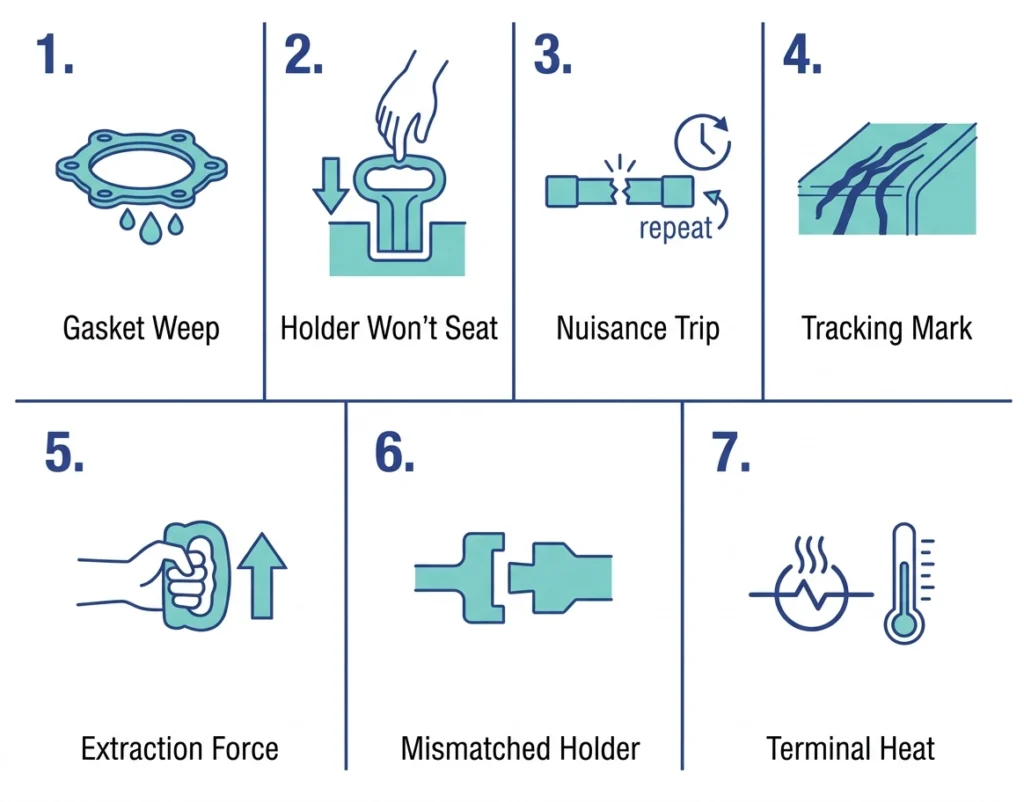
Simple visual index of all 7 scenarios as a numbered grid, each with a one-line symptom label.
Quick Reference: Symptom → Likely Cause → Action
Casebook Summary Table
Scenario
Symptom
Root Cause Category
Preventable At
1
Gasket weeping, first winter
Normal compression set, unchecked
Commissioning schedule
2
Holder won’t seat flush
Series mismatch or debris
Procurement / cleaning
3
Nuisance fuse operation
Load growth vs. fuse rating drift
Periodic re-review
4
Tracking mark on housing
Pollution severity underestimated
Site reassessment
5
Excessive extraction force
Contact misalignment / corrosion
Service-event documentation
6
Mismatched emergency holder
No series standard for stock
Spare parts strategy
7
Terminal overheating
Under-torqued flange bolts
Commissioning torque check
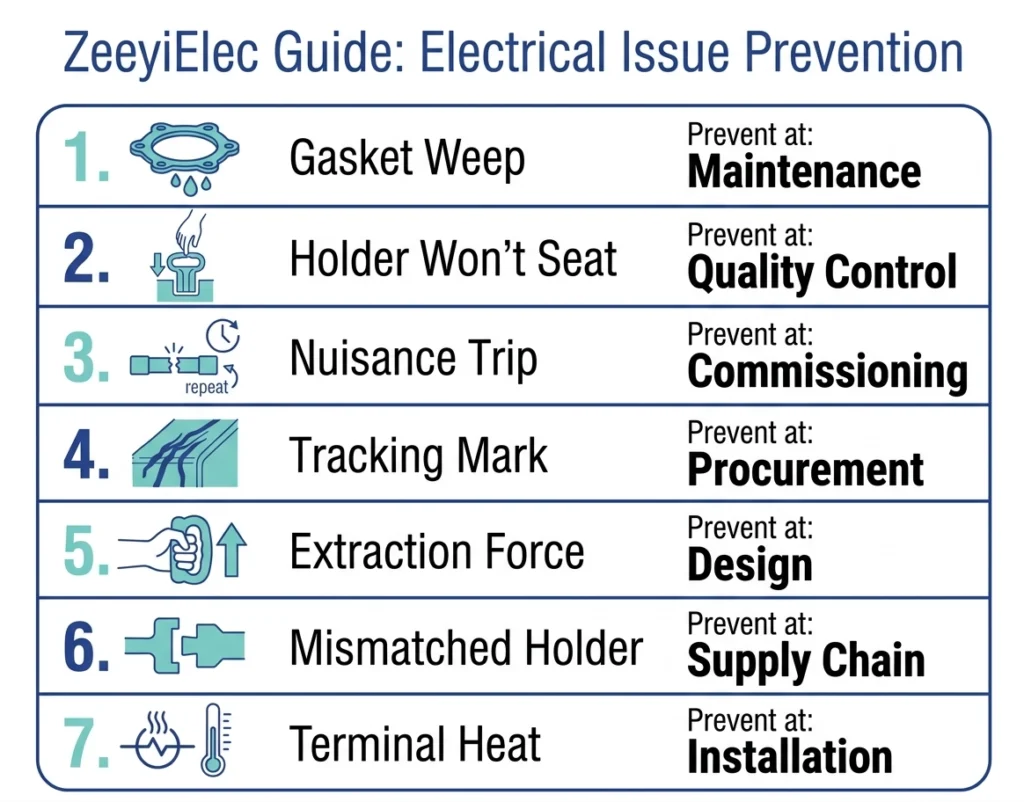
Seven-row visual checklist card summarizing scenario number, symptom icon, and prevention point for quick field reference.
[Expert Insight: Reading the Pattern, Not Just the Scenario]
Five of the seven scenarios above trace back to a commissioning-stage or procurement-stage decision, not a manufacturing defect — this is a pattern worth flagging to whoever owns your commissioning checklist
If the same scenario recurs across multiple units in a fleet, treat it as a process gap (spec, training, or documentation), not a batch of bad parts, until evidence points otherwise
This methodology broadly follows the investigative approach outlined in IEEE C57.125, which frames transformer-related failure investigation as tracing the most probable cause systematically rather than defaulting to a component-defect assumption.
When a Scenario Doesn’t Match the Casebook
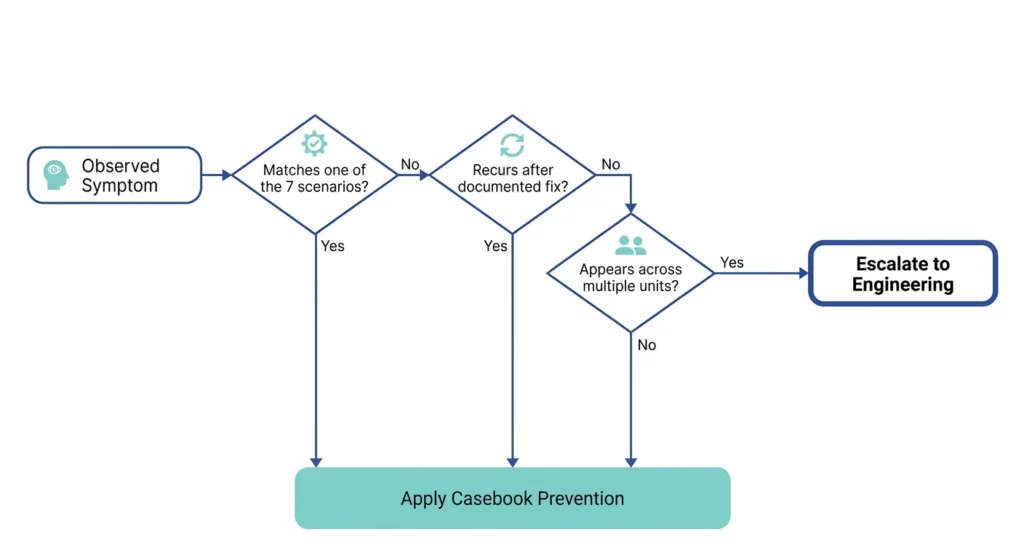
Escalate to engineering rather than guessing when a failure symptom doesn’t clearly map to one of these seven patterns, when the same scenario recurs on the same unit after a documented fix, or when a scenario appears simultaneously across multiple units in a way that suggests a shared root cause beyond individual installation error.
Decision flow for when to escalate a failure to engineering — symptom doesn’t match, recurs after a fix, or appears across multiple units.
For sourcing and replacement parts that address several of these scenarios at the root — series-matched fuse holders, correctly specified current ratings — ZeeyiElec’s transformer accessories range covers the full Bay-O-Net product family built to documented specifications. For broader accessory selection support, see the transformer accessories selection guide.
Frequently Asked Questions
Are these seven scenarios based on real documented failures at specific sites?
No — they’re composite, illustrative patterns built from common failure mechanisms across the Bay-O-Net product category, not reports from specific customers, projects, or test results. They’re meant to help with pattern recognition, not to represent a specific incident log.
Which of these seven scenarios is most common in the field?
Gasket weeping after the first thermal cycle and under-torqued flange bolts tend to be the most frequently reported patterns, largely because both stem from a commissioning-stage step that’s easy to skip under time pressure.
Does a single occurrence of one of these scenarios mean the product is defective?
Not necessarily — most of these scenarios trace back to an installation, procurement, or maintenance-process gap rather than a manufacturing defect. Recurrence across multiple units on the same fleet is the stronger signal worth investigating as a process issue.
How does this casebook relate to the field failure diagnosis workflow?
This casebook provides pattern recognition for Bay-O-Net specifically; the diagnosis workflow provides the general step-by-step process for investigating any accessory failure once a symptom appears, applicable beyond just Bay-O-Net assemblies.
Can spare parts strategy alone prevent scenario 6 (mismatched replacement holder)?
Largely yes — a documented series standardization plan, so emergency stock is always series-matched to the fleet, directly addresses the root cause of that scenario rather than relying on field crews to catch a mismatch under time pressure.
Should thermal imaging surveys specifically target Bay-O-Net terminals?
It’s a reasonable addition to routine thermal surveys, since terminal overheating from under-torqued connections (scenario 7) often shows no other external symptom until temperatures are already elevated.
yoyo shi
Yoyo Shi writes for ZeeyiElec, focusing on medium-voltage accessories, transformer components, and cable accessory solutions. Her articles cover product applications, technical basics, and sourcing insights for global electrical industry buyers.





 English
 한국어
한국어 العربية
 Español
 हिन्दी
 தமிழ்
தமிழ் Deutsch (Sie)
 Français
 Português do Brasil
 Русский