Why Bay-O-Net Spare Parts Deserve Their Own Inventory Strategy
A utility running a mixed fleet of pad-mounted and pole-type distribution transformers typically treats Bay-O-Net fuse assemblies as a minor line item in the broader MRO budget — until a widespread fault event or a cold-weather failure spike reveals that the warehouse holds the wrong fuse ratings, or worse, no spare fuse holders at all for an older assembly series still in service. Bay-O-Net components sit in an awkward inventory position: they’re replaced far more often than a bushing or tap changer, but far less predictably than a consumable like gasket material alone.
This guide lays out a practical Bay-O-Net spare parts strategy for utility fleets — covering what to stock, how to size that stock, and where standardization pays off.— not the fuse coordination logic itself, which is covered in ZeeyiElec’s Bay-O-Net vs current limiting fuse coordination guide, or the mechanical installation tolerances for a single unit, which is a separate field-level question. For cable accessory spares on the same fleet, see ZeeyiElec’s cable accessories range.
What Actually Wears or Fails in a Bay-O-Net Assembly
Not every component in a Bay-O-Net assembly fails at the same rate, and treating the whole assembly as a single spare part wastes warehouse budget.
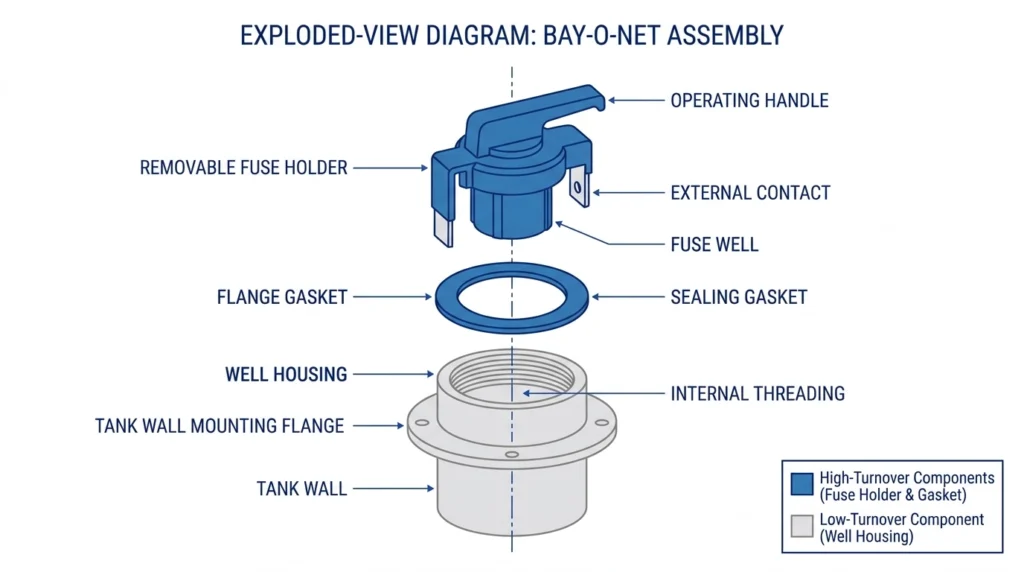
High-Turnover Components
The fuse link/holder itself is the component most utilities replace routinely — it’s designed to be sacrificial, clearing a fault by design rather than failing unexpectedly. The flange gasket is the second most commonly replaced item, since it takes a compression set over its service life and is cheap enough that many utilities replace it proactively during any planned outage that opens the assembly.
Low-Turnover Components
The well housing itself — the fixed part welded or bolted into the tank wall — is rarely a spare parts item in practice; it’s designed for the transformer’s full service life and typically only gets replaced if the tank itself is being reworked. Budgeting warehouse space for spare well housings at the same ratio as fuse links is a common and avoidable over-investment.
Exploded view of a Bay-O-Net assembly with components color-coded by typical replacement frequency — high-turnover versus low-turnover parts.
Which Components to Stock vs. Order As-Needed
Stocking Decision Table
Component
Typical Stocking Approach
Why
Fuse link/holder (common current ratings)
Stock on-hand
Sacrificial by design, frequent replacement, low unit cost
Flange gasket
Stock on-hand
Low cost, high-frequency replacement during any planned access
Fuse link/holder (uncommon current ratings)
Order as-needed
Low usage frequency doesn’t justify shelf space
Well housing / sidewall mounting hardware
Order as-needed
Multi-decade service life, rare replacement trigger
Complete assembly (housing + holder)
Order as-needed, except for critical/non-redundant feeders
High cost, low failure rate for the housing portion
ZeeyiElec’s Bay-O-Net fuse assemblies are produced across a documented current-rating range — fuse links covering 6.3A through 140A continuous nominal current — which is exactly why current-rating spread across a fleet, not just voltage class, drives how many distinct SKUs a warehouse ends up carrying.
Sizing Your Spare Parts Inventory Across a Fleet
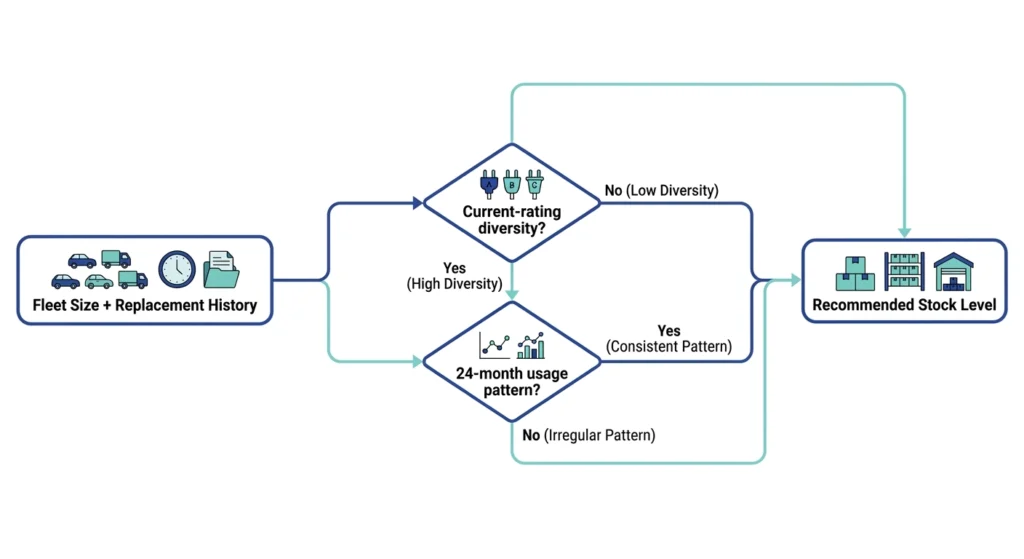
Fleet size and failure history should drive stocking quantity, not a single generic formula. A utility with 200 pad-mounted transformers carrying Bay-O-Net protection has a fundamentally different stocking profile than one with 20 — but the relationship isn’t linear, because fault-driven fuse replacement clusters around specific events (storm seasons, load growth periods) rather than spreading evenly across the year. This mirrors the broader asset management principles in ISO 55000, which frames spare parts stocking as a risk-based decision tied to failure consequence and likelihood, not a fixed formula applied uniformly across every component.
[Expert Insight: Reading Your Own Replacement History Before Stocking]
Pull 24 months of fuse replacement work orders before setting stocking levels — a single storm event can distort a shorter dataset into an inflated “normal” replacement rate
Separate planned replacements (proactive gasket swaps during outages) from unplanned ones (fault-driven fuse clearing) — they have different lead-time tolerances and justify different stocking rules
Simple decision flow for sizing spare parts inventory based on fleet size, current-rating diversity, and 24-month replacement history.
Standardizing Voltage Classes and Series Across a Fleet
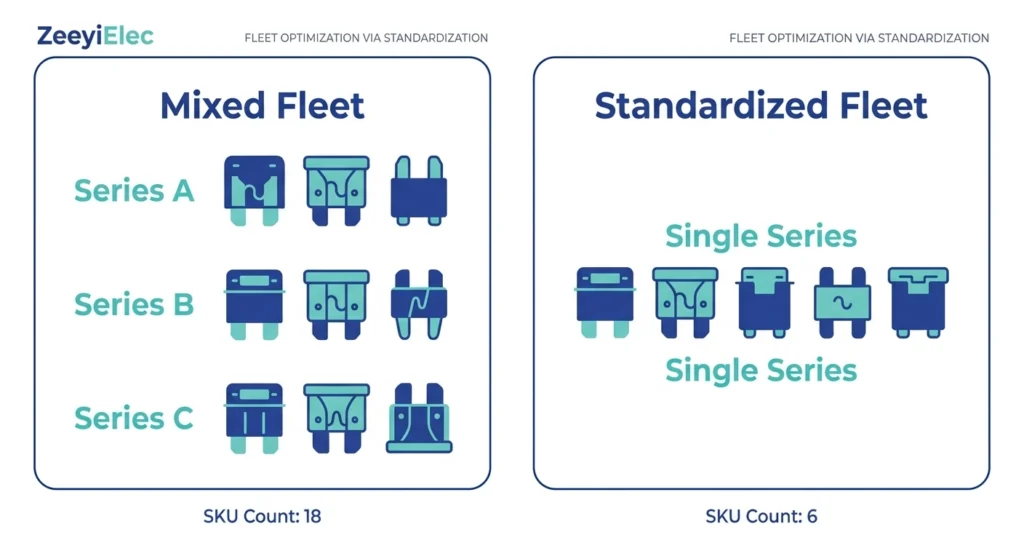
The single highest-leverage inventory decision most utilities can make isn’t a stocking formula — it’s reducing the number of distinct Bay-O-Net series and current ratings deployed across the fleet in the first place. ZeeyiElec’s sidewall assemblies share a common wall hole specification (ø57mm) across the 8.7/15/25kV class, meaning a utility that standardizes new installations on a single voltage class family reduces both the mounting hardware and the fuse holder SKUs it needs to carry, even as the fleet grows.
Side-by-side comparison of a mixed fleet running three Bay-O-Net series versus a standardized fleet running one series, showing relative SKU count.
A fleet running three different Bay-O-Net series across its transformer population doesn’t just carry three times the fuse holder SKUs—it multiplies the training burden on field crews who need to correctly identify which holder fits which well before a hot-stick fuse change, which is exactly the kind of mismatch that turns a routine fuse swap into an extended outage.
This doesn’t mean retrofitting existing installations — it means applying a documented standard to new purchases and major overhauls going forward, so the SKU count trends down over a multi-year horizon rather than staying flat or growing.
Common Inventory Mistakes That Cost Utilities Downtime
Mistake vs. Correct Practice
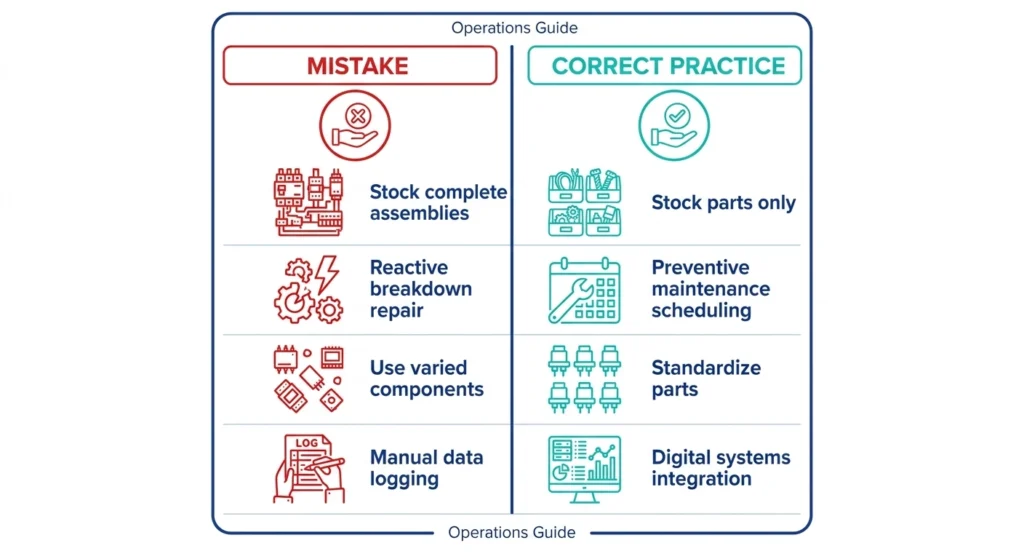
These four mistakes are the ones that most consistently undermine an otherwise sound Bay-O-Net spare parts strategy.
Common Mistake
Correct Practice
Stocking spare complete assemblies at the same rate as fuse links alone
Stock fuse links/gaskets on-hand; order complete assemblies as-needed except for critical feeders
Setting one stocking quantity for all current ratings
Weight stock quantity by actual current-rating usage frequency in the fleet, not an even split
Treating storm-driven replacement spikes as the new normal stocking baseline
Separate planned vs. unplanned replacement data before setting reorder points
Allowing new purchases to introduce additional series/voltage classes without review
Route new-installation specifications through a standardization check before purchase order approval
Quick-reference card contrasting four common Bay-O-Net inventory mistakes with the corresponding correct stocking practice.
When to Move from Reactive to Planned Replacement Strategy
Escalate from ad-hoc restocking to a formal planned-replacement strategy when: fuse-related outage response times are consistently limited by warehouse stock-outs rather than crew availability, the fleet has grown enough that manual tracking no longer reliably flags reorder points, or a recent storm event exposed a stocking gap that a documented review process could have caught earlier.
For sourcing across current ratings and series, working from a single documented specification set matters more than optimizing each purchase order independently. ZeeyiElec’s transformer accessories range covers the full Bay-O-Net current-rating spread alongside bushings and switches built to consistent mounting specifications, and our team can help map an existing fleet’s mixed series against a standardization plan. For broader accessory selection decisions, see the transformer accessories selection guide.
Frequently Asked Questions
What’s the most cost-effective Bay-O-Net component to keep in stock?
Fuse links/holders in the current ratings actually used across the fleet, along with flange gaskets — both are low-cost, high-turnover items where a stock-out directly delays a routine fuse change.
Should we stock complete Bay-O-Net assemblies or just replacement parts?
For most of the fleet, replacement parts alone are sufficient since the well housing rarely fails; complete assemblies are worth stocking only for critical or non-redundant feeders where any extended outage carries outsized cost.
How many current ratings of fuse links should a utility typically carry?
This should be driven by actual usage across the fleet’s transformer population rather than carrying the full available range — reviewing 24 months of replacement work orders typically reveals that a small subset of ratings covers most real demand.
Does standardizing on fewer Bay-O-Net series really reduce costs?
Yes, indirectly — fewer series means fewer fuse holder SKUs, less field-crew training burden on correct part identification, and lower risk of a mismatched part extending an outage, even though the per-unit purchase price may not change.
How often should spare parts stocking levels be reviewed?
Most utilities that track this formally review stocking levels annually, with an additional review triggered after any unusually large replacement event that might distort normal demand patterns.
Who should own the decision to standardize on a single Bay-O-Net series for new installations?
This typically sits with whoever approves new transformer accessory specifications (engineering or procurement, depending on the utility’s structure) — the key is routing new purchases through a documented standard rather than leaving series selection to individual project managers.
yoyo shi
Yoyo Shi writes for ZeeyiElec, focusing on medium-voltage accessories, transformer components, and cable accessory solutions. Her articles cover product applications, technical basics, and sourcing insights for global electrical industry buyers.






 English
 한국어
한국어 العربية
 Español
 हिन्दी
 தமிழ்
தமிழ் Deutsch (Sie)
 Français
 Português do Brasil
 Русский