What Is a Medium Voltage Bushing and Why Does Buyer Due Diligence Matter?
A medium voltage bushing is an insulated pass-through component mounted on a transformer tank wall that safely transfers current between internal windings and external circuits at system voltages typically between 1 kV and 36 kV. Selecting the wrong bushing rarely shows up on day one—it shows up eighteen months later as a tracking mark, a partial discharge alarm, or a failed dissolved gas analysis (DGA) reading.
In our deployments across 200+ transformer installations, the most common bushing-related field complaint is not catastrophic failure but slow degradation traced back to a specification gap at the RFQ stage—wrong BIL class, incompatible mounting flange, or a creepage distance rated for the wrong pollution level. Buyers who ask precise technical questions before ordering avoid most of these outcomes.
This guide answers the questions procurement engineers and buyers most often raise when sourcing medium voltage bushings for distribution transformers, covering voltage class selection, ANSI vs. DIN vs. epoxy interface types, BIL and creepage requirements, mounting and sealing compatibility, and the documentation a reliable supplier should provide without being asked.
Medium voltage bushings sit within the broader transformer accessories category alongside tap changers, fuses, and loadbreak switches—all interface components where installation and specification errors, not core material defects, drive the majority of field issues.
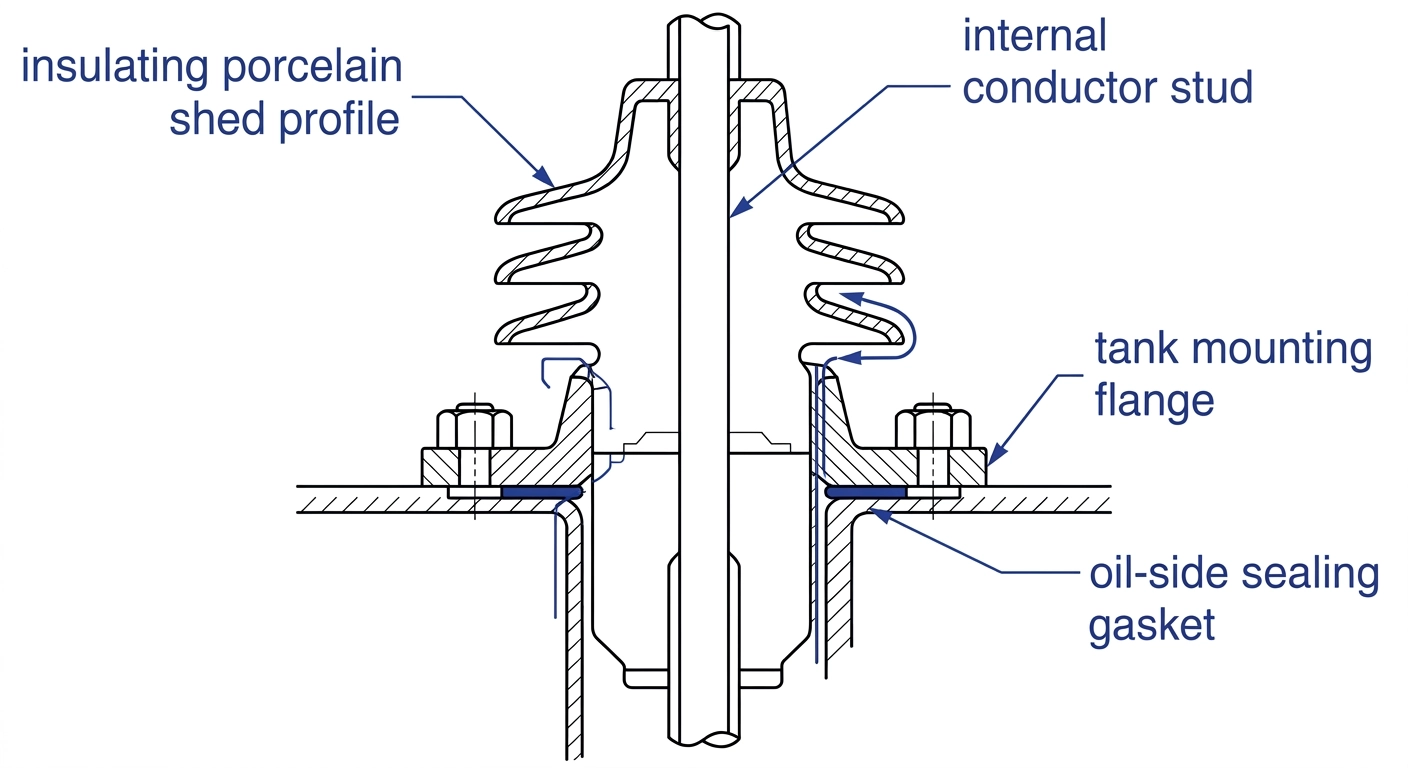
Anatomy of a medium voltage bushing showing the insulating shed profile, internal conductor stud, and the clearance zones most relevant to Basic Insulation Level (BIL) performance.
What Voltage Class and Current Rating Should I Specify First?
Matching Um to System Voltage
Specify by maximum system voltage (Um), not nominal voltage. A 24 kV nominal distribution system typically requires bushings rated for at least 25.8–36 kV Um to preserve adequate margin during switching transients and lightning-induced overvoltages. ZeeyiElec’s medium voltage bushing range spans 12–52 kV Um, covering the majority of 6–35 kV distribution networks along with select sub-transmission interfaces.
Current Rating Beyond Nameplate Load
Current rating should reflect not the transformer’s nameplate rating alone but the expected loading profile, including forecast load growth and any short-time overload allowance in the utility’s operating philosophy. Typical current ratings for distribution-class MV bushings range 55 A to 3,150 A depending on core diameter and conductor material—copper stud bushings generally support higher continuous current density than aluminum equivalents at the same physical size.
During commissioning of 24 kV distribution networks, undersized current rating rarely causes immediate failure; instead it accelerates thermal aging of the internal insulation over years, showing up first as elevated tan δ readings during routine maintenance testing.
Buyers should also confirm ambient temperature rating and altitude derating—the altitude correction procedure in IEC 60137:2017, Clause 5.2 (“Altitude”) applies above 1,000 m and can reduce the effective voltage withstand if not accounted for in the original specification.
[Expert Insight: Voltage Class Margin]
Always size Um above nominal system voltage, never equal to it
Confirm altitude derating separately from voltage class if the site sits above 1,000 m
Cross-check current rating against forecast load growth, not just today’s nameplate value
ANSI vs. DIN vs. Epoxy Interface: Which Bushing Type Fits My Project?
Buyers sourcing internationally often default to whatever interface standard their last project used, but ANSI, DIN, and epoxy resin-cast bushings solve different mechanical and environmental problems.
Interface Comparison at a Glance
Criterion
ANSI Porcelain
DIN Porcelain
Epoxy Resin-Cast
Typical region of use
North America, Latin America
Europe, Middle East, parts of Asia
Compact/indoor switchgear, harsh coastal sites
Mounting interface
ANSI flange, threaded stud
DIN flange, cone-type stud
Bolt-on flange, smaller footprint
Mechanical strength
High, but brittle under impact
High, but brittle under impact
Higher impact resistance, lighter weight
Maintenance profile
Periodic cleaning for creepage integrity
Periodic cleaning for creepage integrity
Lower cleaning frequency in polluted environments
Cross-sectional comparison of ANSI porcelain, DIN porcelain, and epoxy resin-cast bushing interfaces, highlighting differences in flange geometry and stud mounting configuration.
Selection Decision Rule
Match the interface standard to the transformer tank’s existing flange geometry first, then to the environment. ANSI and DIN porcelain bushings remain the default for utility-standard tank designs and offer well-understood field replacement logistics, but porcelain sheds are brittle under mechanical impact and require periodic cleaning to maintain rated creepage distance in polluted environments. Epoxy resin-cast bushings trade some of that field-replacement familiarity for higher impact resistance and lower maintenance frequency—a relevant factor for coastal or heavy-industrial sites with airborne contamination.
Across multiple bushing replacement projects in coastal distribution networks, we’ve measured accelerated shed erosion on porcelain units exposed to salt-laden air within three to four years of service, reinforcing that pollution class selection matters at least as much as interface material choice.
What BIL, Creepage Distance, and Standards Should I Confirm Before Ordering?
Basic Insulation Level (BIL) and creepage distance are the two specifications buyers most frequently under-specify, because both interact with site conditions rather than being fixed by voltage class alone.
Basic Insulation Level (BIL)
BIL defines how much lightning-impulse overvoltage a bushing can withstand without flashover, expressed as a crest voltage in kV. It is not automatically implied by system voltage—a 24 kV Um bushing might carry a 125 kV or a 150 kV BIL rating depending on the exposure risk (overhead line-connected vs. underground-fed) and the utility’s insulation coordination study.
As a working rule, distribution-class MV bushings connected to overhead lines should specify BIL ≥125 kV for 15–25 kV class systems, rising to ≥150 kV where direct lightning exposure or a higher lightning-flash-density region is documented in the project’s insulation coordination study.
Creepage Distance and Pollution Class
Creepage distance—the shortest path along the bushing’s insulating surface between the energized and grounded ends—must scale with site pollution severity, not just voltage class. Standard pollution environments typically call for 25 mm/kV; heavy industrial or coastal pollution zones call for 31 mm/kV or higher.
Standards to Reference in Your RFQ
IEC 60137 governs the characteristics and tests for insulated bushings above 1,000 V and is the primary reference for buyers writing technical specifications (IEC 60137, Insulated bushings for alternating voltages above 1000 V). Where a project calls for ANSI equivalency instead, the relevant reference is IEEE C57.19.01, Performance Characteristics and Dimensions for Power Transformer and Reactor Bushings—but confirm the edition with the supplier before finalizing: the 2017 edition applies to bushings with BIL ≥150 kV, while the earlier 2000 edition covered BIL ≥110 kV, so a 125 kV BIL distribution-class bushing can fall outside the current edition’s stated scope depending on which edition a project specification references [VERIFY STANDARD: applicable C57.19.01 edition for BIL <150 kV].
What Should I Ask a Supplier About Mounting, Sealing, and Compatibility?
Mounting and sealing questions catch buyers off guard because tank flange dimensions and gasket compatibility are rarely standardized across manufacturers, even within the same nominal voltage class.
Field Compatibility Checklist
Confirm mounting flange bolt pattern and center-to-center dimensions against the existing or planned tank cutout
Request gasket material compatibility with the transformer’s insulating oil (mineral oil vs. ester-based fluids can affect long-term gasket seal integrity)
Verify stud thread size and terminal configuration match the connecting bus or cable lug
Ask whether the bushing ships with routine dielectric and oil-tightness test certificates, or only type-test data
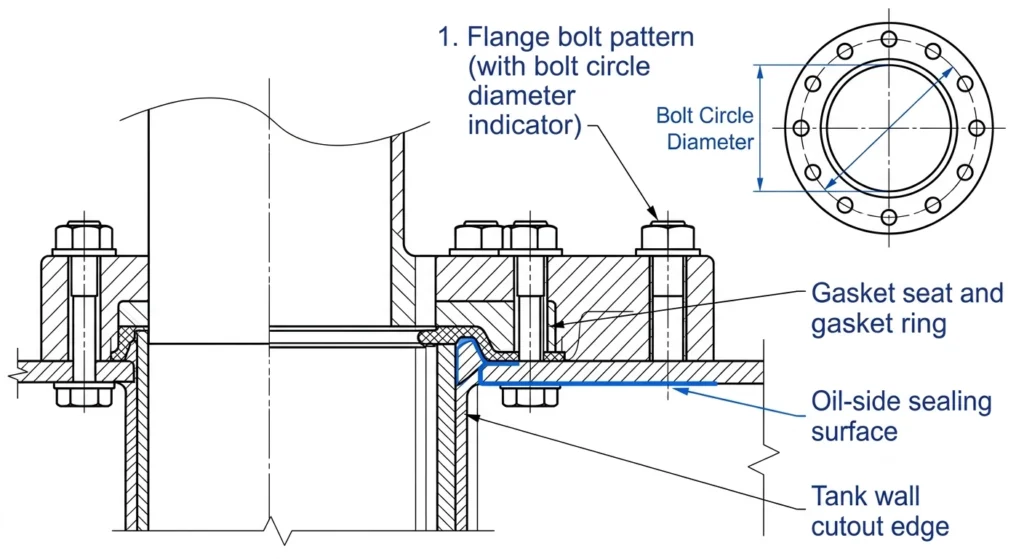
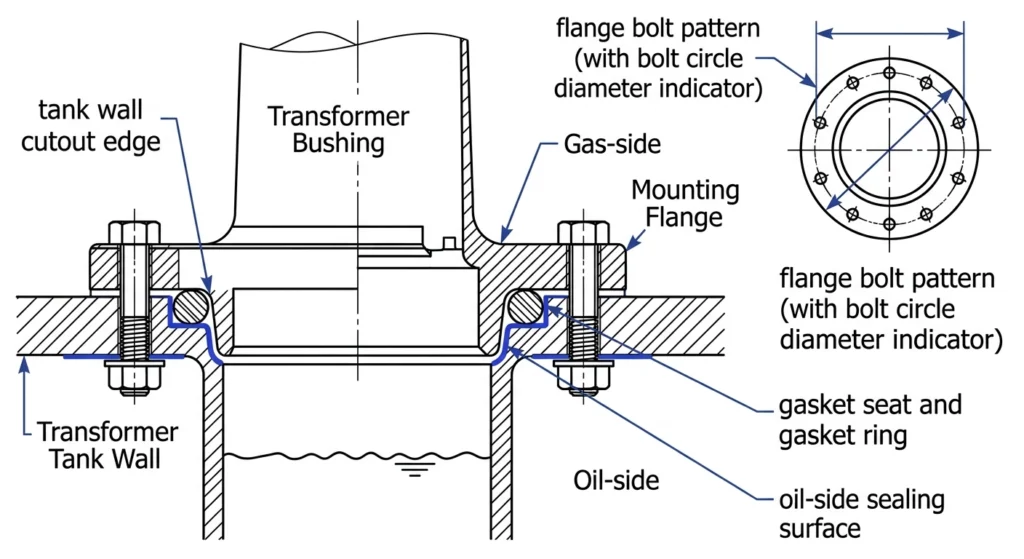
Detail view of a medium voltage bushing mounting flange, showing the gasket seat, bolt pattern, and oil-side sealing interface that buyers should verify against their tank cutout.
Projects that pair transformer-mounted bushings with medium-voltage cable terminations—common on pad-mounted transformer installs—should also confirm bushing-well and stress-cone compatibility with the paired cable accessories before ordering either component separately, since a mismatch at this interface is difficult to correct on site.
Buyers who want a structured way to capture these parameters before sending an RFQ can start from a dedicated transformer accessories RFQ checklist rather than rebuilding the specification from scratch each time.
What Documentation and Quality Checks Reduce Sourcing Risk?
Across multiple bushing sourcing projects, the buyers who avoid rework are the ones who request documentation before placing a purchase order, not after a shipment arrives.
Minimum Documentation to Request
Routine test reports for the specific production lot (not generic type-test certificates)
Dimensional drawings confirmed against the buyer’s tank cutout, not generic catalog drawings
Material certification for porcelain, epoxy, or gasket components where the environment is corrosive or high-altitude
Export documentation readiness—commercial invoice format, HS code classification, and any required certificates of origin for the destination customs authority
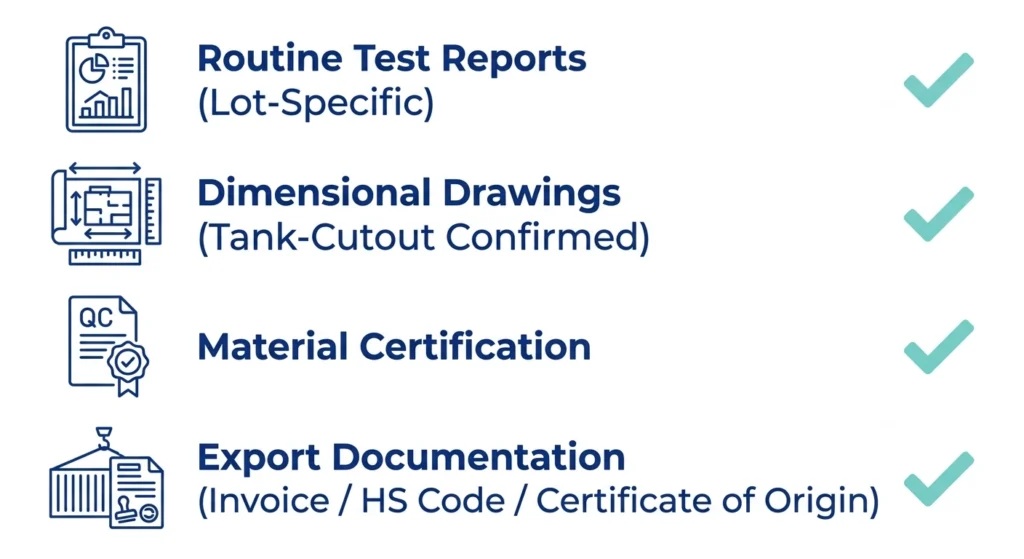
Pre-shipment documentation checklist for medium voltage bushing orders, covering routine test reports, dimensional drawings, material certification, and export paperwork.
When to Escalate a Supplier Response
A supplier unable to provide lot-specific routine test data, or one that substitutes generic marketing drawings for dimensional confirmation, is a signal to slow the order down—not to proceed and resolve discrepancies after delivery. This applies equally to buyers deciding between low voltage and medium voltage bushings for the same transformer, since documentation gaps often surface first at the interface between the two voltage classes.
[Expert Insight: Reducing Sourcing Risk]
Request lot-specific routine test reports before shipment, not after
Confirm dimensional drawings against the actual tank cutout, not catalog defaults
Escalate any supplier unable to provide production-lot certification
Frequently Asked Questions
What voltage rating should I specify for a medium voltage bushing?
Specify using maximum system voltage (Um) rather than nominal voltage, adding margin for switching and lightning transients; most 6–35 kV distribution systems fall within a 12–52 kV Um bushing range, with the exact class confirmed against the transformer’s insulation coordination study.
Can ANSI and DIN bushings be used interchangeably on the same transformer tank?
Generally no—ANSI and DIN bushings use different flange geometries and stud configurations, so mixing them on the same tank typically requires a tank redesign or an adapter flange rather than a direct substitution.
How do I know if I need heavy pollution class creepage distance?
Heavy pollution class (around 31 mm/kV) is typically warranted in coastal, heavy-industrial, or high-dust environments; standard 25 mm/kV creepage is adequate for most inland, low-contamination sites, but local utility guidelines should take precedence when they differ.
What is the difference between type-test and routine-test documentation?
Type tests confirm a bushing design meets IEC or ANSI requirements once per design, while routine tests are performed on every production unit or lot; buyers should request routine test reports specific to their shipment, not only type-test certificates.
Do epoxy resin-cast bushings cost more than porcelain bushings?
Pricing varies by manufacturer and order volume, but epoxy resin-cast bushings often carry a higher unit cost than comparable porcelain units, which buyers typically offset against lower maintenance frequency and reduced breakage risk during transport and installation.
What lead time should I expect for medium voltage bushings on an international order?
Lead times depend on voltage class, customization, and order volume; buyers should confirm manufacturing lead time and export documentation preparation time separately, since customs and banking paperwork can add several weeks beyond production if not requested early.
yoyo shi
Yoyo Shi writes for ZeeyiElec, focusing on medium-voltage accessories, transformer components, and cable accessory solutions. Her articles cover product applications, technical basics, and sourcing insights for global electrical industry buyers.






 English
 한국어
한국어 العربية
 Español
 हिन्दी
 தமிழ்
தமிழ் Deutsch (Sie)
 Français
 Português do Brasil
 Русский