Why MV Bushing Logistics Fail Between Factory and Site
MV bushing packing and shipping decisions determine whether a unit arrives intact — most transit damage traces back to two distinct failure mechanisms, and confusing them leads buyers to specify the wrong precautions. A bushing’s dielectric integrity depends on either a fired ceramic body or a cast epoxy body, and these materials fail in transit for opposite reasons — one from mechanical shock, the other from moisture ingress.
Porcelain Shell Fracture Mechanics Under Shock Load
Glazed porcelain insulators are kiln-fired at extremely high temperatures, producing a vitrified ceramic body that is dielectrically excellent but mechanically brittle. Porcelain resists sustained compressive load well but tolerates very little impact stress — a sharp jolt during crane lifting, forklift handling, or a container drop of even a few centimeters can propagate a hairline crack through the shell wall. This kind of crack is frequently invisible at the glaze surface immediately after the event; it may not show up as a measurable dielectric weakness until the bushing is energized and thermal cycling extends the fracture. On a typical 15/25kV class bushing, the ceramic wall thickness at the thinnest shed section commonly falls in the 4 mm–8 mm range — enough margin for normal service stress, not enough to absorb a sharp mechanical impact.
Epoxy Housing Moisture Sensitivity in Transit
Cast epoxy-resin bushings are more impact-tolerant than porcelain but carry a different vulnerability: moisture absorption during long transit or humid storage. Absorbed moisture can degrade surface resistivity and, in more severe cases, contribute to partial discharge activity once the unit is energized. This is why epoxy bushings typically ship inside sealed packaging with desiccant, targeting an internal relative humidity generally held below 50% RH during transit — a figure that should be treated as general practice rather than a fixed value across all suppliers.
Field experience across multiple import inspections shows porcelain-related damage tends to surface immediately at unloading, while epoxy moisture damage often isn’t detected until commissioning testing — a distinction that shapes the inspection sequence covered later in this guide.
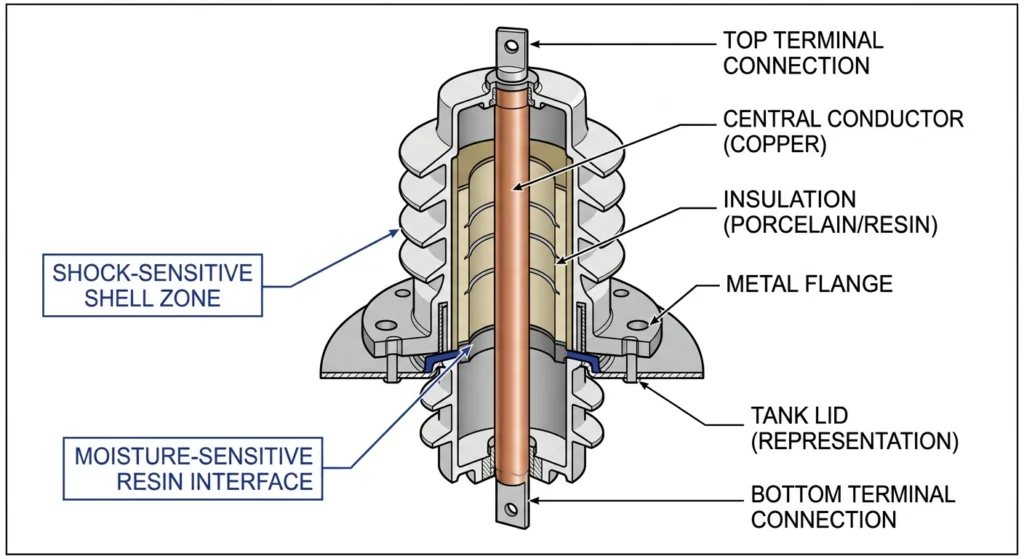
Cross-section of a medium-voltage bushing highlighting the porcelain shell’s impact-sensitive zone and the epoxy body’s moisture-sensitive resin interface.
[Expert Insight]
Porcelain and epoxy failures rarely show the same warning signs — inspect each material against its own risk, not a single generic damage checklist
A crack that started in transit often doesn’t register on a hand-held megohmmeter until the unit has gone through several thermal cycles in service
Packing Specification Checklist Before Container Loading
MV bushing packing and shipping decisions determine whether a unit arrives intact — most transit damage traces back to two distinct failure mechanisms, and confusing them leads buyers to specify the wrong precautions.
Porcelain Bushing Crating Requirements
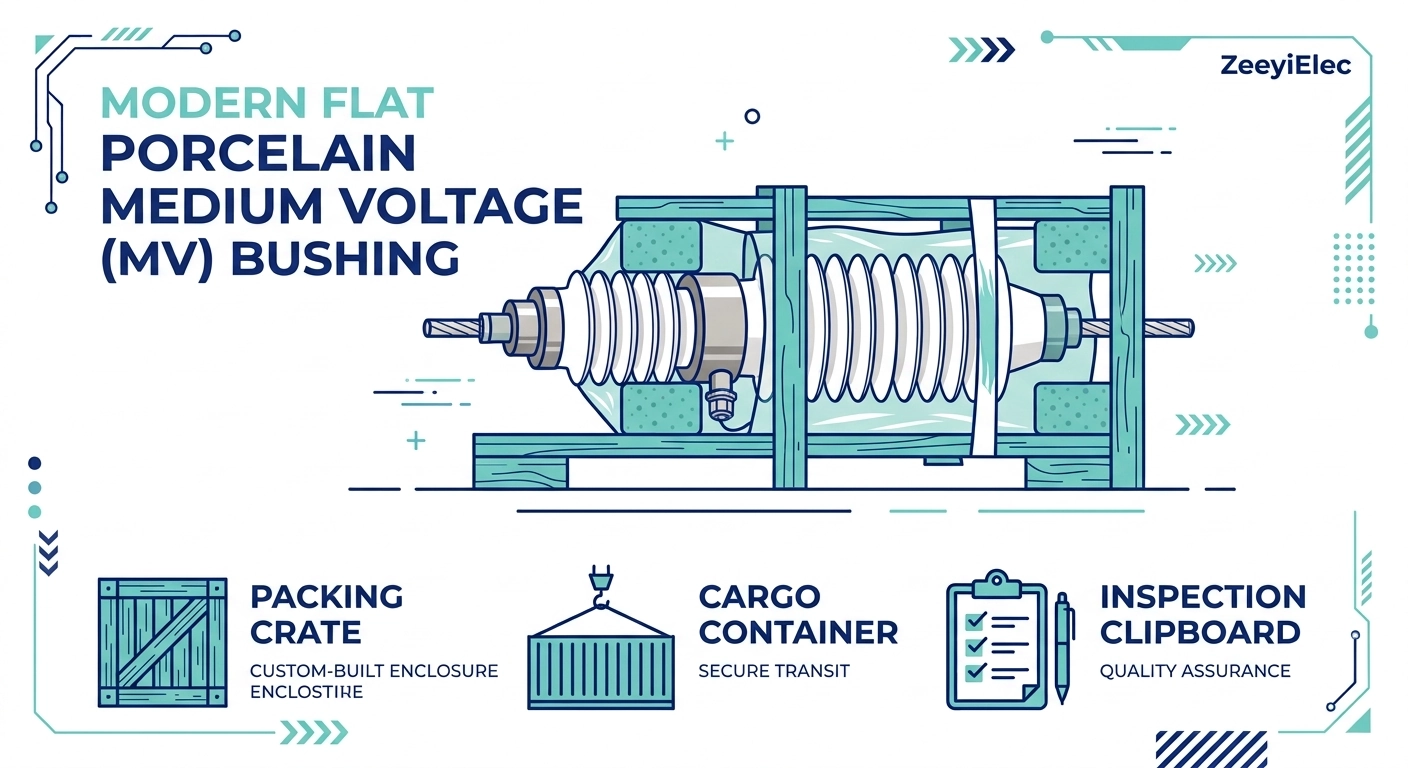
Porcelain MV bushings are typically packed in individual wooden crates rather than palletized in bulk, cushioned by foam blocking or fiberboard bracing that isolates the flange and terminal stud from point-contact shock. The crate interior should hold the bushing rigid enough that it cannot shift during transit — a gap of even 10 mm–15 mm between the housing and unpadded crate framing gives repeated low-level impacts room to accumulate into a fracture over a multi-week sea freight. Crate labeling should include fragile/glass-handling markings and an up-arrow orientation indicator.
Epoxy/Resin Bushing Padding and Desiccant Requirements
Epoxy and cast-resin bushings need less shock bracing but require a sealed moisture barrier — typically a heat-sealed poly bag or vacuum-sealed wrap with desiccant packets sized to the container’s internal volume, plus a visible humidity indicator card. Padding still matters for the terminal stud and mounting flange, which remain vulnerable to bent threads or deformed gasket surfaces even though the housing body tolerates handling better than porcelain.
Vertical vs Horizontal Orientation Rules
Orientation depends on internal construction, not housing material alone. Bushings with an oil-impregnated paper (OIP) core or an oil-filled interface generally require strict vertical shipping to prevent air migration into the dielectric fluid column, while solid-core epoxy or dry-type units tolerate horizontal transport with proper cradling. Mixing these rules — shipping an OIP-core bushing horizontally to save container space — is a recurring root cause of incoming rejection.
Packing Spec Quick-Reference Table
Housing Type
Primary Risk
Packing Priority
Orientation
Porcelain
Shock/impact fracture
Individual crate + shock bracing
Vertical (up-arrow marked)
Epoxy/cast resin
Moisture absorption
Sealed bag + desiccant
Horizontal tolerable (dry-type)
OIP/oil-filled core
Air migration into dielectric fluid
Sealed + vertical constraint
Strict vertical only
For voltage-class and current-rating parameters that also factor into packing decisions, see ZeeyiElec’s medium voltage bushings product family page.
Field Case — A Container Load That Failed Incoming Inspection
A distribution utility contractor received a 40-foot container of 25kV-class porcelain MV bushings for a substation retrofit. The crates showed no visible exterior damage — no crushed corners, no torn packaging — after roughly six weeks in transit.
During incoming inspection, the receiving technician initially passed twelve of fourteen units on visual review. Two were flagged only because of a faint hairline discoloration near the base of the porcelain shed closest to the mounting flange, easy to mistake for a glaze inconsistency. Rather than accept on visual inspection alone, the site engineer requested a dielectric spot-check before release to the installation crew.
The test showed a partial discharge inception voltage roughly 15%–20% below the units’ rated withstand level on both flagged bushings — consistent with an internal crack that hadn’t fully propagated to the outer glaze. Neither unit showed external crushing, pointing to a shock event during intermodal transfer rather than a container-loading error.
The practical lesson: a clean-looking crate and undamaged exterior are not sufficient evidence a porcelain bushing survived transit intact. Visual inspection catches obvious damage — cracked crates, crushed flanges, visible glaze chips — but not a hairline internal fracture from a shock event absorbed by the packing material itself. An incoming inspection sequence for porcelain-housed bushings should escalate to electrical verification whenever any surface anomaly is observed, even a cosmetic-looking one. It’s also why tilt-and-shock recorders — impact-logging indicators fitted to the crate — are increasingly specified on higher-value porcelain shipments, since they flag which units need priority electrical screening before the full inspection queue is worked through.
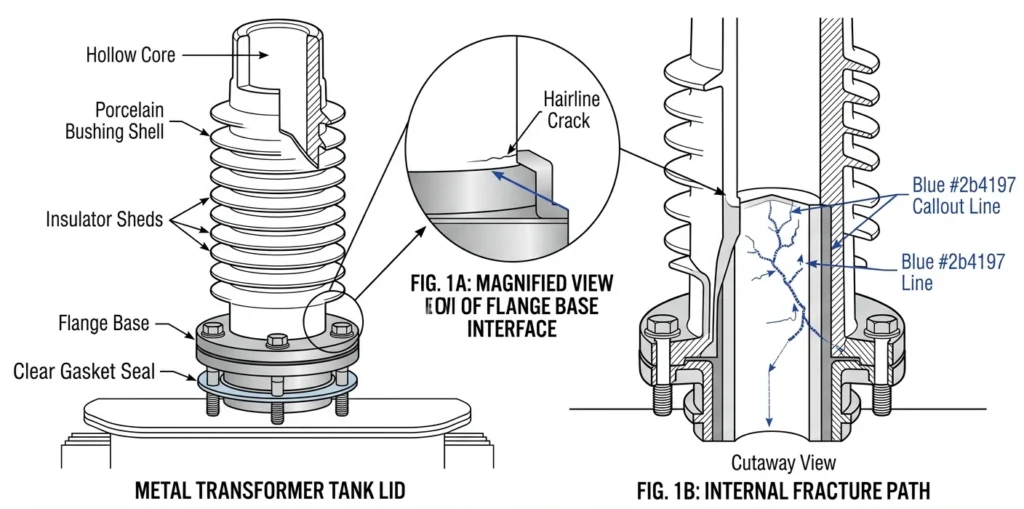
A hairline crack originating near the flange base of a porcelain bushing, illustrating internal fracture damage not visible during a casual exterior inspection.
Export Documentation That Must Travel With the Shipment
Packing protects the bushing physically, but documentation determines whether the shipment clears customs, releases payment, and gives the receiving team the traceability needed to run a proper inspection. A missing or mismatched document can hold a container at port for 2–3 weeks even when every unit inside arrived undamaged.
Test Certificates and Traceability Records
Every shipment should travel with routine test certificates for the specific production batch, not a generic type test certificate for the product family. A type test validates the design once; a routine test verifies that the individual units in this shipment match that design — buyers relying on a type test certificate alone have no batch-level assurance the units on the truck were actually tested. Traceability should tie each bushing’s nameplate serial number to its routine test record, since incoming inspection can’t confirm nameplate-to-PO conformance without that link. This documentation should reference the governing accessory standard — for porcelain and epoxy MV bushings this is typically IEC 60137, which sets dielectric and mechanical test requirements separate from the base transformer standard IEC 60076.
Commercial and Customs Paperwork
The commercial paperwork set typically includes the commercial invoice, packing list, certificate of origin, and bill of lading. The packing list carries particular weight for incoming inspection, since it states unit count, gross/net weight, and crate dimensions the receiving team cross-checks before opening a single crate. A commercial invoice that doesn’t match Letter of Credit terms can trigger bank rejection independent of the goods’ physical condition, which is why documentation review generally runs in parallel with — not after — physical inspection. Buyers should also confirm HS code classification before shipment, since a code mismatch on MV bushings can trigger customs delays or unexpected duty assessments unrelated to the goods themselves.
A packing list mismatch stalls customs even when every physical unit is correct — treat documentation review as a parallel workstream, not a follow-up step
Ask for batch-linked routine test certificates at RFQ stage, not after the shipment has already left the factory
Incoming Inspection Walkdown at Site or Warehouse
Incoming inspection follows a fixed sequence, and skipping ahead to electrical testing before completing the earlier steps wastes effort on units that may already fail on documentation or visual grounds.
Exterior and Packaging Damage Check
The walkdown starts with the crate itself, before it’s opened: crushed corners, water staining, tilt-and-shock indicator status if fitted, and any visible penetration of the packaging. Crate damage is treated as a trigger for closer inspection of the unit inside, since impact energy can transfer through bracing without leaving an external mark. Once opened, the technician checks the porcelain shell or epoxy housing for chips, cracks, or glaze discoloration, paying particular attention to the flange-to-shell transition where mechanical stress concentrates.
Nameplate-to-PO Conformance Check
Each unit’s nameplate is checked against the purchase order and routine test certificate: voltage class, current rating, BIL, and batch/serial number. A bushing rated for 95 kV BIL installed on a system engineered for a 125 kV BIL requirement will often pass an initial visual and even a low-voltage functional check, but it carries real flashover risk under a lightning-induced transient overvoltage — a mismatch only nameplate cross-referencing catches before energization.
Dimensional and Creepage Spot-Check
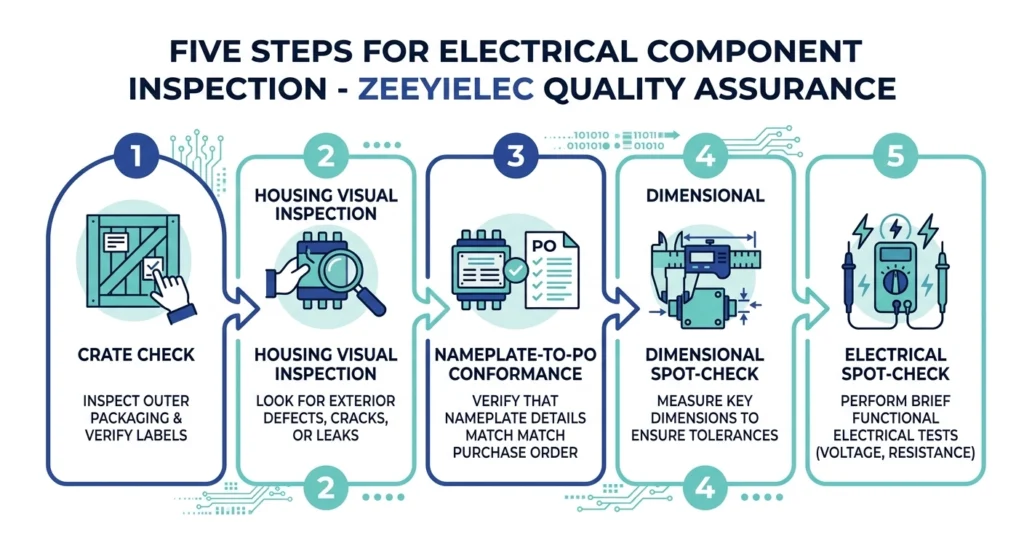
A sample of units — commonly 10%–20% of the shipment on a project-scale order — gets measured against the approved drawing for creepage distance, overall length, and flange bolt pattern. A dimensional error can pass every electrical test in the factory and still fail to physically mount on-site. <p>The standard sequence runs: (1) crate/packaging check → (2) housing visual inspection → (3) nameplate-to-PO conformance → (4) dimensional spot-check (n ≈ 10%–20% of shipment) → (5) electrical spot-check when any anomaly is flagged in steps 1–4.</p>
The five-step incoming inspection sequence for MV bushings, from crate check through nameplate conformance to electrical spot-check.
Handling Rejected or Damaged Shipments
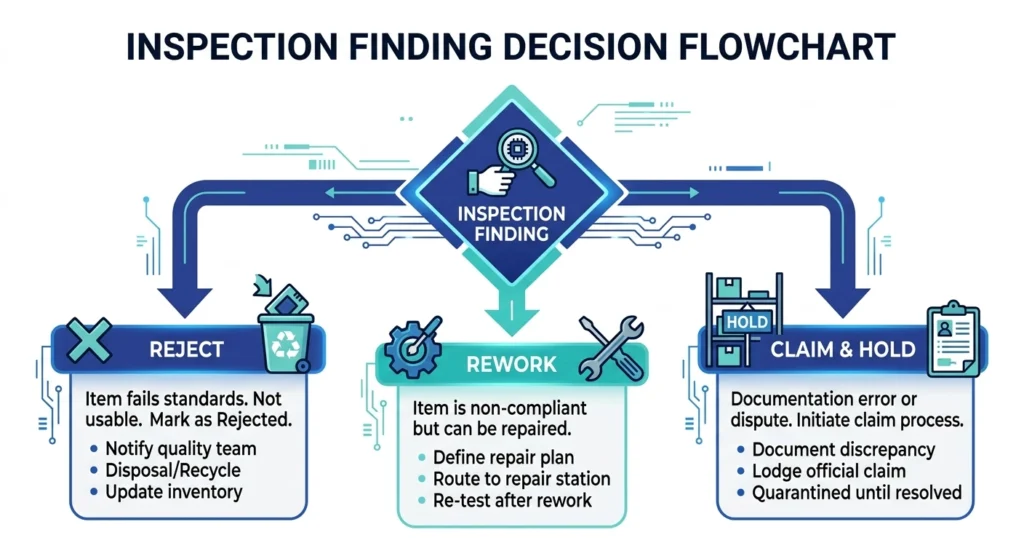
When incoming inspection flags a unit, the receiving team faces one of three paths — reject, rework, or file a claim while proceeding under supplier agreement — and the right choice depends on fault location and severity, not just visible damage.
Reject Immediately
A unit gets pulled from the installation sequence outright when the finding involves internal dielectric compromise: a confirmed shell fracture, a partial discharge inception voltage measurably below rated withstand, or moisture ingress confirmed on an epoxy unit via humidity indicator failure plus surface resistivity testing. These conditions aren’t field-correctable — installing and energizing a unit with confirmed internal damage risks a fault well beyond the cost of the replacement bushing, including potential collateral damage to the transformer tank and connected switchgear.
Rework or Accept With Documentation
Some findings are cosmetic or purely mechanical at the external interface — a bent terminal stud, a scuffed gasket surface, minor packaging damage with no corresponding housing anomaly. These are typically correctable on-site through cleaning, reseating, or hardware replacement without touching the internal dielectric system.
File a Claim, Hold for Supplier Resolution
Ambiguous findings — a hairline surface mark not yet electrically confirmed as internal, a documentation mismatch pending clarification — should be held in a quarantine area rather than installed or scrapped. Photographing the crate condition, the unit, and the nameplate before filing gives the supplier enough evidence to process a replacement without a second round of dispute over what was actually received.
Decision logic: internal dielectric compromise confirmed → reject; external/mechanical-only finding → rework and document; ambiguous or unconfirmed finding → quarantine + claim, hold for supplier resolution before installation proceeds.
Every rejection or claim decision should be documented with photos, test data where applicable, and a written record tied to the batch/serial number — standard practice, not a guarantee of any specific commercial outcome, since claim resolution terms vary by supplier agreement and Incoterms.
A three-branch decision flow guiding receiving teams through reject, rework, or claim-and-hold outcomes for MV bushing incoming inspection findings.
Work With a Supplier Who Engineers Packing for the Full Route
Packing specification and incoming inspection protocol are only as reliable as the supplier’s willingness to build them into the order from the start — a bushing that’s engineered correctly but packed generically still arrives at risk. When evaluating a supplier, ask specifically whether packing is differentiated by housing type, whether shock indicators are available for high-value shipments, and whether routine test certificates are issued per batch with serial-number traceability.
ZeeyiElec supplies MV bushings across the 12kV–52kV range with OEM/ODM configuration support and export documentation prepared for each shipment, covering the certificate and packing-list detail incoming inspection teams need to complete nameplate-to-PO conformance quickly. Sample orders are available to validate packing and documentation practices before committing to a full container quantity.
Review current medium voltage bushing specifications and product families, or check sample policy, MOQ, and lead time details before issuing an RFQ to confirm packing and documentation terms are addressed up front rather than discovered at incoming inspection.
Frequently Asked Questions
How long can an MV bushing sit in storage before installation?
Most porcelain and epoxy MV bushings tolerate 6–12 months of covered, climate-controlled storage without performance loss, though EPDM gasket components degrade faster in high-UV or high-humidity conditions and should be inspected before installation if storage exceeds that window.
What packing method is used for porcelain MV bushings during export?
Porcelain bushings typically ship in individual wooden crates with foam or fiberboard bracing that isolates the flange and terminal stud from shock, since even a short vertical drop of a few centimeters during handling can initiate a hairline shell fracture that isn’t visible until energization.
Can a damaged bushing crate still contain an undamaged bushing?
It’s possible, but crate damage is treated as a trigger for full inspection rather than dismissed, because impact energy transferred through bracing can crack porcelain or displace internal components without leaving visible marks on the housing itself.
What is checked first during MV bushing incoming inspection?
Inspectors generally start with a visual check of the crate and packaging condition, then move to nameplate-to-purchase-order conformance, before any electrical or dimensional verification begins.
Do epoxy MV bushings need different shipping precautions than porcelain ones?
Epoxy-housed bushings are more impact-resistant than porcelain but more moisture-sensitive, so their packing typically emphasizes sealed desiccant packaging over heavy shock bracing, reversing the priority used for porcelain units.
What documents should accompany an MV bushing shipment for customs clearance?
A typical package includes the commercial invoice, packing list, certificate of origin, and routine or type test certificates, with the exact set depending on destination country requirements and the payment instrument governing the order.
What happens if a bushing fails incoming inspection after installation has already started?
The affected unit is typically pulled from the installation sequence and held for supplier claim documentation, since energizing a bushing with unresolved inspection findings risks a field failure that costs far more than the shipment delay.
yoyo shi
Yoyo Shi writes for ZeeyiElec, focusing on medium-voltage accessories, transformer components, and cable accessory solutions. Her articles cover product applications, technical basics, and sourcing insights for global electrical industry buyers.





 English
 한국어
한국어 العربية
 Español
 हिन्दी
 தமிழ்
தமிழ் Deutsch (Sie)
 Français
 Português do Brasil
 Русский