What Counts as a Terminal Connection Error on an MV Bushing
MV bushing terminal connection errors are faults that originate at the bolted or clamped interface between a bushing’s terminal stud and the external conductor lug — not within the bushing’s internal insulation system. This distinction matters in the field: both fault types can show similar symptoms during a walkdown (heat discoloration, oil weeping, arcing marks), but they call for different corrective actions. A degraded internal dielectric path requires bushing replacement; a connection error is usually correctable through inspection, cleaning, and reseating without touching the bushing body.
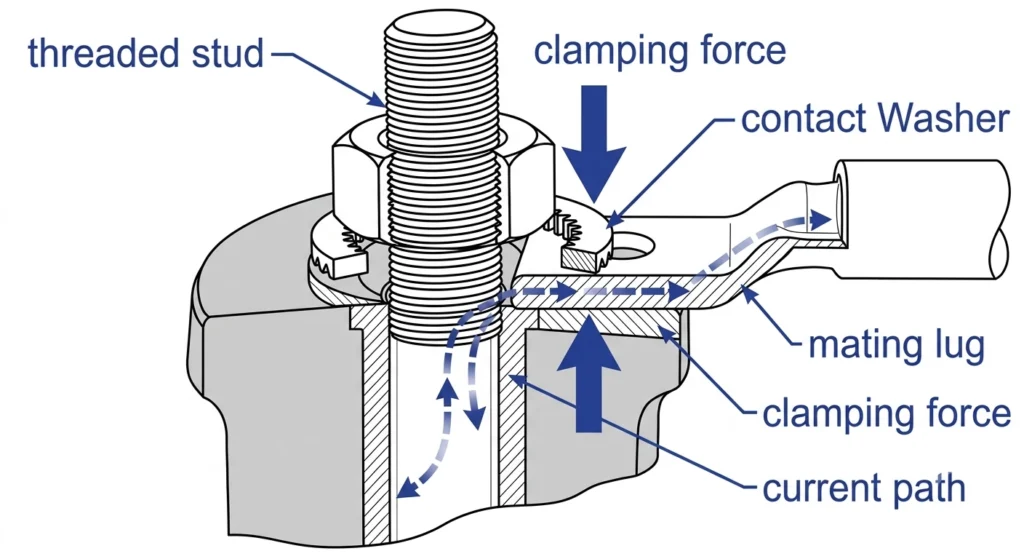
The terminal interface typically consists of a threaded copper or bronze stud, a flat or dished contact washer, and a mating lug, torqued to a manufacturer-specified value — commonly 40 N·m–90 N·m depending on stud diameter and current rating. Thread damage, an improperly seated washer, a misaligned lug face, or trapped contamination all qualify as connection errors.
Distinguishing Terminal Errors from Bushing Body Defects
A connection error produces a resistance or thermal anomaly confined to the stud-lug interface, resolving once the joint is cleaned and correctly retorqued. A body defect — internal tracking or a degraded seal — persists regardless of terminal work and often shows a rising trend on periodic power-factor or partial-discharge testing.
In one recurring field pattern, a bushing flagged during a thermal survey for a terminal-area hot spot was found, on disassembly, to have a lug seated at a slight angle against the contact washer — reducing effective contact area well below the joint’s rated cross-section. Reseating the lug square and retorquing to spec resolved the anomaly without bushing replacement.
Cross-sectional view of a medium-voltage bushing terminal assembly showing the stud, contact washer, and mating lug forming the current-carrying joint.
[Expert Insight]
A hot spot confined to one edge of the joint usually points to misalignment, not a bad connection overall
Don’t assume oil weeping near a terminal means the bushing has failed — check the joint first
Power-factor and partial-discharge trends distinguish a body defect from a terminal issue faster than visual inspection alone
Why These Errors Develop During and After Installation
A bolted joint doesn’t conduct current across its full apparent contact area — it conducts through microscopic asperity points where the surfaces actually touch. Clamping force increases real contact area by flattening these asperities, which is why torque accuracy, not surface size, determines joint resistance.
The Mechanics of Contact Degradation
An under-torqued joint — typically below roughly 80% of specified value — keeps real contact area small and resistance elevated, running hotter under load than a correctly torqued joint. Over-torquing deforms the contact washer or cracks a porcelain terminal boss, which paradoxically reduces contact pressure once the material relaxes.
Joint resistance R is inversely related to real contact area Ac, which scales with clamping force Fc raised to a fraction less than 1 (typically Fc0.5–Fc), so resistance drops sharply as force rises from zero but flattens at higher torque — meaning added torque beyond spec yields diminishing electrical benefit while raising mechanical risk.
Thermal cycling compounds this: copper, aluminum, and steel hardware expand and contract at different rates, gradually loosening a joint torqued correctly at installation — a mechanism generally described in bolted-joint engineering literature as thermal cycling-induced preload loss or self-loosening.
Common MV Bushing Terminal Connection Errors in the Field
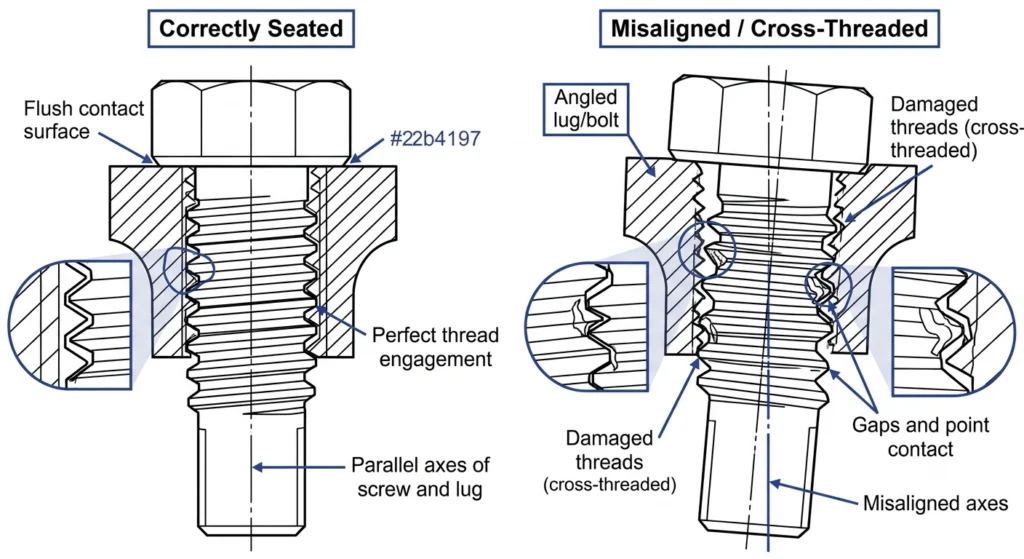
Side-by-side comparison of a correctly seated MV bushing terminal connection and a misaligned, cross-threaded connection prone to rework.
Cross-Threading and Thread Damage
Most common in confined switchgear or pad-mount enclosures with limited hand clearance, and more likely on reconnection than first-time installation. Once threads are damaged, torque readings become unreliable — the wrench may show the target 40 N·m–90 N·m while actual clamping force at the contact face is lower, since torque is partly consumed overcoming thread friction.
Contact Face Misalignment
A lug seated even a few degrees off perpendicular concentrates current through a smaller region of the interface. A hot spot localized to one edge of an otherwise correctly torqued joint is a strong indicator of this.
Under-Torque and Over-Torque on Reconnection
Crews reconnecting by feel rather than with a calibrated tool risk under-torquing (mechanically loose, prone to ratcheting) or over-torquing a reused fastener whose threads are already weakened.
Contamination Introduced During Rework
Dust, moisture, or solvent residue left on contact surfaces creates a thin resistive film. Unlike the other error types, this often passes initial inspection and surfaces later as a slowly rising resistance trend — why periodic rechecking after any rework matters.
Diagnosing a Suspected Terminal Connection Error Before Re-Energization
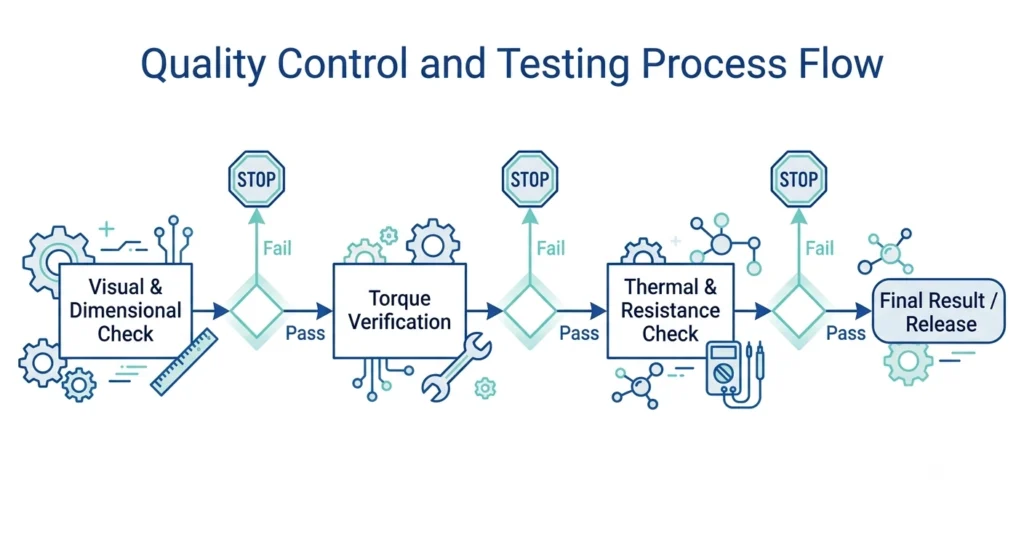
Three-stage diagnostic flow for MV bushing terminal connections, progressing from visual inspection through torque verification to thermal resistance testing.
Visual and Dimensional Checks
A close inspection of stud threads, washer, and lug face under adequate lighting — with a magnifier or borescope in confined compartments — catches thread galling, an out-of-square lug seat, or discoloration from prior overheating. Feeler gauges confirm the lug sits flush within roughly 0.1 mm–0.3 mm of flatness tolerance.
Torque Verification
A calibrated torque wrench confirms the joint holds its specified 40 N·m–90 N·m value. A joint requiring noticeably less torque to reach target, or that doesn’t hold under a brief re-check, indicates thread damage or contact-face deformation the visual check may have missed.
Thermal and Contact Resistance Checks
A micro-ohmmeter measures contact resistance directly, while an infrared camera or thermal indicator identifies hot spots under load IEEE C57.19.100 provides general principles for evaluating bushing performance in service, though its scope is oriented toward higher-BIL power apparatus bushings rather than MV distribution-class terminals specifically, and it does not define terminal-specific micro-ohm resistance thresholds. Since these thresholds vary by manufacturer and stud size, teams typically compare a suspect joint against sister connections on the same transformer.
A joint failing any of these three checks should be disassembled and rebuilt rather than re-torqued in place — retorquing over an already-compromised surface tends to mask the problem rather than resolve it.
[Expert Insight]
Check visual and torque before thermal instrumentation — it saves time on joints that are simply loose, not damaged
A joint that won’t hold torque on a quick re-check almost always has thread or washer damage
Compare a suspect joint against sister connections on the same unit rather than chasing a universal resistance number
The Hidden Cost of Repeated Rework Cycles
Each disassembly and reconnection carries slightly more risk than the last — easy to overlook when a single rework resolves the immediate symptom but accumulates cost over the transformer’s service life.
Cumulative Wear and Diagnostic Uncertainty
Thread engagement degrades incrementally on each disassembly, particularly on softer bronze or copper-alloy studs — a stud tolerating 60 N·m cleanly on first installation may show measurable wear by the third or fourth reconnection. Contact washers can also lose flatness after repeated compression, even while looking structurally intact. A joint with undocumented rework history is harder to diagnose confidently later: if a thermal survey flags it again, the team can’t easily tell whether the anomaly is new or residual, pushing toward full disassembly rather than a faster torque-only recheck. Transformers with two or more documented reworks are often flagged for closer interval monitoring than sister units with a clean installation history.
Outage and Schedule Impact
A pad-mounted distribution transformer taken offline for a suspected terminal fault typically needs a 4-hour–8-hour outage window to de-energize, disassemble, inspect, and re-energize, and a repeat rework within the same cycle compounds that downtime against a utility’s outage budget. Evaluating medium voltage bushing hardware quality upfront — rather than treating terminal hardware as a commodity line item — reduces how often this cycle repeats.
Rework Prevention Practices for MV Bushing Terminal Connections
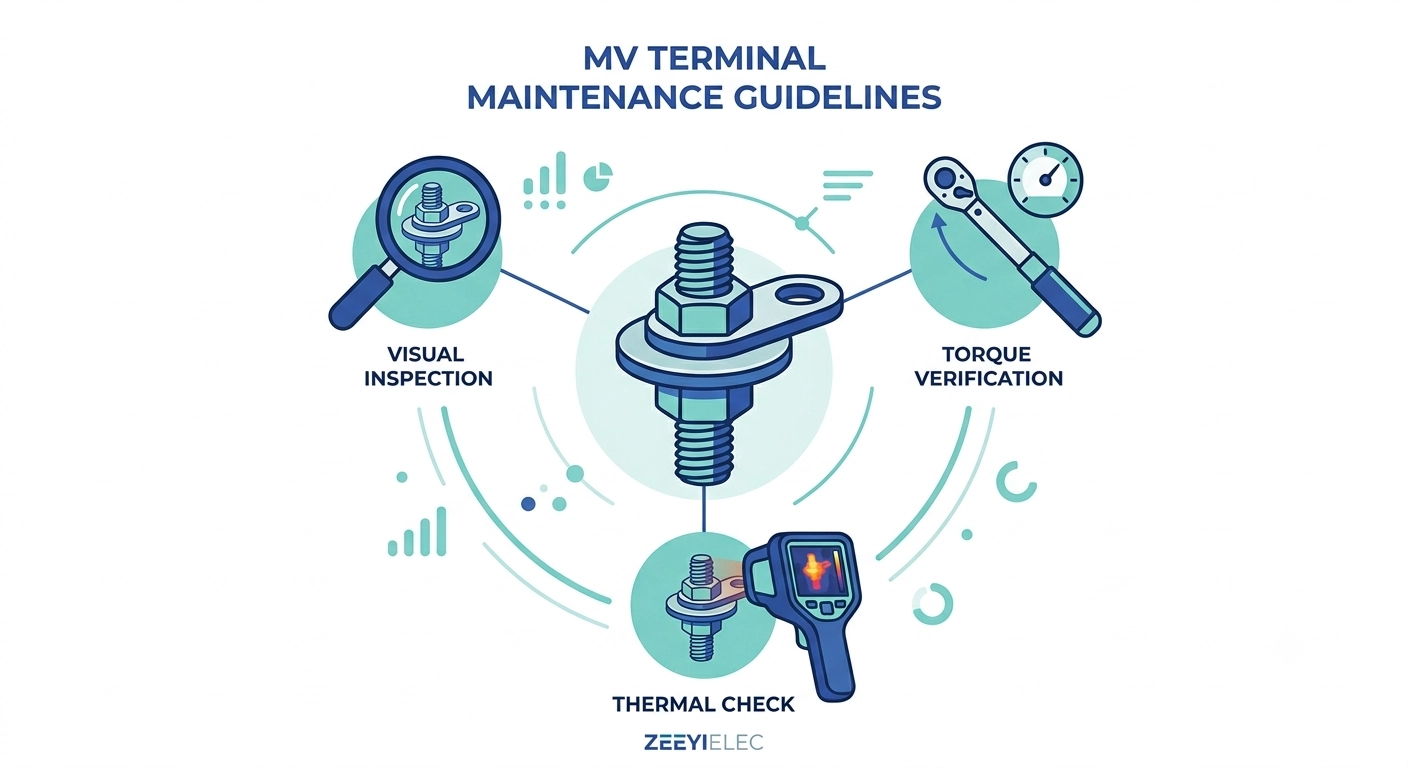
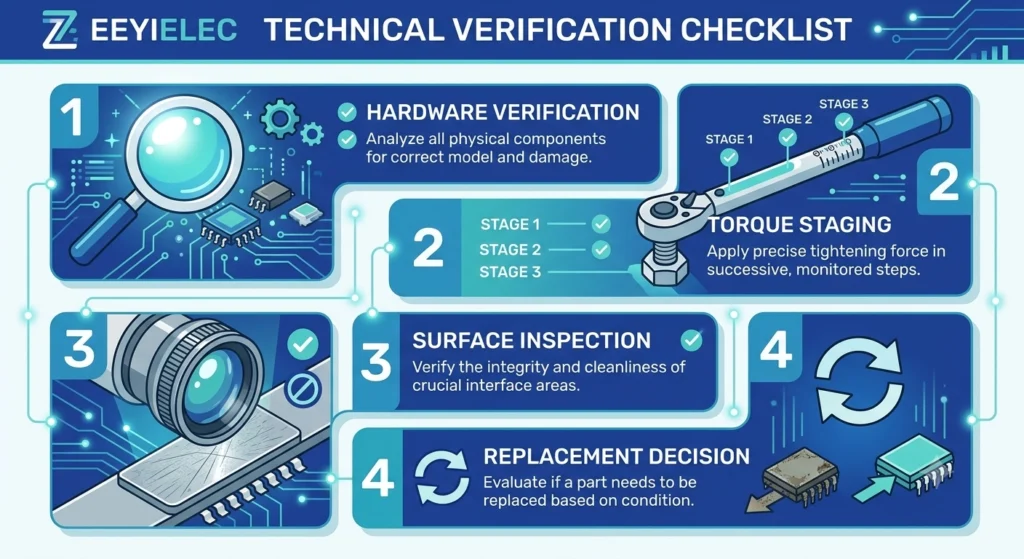
A preventive checklist infographic covering hardware verification, torque staging, contact inspection, and replacement decisions for MV bushing terminals.
Verification Before First Connection
Confirm stud size, thread condition, and specified torque before the first connection. Check that the lug or busbar connector matches the terminal’s rated current — typically 200 A–3150 A across ZeeyiElec’s medium voltage bushing families — since an undersized lug forced onto an oversized stud is a common misalignment source. Reviewing requirements against a project’s transformer accessories RFQ checklist at the spec stage catches mismatches before hardware reaches the field.
Handling Repeated Disconnection and Reconnection
Treat every planned reconnection as a fresh installation: clean both contact surfaces, inspect thread condition, and retorque to the full specified value rather than a partial turn. Documenting each rework event — date, torque achieved, hardware condition — gives future inspections a baseline that shortens diagnostic time.
When to Replace vs. Reuse Hardware
Hardware with thread galling, a deformed washer, or contact-face pitting should generally be replaced, not reused. Studs and washers through two or more reconnection cycles warrant closer scrutiny even if undamaged. The transformer accessories selection guide and IEC specification cheat sheet outline parameters worth confirming with a supplier before ordering replacement hardware.
Getting Terminal Connection Specs Right from the Start
Consistent hardware quality — stud tolerances, washer material, torque spec — is one of the more overlooked variables in reducing MV bushing rework. The same joint-quality principles apply across ZeeyiElec’s transformer accessories and cable accessories lines, since both rely on correctly torqued, contamination-free contact interfaces for long-term reliability.
For teams specifying or sourcing terminal hardware for a new project or a maintenance-driven replacement order, confirming dimensions, current rating, and torque specification at the RFQ stage — rather than after installation issues surface — is the most direct way to prevent the errors covered here. Share your bushing voltage class, terminal current rating (typically 200 A–3150 A), and any known rework history, and the technical team can confirm whether standard hardware meets the application or a customized terminal configuration is warranted.
Frequently Asked Questions
How many times can an MV bushing terminal be safely reconnected?
Most hardware tolerates a small number of reconnection cycles before thread and contact-face wear become a concern, depending on hardware material and torque history. Field teams generally treat repeated reconnection as a flag for inspection rather than routine practice.
What are the signs of a cross-threaded MV bushing terminal?
Signs include unusual resistance during hand-starting the fastener, visible metal shavings near the thread, and a lug seating at an angle instead of flush. Any of these should stop the process and prompt a hardware check before torquing further.
Can a misaligned terminal connection cause a hot spot without tripping protection?
Yes — reduced contact area from misalignment can raise local resistance and generate heat well below fault-current thresholds, so protective devices typically won’t detect it. Thermal or infrared scanning during commissioning is the more reliable way to catch this early.
Is it safe to reuse terminal hardware after a failed connection?
It depends on the extent of thread or surface damage; lightly marked hardware may be reusable after inspection, while cross-threaded or deformed hardware should generally be replaced. The decision should weigh downtime cost against the risk of repeat failure.
How long does a terminal connection rework typically take in the field?
A straightforward rework — inspection, cleaning, re-torquing — can often be completed within an hour or two, extending significantly if hardware replacement is required. Access constraints and outage-window limits usually drive total time more than the mechanical work itself.
Does contamination during rework affect reliability even if the connection passes initial testing?
Yes — surface contamination can pass an initial resistance or visual check and still degrade the joint over months of thermal cycling. This is why field teams treat cleanliness during rework as equally important as torque accuracy.
What tools are needed to diagnose a suspected terminal connection error?
A calibrated torque wrench, a contact-resistance measurement tool such as a micro-ohmmeter, and an infrared camera or thermal indicators cover most field diagnostic needs, supplemented by a borescope or magnifier for visual confirmation.
yoyo shi
Yoyo Shi writes for ZeeyiElec, focusing on medium-voltage accessories, transformer components, and cable accessory solutions. Her articles cover product applications, technical basics, and sourcing insights for global electrical industry buyers.




 English
 한국어
한국어 العربية
 Español
 हिन्दी
 தமிழ்
தமிழ் Deutsch (Sie)
 Français
 Português do Brasil
 Русский