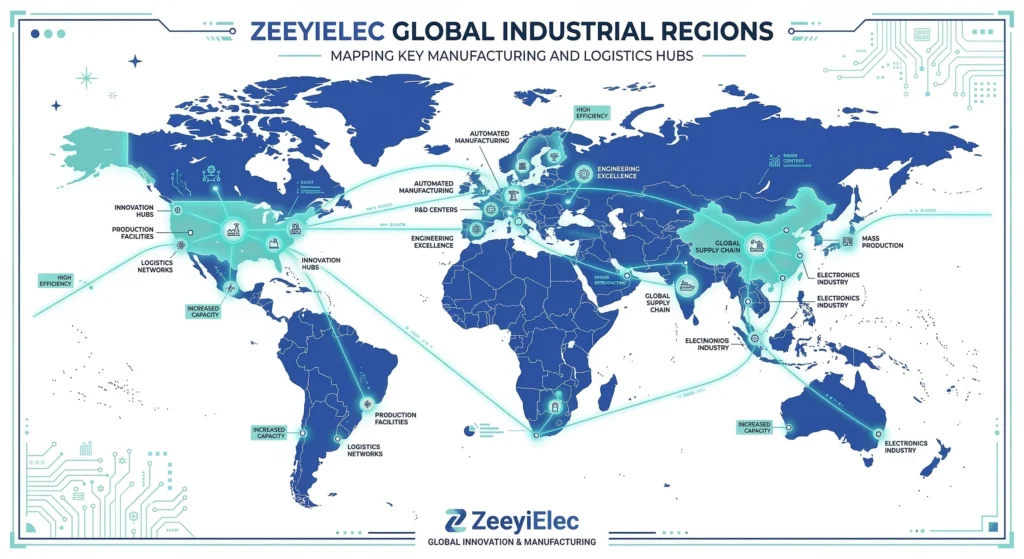
Figure 01:A geographic distribution of Tier-1 transformer bushing manufacturing hubs across Europe, Asia, and North America.
Sourcing reliable in 2026 requires navigating a highly consolidated and technologically shifting manufacturing landscape. Transformer bushings act as the critical dielectric bridge between the internal active parts of a transformer and the external power grid. As grid modernization accelerates globally, the criteria for selecting top-tier bushing manufacturers have shifted from pure cost-evaluation to a strict focus on supply chain resilience, advanced insulation materials, and verified field reliability.
The global supply chain for high-voltage and medium-voltage bushings is dominated by a select group of manufacturers capable of meeting stringent international standards. Procurement engineers must account for extended production schedules; custom engineering for extra-high voltage (EHV) applications ranging up to 800 kV, or specialized resin-impregnated synthetic (RIS) designs, can push lead times from a standard 16 weeks to well over 36 weeks.
Shifting Procurement Criteria
Historically, oil-impregnated paper (OIP) bushings dominated both distribution and transmission networks. However, recent procurement data highlights a distinct pivot toward dry-type technologies to mitigate fire risks and reduce maintenance overhead. When evaluating global vendors, modern procurement teams prioritize manufacturers that demonstrate expertise across multiple insulation paradigms. Key evaluation metrics now include:
Dielectric Performance: The ability to withstand high transient overvoltages and maintain low partial discharge levels over an expected 30- to 40-year operational lifespan.
Environmental Resilience: Proven field performance in high-pollution or seismically active zones, often requiring specific composite polymer housings with optimized creepage distances rather than traditional porcelain.
Standardization and Testing: Strict adherence to international testing protocols, ensuring interoperability and safety.
For authoritative guidance on failure rates and expected lifecycle performance, engineers frequently refer to the [NEED AUTHORITY LINK SOURCE] (Anchor text: CIGRE Technical Brochure 731: Transformer Bushing Reliability), which provides comprehensive statistical data on bushing failure modes across different voltage classes. Selecting a manufacturer from the top global tiers ensures alignment with these rigorous industry expectations, reducing the risk of catastrophic failure at the critical transformer interface.
[Expert Insight]
Raw material shortages for specialized epoxy resins are extending dry-type bushing lead times by an average of 4 to 6 weeks in early 2026.
Standardization across the 145 kV and 245 kV voltage classes is becoming the primary strategy for EPCs to mitigate these supply chain delays.
Utilities are increasingly demanding localized DGA (Dissolved Gas Analysis) testing capabilities from vendors before signing off on final procurement approvals.
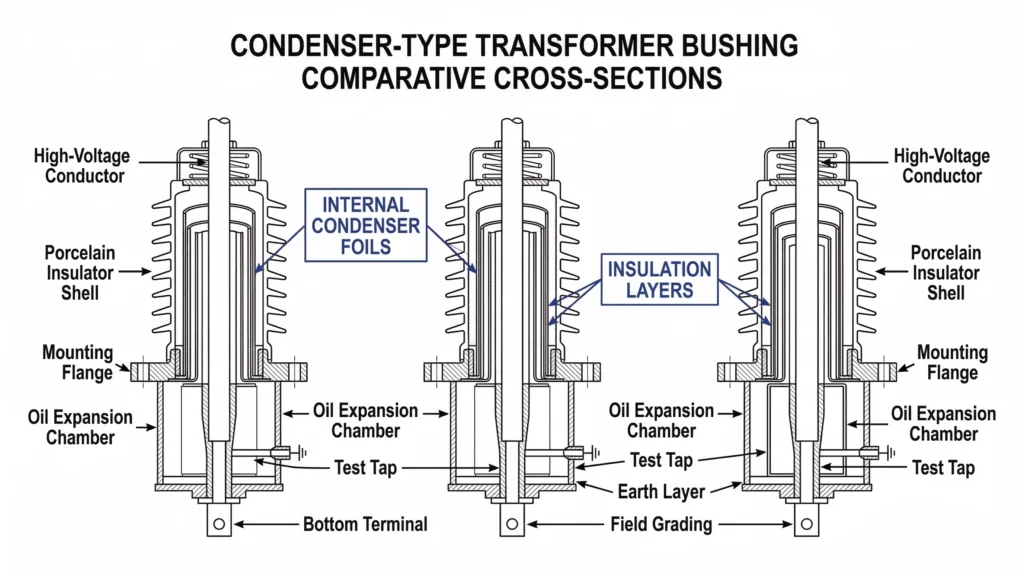
Figure 02:Structural cross-section of condenser bushing cores, illustrating the internal capacitive grading foils in OIP, RIP, and RIS technologies.
The technological capability of a tier-1 manufacturer is largely defined by their mastery of capacitive grading and internal insulation chemistry. A transformer bushing is not merely a conductive pass-through; it is a complex capacitor specifically designed to manage severe electric field stress. By alternating layers of insulating material with conductive aluminum foils, the condenser core distributes electrical stress evenly from the high-voltage central conductor to the grounded transformer tank. Whether engineering standard ANSI/DIN for local distribution or sourcing massive components for critical grid infrastructure, the choice of core insulation fundamentally dictates field performance.
OIP (Oil-Impregnated Paper) Bushings
OIP remains the traditional standard for high-voltage applications. The condenser core is wound with highly refined Kraft paper and vacuum-impregnated with degassed mineral oil. OIP designs offer excellent dielectric strength and thermal dissipation, allowing them to handle substantial current loads without excessive temperature rise. However, they present distinct field challenges: they typically must be stored and transported vertically to prevent gas bubble formation in the high-stress regions, and they require periodic dissolved gas analysis (DGA) to monitor for internal arcing or paper degradation.
From a physics standpoint, OIP systems must maintain a strictly controlled dielectric dissipation factor (tan δ) of ≤ 0.004 to prevent thermal runaway.
RIP (Resin-Impregnated Paper) Bushings
RIP technology eliminates liquid insulation entirely by vacuum-impregnating the wound paper core with an advanced epoxy resin. This dry-type construction provides a robust, void-free solid insulation system. From an installation perspective, RIP bushings offer significant field advantages: they are oil-free (eliminating fire and environmental leak risks), highly seismically resilient, and can be mounted at virtually any angle up to 90 degrees from vertical.
During factory acceptance, top manufacturers test RIP cores under IEC 60137 protocols to ensure partial discharge levels remain ≤ 10 pC at 1.5× maximum phase-to-ground voltage.
RIS/RIN (Resin-Impregnated Synthetic) Bushings
The latest evolution in dry-type technology replaces the traditional cellulosic Kraft paper with a synthetic polymer mesh (RIS) or non-woven synthetic fabric (RIN). Because synthetic fibers are naturally hydrophobic, this architecture is virtually immune to the moisture ingress problems that plague paper-based condenser cores. By eliminating the lengthy paper-drying phase during manufacturing, top-tier vendors can significantly compress production lead times. Furthermore, RIS structures exhibit exceptional thermal stability, safely operating at continuous hotspot temperatures that would rapidly degrade traditional cellulose.
Top 10 Transformer Bushing Manufacturers (Global Leaders)
Selecting the right manufacturing partner dictates the long-term reliability of your grid assets. The following ten manufacturers represent the 2026 global vanguard, evaluated on their voltage class expertise, insulation technology deployment, and proven track records in commercial power applications.
1. Hitachi Energy
A dominant force in ultra-high voltage (UHV) applications, Hitachi Energy leads the market with its dry-type RIS and RIP technologies. They are a preferred vendor for HVDC interconnectors, frequently supplying bushings rated up to 1100 kV for massive cross-border transmission projects.
2. Trench Group
Trench boasts an exceptionally broad portfolio of both OIP and RIP bushings. Their products are heavily specified in seismically active regions due to their advanced composite polymer housings, which provide superior mechanical flexibility and shatter resistance compared to traditional porcelain.
3. GE Vernova
Operating a vast global supply chain, GE Vernova provides robust OIP and RIP solutions tailored for both utility generation and heavy industrial applications. Their standardization across 145 kV to 420 kV classes allows for highly predictable procurement cycles.
4. Maschinenfabrik Reinhausen (MR)
While universally recognized for tap changers, MR’s Micafil RIP bushing technology is highly sought after for premium dry-type applications. Their strict void-free resin curing process ensures exceptional long-term dielectric stability under heavy loads.
5. HSP (High Voltage Synchronous Polymer)
HSP specializes in custom-engineered EHV resin-impregnated solutions. They are frequently selected for specialized generator step-up (GSU) transformers where extreme thermal constraints and high continuous current ratings dictate the mechanical design.
6. Yash Highvoltage
As a rapidly growing powerhouse in the Asian market, Yash Highvoltage dominates the 72.5 kV to 420 kV OIP segment. They offer highly competitive lead times and robust designs well-suited for high-temperature operating environments.
7. Nanjing Electric
One of the largest producers globally by volume, Nanjing Electric provides massive manufacturing capacity for both traditional porcelain and modern composite high-voltage bushings, driving major infrastructure expansions across emerging markets.
8. Pfisterer
Pfisterer’s CONNEX system revolutionizes field installation. From a field operations perspective, their dry-type, pluggable bushing interfaces eliminate the need for on-site oil handling or vacuum treatments. In practical terms, this plug-and-play architecture can save up to 48 hours of critical installation time during offshore wind platform commissioning.
9. RHM International
RHM International focuses exclusively on proprietary dry-type RIP and RIS technologies. Their unique stress-grading designs are engineered to be entirely maintenance-free, targeting utilities looking to aggressively reduce their total cost of ownership over a 40-year lifespan.
10. ZeeyiElec
Serving the critical medium and low voltage distribution sectors, ZeeyiElec provides precision-engineered components for pad-mounted and pole-mounted utility networks. By focusing heavily on stable secondary distribution interfaces, such as ruggedized , they ensure continuous power delivery for the last mile of the electrical grid.
[Expert Insight]
When comparing Tier-1 vendors, always request their specific altitude correction derating curves if your installation site exceeds 1,000 meters above sea level.
A manufacturer’s ability to supply perfectly matched internal components directly impacts the final contact resistance of the entire assembly.
Long-term warranty claims are notoriously difficult to process if the external mounting flange was not factory-matched to the transformer tank’s exact dimensional cutout.
How to Evaluate a Manufacturer for Your Project
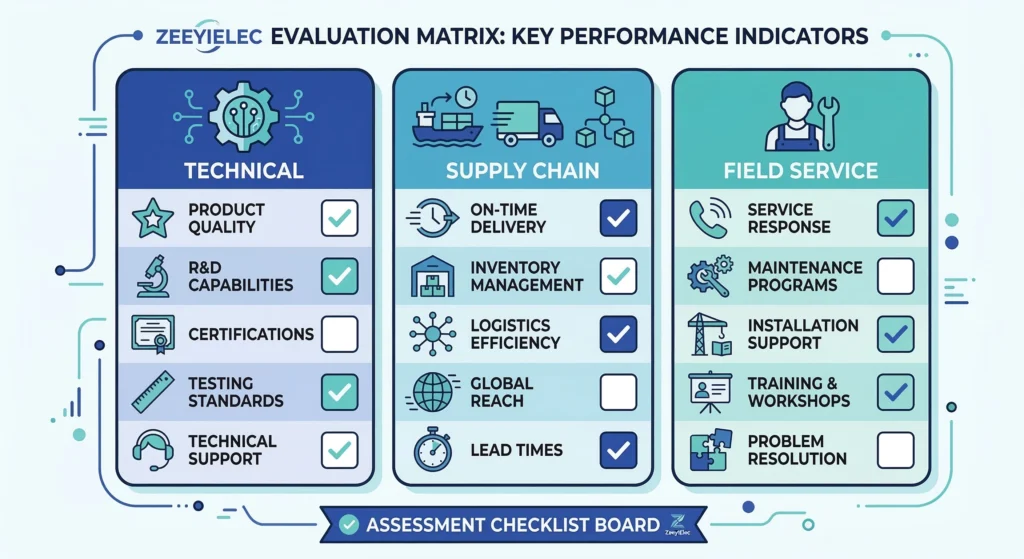
Figure 03:A structured evaluation matrix for assessing bushing vendors based on technical compliance, lead times, and field support.
Selecting a bushing manufacturer based purely on a pristine laboratory datasheet often leads to complications during site execution. In real-world substation environments, environmental contamination, installation constraints, and procurement bottlenecks dictate project success just as much as dielectric design. A systematic evaluation must bridge the gap between factory acceptance tests and long-term field realities.
Verifying Technical Compliance and Testing
Standard type testing proves baseline competency, but your evaluation must account for specific site conditions. For instance, installations situated at high altitudes experience reduced air density, which directly compromises the external dielectric strength of the bushing housing.
If your site elevation exceeds 1,000 meters, verify that the manufacturer correctly applies altitude correction factors, which typically requires the external basic impulse insulation level (BIL) to be uprated by approximately 1.0% to 1.25% for every 100 meters above the 1,000-meter threshold.
Furthermore, ensure the vendor conducts routine partial discharge testing under strict adherence to IEC 60137, confirming a void-free internal insulation structure before shipping the component to the site.
Assessing Supply Chain and Lead Times
Procurement delays for critical transformer interfaces routinely derail energization schedules. Evaluate the manufacturer’s vertical integration: vendors who produce their own condenser cores and composite housings internally are far less susceptible to raw material shortages. Custom-engineered 230 kV RIP bushings can easily stretch beyond 30 weeks. Establish firm penalty clauses for late delivery during the initial RFQ stage to secure your priority spot in their production queue.
Evaluating Field Service and Global Support
The most advanced condenser bushing will fail prematurely if mishandled during installation. For high-voltage OIP systems, evaluate the vendor’s local field service network and their ability to mobilize oil-handling and vacuum-treatment equipment directly to your site. At the distribution level, installation errors are equally critical. Improper torqueing of terminal connections or misalignment during final assembly frequently leads to localized thermal stress.
If contact resistance spikes > 50 μΩ due to poor installation practices, the resulting temperature rise will rapidly degrade the surrounding NBR or Viton gasket seals, leading to moisture ingress and catastrophic dielectric failure.
Partner with manufacturers who provide comprehensive installation manuals, hands-on field training, and responsive technical support to mitigate these common execution risks.
Sourcing MV and LV Bushings for Distribution Transformers
When specifying components for distribution networks, procurement teams must balance unit economics with long-term dielectric reliability. Sourcing medium and low voltage bushings requires strict attention to operational parameters, including continuous current ratings, thermal dissipation capabilities, and environmental creepage distances.
For low-voltage secondary applications, specifying the correct structural interface—whether high-temperature nylon (HTN), porous resin, or traditional porcelain—ensures stable current transfer from 600 A up to 5000 A under continuous load without exceeding allowable temperature rise limits. On the primary side, medium-voltage installations operating between 15 kV and 35 kV demand highly robust insulation structures. These components must withstand severe transient overvoltages while maintaining a hermetic seal to protect the transformer’s internal insulating oil from external moisture.
For distribution sites exposed to heavy industrial or coastal contamination, specifying an extended specific creepage distance of ≥ 31 mm/kV is critical to prevent surface tracking and catastrophic flashovers across the external bushing housing.
ZeeyiElec engineers and manufactures a comprehensive portfolio of transformer accessories tailored specifically for utility and industrial distribution systems. By maintaining strict quality control and adhering to rigorous international testing standards, we help procurement teams eliminate the specification gaps that lead to premature field failures and costly site rejections.
Ready to standardize your distribution transformer bill of materials and secure reliable production lead times? Submit your technical specifications, required voltage classes, and project volumes for dedicated engineering support and direct factory pricing. Reach out to our technical sales team to configure your exact requirements: .
Frequently Asked Questions
What is the typical lead time for high-voltage transformer bushings?
Lead times generally range from 16 to 36 weeks depending on the specific voltage class and the manufacturer’s current production backlog. Custom engineering requirements for EHV (Extra High Voltage) applications or severe global supply chain disruptions can push this manufacturing timeline well beyond 40 weeks.
How do I choose between RIP and OIP bushings?
RIP bushings are preferred for installations requiring high seismic resilience and oil-free fire safety, though they typically carry a capital cost premium of ≥ 15% to 30% over standard options. OIP bushings remain the economical standard for typical utility applications where strict maintenance protocols and oil handling procedures are already well-established.
What is the expected lifespan of a transformer bushing?
A properly specified and meticulously maintained bushing typically operates reliably for 25 to 40 years under normal grid conditions. However, high-pollution environments, frequent electrical transients, or a lack of routine dissolved gas analysis (DGA) can reduce this functional lifespan by more than half.
Are ANSI and IEC bushings physically interchangeable?
No, ANSI and IEC bushings adhere to entirely different dimensional, testing, and mounting interface standards. While a top-tier manufacturer might produce dual-certified internal condenser components, the external mounting flanges and terminal connections require specific matching to the original transformer tank design.
What causes transformer bushings to fail prematurely?
Moisture ingress is the leading cause of premature field failure, often degrading the dielectric strength of the internal paper insulation within 3 to 5 years if the external gasket seals are compromised. Secondary causes include electrical tracking from severe surface contamination or thermal degradation resulting from sustained overloading beyond the nameplate ratings.
Do bushing failures impact other connected grid components?
Yes, a catastrophic bushing failure can create severe voltage transients (ΔV) that stress downstream distribution equipment, including such as cold shrink terminations and joints. Ensuring coordinated basic impulse insulation levels (BIL) across both transformer interfaces and cable connections is critical for overall network stability.
yoyo shi
Yoyo Shi writes for ZeeyiElec, focusing on medium-voltage accessories, transformer components, and cable accessory solutions. Her articles cover product applications, technical basics, and sourcing insights for global electrical industry buyers.




 English
 한국어
한국어 العربية
 Español
 हिन्दी
 தமிழ்
தமிழ் Deutsch (Sie)
 Français
 Português do Brasil
 Русский