A medium-voltage (MV) transformer is a specialized piece of electrical equipment designed to step down high transmission voltages to safer, usable distribution levels. Operating primarily within the 11 kV to 35 kV voltage range, these transformers relay on electromagnetic induction to transfer power between utility grids and industrial, commercial, or residential load centers.
How Medium-Voltage Transformers Work
At its core, a medium-voltage transformer operates on Faraday’s law of induction. Power enters the primary winding — typically constructed from tightly wound copper or aluminum conductors — creating an alternating magnetic flux. This flux travels through a high-permeability, laminated silicon steel core and intersects the secondary winding. The ratio of turns between the primary and secondary windings dictates the exact voltage step-down; a common industrial unit might step down a 33 kV primary feed to a 415 V secondary output, supporting power ratings anywhere from 500 kVA up to 10 MVA depending on the facility’s demand.
The core itself is built from cold-rolled grain-oriented (CRGO) silicon steel laminations, typically manufactured to thicknesses between 0.23 mm and 0.30 mm and stacked tightly to form a low-reluctance flux path while minimizing eddy currents. The surrounding windings, wound from high-conductivity electrolytic copper or aluminum, are sized to minimize I²R (copper) losses and hysteresis, keeping maximum winding temperature rise typically at or below 65°C under full continuous load.
Dielectric Insulation: Oil-Filled vs. Dry-Type
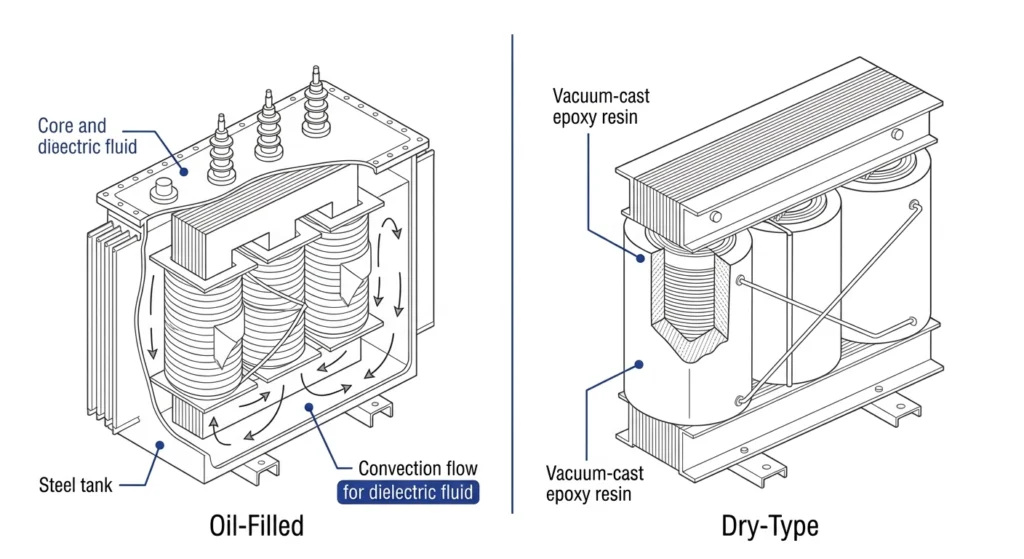
Because internal conductors carry voltages from 11 kV up to 35 kV, preventing phase-to-phase and phase-to-ground arcing is paramount. In liquid-immersed transformers, the entire core and coil assembly is submerged in highly refined mineral oil or synthetic ester fluids. This dielectric fluid penetrates the specialized kraft paper wrapped around the winding conductors, providing insulation strength while circulating via natural or forced convection to dissipate heat.
Dry-type alternatives replace the liquid medium with cast epoxy resin: the windings are encapsulated under vacuum, creating a solid dielectric barrier that is self-extinguishing and free of fluid-leakage risk, though they generally require a larger physical footprint to achieve comparable cooling.
Interfaces and Connections
Because the active core is heavily insulated and sealed within a grounded steel tank, transferring the 11 kV to 35 kV current into and out of the enclosure requires specialized hardware. The main unit relies heavily on to function safely. These critical interface components support insulated connection, fault protection, switching operations, and voltage adjustment in distribution transformer systems. Insulated bushings bridge the grounded tank wall, while off-circuit tap changers and protection fuses ensure the core remains shielded from external grid transients. Without these precision-engineered interfaces, the transformer cannot be safely energized or connected to the wider distribution network.
Governing standards:
IEC 60076-1 — the closest international equivalent, used by buyers sourcing to IEC-compliant specifications outside North America
IEEE Std C57.12.00 — general requirements for liquid-immersed distribution, power, and regulating transformers
IEEE Std C57.12.01 — general requirements for dry-type distribution and power transformers
To understand how medium-voltage transformers safely handle substantial electrical loads, it is necessary to examine their internal architecture. The core structural components are engineered to simultaneously manage high-voltage magnetic flux, extreme thermal outputs, and severe dielectric stress.
Interfaces & Accessories: Bushings, Tap Changers, and Protection
Because the active core and windings are heavily insulated and sealed within a grounded steel tank, transferring current safely into and out of the enclosure requires specialized interface hardware.
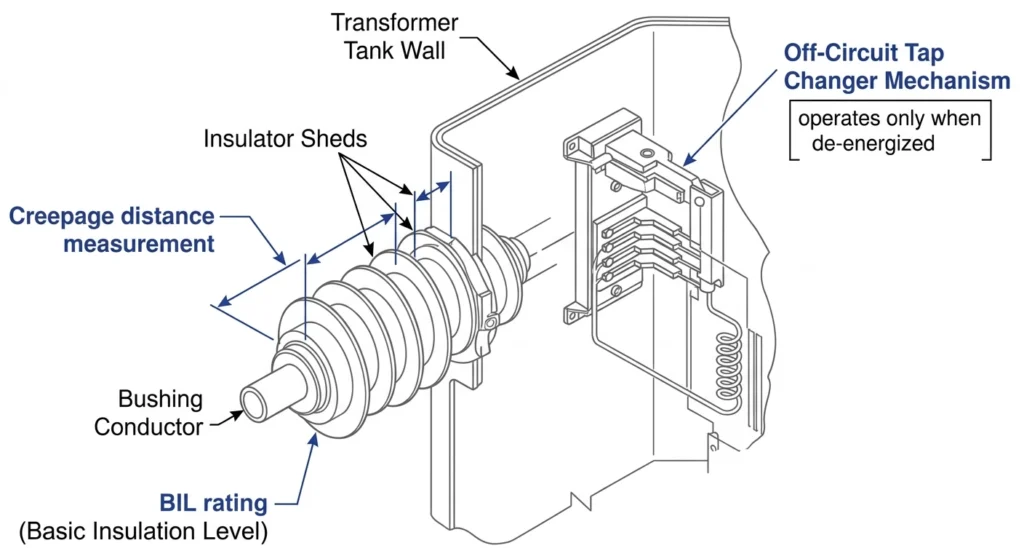
Bushings function as critical insulated pass-through components installed on the transformer tank wall, safely transferring current between internal windings and external circuits. In practical applications, ZeeyiElec’s medium-voltage bushings are selected by standard voltage class and rated from 12 kV up to 52 kV.
External grid voltages are rarely perfectly stable. To compensate for minor voltage fluctuations, transformers incorporate an off-circuit tap changer — a mechanical switching device that adjusts the transformer’s turns ratio, strictly operating only when the unit is de-energized.
Bushing dimensional and performance requirements are set out in IEEE Std C57.19.01, which defines electrical and dimensional requirements including BIL ratings and creepage distances — the same creepage requirements referenced below in the altitude-derating discussion.
Cutaway diagram of bushing and off-circuit tap changer mounting positions on the tank wall, with BIL rating and creepage-distance callouts
Expert Insight
Dielectric fluid testing: Always mandate dissolved gas analysis (DGA) for oil-filled units before commissioning; establishing baseline data is critical for future fault diagnosis.
Bushing specification: Over-specifying bushing creepage distance by 10–15% is a low-cost insurance policy against unexpected site contamination or salt spray.
Epoxy cast curing: For dry-type transformers, verify the manufacturer’s vacuum casting process documentation to ensure zero void formation in the resin, which prevents partial discharge.
Voltage Classifications and Selection Logic
Selecting the correct medium-voltage transformer requires mapping the facility’s power demand and grid infrastructure to standardized voltage classes. The chosen voltage class dictates not only the internal winding design but also the required dielectric strength, spatial clearances, and the exact specifications for connecting components.
The 11 kV / 15 kV Distribution Class
Application comparison diagram: 11kV/15kV indoor distribution scenario vs 33kV/35kV industrial/renewable collector-substation scenario, with typical BIL/clearance values labeled
The 11 kV and 15 kV systems represent the backbone of standard commercial and urban distribution. Transformers in this category are designed to balance compact footprints with reliable power delivery. Because these units are frequently installed in confined indoor switchgear rooms or underground vaults, field engineers prioritize installation safety and spatial efficiency. In such restricted environments, connection points are typically sealed using heat shrink cable accessories — pre-expanded, flame-free insulation components used for medium-voltage cable terminations and joints, which allow secure installation where open-flame techniques would pose a severe fire hazard.
The 33 kV / 35 kV Sub-Transmission Class
Moving up to the 33 kV and 35 kV classes shifts the engineering focus toward managing significantly higher dielectric stress and environmental exposure. These transformers serve as critical nodes in heavy industrial facilities or renewable energy collector substations, bridging the gap between high-voltage transmission and localized distribution.
Equipment in this tier must withstand severe transient overvoltages, often requiring a BIL of 150 kV or 200 kV according to IEEE C57.12.00. 35 kV class transformers also demand strict phase-to-phase and phase-to-ground clearances, typically mandating spatial gaps of ≥ 350 mm in air to prevent arc flashes.
Field Conditions and Environmental Variables
A transformer’s theoretical lifespan relies heavily on mitigating harsh field conditions. Understanding these variables is critical for long-term grid reliability and accurate specification.
Temperature Rise and Cooling
During peak load cycles in ambient environments exceeding 40°C, the internal winding ΔT (temperature rise) can easily surpass the standard 65°C design limit. Field experience consistently shows that for every 8°C the operating temperature rises above its nameplate thermal rating, the internal paper insulation life is effectively halved. External radiator fins and cooling fans mitigate this heat, but blocked airflow in poorly ventilated indoor vaults remains a frequent cause of nuisance tripping and accelerated thermal aging.
Altitude and Dielectric Derating Constraints
Installations in high-altitude regions, such as mining operations situated above 1,000 meters, face unique challenges due to reduced air density. Thinner air diminishes both the dielectric strength of external clearances and the convective cooling efficiency of the transformer tank. Per IEC 60076-2 (temperature rise and altitude correction provisions), equipment operating above this threshold requires a dielectric derating of approximately 1 percent per 100 meters of elevation. To compensate, field deployment in these rarefied atmospheres requires specifying higher basic impulse levels (BIL) and larger bushing creepage distances.
For loading behavior beyond nameplate rating — a frequent question for cyclic or emergency-overload duty — IEEE Std C57.91 (“IEEE Guide for Loading Mineral-Oil-Immersed Transformers and Step-Voltage Regulators”) provides the accepted methodology for evaluating insulation aging against elevated loading and ambient-temperature combinations.
Contamination and Moisture Ingress
In coastal, agricultural, or heavily industrialized zones, salt spray and conductive dust settle on exposed terminals, leading to surface tracking and eventual phase-to-ground faults. At the critical cable interfaces, installation crews commonly use heat shrink cable accessories to create a weather-tight, anti-tracking seal over medium-voltage connections.
Moisture ingress is particularly damaging to liquid-filled units: if water content in the insulating mineral oil reaches ≥ 30 ppm, internal dielectric strength drops sharply, reducing flashpoint and increasing the risk of internal short circuit.
Expert Insight
Ventilation calculations: Never rely solely on passive louvers for indoor 35 kV vaults; always calculate forced-air CFM requirements based on maximum load thermal dissipation.
Altitude corrections: If your site exceeds 1,000 meters, explicitly state the elevation in your RFQ so the factory can properly adjust BIL and external clearances.
Moisture defense: In areas with heavy rainfall or coastal humidity, specify hermetically sealed tanks or ensure free-breathing units are equipped with oversized silica gel breathers.
Common Failure Modes and Accessory Protection
Medium-voltage transformers rarely fail in isolation; catastrophic breakdowns typically result from external grid anomalies exceeding the core’s mechanical and thermal limits. Transformers rely on a coordinated suite of protective accessories to isolate faults and manage switching arcs before a localized failure cascades into a substation outage.
Overcurrent Protection Coordination
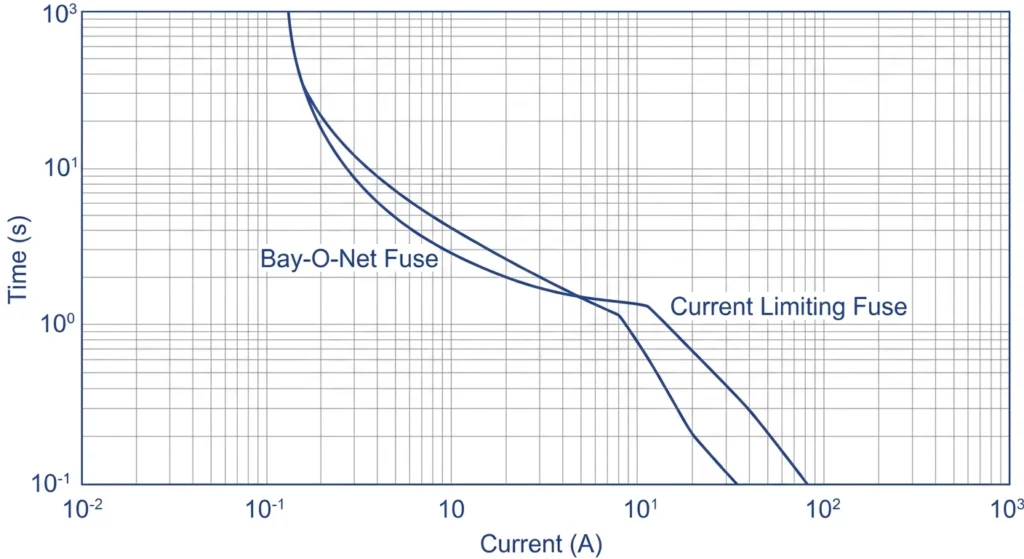
A primary failure mode involves severe short circuits that subject transformer windings to massive electromechanical forces. During a bolted fault, currents can spike to tens of thousands of amperes within milliseconds. To mitigate this, engineers deploy current limiting fuses engineered for rapid fault-current cutoff, high interrupting capability, and reliable coordination in distribution transformer protection schemes. The fuse operates by melting its internal element and introducing a high-resistance arc, forcing the current to zero within a half-cycle — severely limiting the destructive I²t let-through energy and shielding the core from mechanical deformation.
Current limiting fuses are typically deployed as backup protection working alongside a Bay-O-Net fuse assembly: the Bay-O-Net handles low-to-moderate overload and secondary-fault currents, while the current limiting fuse clears the high-magnitude internal faults the Bay-O-Net cannot safely interrupt. (See Bay-O-Net vs Current Limiting Fuse: Coordination Guide for full selective-coordination guidance.)
Time-current characteristic (TCC) coordination curve showing Bay-O-Net and current limiting fuse working together
Safe Switching and Load Management
Another critical failure pathway involves improper field switching operations — operating an off-circuit tap changer under load damages contacts and risks internal transformer faults. To safely manage energized networks, transformers utilize a dedicated loadbreak switch, typically rated for 630 A continuous current across 15/25 kV and 38/40.5 kV voltage classes. Specialized arc-quenching materials and spring-loaded quick-make/quick-break mechanisms let field personnel safely isolate transformer loads without generating sustained arcs that could vaporize the surrounding dielectric oil. (See 2-Position vs 4-Position Loadbreak Switch: Selection Guide for configuration selection.)
Application Scenarios
Industrial substations and manufacturing load centers — MV transformers step incoming utility supply down to distribution-usable levels at the point of consumption, sized to peak demand plus a growth margin.
Renewable energy collector substations — solar and wind sites use MV transformers in the reverse role, stepping generator-level voltage up to collector-system voltage, a fast-growing segment of 33/35 kV demand.
Mining and remote high-altitude sites — the clearest real-world case for the altitude-derating guidance above, since remote mine sites are frequently sited well above 1,000 meters.
Specifying Transformers and Critical Accessories for Your Project
Specifying a medium-voltage transformer for your distribution network extends far beyond selecting a base kVA rating. Whether you are engineering a compact 15 kV commercial pad-mounted unit or a 35 kV renewable energy collector substation, long-term system reliability depends entirely on strict accessory compatibility. The active core and windings dictate theoretical power capacity, but the external protective and connection interfaces dictate real-world operational safety.
Procurement and field engineers must verify that every component matches the exact system voltage and fault-current parameters — for instance, cross-referencing basic impulse levels (BIL) and thermal limits between a bushing well and a loadbreak switch to ensure the accessories withstand the network’s transient overvoltages. A mismatch in dimensional tolerances or dielectric strength between the transformer tank and its connecting bushings can lead to accelerated partial discharge and premature failure at the interface.
At ZeeyiElec, our engineering team bridges this specification gap. We provide a complete, technically verified ecosystem of transformer and cable accessories engineered to integrate seamlessly into your 11 kV to 35 kV distribution projects. Share your project drawings and environmental requirements with our team to receive precise model matching, export documentation support, and a comprehensive RFQ response tailored to your exact distribution parameters.
Frequently Asked Questions
What is the lifespan of a medium-voltage transformer?
A typical medium-voltage transformer operates reliably for 25 to 30 years under normal environmental baseline conditions and standard 80 percent load cycles. Sustained thermal overloading or neglected maintenance can prematurely degrade the internal paper insulation, reducing this projected service life by up to 50 percent.
Can an 11 kV transformer handle 33 kV inputs?
No. An 11 kV transformer is engineered with dielectric insulation thresholds and clearance distances designed exclusively for an 11 kV or 15 kV maximum continuous system voltage. Applying a 33 kV feed to these primary terminals will overcome the dielectric rating, causing immediate electrical flashover and catastrophic equipment failure.
What is the difference between dry-type and oil-filled MV transformers?
Oil-filled transformers use refined mineral or synthetic ester fluid for both active-core cooling and internal dielectric insulation, making them efficient for exposed outdoor distribution substations. Dry-type transformers rely entirely on vacuum-cast epoxy resin or solid insulation systems, and are typically mandated for confined indoor commercial applications due to strict fire safety regulations.
How much clearance is required around a 35 kV transformer?
Standard high-voltage safety protocols generally dictate a minimum spatial clearance ranging from 3 to 10 feet around the unit, depending on whether the perimeter serves as operational working space or a fire barrier. Field engineers should always consult local electrical codes and the manufacturer’s specific dimensional datasheets.
Why do medium-voltage transformers hum?
The characteristic humming noise occurs when the alternating magnetic field causes silicon steel core laminations to microscopically expand and contract 100 to 120 times per second based on grid frequency. This low-frequency baseline hum is a normal operational trait, but sudden excessive rattling often indicates mechanical loosening of core bolts that requires immediate diagnostic maintenance.
How often should a medium-voltage transformer be tested?
Routine visual inspections and thermographic scanning should be conducted monthly to identify surface hot spots, while comprehensive dielectric fluid analysis and heavy electrical testing typically occur every 12 to 36 months. Installations in high-humidity regions, heavy-load industrial plants, or coastal salt-spray environments generally require more aggressive, annual testing schedules to prevent insulation failure.
yoyo shi
Yoyo Shi writes for ZeeyiElec, focusing on medium-voltage accessories, transformer components, and cable accessory solutions. Her articles cover product applications, technical basics, and sourcing insights for global electrical industry buyers.







 English
 한국어
한국어 العربية
 Español
 हिन्दी
 தமிழ்
தமிழ் Deutsch (Sie)
 Français
 Português do Brasil
 Русский