Transformer butterfly valve size should match the approved radiator connection, available assembly space and cooling-circuit requirements. Compare nominal size with the actual passage, flange or mounting pattern, sealing faces, body thickness and disc travel. A matching DN label or transformer power rating alone cannot confirm fit, flow performance or replacement suitability.
For a buyer, the useful output is a reviewed drawing package rather than a diameter selected from a photograph. This guide focuses on dimensional matching and the evidence needed to release one configuration. Use the wider transformer accessories selection guide to coordinate the valve with the complete equipment specification.
Start With the Radiator Connection, Not Transformer kVA
Identify the exact branch and design responsibility
A radiator connection belongs to a particular cooling arrangement. Record the transformer identification, radiator or bank reference, connection location and approved drawing revision. Confirm whether the enquiry concerns a new design, a like-for-like replacement or a change to the cooling circuit. These are different engineering decisions.
Transformer rating describes electrical capacity; it does not uniquely define radiator quantity, branch flow, connection geometry or the allowable restriction through one valve. Avoid a universal kVA-to-DN table. The responsible transformer designer must establish the cooling requirement and approve changes affecting it.
Establish the baseline before comparing quotations
For a replacement, obtain the existing assembly drawing and the proposed valve drawing. Field measurements can help resolve a missing dimension, but document the measurement locations, equipment condition and uncertainty. Do not treat an indistinct photograph as a controlled dimensional record.
For a new assembly, start with both mating connections and the cooling design requirements. The transformer valve product family can identify candidate arrangements; the offered configuration still needs a drawing review. Keep one baseline for every supplier so that transformer butterfly valve size comparisons address the same interface.
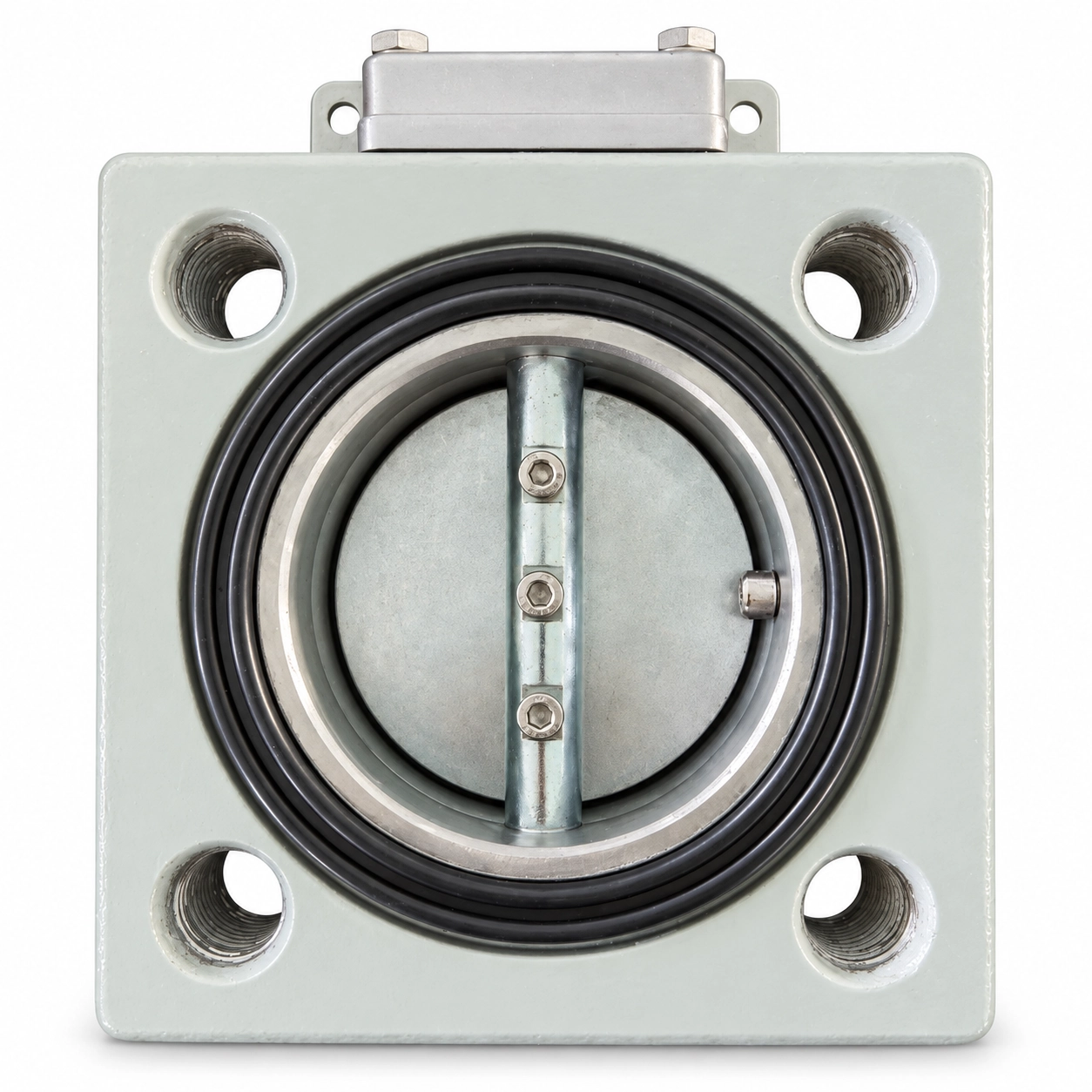
Presentation-edited product photograph shows the mounting face, threaded holes and sealing recess. Use the controlled drawing for hole sizes, pitches and recess dimensions.
Separate Nominal Size From Measured Flow Geometry
Read DN as a designation
DN is a nominal size designation used for pipework components. ISO 6708:1995 defines and lists preferred DN designations. The designation does not replace a component drawing or establish every manufacturing dimension.
Distinguish the stated DN from the mating connection opening, actual internal passage and unobstructed flow area. A butterfly valve includes a disc and shaft within its passage. Consequently, a circular opening shown on a drawing is not automatically the free flow area of the assembled valve.
Use actual dimensions for geometric comparisons
When reviewing transformer butterfly valve size, ask which diameter a quotation describes. Is it the connection opening, body bore, disc diameter or outside body dimension? Give each dimension a distinct label in the enquiry. Mixing these values can make two different assemblies appear equivalent.
For a simple circular opening, area A = π × d2 / 4. As a hypothetical geometry example, increasing a clear circular diameter from 70 mm to 80 mm increases area by (80/70)2, approximately 1.31 times. These are assumed opening dimensions, not product sizes or a radiator recommendation. The calculation excludes the disc and shaft and cannot establish valve pressure loss.
Use this distinction to identify the information missing from an offer. Do not convert an area comparison into a cooling-capacity claim. The actual passage geometry, liquid conditions and hydraulic data require a separate review.
Match Transformer Butterfly Valve Size to Both Interfaces
Compare corresponding datums
A valve may need to match a tank-side connection on one face and a radiator-side connection on the other. Check both. Confirm the viewing direction and the datum used for each dimension before overlaying drawings. A mirrored view can make an asymmetric hole pattern appear correct when it is not.
The worksheet below makes a transformer butterfly valve size review explicit. Enter the required dimension, offered dimension, drawing reference and review result; leave missing entries open.
Review item
Required evidence
What a mismatch can affect
Nominal designation and actual opening
DN plus separately dimensioned passage
Connection identity and restriction
Hole pattern
Hole quantity, diameter, pitch and angular orientation
Fastener alignment
Threaded connections
Thread system, size, pitch and engagement requirement
Supplied fastener compatibility
Sealing interface
Face geometry, recess or groove, gasket identification
Assembly fit and sealing
Body and assembly thickness
Defined face-to-face datums and gasket arrangement
Available connection spacing
Moving-disc envelope
Disc projection through the required travel
Clearance to adjacent components
Stem and operator envelope
Overall dimensions and required access space
Operation and future access
Separate bolt pattern from outside shape
A round body can have a bolt-circle dimension; a square arrangement may instead be controlled by horizontal and vertical hole pitches. Use the dimensioning method on the actual drawing. Outside shape, equal hole count and a matching DN are insufficient evidence of interchangeability.
Include whether the holes are threaded or through holes. Also identify what the quotation supplies: valve, gaskets, bolts, studs, nuts or connection pieces. A dimensionally acceptable valve can still arrive with unsuitable associated parts.
Keep units and tolerances visible in the review record. If a measurement is taken from an existing component, distinguish that observation from the drawing's specified dimension and acceptance tolerance. Ask the responsible engineer to resolve a difference; rounding two measured values to the same nominal size does not establish agreement.
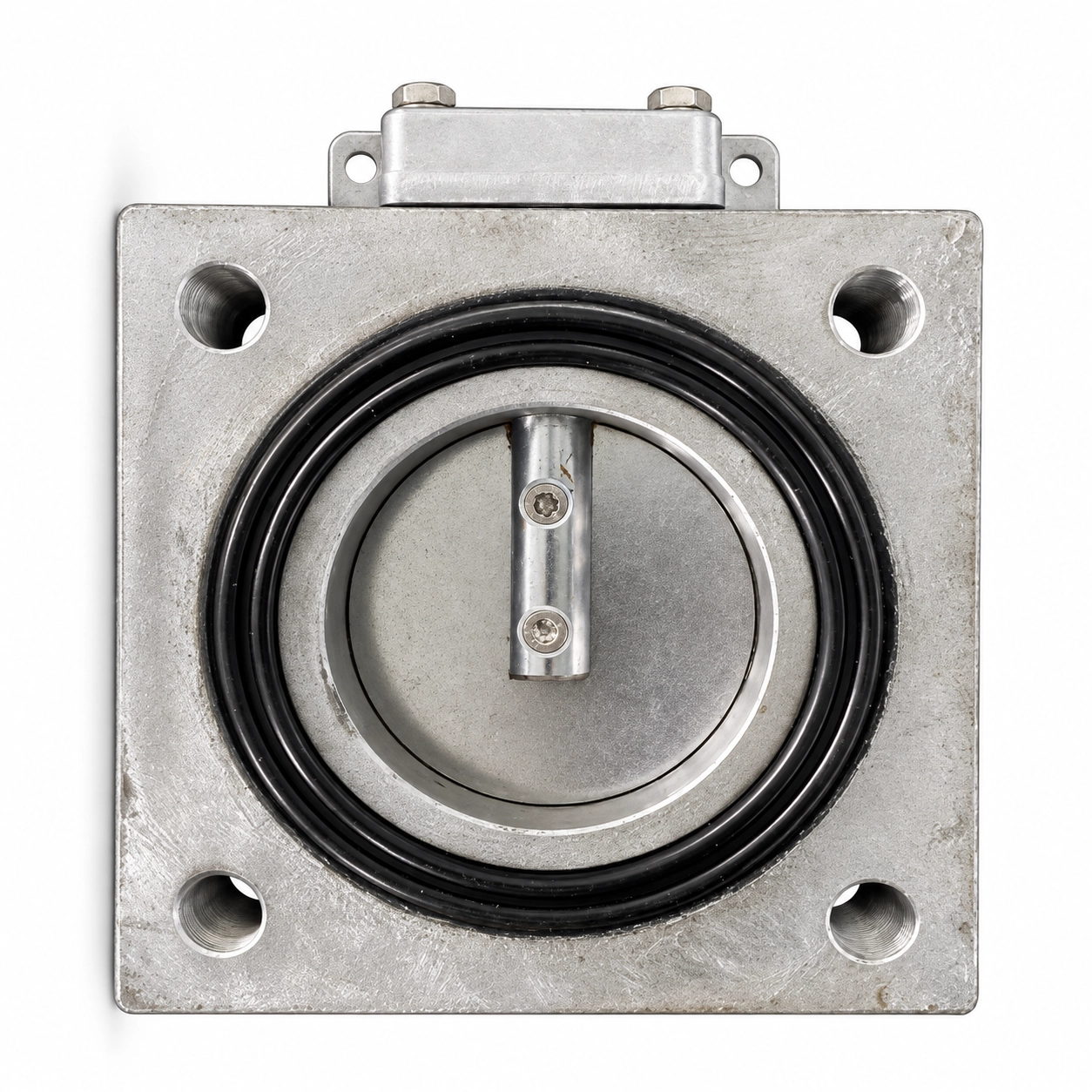
Presentation-edited product view highlights the hole arrangement, sealing recess and stem housing. Confirm material, dimensions and fastening details using the controlled drawing.
Check Disc Travel, Assembly Thickness and Access
Look beyond the closed front view
A closed disc can look contained within the body even when the moving disc requires space beyond a sealing face. Obtain the applicable travel envelope and check it against the adjacent connection geometry. Consider the pipe opening, gasket inner edge and any nearby internal feature shown on the assembly drawing.
A check of transformer butterfly valve size should therefore include moving clearances, not just the external outline. Confirm how the supplier defines projection and the reference face. Do not infer a clearance value by scaling a product image.
Reconcile the complete installed stack
Compare body thickness with the available space using defined mating-face datums. Account for the specified gasket arrangement and the manufacturer's assembly requirements. Uncompressed gasket thickness and final assembled spacing are different quantities; avoid substituting one for the other without the applicable instruction.
Check stem, indicator and operator access in the equipment layout. A body that fits between the connections may leave insufficient space for the intended operating mechanism or approved maintenance access. Dimensional approval should cover the complete supplied assembly, including optional parts that change its envelope.
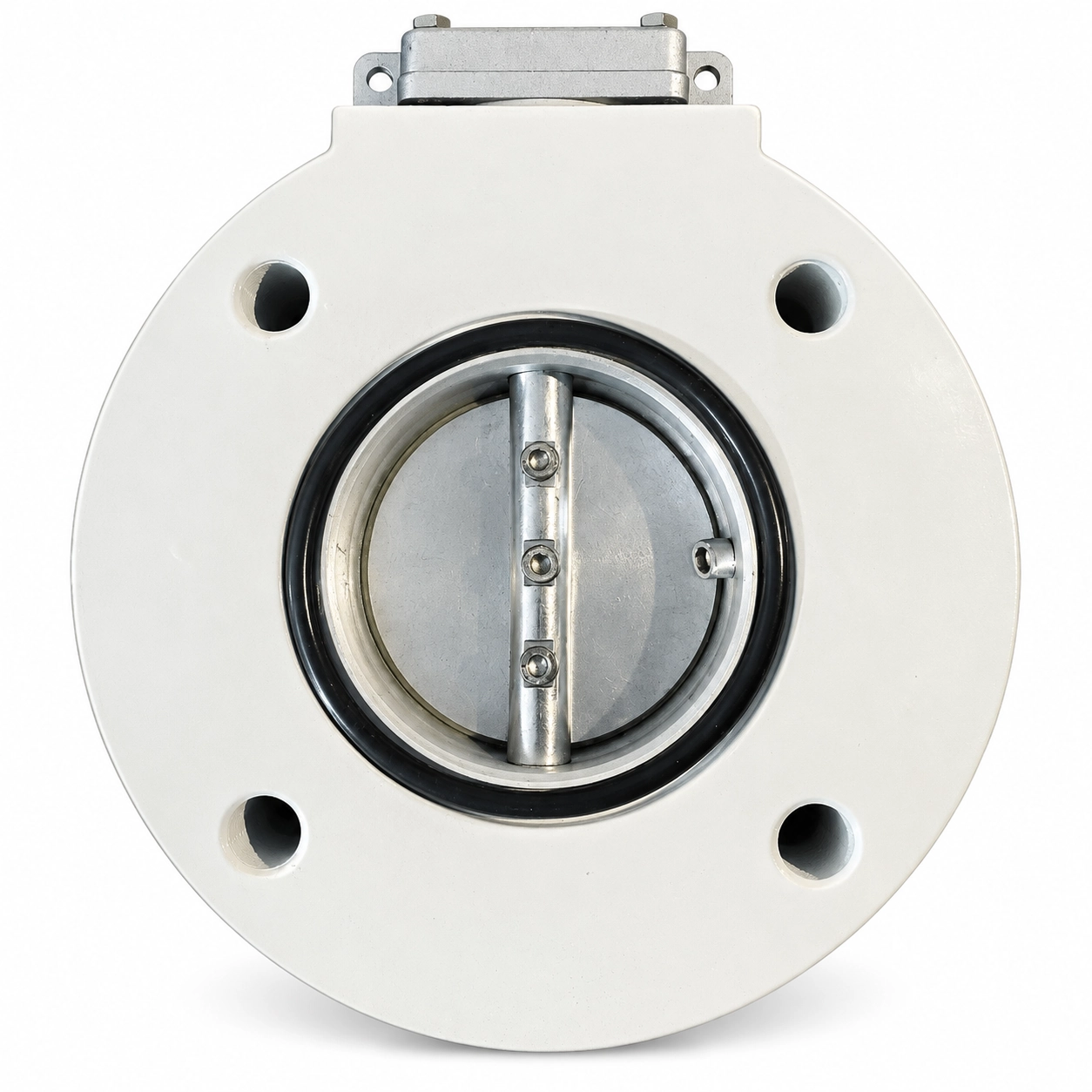
Presentation-edited round-body product photograph illustrates a different mounting-face arrangement. Confirm its bolt circle, sealing interface and moving-disc envelope on the controlled drawing.
Reconcile the Size With the Cooling-Circuit Review
Connect flow requirements to valve data
Mechanical fit is necessary, but the cooling design also needs an acceptable flow path. Request the flow or pressure-loss information applicable to the offered valve configuration and intended operating condition. Identify the liquid, temperature or viscosity basis, valve position and units used in the data.
Two valves with the same nominal designation may have different passages or disc geometries. Conversely, selecting a larger nominal body does not automatically improve the complete circuit: reducers, adjacent connections and the available driving conditions also matter. The designer must assess the proposed assembly within that circuit.
Keep size approval separate from service approval
Transformer butterfly valve size is only one part of selection. Confirm liquid compatibility, temperature conditions, required pressure and vacuum exposure, and the acceptance requirements for internal and external leakage. Dimensional agreement does not establish these properties.
Do not use a generic flow coefficient without its definition, units and stated conditions. If hydraulic evidence is unavailable, record the gap and obtain the responsible designer's disposition. Avoid inventing a universal velocity limit or assuming that an isolation valve is suitable for continuous throttling.
Close the RFQ Against One Approved Configuration
Resolve exceptions before purchase release
Consider a hypothetical replacement review: both offers state the same DN, but one drawing shows threaded mounting holes while the existing arrangement uses through holes. A matching nominal designation does not close that difference. Record the discrepancy and obtain an approved solution covering the fastening arrangement and both mating faces.
Another hypothetical offer matches the hole pattern but omits disc projection. Its fit remains unconfirmed until the missing envelope is reviewed. These examples illustrate decisions; they are not reported customer cases or instructions to modify an installed valve.
Preserve the selected drawing and supply scope
The final transformer butterfly valve size record should identify the accepted model, drawing revision, mating references, agreed dimensions, service evidence and closed exceptions. State which gaskets, fasteners and operating parts are included. Keep the responsible review decision with the purchase record.
Presentation-edited product photograph illustrates another body configuration. Use its controlled drawing to establish dimensions, ratings and replacement compatibility.
Frequently Asked Questions
Can transformer kVA determine radiator butterfly valve size?
No. Transformer rating does not uniquely define the cooling arrangement, branch flow or connection geometry. Use the approved radiator interfaces and cooling design requirements, and obtain the responsible designer's approval for the selected assembly.
Does DN specify the exact valve bore?
No. DN is a nominal designation. Request the actual passage dimensions and distinguish them from disc diameter, connection opening and outside body dimensions. The disc and shaft also influence the assembled flow path.
Which mounting dimensions should match?
Check both mating faces, including hole quantity, hole or thread details, pitches or bolt circle, orientation, sealing-face geometry and assembly thickness. Confirm the moving-disc and operating envelopes against the adjacent equipment arrangement.
Is a larger butterfly valve always better for cooling?
No. The complete cooling circuit determines suitability. A larger valve may require connection changes and does not remove restrictions elsewhere. Review applicable flow data, pressure loss and mechanical fit before approving a size change.
Why is disc clearance part of a size check?
The disc moves within and sometimes beyond the body envelope. Check its specified travel against adjacent connections, gasket openings and internal features. A matching bolt pattern alone does not establish interference-free operation.
What should a transformer butterfly valve size enquiry include?
Include the equipment and branch references, both mating drawings, nominal designation, actual dimensions, available space, service conditions, cooling requirements and supplied-parts scope. Request a controlled valve drawing and document any unresolved deviations before release.
yoyo shi
Yoyo Shi writes for ZeeyiElec, focusing on medium-voltage accessories, transformer components, and cable accessory solutions. Her articles cover product applications, technical basics, and sourcing insights for global electrical industry buyers.







 English
 한국어
 العربية
 Español
 हिन्दी
 தமிழ்
 Deutsch (Sie)
 Français
 Português do Brasil
 Русский