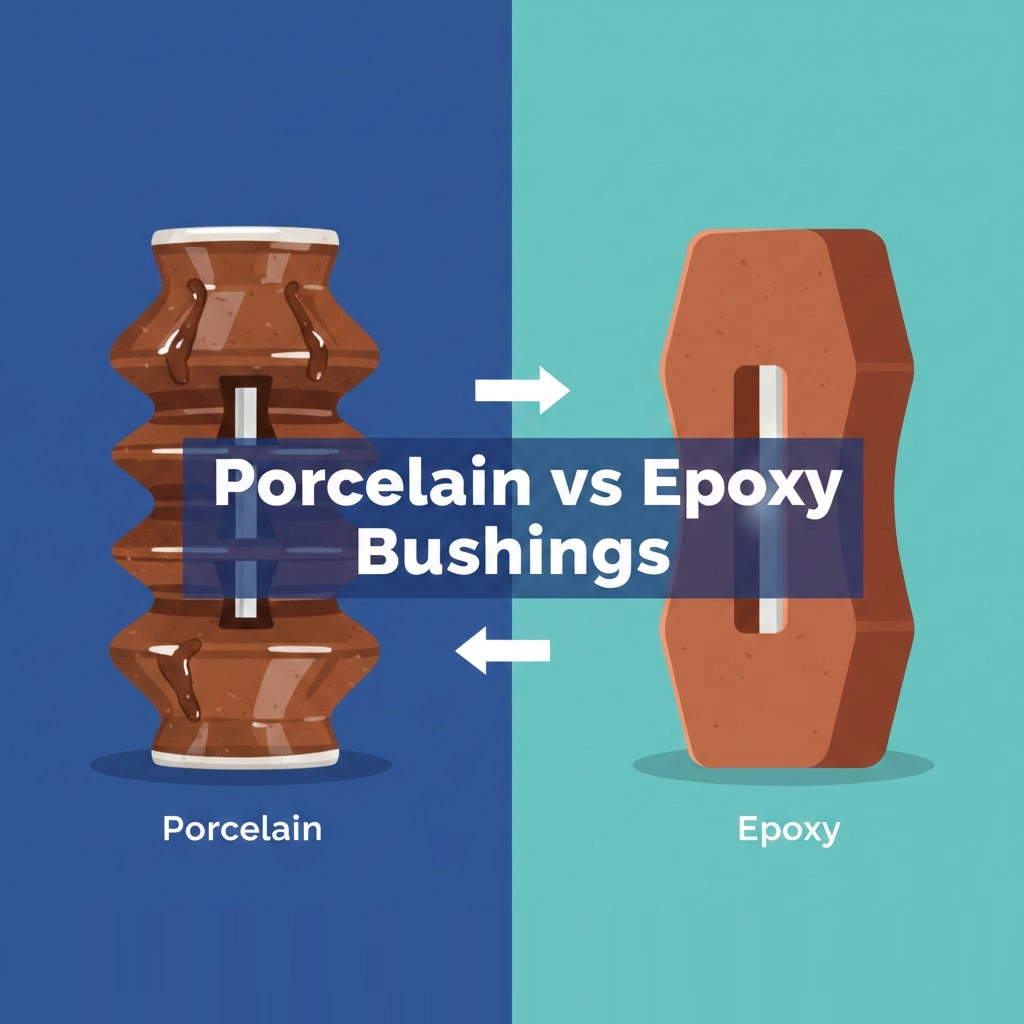
When specifying for distribution networks, engineers are no longer limited to traditional ceramics. The choice between porcelain and cast epoxy represents a fundamental shift in how electrical insulation is structurally engineered and manufactured. Understanding the molecular and architectural differences between these two materials is critical for matching the component to its intended operational environment.
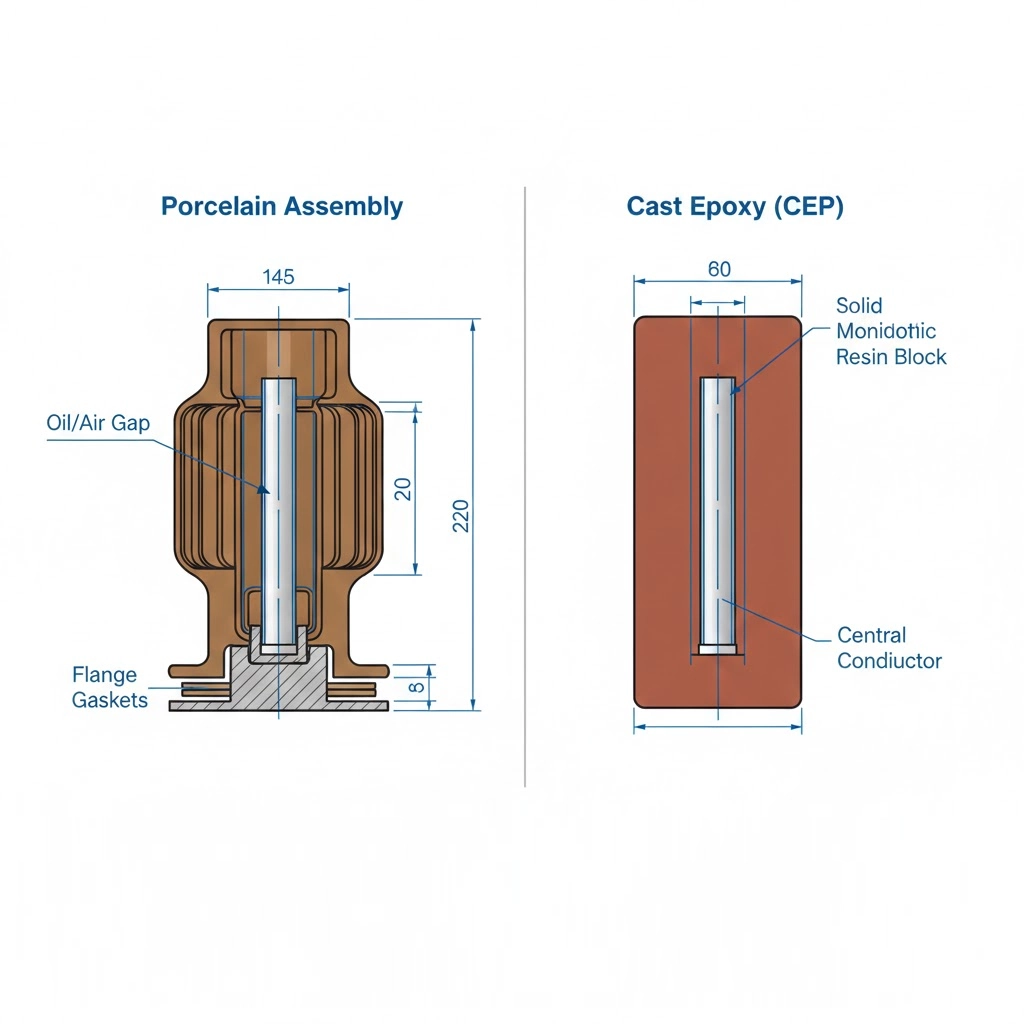
Figure 01:Structural comparison illustrating the multi-part, gasketed assembly of traditional porcelain versus the monolithic, void-free construction of cast cycloaliphatic epoxy.
The Physics of Porcelain Insulation
For decades, glazed porcelain has been the default dielectric barrier in high-voltage applications. Manufactured from a tightly controlled blend of clay, quartz, and alumina, porcelain insulators are kiln-fired at extreme temperatures ranging from 1,200°C to 1,300°C. This vitrification process creates a highly dense, inorganic material that is completely impervious to internal moisture tracking.
Structurally, porcelain bushings are typically manufactured as hollow shells. The central current-carrying conductor (usually a copper or brass stem) runs through the center void, which is then either filled with transformer oil or sealed with air. Because porcelain is inherently rigid and non-compressible, securing it to a metal transformer tank requires a complex mechanical assembly of flanges, clamping rings, and compressed gaskets. The performance and testing of these ceramic assemblies are strictly governed by frameworks such as [NEED AUTHORITY LINK SOURCE] Anchor: IEC 60137 testing standards, which define the thermal and mechanical endurance limits of the complete hollow insulator assembly.
The Chemistry of Cycloaliphatic Epoxy
In contrast, modern epoxy bushings rely on advanced polymer chemistry rather than kiln-fired ceramics. Specifically, cycloaliphatic epoxy (CEP) resin is utilized for outdoor and high-stress utility applications due to its superior resistance to UV degradation and carbon tracking compared to standard indoor-rated bisphenol epoxies.
The manufacturing architecture of an epoxy bushing is fundamentally different from porcelain. Instead of a hollow shell, the cycloaliphatic epoxy is cast directly around the central conductor and mounting flange under a high vacuum. This solid-cast construction eliminates internal air voids and removes the need for internal oil seals. The cured resin matrix typically delivers an exceptionally high dielectric strength of ≥ 25 kV/mm and maintains a volume resistivity exceeding 1014 Ω·cm, providing a highly stable insulation profile across extreme thermal cycles.
Mechanical Performance and Field Handling Realities
While the dielectric properties of a often dominate technical specifications, its mechanical characteristics dictate its survivability in the field. From the factory floor to the substation yard, the physical differences between heavy, brittle porcelain and lightweight, impact-resistant epoxy drastically alter how installation crews handle and mount these critical components.
Weight and Dimensional Impact on Transformer Tanks
Porcelain is an extremely dense ceramic material, typically yielding a specific gravity between 2.3 and 2.5 g/cm³. For a standard 24 kV / 630 A distribution transformer bushing, this density translates directly into significant component weight—often exceeding 8 to 12 kilograms per unit.
When mounting three of these heavy ceramic assemblies to a distribution transformer tank cover, engineers must account for substantial static loading. The sheer mass of the porcelain requires a thicker steel tank cover to prevent deflection and maintain a parallel mounting surface for the flange gaskets.
Conversely, cast cycloaliphatic epoxy formulations typically possess a lower specific gravity and can be engineered with thinner wall sections due to the integrated solid-cast conductor. This structural efficiency generally results in a 40% to 50% weight reduction compared to an equivalent porcelain design. For mobile substations or pole-mounted units where total weight is a critical design constraint, specifying an epoxy bushing significantly reduces the mechanical burden on the transformer housing.
Shatter Resistance and Transport Risks
The most immediate practical difference between the two materials emerges during transport and installation. Glazed porcelain is exceptionally hard but notoriously brittle.
If a porcelain bushing is dropped from a tailgate or struck by a wrench during installation, it will almost certainly shatter, requiring an immediate replacement and extending the project outage. Furthermore, over-torquing the mounting flange bolts beyond the typical 30-40 N·m specification can easily crack the ceramic base, causing catastrophic oil leaks upon energization.
Epoxy resins, by contrast, exhibit significantly higher tensile strength and impact resistance. An epoxy bushing can withstand the rough handling typical of a field construction site without cracking or shattering. This inherent mechanical resilience also makes epoxy the preferred choice for seismically active regions. During an earthquake event, the slight flexibility of the cast polymer dampens resonant vibrations and resists the extreme cantilever loads that would snap a rigid porcelain insulator at its mounting flange.
[Expert Insight]
Field crews accustomed to forgiving steel flanges often crack porcelain insulators by exceeding the 40 N·m torque limit. Epoxy’s slight material flexibility offers more margin for error but still requires strict adherence to star-pattern tightening to ensure gasket compression.
Swapping a 12 kg porcelain unit for a 6 kg epoxy equivalent frequently allows engineers to downgrade the transformer tank cover plate thickness by 2 to 3 mm, reducing overall structural steel costs.
Side-by-Side Comparison: Electrical and Environmental Limits
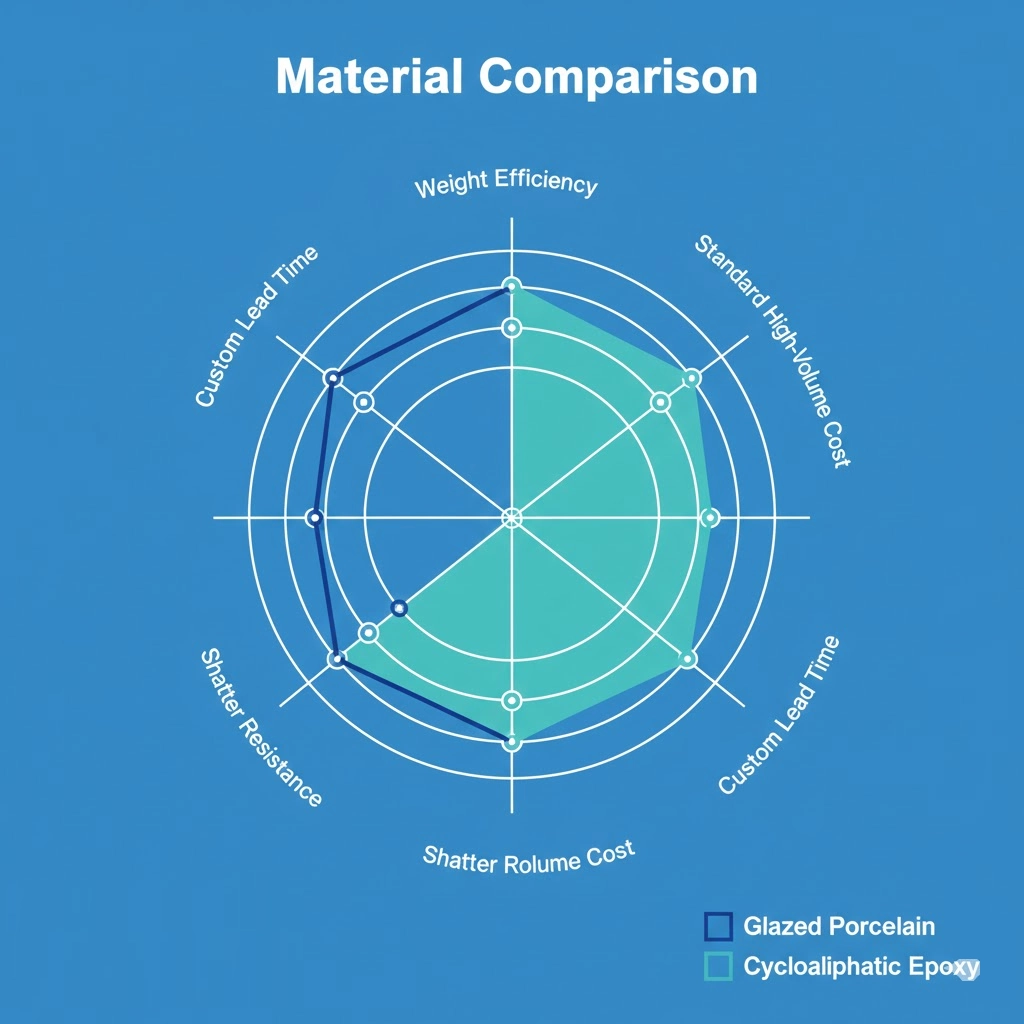
When evaluating insulating materials for medium-voltage distribution systems, procurement and engineering teams must look beyond nominal voltage classes. The fundamental differences in how porcelain and epoxy handle partial discharge, manage surface creepage, and resist environmental degradation over a 30-year lifecycle heavily dictate their suitability for specific field applications.
Figure 02:Performance radar chart highlighting the trade-offs between porcelain and cast epoxy across critical mechanical, environmental, and procurement metrics.
Performance Metric
Glazed Porcelain
Cycloaliphatic Epoxy (CEP)
Partial Discharge (PD)
Higher risk of internal corona if flange seals degrade over time
Consistently ≤ 10 pC due to void-free vacuum casting
UV Degradation
Completely immune (inorganic ceramic structure)
Highly resistant, but subject to surface chalking after 20-30 years
Pollution Resilience
Excellent natural washing; preferred in heavy coastal salt fog
Hydrophobic recovery, but can carbonize under severe tracking
Standard Creepage
Readily achieves 31 mm/kV with deep, complex shed profiles
Achieves 25-31 mm/kV, though deep sheds are harder to demold
Dielectric Strength and Partial Discharge
Partial discharge (PD) is the silent killer of high-voltage insulation. Traditional porcelain assemblies, especially air-filled hollow core designs, are inherently susceptible to corona discharge if internal voids exist or if the top and bottom gasket seals degrade, allowing moisture ingress. Conversely, because cycloaliphatic epoxy is cast under a high vacuum directly onto the conductive copper or brass stem, the resulting monolithic structure eliminates the internal air pockets where partial discharge initiates.
For a standard 24 kV rated component, high-quality cast epoxy routinely demonstrates partial discharge levels of ≤ 10 pC when tested at 1.05 × Um / √3. This void-free construction provides exceptional long-term dielectric stability, making epoxy highly desirable for indoor switchgear applications and compact pad-mounted transformers.
UV Degradation and Outdoor Weathering
While epoxy dominates indoor enclosed environments, outdoor weathering remains the ultimate equalizer. Glazed porcelain is an inorganic ceramic; it is completely immune to ultraviolet (UV) radiation. A porcelain shed profile can sit in direct equatorial sunlight for fifty years without its molecular structure degrading or its surface tracking resistance becoming compromised.
Modern cycloaliphatic epoxy formulations utilize advanced UV inhibitors and alumina trihydrate (ATH) fillers to achieve remarkable outdoor longevity, typically offering 20 to 30 years of reliable service. However, under constant UV exposure combined with severe industrial pollution or coastal salt spray (environments mandating ≥ 31 mm/kV specific creepage), the epoxy surface will eventually experience chalking. This microscopic surface degradation reduces the material’s hydrophobicity over time, allowing leakage currents to form dry-band arcing that can slowly erode the polymer matrix.
[Expert Insight]
In highly polluted coastal environments requiring ≥ 31 mm/kV creepage, porcelain remains the globally dominant choice, as epoxy is more susceptible to long-term carbonization under continuous salt-fog exposure.
When reviewing Factory Acceptance Tests (FAT) for cast epoxy, engineers should demand PD levels of ≤ 10 pC. Anything higher strongly indicates micro-voids trapped during the vacuum casting process, which will inevitably lead to premature dielectric failure.
Cost, Lead Time, and Supply Chain Impact
For procurement professionals, the decision between porcelain and cast epoxy extends beyond dielectric performance to the realities of global supply chains. The distinct manufacturing processes required for ceramics versus polymers fundamentally alter project lead times, tooling investments, and minimum order quantities (MOQs).
Manufacturing Cycle Realities
Traditional porcelain manufacturing relies on wet clay extrusion, precision turning, and prolonged kiln firing. Because vitrification cycles cannot be accelerated without shattering the green ceramic, standard lead times for custom porcelain components often stretch from 10 to 14 weeks. Furthermore, the economy of scale in ceramic production requires massive volume, frequently demanding MOQs ≥ 500 units to justify the factory setup.
Conversely, cycloaliphatic epoxy components are produced via Automatic Pressure Gelation (APG) or vacuum casting. Once the aluminum molds are machined, the epoxy resin is injected, cured, and demolded in a matter of hours. This rapid cycle time allows manufacturers to deliver standard cast epoxy components in just 4 to 6 weeks, providing a critical buffer for fast-track project schedules or emergency grid repairs.
Tooling and Customization Costs
The inflexibility of porcelain makes it highly cost-effective for globally standardized dimensions—such as high-volume 12 kV or 24 kV DIN configurations—where factories produce identical units continuously. In these commodity categories, established porcelain supply chains remain 15% to 25% cheaper per unit than an equivalent epoxy component.
However, when a utility needs to replace an obsolete footprint or design a highly compact switchgear interface, epoxy becomes the dominant economic choice. Creating a custom porcelain profile is prohibitively expensive and time-consuming. In contrast, machining a new aluminum mold for a custom epoxy profile or specialized requires a moderate initial tooling investment and can be completed in under a month.
For field maintenance teams facing an unplanned outage due to an obsolete, shattered ceramic insulator, reverse-engineering and casting a drop-in epoxy replacement is often the only viable strategy. It allows them to bypass the rigid, high-volume ceramic supply chain and restore power without waiting a quarter of a year for custom kiln firing.
Application Decision Matrix for Procurement Teams
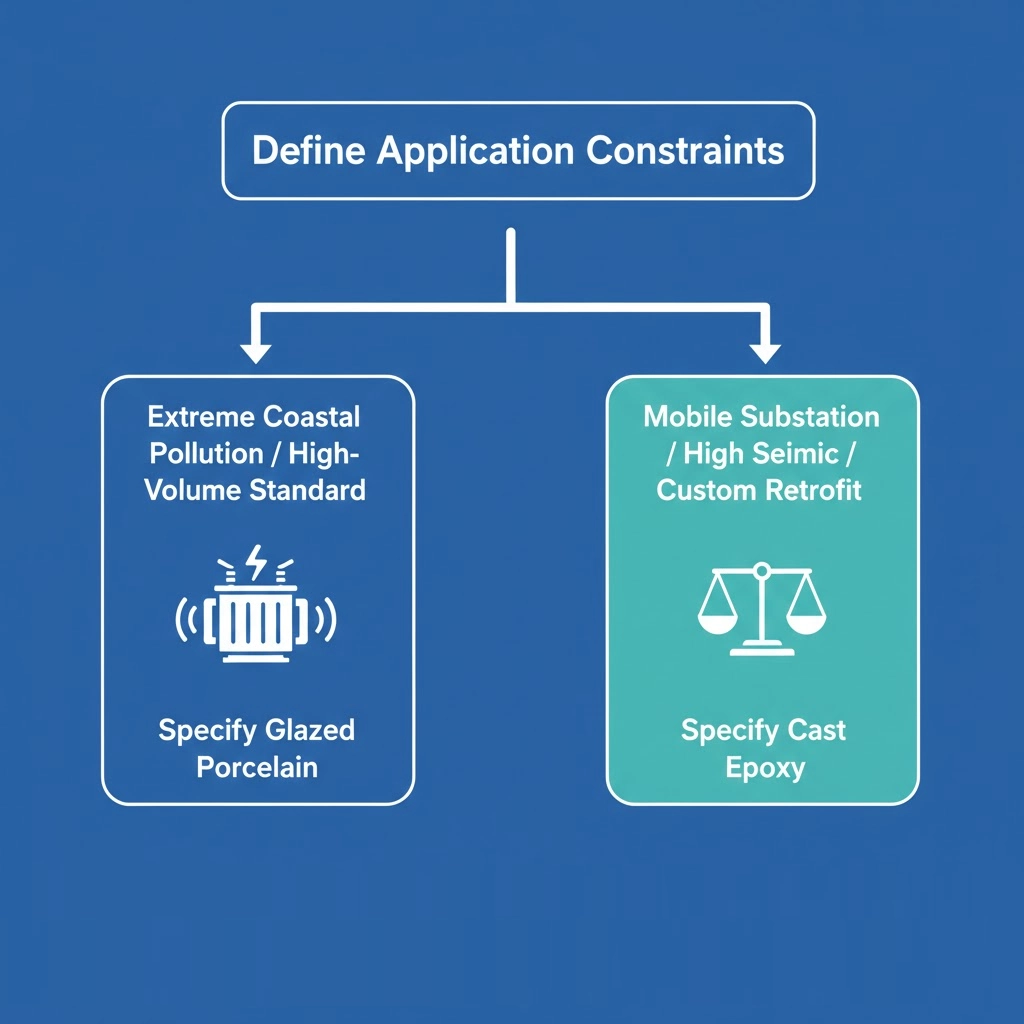
Selecting the correct insulation material requires aligning the component’s physical properties with the project’s operational realities.
Figure 03:A practical specification workflow to help procurement teams and engineers select the optimal insulation material based on environmental severity and mechanical constraints.
When to Specify Porcelain
Specify glazed porcelain for traditional outdoor distribution transformers exposed to extreme UV radiation or heavy coastal salt fog. Its inorganic structure excels in environments requiring aggressive natural washing and specific creepage distances of ≥ 31 mm/kV. It is also the most cost-effective choice for standard, high-volume commodity sizes, such as a universally deployed 24 kV / 630 A DIN footprint.
When to Specify Epoxy
Specify cast cycloaliphatic epoxy for applications where mechanical resilience is paramount. This includes mobile substations requiring a 40% to 50% weight reduction, seismically active installation zones, and compact indoor switchgear where void-free construction guarantees partial discharge levels ≤ 10 pC. Epoxy is also the primary solution for retrofitting obsolete tank footprints where custom aluminum tooling is required quickly.
Requesting a Custom Review
Mismatched specifications cascade into project delays, affecting everything from transformer sealing to the connected . Stop guessing at material limitations. Send your technical datasheets, dimensioned tank drawings, and environmental requirements to ZeeyiElec. Our engineering team will review your parameters, match them to the optimal insulation material, and provide a rapid, accurate tailored to your specific project needs.
Frequently Asked Questions
Are epoxy bushings safe for direct outdoor sunlight?
Modern cycloaliphatic epoxy formulations utilize UV inhibitors and alumina trihydrate fillers, offering 20 to 30 years of reliable outdoor service before minor surface chalking occurs. However, for extreme UV exposure combined with severe coastal salt fog, traditional porcelain remains the preferred choice.
Which bushing material is lighter?
Cast epoxy components generally weigh 40% to 50% less than glazed porcelain equivalents in the 12 kV to 36 kV range. This significant weight reduction lowers the static mechanical stress on transformer tank covers and simplifies manual lifting requirements for field installation crews.
Can I replace a broken porcelain bushing with an epoxy one?
Yes, a direct retrofit is safe and effective if the epoxy replacement exactly matches the original bolt circle diameter and maintains the required minimum striking distance to the grounded tank wall. If the original ceramic footprint is obsolete, a custom-cast epoxy flange can easily bridge the dimensional gap.
Do epoxy bushings have lower partial discharge than porcelain?
Because epoxy is cast directly around the internal conductor under a high vacuum, it eliminates the internal air voids that cause corona. This allows high-quality epoxy to routinely maintain partial discharge levels below 10 pC, significantly outperforming traditional hollow porcelain assemblies.
Is porcelain cheaper than epoxy for standard transformers?
For high-volume, standardized dimensions like a 24 kV / 630 A DIN footprint, porcelain remains 15% to 25% cheaper per unit due to massive global economies of scale in ceramic production. Epoxy becomes highly cost-effective primarily for custom, low-volume retrofit shapes or specialized indoor switchgear.
What is the lead time difference between the two materials?
Standard custom porcelain requires 10 to 14 weeks of lead time due to prolonged kiln firing and cooling cycles that cannot be rushed. In contrast, cast cycloaliphatic epoxy components can be injection-molded and delivered in just 4 to 6 weeks once the initial aluminum tooling is established.
yoyo shi
Yoyo Shi writes for ZeeyiElec, focusing on medium-voltage accessories, transformer components, and cable accessory solutions. Her articles cover product applications, technical basics, and sourcing insights for global electrical industry buyers.




 English
 한국어
한국어 العربية
 Español
 हिन्दी
 தமிழ்
தமிழ் Deutsch (Sie)
 Français
 Português do Brasil
 Русский