An off-circuit tap changer (OCTC) is a mechanical switching device integrated into a distribution transformer that adjusts the transformer’s turns ratio and its secondary voltage by selecting between a fixed number of winding taps. The transformer must be fully de-energized before any tap position change; operating an OCTC under load destroys contact surfaces within a small number of operations and risks an internal transformer fault. Rated current for distribution-class OCTCs typically falls between 50 A and 400 A across voltage classes spanning 6 kV to 35 kV.
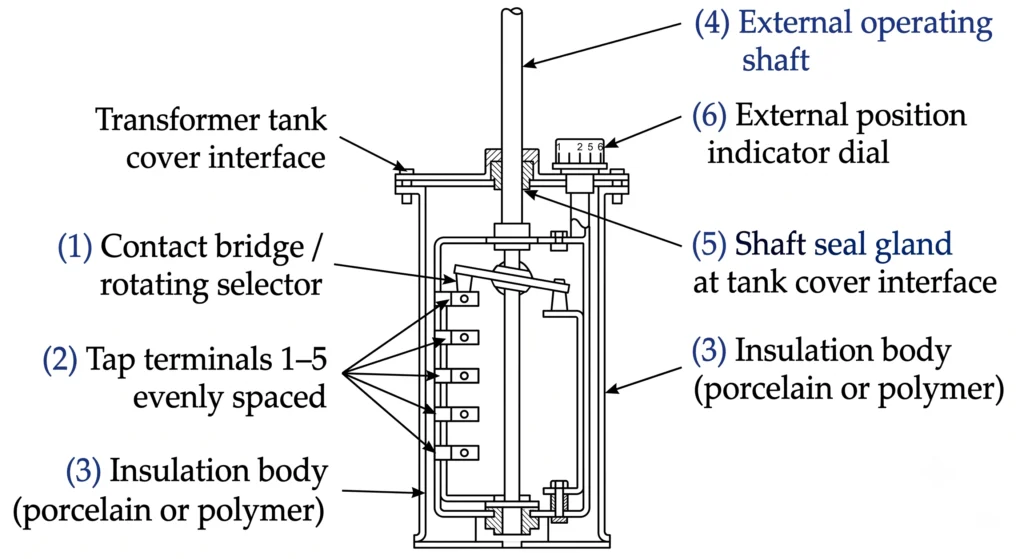
Inside the OCTC, a rotating or sliding contact bridge connects the transformer winding to one of typically 3 to 5 discrete tap terminals. Each tap step corresponds to a fixed voltage increment, commonly 2.5% per step allowing a total regulation range of ±5% on a 5-position unit. The contact bridge is driven by an external operating shaft passing through the transformer tank wall via a sealed gland, terminating in a handle and position indicator visible from outside.
Contact material and insulation grade are where supplier quality becomes concrete. Silver-alloy or copper-alloy contacts are the baseline for distribution-class units; lower-grade materials may show acceptable resistance on delivery but deteriorate after 200 to 500 mechanical operations. The insulation body must maintain dielectric integrity at the rated voltage class throughout service life. A supplier’s willingness to provide full test documentation before order placement is itself a qualification signal, teams that skip this step on price grounds frequently encounter failures in humid or high-altitude installations where marginal insulation grades are stressed beyond their design envelope.
Cross-sectional view of a distribution-class off-circuit tap changer, identifying the contact bridge, discrete tap terminals, insulation body, shaft seal gland, and external position indicator as key supplier-quality evaluation points.
Key Technical Criteria to Evaluate Before Choosing a Supplier
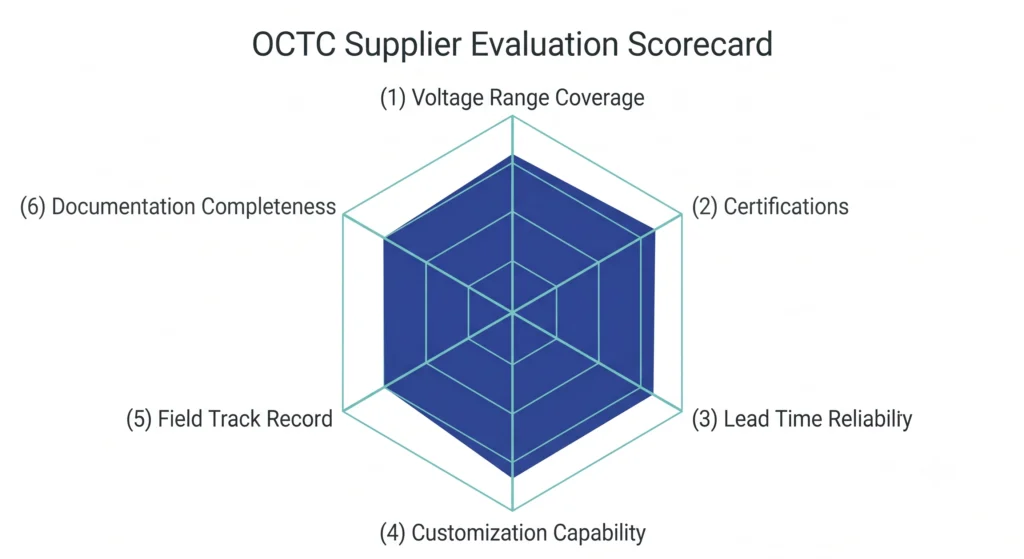
Evaluating a supplier on brand recognition or price alone introduces compatibility and reliability risks that surface after installation. A structured evaluation across six criteria reduces that risk before a purchase order is issued.
Supplier evaluation scorecard radar chart for off-circuit tap changer procurement, illustrating relative weighting across six criteria: voltage range, certifications, lead time reliability, customization capability, field track record, and documentation completeness.
Voltage Class and Current Rating Coverage
Confirm the supplier’s standard range covers your transformer’s HV winding class, typically 6 kV, 10 kV, 15 kV, 20 kV, or 35 kV for distribution applications and that the rated current matches the HV winding current at maximum kVA. A mismatch of even one voltage class tier means the OCTC’s insulation system and creepage distances are designed for a different dielectric stress level. OCTCs are commonly available from 50 A to 630 A; selecting below the actual winding current causes contact overheating during normal load cycling.
Contact Material, Operating Torque, and Mechanical Endurance
Request the supplier’s specification sheet for contact bridge material and mechanical endurance rating. Reputable suppliers specify a minimum number of mechanical operations typically 500 to 5,000 cycles depending on product tier verified through type testing. Operating torque at the external handle should be documented; excessively high values indicate shaft seal friction or internal misalignment that maintenance personnel will encounter in the field.
Standards Compliance Indicators
Ask which standard edition the supplier’s type test report references and verify the issuing laboratory’s accreditation status. IEC 60214 governs tap changer design and testing requirements; for procurement purposes, confirm whether the supplier’s type test references the current edition applicable to your target market — full standard details are available via the IEC 60214 tap changer standard overview. ISO 9001 covers quality management process but does not substitute for product-level electrical type testing. CE marking applies to European market entry; utility procurement specifications in Southeast Asia and the Middle East frequently add requirements beyond baseline IEC.
Lead Time, MOQ, and Export Documentation Capability
Standard catalog OCTCs from established manufacturers typically ship within 3 to 8 weeks; customized flange configurations or non-standard current ratings extend this to 10 to 16 weeks. Confirm the supplier can provide a complete export documentation package, commercial invoice, packing list, certificate of origin, and product test report formatted for your target market’s customs requirements.
For a structured overview of what parameters to include in your supplier inquiry, the Transformer Accessories RFQ Checklist covers the critical specification fields that prevent clarification delays after RFQ submission.
Expert Insight — What Experienced Procurement Engineers Check First
Contact resistance value and acceptance limit stated explicitly in the test report, not just a pass/fail stamp
Insulation body material (porcelain vs. polymer) specified against the installation environment, not left as supplier default
Shaft seal design reviewed for compatibility with transformer oil type, particularly for synthetic ester-filled units
Laboratory accreditation status of the issuing test body confirmed before accepting type test documentation
Top 10 Off-Circuit Tap Changer Suppliers You Should Know
The ten suppliers below represent a cross-section of the global OCTC market organised by capability tier. Inclusion is based on publicly available product range evidence and market presence; it does not constitute an endorsement, and individual project suitability should be verified through direct technical inquiry and sample testing. Each supplier was evaluated against four baseline criteria: documented OCTC product range covering at least one distribution voltage class (6 kV–35 kV), ISO 9001 or equivalent certification, publicly accessible technical data, and demonstrated international supply capability.
Supplier Comparison Table
Supplier
HQ Location
Voltage Class Range
Key Certifications
Notable Strength
ABB (Hitachi Energy)
Switzerland / Global
6 kV – 800 kV
IEC, IEEE, ISO 9001
Full OLTC and OCTC portfolio; global service network
Reinhausen (MR)
Germany
6 kV – 800 kV
IEC, ISO 9001, ATEX
Dominant OLTC OEM; OCTC for distribution class
Dohle
Germany
6 kV – 72.5 kV
IEC, ISO 9001
Specialized tap changer manufacturer; retrofit expertise
Easun Reyrolle
India
6 kV – 33 kV
IEC, IS, ISO 9001
Strong South Asian utility track record
FDUEG
Italy
6 kV – 36 kV
IEC, CE, ISO 9001
European distribution transformer accessory specialist
ZeeyiElec
China (Wenzhou)
6 kV – 35 kV
ISO 9001, CE, RoHS
Export-oriented; full documentation support; OEM/ODM
Sönmez Trafo
Turkey
6 kV – 36 kV
IEC, CE, ISO 9001
Regional strength in MENA and Central Asia markets
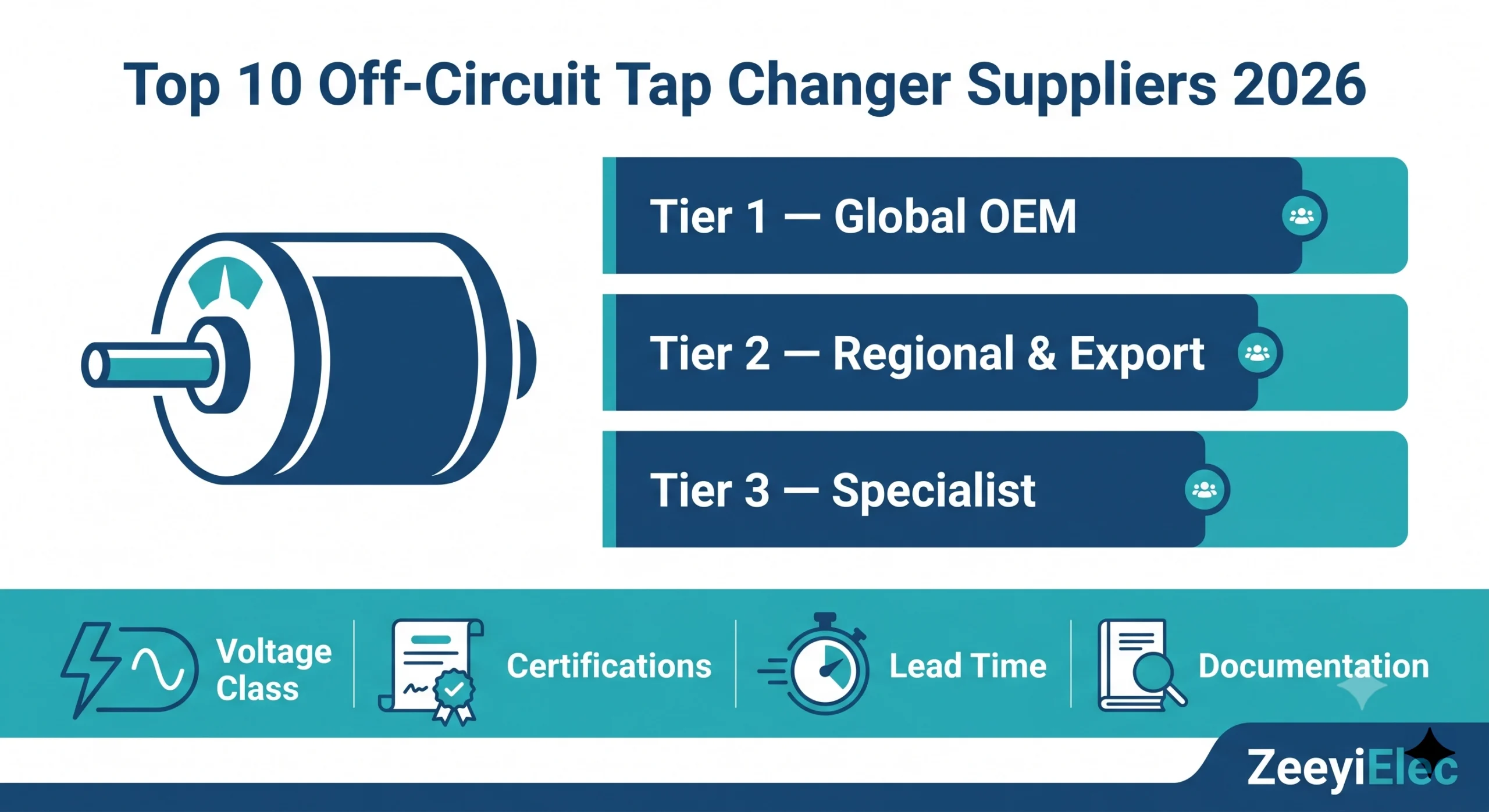
ABB (Hitachi Energy) and Reinhausen (MR) operate at the top of the OCTC and OLTC market globally, with type-tested product ranges across the full distribution and transmission voltage spectrum and international service networks supporting long-term maintenance agreements. For projects requiring the highest documentation standards, IEC type test reports from accredited laboratories, full material traceability, and multi-market certification. Tier 1 suppliers set the benchmark. Lead times and minimum order economics are typically less flexible than regional manufacturers, making them most suitable for large utility framework contracts rather than single-transformer procurement. Dohle and FDUEG occupy a strong secondary position for European and IEC-market projects, with tighter focus on distribution-class tap changers.
Tier 2: Regional and Export-Focused Manufacturers
Easun Reyrolle, Sönmez Trafo, and ZeeyiElec offer strong regional credentials combined with active international export programs. This tier typically delivers better lead time flexibility, standard catalog products shipping in 3 to 8 weeks, alongside willingness to accommodate OEM nameplate requirements, custom flange configurations, and project-specific documentation packages. Field procurement experience in Southeast Asian and Middle Eastern distribution projects consistently shows this tier delivering competitive value when the full documentation package is treated as a standard deliverable from order placement.
Tier 3: Specialist and Niche OCTC Producers
Julun Electric and Accurate Transformers are volume producers oriented toward domestic and regional utility supply chains; their economics favour project quantities of 50 units and above rather than mixed small-batch procurement. Toshiba’s OCTC products are embedded within its broader transformer manufacturing capability and are most accessible through transformer OEM channels rather than direct component procurement.
For buyers sourcing across the full transformer accessories product scope, bushings, fuses, and switching devices alongside tap changers, suppliers covering multiple accessory categories simplify qualification, documentation management, and freight consolidation.
Red Flags to Watch During Supplier Evaluation
Recognising disqualifying signals before a purchase order is issued is as important as identifying capable suppliers. The following patterns recur across distribution transformer accessory procurement and each represents a failure mode that surfaces at goods receipt, during factory acceptance testing, or after energization.
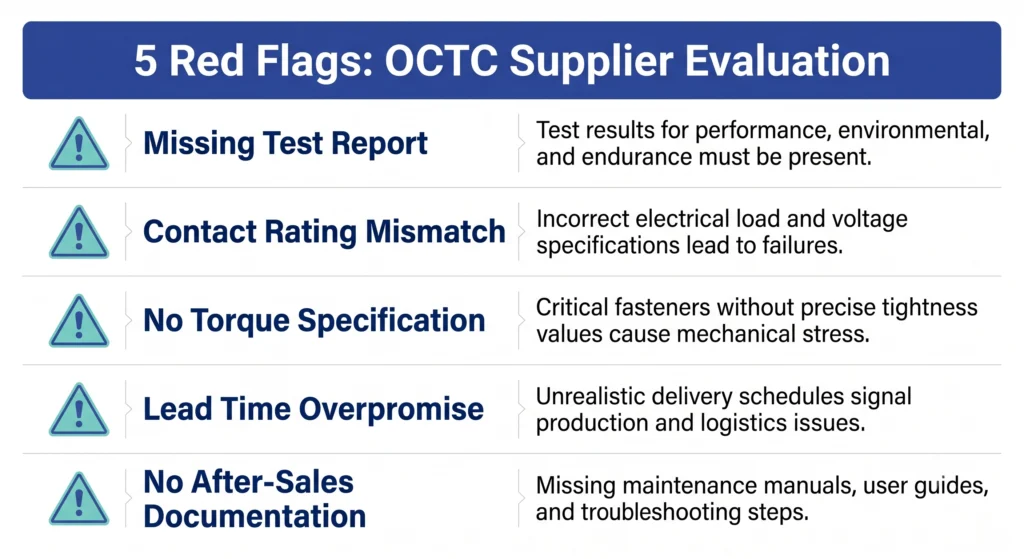
Visual procurement checklist identifying five critical red flags in off-circuit tap changer supplier evaluation, covering test report gaps, contact rating mismatch, missing torque specification, lead time overpromise, and absent after-sales documentation.
Documentation Red Flags
Missing or undated test reports are the single most common disqualifier in serious procurement reviews. A routine test report should accompany every production batch, confirming contact resistance, dielectric withstand voltage, and mechanical operation count at minimum. Suppliers offering only a generic certificate of conformity provide no verifiable basis for acceptance. Watch also for reports referencing superseded standard editions without explanation, this may indicate the supplier has not updated its type testing to current market requirements.
HS code misclassification on commercial invoices is a separate but equally disruptive problem. Off-circuit tap changers must be classified under the correct harmonized system code for the import jurisdiction; misclassification triggers customs holds, unexpected duty recalculations, and in Letter of Credit transactions, potential document discrepancy rejection.
Technical Red Flags
Contact current rating mismatch has direct field consequences. An OCTC rated at 200 A installed on a transformer with a 315 A HV winding current will exhibit progressive contact surface degradation and localised overheating within the first years of service. The failure develops slowly and may not trigger protection systems until contact damage is advanced. Always cross-reference the supplier’s rated current against the transformer nameplate HV current not the kVA rating alone.
Absence of operating torque specification is a subtler but meaningful signal. Torque at the external handle should fall within a range that maintenance personnel can apply safely, typically 5 N·m to 25 N·m for distribution-class units. Suppliers unable to provide this figure either have not characterised their product adequately or are supplying units with shaft seal designs that produce unpredictable friction under field conditions.
Operational Red Flags
Lead time overpromise is endemic in commodity procurement. A supplier confirming 2-week delivery on custom-flange OCTCs requiring non-standard current ratings is either misrepresenting production capacity or planning to ship a non-conforming substitute. Request a signed production schedule with milestone dates tied to order confirmation.
One field case illustrates the compounding effect: a procurement team sourcing OCTCs for a 33-unit rural electrification project accepted delivery without requesting routine test reports. At site, three units exhibited contact resistance values exceeding acceptable limits at goods receipt inspection. With no batch test data available, the entire shipment required individual testing before installation, adding two weeks to the project schedule and shifting the cost entirely to the buyer.
Expert Insight — Four Checks Before Approving a Supplier’s Test Report
Confirm the report date falls within the same production quarter as the shipment batch, generic undated reports are not batch-specific
Verify contact resistance values are recorded in μΩ with a stated acceptance limit, not simply marked “pass”
Check that dielectric withstand test voltage matches the voltage class of the units being ordered, not a lower-class product in the same family
Confirm the test laboratory name appears on the report and can be cross-referenced against an accreditation register
How to Match an Off-Circuit Tap Changer to Your Transformer Specification
Supplier capability means little if the selected OCTC is incompatible with the transformer it will serve. This five-step process moves from electrical parameters through mechanical dimensions to documentation readiness completing each step before issuing a purchase order eliminates the most common sources of site rejection.
Step 1 — Confirm Transformer Voltage Class and Tap Range
Begin with the transformer nameplate. The HV winding voltage class determines the OCTC’s required insulation level; a unit specified for 10 kV service cannot be substituted with a 6 kV-class OCTC even if mounting dimensions are identical, as creepage distances and dielectric withstand ratings differ by design. Confirm the number of tap positions and the tap step percentage, these must match the transformer winding design exactly and cannot be field-adjusted.
Step 2 — Cross-Reference Mounting Dimensions and Flange Type
The OCTC mounts through the transformer tank cover via a flange plate. Flange bolt circle diameter, bolt count, shaft diameter, and shaft length below the tank cover must all match the transformer manufacturer’s design. A 2 mm shaft length discrepancy produces incomplete tap selection that may not be detectable from the external position indicator but results in high-resistance partial contact under load cycling. For retrofit procurement on aged transformers without original documentation, physical measurement of the existing unit before ordering is the only reliable approach.
Step 3 — Verify Rated Current and Dielectric Withstand
The OCTC’s rated current must equal or exceed the transformer’s HV winding current at maximum rated kVA. For a 1,000 kVA, 10 kV / 0.4 kV distribution transformer, the HV winding current at full load is approximately:
IHV = S / (√3 × UHV) = 1,000,000 / (1.732 × 10,000) ≈ 57.7 A
An OCTC rated at 50 A would be undersized for this application; the correct selection is a unit rated at 63 A or 100 A depending on available standard ratings. Dielectric withstand voltage should meet the impulse and power-frequency test levels applicable to the transformer’s voltage class for 10 kV systems, a lightning impulse withstand of 75 kV peak and a one-minute power-frequency withstand of 28 kV are typical reference values.
Step 4 — Request Sample Test Report and FAT Criteria
Before committing to a production order, request a representative routine test report from the supplier’s most recent production batch. The report should confirm contact resistance in μΩ with stated acceptance limits, dielectric withstand pass/fail result, and mechanical operation count completed during type testing. For project quantities exceeding 20 units, define factory acceptance test (FAT) criteria in writing before order placement specifying which tests will be witnessed or verified by documentation and what the rejection threshold is at goods receipt.
Step 5 — Confirm Export and Customs Documentation Readiness
Verify the supplier can produce a complete documentation package aligned to your import requirements: commercial invoice with correct HS code, packing list with unit weights and dimensions, certificate of origin, and product test report. For Letter of Credit transactions, confirm the supplier has experience with LC document preparation, first-time LC exporters frequently produce invoice formats or description fields that trigger bank discrepancy notices, delaying payment and sometimes holding shipment release.
The operational boundary between loadbreak switching and tap changing on transformers equipped with both devices is covered in the Loadbreak Switch vs Off-Circuit Tap Changer guide for engineers specifying both accessories on the same transformer unit.
ZeeyiElec as Your Off-Circuit Tap Changer Supplier — Capabilities and Fit
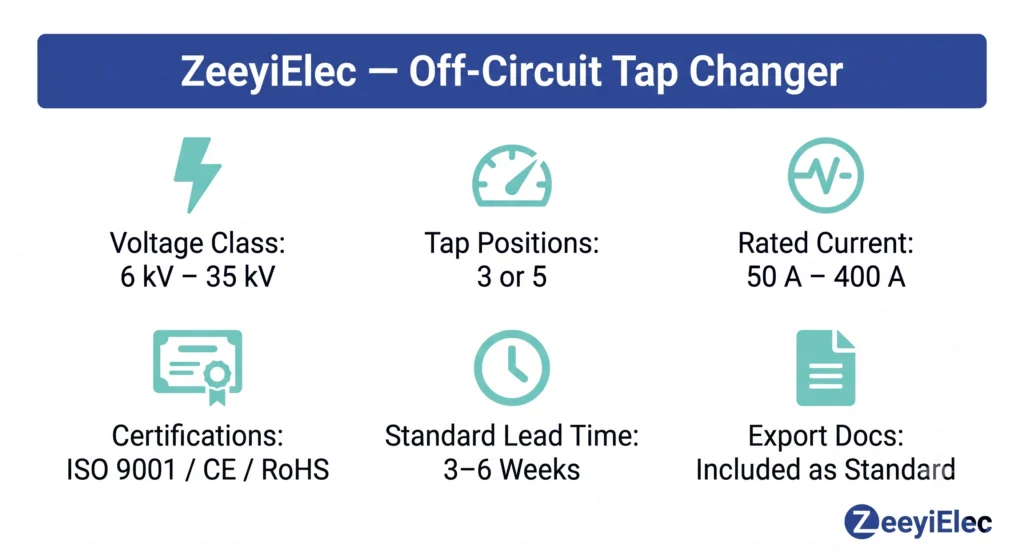
ZeeyiElec manufactures off-circuit tap changers for distribution transformer applications across the 6 kV to 35 kV voltage class range, with rated current options covering 50 A to 400 A for standard catalog configurations. Production is based in Liushi Town, Wenzhou a manufacturing cluster with a concentrated electrical component supply chain supporting consistent material sourcing and quality control traceability.
Standard catalog OCTCs ship within 3 to 6 weeks from order confirmation for volumes up to approximately 50 units. OEM and ODM configurations including custom flange dimensions, non-standard shaft lengths, and alternative position indicator formats are available with lead times negotiated at order stage. ISO 9001, CE, and RoHS certifications cover the standard product range; routine test reports are produced per production batch and provided as standard documentation. Export paperwork commercial invoice with correct HS classification, certificate of origin, packing list, and product test report is treated as a core deliverable on every shipment.
ZeeyiElec’s product scope extends across the full transformer accessory range, including bushings, fuse assemblies, loadbreak switches, and bushing well inserts, allowing consolidated procurement and single-supplier documentation management for projects requiring multiple accessory types. The complete range is covered across the cable accessories and transformer accessories pillar pages.
Ready to match an OCTC to your transformer specification? Share your nameplate data, tap range, and target market — ZeeyiElec’s engineering team will respond with product matching and a formal quotation: Off-Circuit Tap Changer Series.
ZeeyiElec off-circuit tap changer product capability summary card, presenting standard voltage class range, tap position options, rated current coverage, active certifications, lead time, and export documentation scope for distribution transformer procurement reference.
Frequently Asked Questions
What is an off-circuit tap changer and how does it differ from an on-load tap changer?
An off-circuit tap changer adjusts a transformer’s voltage ratio only when fully de-energized, covering ±2 to ±5% regulation across 3 to 5 tap positions; an on-load tap changer performs the same function under full load current using a more complex internal mechanism with transition resistors or reactors. The correct choice depends on whether continuous voltage regulation under load is required or whether de-energized adjustment during planned outages is operationally acceptable for the network application.
What voltage classes do off-circuit tap changers typically cover?
Most distribution-class OCTCs cover 6 kV to 35 kV, with rated currents ranging from 50 A to 630 A depending on transformer kVA and HV winding configuration. Sub-transmission applications up to 72.5 kV exist but represent a smaller supplier segment with longer lead times and higher minimum order economics than standard distribution-class units.
Which certifications should I require from an OCTC supplier?
ISO 9001 confirms quality management process but does not substitute for product-level electrical type testing; require a routine test report per production batch and, where applicable, a type test report referencing the standard edition relevant to your target market. CE marking covers European market entry, while projects in South Asia, Southeast Asia, and the Middle East frequently reference additional local utility specifications beyond baseline IEC requirements.
How many tap positions are standard for distribution transformer OCTCs?
The most common configuration is 5 tap positions providing ±2 × 2.5% voltage regulation, with 3-position variants for simpler applications and 7-position units available where more granular adjustment is required. The tap position count is defined in the transformer’s winding design and must be matched exactly the internal contact stack geometry is specific to tap count and cannot be field-adjusted.
What lead times should I expect when sourcing OCTCs from Chinese manufacturers?
Standard catalog units from established Chinese manufacturers typically ship within 3 to 8 weeks for volumes up to 50 units; customized configurations involving non-standard flange dimensions or current ratings above 400 A extend lead times to 10 to 16 weeks. Requesting a signed production milestone schedule tied to order confirmation is advisable on any project with a fixed energization date.
What documentation should an OCTC supplier provide for international export orders?
A complete package should include a commercial invoice with correct HS code classification, packing list with gross and net weights, certificate of origin, routine test report per production batch, and any market-specific certification documents required by the destination country. For Letter of Credit transactions, field-level accuracy must match LC terms precisely description wording and unit-of-measure discrepancies are among the most common causes of bank rejection, as detailed in the Export Documentation Checklist for Electrical Accessories.
Can an off-circuit tap changer be replaced without taking the transformer out of service?
No — OCTC replacement requires the transformer to be fully de-energized, isolated from both HV and LV circuits, and earthed before the tank cover is opened or the shaft seal is disturbed. Any internal access on an energized transformer is a serious safety violation; the correct procedure is a planned outage with switching and earthing confirmation completed before work begins.
yoyo shi
Yoyo Shi writes for ZeeyiElec, focusing on medium-voltage accessories, transformer components, and cable accessory solutions. Her articles cover product applications, technical basics, and sourcing insights for global electrical industry buyers.





 English
 한국어
한국어 العربية
 Español
 हिन्दी
 தமிழ்
தமிழ் Deutsch (Sie)
 Français
 Português do Brasil
 Русский