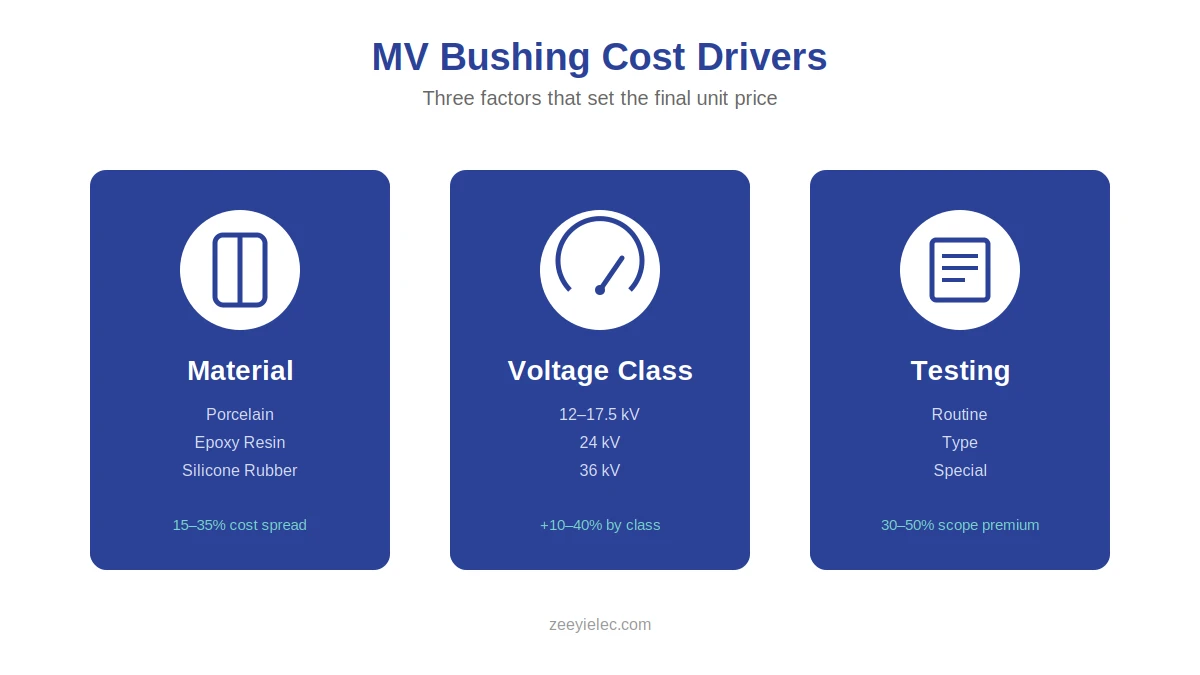
The price of a medium-voltage bushing rarely comes down to a single number on a datasheet. Three variables interact to set the final unit cost: the insulator material system, the voltage/current class the bushing is rated for, and the depth of testing and certification behind it. Buyers who only compare rated voltage across suppliers often miss that a 24 kV bushing tested to full type-test scope can cost 30-50% more than a nominally equivalent unit built to routine-test scope only — even when both meet the same catalog voltage class.
In field procurement work, the most common pricing surprise isn’t material or voltage class — it’s discovering late in the RFQ process that a project spec silently requires special tests that weren’t priced into the initial quote. Getting test scope confirmed early avoids re-quoting cycles that can add weeks to lead time.
The sections that follow break down each of these three levers individually, starting with material system, since it sets the baseline that voltage class and testing scope then build on. For a broader view of how bushing accessories fit into overall transformer accessory selection, see ZeeyiElec’s transformer accessories overview.
Material Selection and Its Cost Impact
Material system is the first cost lever, and the one buyers most often evaluate too coarsely — “porcelain vs. composite” without accounting for how manufacturing process, mechanical performance, and expected service life each feed into unit price.
Porcelain Bushings
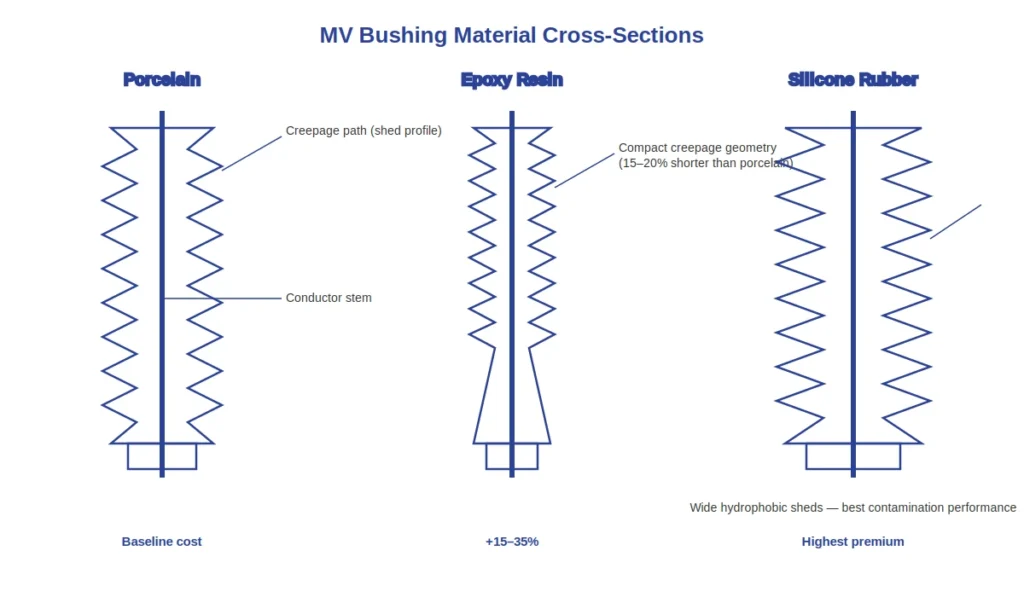
Porcelain remains the reference-cost material across most catalog ranges, thanks to mature, high-volume firing processes. Its brittleness under mechanical shock or seismic loading is the tradeoff that pushes some specs toward composite alternatives despite the price gap. A typical porcelain MV bushing in the 12 kV-24 kV range runs a lower baseline unit cost than an equivalent composite design, though the exact premium varies by manufacturer and order volume.
Epoxy Resin Bushings
Cast epoxy resin bushings cost more than porcelain, largely due to curing cycle time and mold tooling investment that doesn’t amortize as efficiently at low order volumes. In exchange, epoxy offers better dimensional consistency and indoor switchgear compatibility. Field commissioning experience shows epoxy bushings are frequently specified for GIS and metal-enclosed switchgear applications specifically because their compact creepage geometry — sometimes 15-20% shorter than an equivalent porcelain design for the same voltage class — reduces enclosure footprint, which can offset part of the material premium at the system level.
Silicone Rubber Sheds
Silicone rubber (typically applied as sheds over an epoxy or composite core) carries the highest material premium, driven by hydrophobic polymer cost and the added bonding/vulcanizing step. The payoff is superior performance in heavy contamination or coastal environments, where silicone’s self-cleaning hydrophobicity reduces flashover risk that would otherwise require oversized creepage distance — itself a cost driver, independent of material choice.
Cross-sectional comparison of porcelain, epoxy resin, and silicone rubber-sheathed bushing constructions, with creepage path and conductor stem labeled.
Material selection should be governed by environmental service conditions, not price alone — IEC 60137 governs creepage distance requirements by pollution class, and a material chosen to meet a contamination or seismic requirement isn’t a discretionary cost-saving target.
[Expert Insight]
Don’t default to composite “for durability” if the site has no seismic or contamination driver — porcelain often meets the same spec at lower cost
Epoxy’s compact footprint can offset its unit premium in space-constrained switchgear
Ask suppliers for material cost breakdown separately from test-tier cost — the two are often bundled in quotes but driven by different factors
Voltage Class and Rated Current: Where Cost Steps Up
Voltage class is the variable buyers compare most directly across suppliers, but it’s rated current — not rated voltage — that often drives the larger jump in bill-of-materials cost. Both interact with insulation length and creepage distance requirements in ways that aren’t obvious from a nameplate comparison alone.
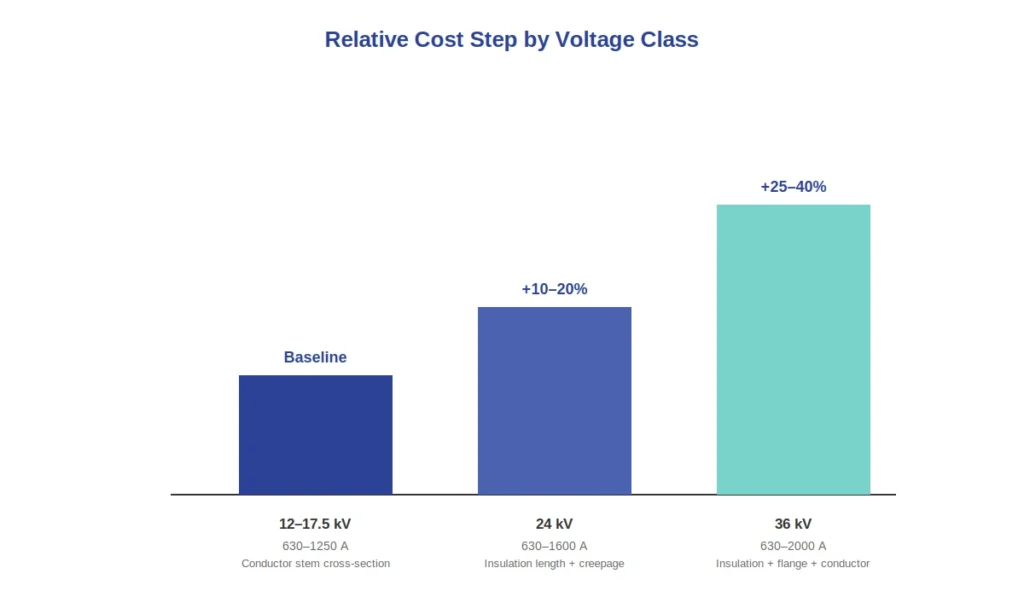
This range covers the bulk of standard distribution transformer applications and represents the cost baseline. Conductor sizing tracks rated current in fairly predictable steps here, with minimal insulation-length penalty.
24 kV Class
At 24 kV, creepage distance requirements begin to meaningfully lengthen the insulator body, increasing both material volume and mold/tooling complexity for composite designs. This is also where contamination-class upgrades — governed under IEC 60815’s pollution severity classification — most commonly get specified, compounding the class-driven cost increase.
36 kV Class
Above 30 kV, flange geometry and terminal hardware often change alongside insulation length, since current ratings in this class frequently push toward 1600 A-2000 A for higher-capacity transformers. This is the class where buyers most often overspecify current rating “for margin” without checking whether the incremental cost is justified by actual load — a 2000 A conductor stem on a transformer that will never exceed 1200 A load is a common and avoidable overspend.
Relative cost step across 12 kV, 24 kV, and 36 kV bushing classes, driven by conductor sizing, insulation length, and creepage distance.
Matching current rating to actual expected load, rather than defaulting to the next catalog step up, is one of the more reliable ways to control cost without touching material or test scope. For a full breakdown of selection logic across voltage and current classes, see ZeeyiElec’s transformer accessories selection guide.
Testing and Certification Cost Layers
Test scope is the least visible cost driver on a quotation, and the one most likely to cause budget surprises mid-project — because it’s often defined by the buyer’s project specification rather than the bushing’s catalog rating.
Routine Tests (per-unit)
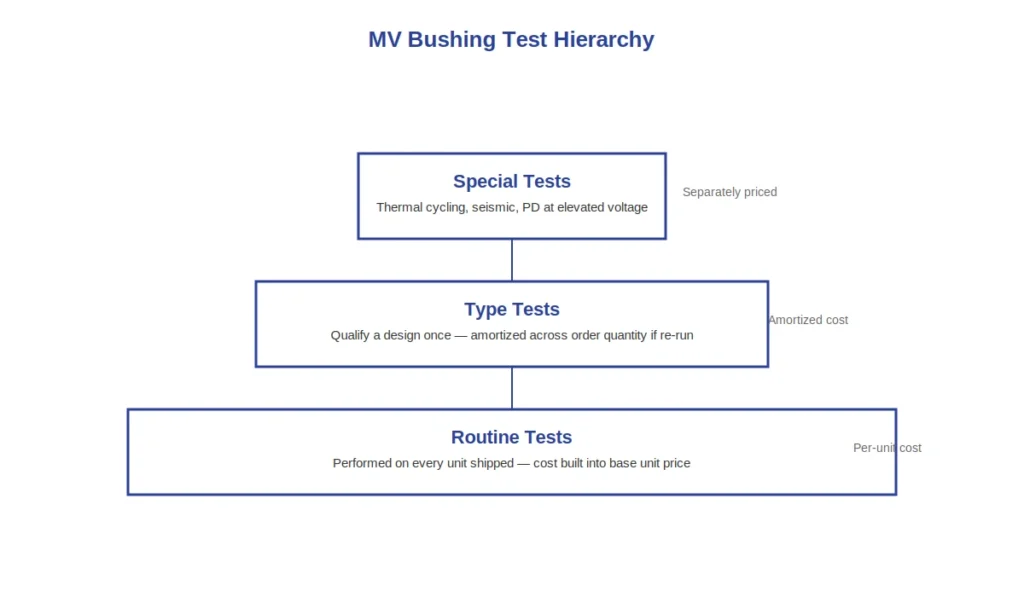
Routine tests are performed on every unit shipped and are already priced into the base unit cost. These typically include dielectric withstand and partial discharge screening at production level, adding minimal per-unit cost since they’re built into the manufacturing line’s standard QA flow.
Type Tests (design-level, amortized)
Type tests qualify a bushing model once, not per shipped unit — but if a project requires a supplier to run or re-run type tests for that specific order (a new configuration, a non-standard current rating, or a first-time supplier relationship), that cost amortizes across the order quantity rather than the manufacturer’s full production volume. On smaller orders this can add a meaningful percentage to per-unit price; on larger orders the same absolute cost becomes nearly negligible per unit.
Special/Optional Tests
Special tests — thermal cycling, seismic qualification, or extended partial discharge measurement at elevated temperature — sit outside standard routine/type scope and are priced separately, per [VERIFY STANDARD: IEC 60137 clause distinguishing routine, type, and special test categories].
[Expert Insight]
Confirm test tier in writing at RFQ stage, before requesting a formal quote
“Full IEC 60137 compliance” in a spec can mean routine-only or special-test scope — the wording alone doesn’t tell you which
Type-test amortization means small orders absorb a disproportionate share of design-qualification cost
Special tests like partial discharge at elevated voltage are often the single largest line-item surprise on a quote
In commissioning and QA review work, the recurring pattern is a project spec referencing “full IEC 60137 compliance” without the buyer confirming which test tier that actually triggers. On one recent order, a customer assumed routine-test pricing applied, only to find the referenced clause required special partial discharge testing at 1.5x rated voltage — a scope difference that surfaced only after the RFQ was already submitted, adding roughly two weeks to the quote-revision cycle.
Test hierarchy for medium-voltage bushings, showing routine, type, and special test tiers and how their cost amortizes differently.
Field Conditions That Push Spec — and Cost — Upward
Even when material, class, and test tier are correctly matched to a project’s baseline requirements, site conditions can force spec upgrades that weren’t in the original RFQ — and each tends to compound with the cost drivers already covered, rather than replace them.
Altitude Derating
Bushings rated for standard conditions typically assume installation at or below 1000 m elevation. Above that threshold, dielectric performance derates with air density, and per IEC 60071-2, Clause 7.2.2 (altitude correction), projects at higher elevations often need a bushing rated one insulation level above what nominal system voltage alone would suggest — effectively pulling in the next voltage class’s cost structure without a change in actual operating voltage.
Contamination Class Upgrades
Coastal, industrial, or desert sites frequently require a pollution class upgrade from the default “medium” rating to “heavy” or “very heavy,” increasing required creepage distance independent of voltage class. This is one of the more common late-stage spec changes: a project initially quoted against catalog defaults gets revised after a site survey confirms proximity to a coastline or cement plant, pushing creepage distance requirements up by 20-30% and triggering a material or dimension change on bushings already in production planning.
Ambient Temperature
Sustained ambient temperatures above roughly 40°C can require conductor derating or additional thermal margin in the terminal connection design, since current-carrying capacity is temperature-dependent. On a recent high-ambient industrial installation, the originally specified 1250 A bushing needed a derated-current recheck against actual peak ambient readings before commissioning sign-off — a step that’s easy to skip when specs are pulled from a standard catalog table rather than site data.
These field-driven upgrades are why a bushing spec finalized purely from a single-line diagram often costs more once site conditions are factored in — and why confirming site data before finalizing an order avoids costly mid-project revisions.
Getting Cost-Efficient Specs Without Compromising Reliability
MV bushing cost is rarely reducible to a single line-item decision. Material, voltage/current class, and test tier interact, and site conditions can override all three after the fact. The most cost-effective specs come from matching each variable to actual application requirements — not defaulting to the highest catalog option “for margin,” and not under-specifying to save cost on a line that later triggers a change order.
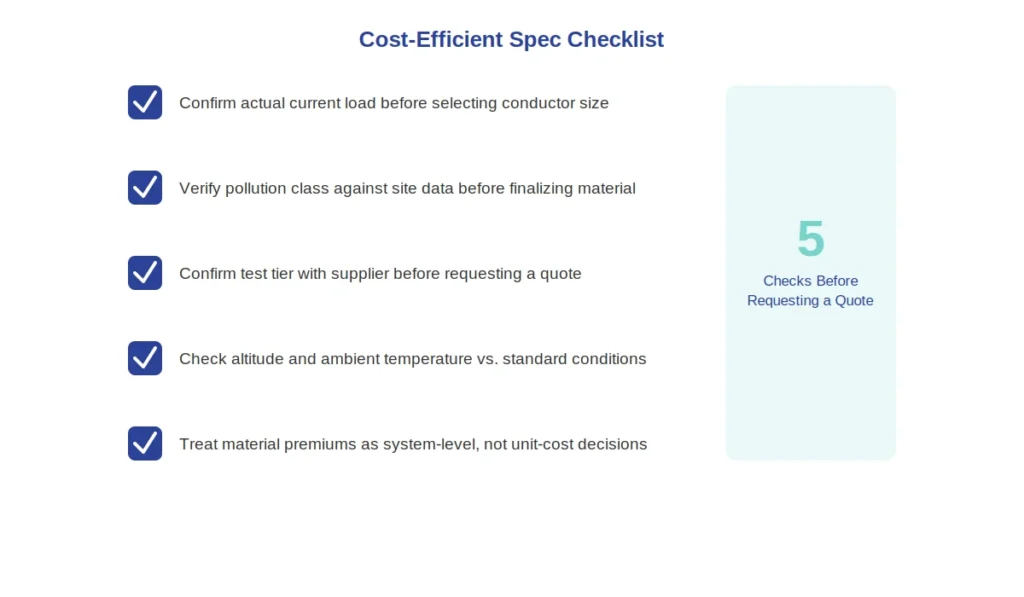
A practical procurement checklist for balancing cost against reliability:
Confirm actual current load before selecting conductor size — don’t default to the next catalog step
Verify pollution class against site data (coastal, industrial, desert) before finalizing material
Ask suppliers directly which test tier a project spec triggers, before requesting a quote
Check altitude and ambient temperature against standard-condition assumptions
Treat epoxy/silicone premiums as system-level decisions, not just unit-cost comparisons
A five-point procurement checklist for balancing MV bushing cost against reliability, covering load current, pollution class, and test tier confirmation.
For projects sourcing both transformer and cable accessories together, ZeeyiElec’s cable accessories range covers complementary MV/LV components that often appear on the same RFQ. If your project spec is still taking shape, ZeeyiElec’s engineering team can review current, voltage class, and site conditions before you request quotes — helping avoid the test-tier and spec-revision surprises covered above.
Frequently Asked Questions
How much does an MV bushing typically cost?
Unit cost varies widely by material, voltage class, and test scope, but a standard 12 kV-24 kV porcelain bushing built to routine-test scope sits at the low end of the range, while a 36 kV composite bushing with special test requirements can run several times higher — actual pricing depends heavily on order volume and supplier.
Does epoxy resin cost more than porcelain for MV bushings?
Yes, typically 15-35% more for equivalent electrical ratings, driven by curing cycle time and tooling cost, though epoxy’s compact footprint can offset part of that premium in space-constrained switchgear applications.
Why do type tests add so much to bushing procurement cost?
Type tests qualify a design once but get amortized across the order quantity when a project requires design-specific re-testing, so smaller orders absorb a proportionally larger share of that qualification cost than large-volume orders.
Does voltage class alone determine bushing price?
No — rated current often has a larger cost impact than voltage class alone, since conductor sizing and terminal hardware scale with current in ways that aren’t reflected in the voltage rating.
Are special tests like partial discharge testing worth the added cost?
It depends on the application; special tests are generally justified when project specs or environmental conditions demand verified performance margins, but they add meaningful cost and shouldn’t be assumed as default scope without confirming the project actually requires them.
How does contamination class affect MV bushing cost?
Upgrading from a medium to heavy or very heavy pollution class typically increases required creepage distance by 20-30%, which can require a larger insulator or a material change, both of which raise unit cost independent of voltage or current rating.
How can buyers avoid unexpected bushing cost overruns?
Confirming actual load current, site environmental conditions, and required test tier before requesting a quote is the most reliable way to avoid mid-project spec revisions that drive up cost after an order is already placed.
yoyo shi
Yoyo Shi writes for ZeeyiElec, focusing on medium-voltage accessories, transformer components, and cable accessory solutions. Her articles cover product applications, technical basics, and sourcing insights for global electrical industry buyers.





 English
 한국어
한국어 العربية
 Español
 हिन्दी
 தமிழ்
தமிழ் Deutsch (Sie)
 Français
 Português do Brasil
 Русский