What Is LV Bushing Material Selection and Why Thermal Stability Matters
Low-voltage bushing selection determines how reliably a distribution transformer transfers current from its internal secondary windings to external LV circuits, and thermal stability is the parameter that most directly governs bushing service life under sustained load. An LV bushing operates continuously in a current range of roughly 600 A to 5000 A or higher, depending on transformer kVA rating, and every ampere of current flow generates I²R heating at the conductor-insulation interface. Unlike a momentary fault event, this heating is constant during normal operation, so the insulation material must tolerate a steady-state temperature rise without softening, cracking, or losing dielectric strength over years of service.
Thermal stability describes how well a bushing’s insulation system maintains its mechanical and electrical properties across repeated heating and cooling cycles. A transformer under daily load variation — heavy during peak demand hours, lighter overnight — subjects the bushing to continuous thermal cycling rather than a single fixed temperature. Insulation with poor thermal stability tends to develop microcracking or dimensional distortion after repeated cycles, which can compromise the seal at the tank wall interface and allow moisture ingress over time.
Where Heat Concentrates in the Bushing Assembly
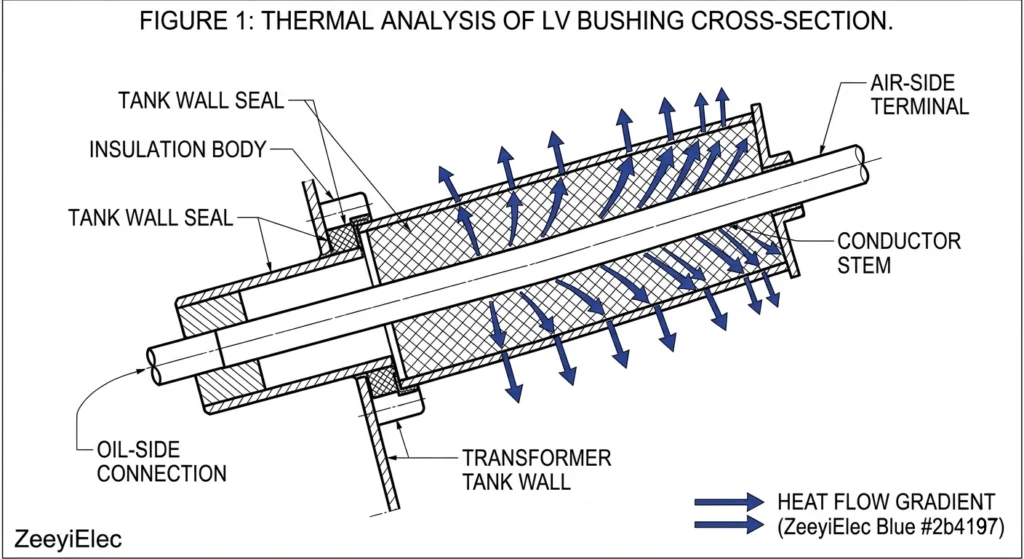
Heat generation is not uniform across a bushing. The conductor stem and terminal connection points run hottest, since these are the highest current-density areas. Field commissioning data on secondary bushings rated 1.2 kV to 3.0 kV commonly shows terminal-area temperature rise in the 30°C to 55°C range above ambient under rated continuous load, depending on ventilation, terminal torque quality, and conductor cross-section.
Why Material Choice Drives the Outcome
The insulation body — HTN, porous resin, or porcelain — acts as both an electrical barrier and a heat-dissipation path. A material with low thermal conductivity traps heat near the conductor, accelerating aging; one with poor thermal expansion matching risks stress cracking during cycling. Material selection and thermal stability performance are the same engineering decision viewed from two angles.
Cross-sectional view of an LV bushing showing conductor stem, insulation body, tank wall seal interface, and heat flow path under load.
Core LV Bushing Insulation Materials: HTN, Porous Resin, and Porcelain
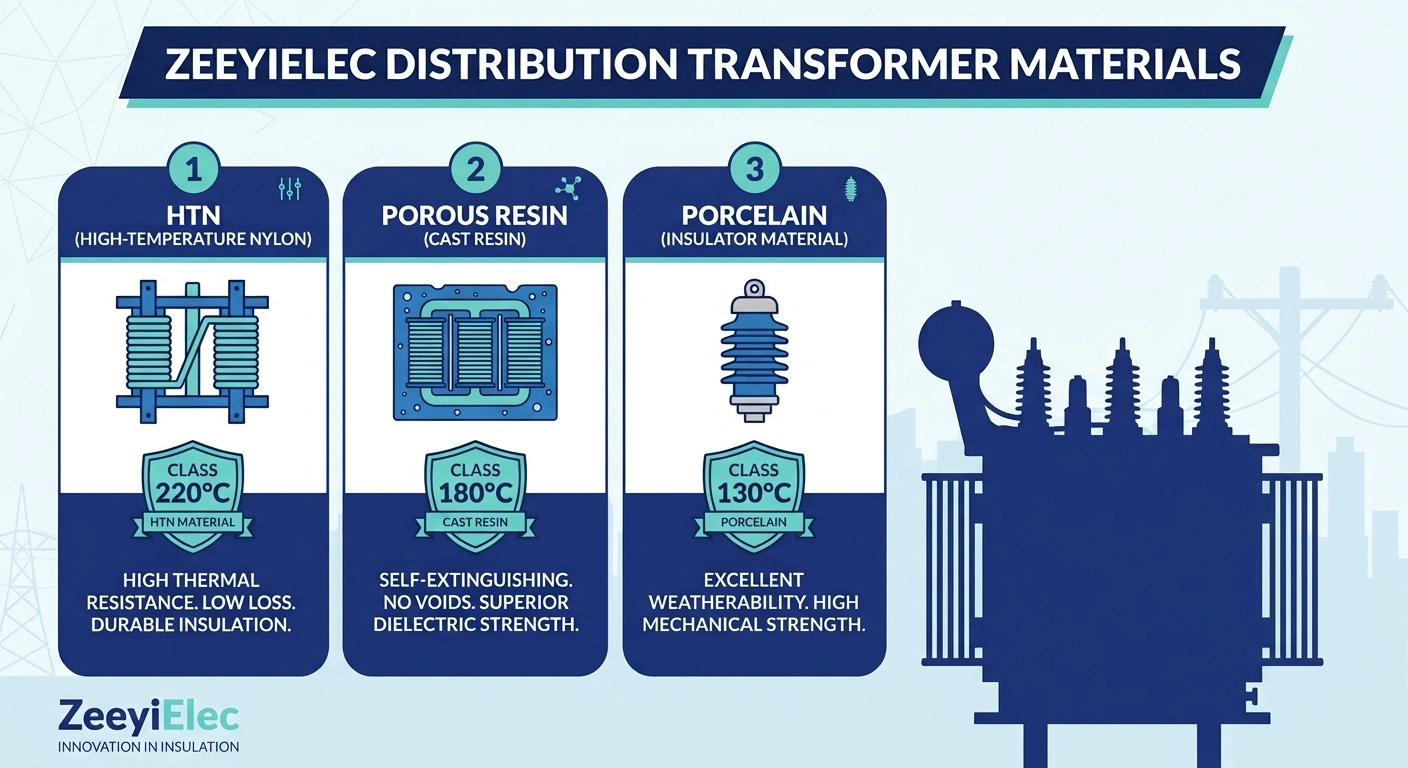
Three insulation systems dominate LV bushing manufacturing, each with a distinct thermal profile that determines suitability for a given application.
HTN (High Temperature Nylon)
Thermal and Mechanical Properties
HTN is a glass-reinforced thermoplastic commonly rated to a thermal class of 130°C (Class B) or higher, giving it strong resistance to thermal cycling fatigue. Its coefficient of thermal expansion (CTE) sits closer to copper than porcelain’s, reducing stress-cracking risk during repeated heating and cooling.
Typical Applications
HTN is typically specified for compact pad-mounted transformers with high terminal density and limited cooling airflow, where cycling resilience matters more than raw mechanical mass.
Porous Resin
Thermal and Mechanical Properties
Porous resin bushings use a filled epoxy or polyester body, offering dielectric strength of roughly 15 kV/mm to 20 kV/mm depending on filler content and cure quality. Resin handles moderate cycling well but is more sensitive to prolonged exposure above its rated thermal class than HTN.
Typical Applications
Resin suits steadier load curves — industrial or utility feeds with predictable daily demand — over applications with sharp daily peaks.
Porcelain
Thermal and Mechanical Properties
Porcelain remains the benchmark for mechanical robustness and thermal stability under sustained heat, since it does not soften or creep the way polymers can over decades of service.
Installation Sensitivity
Its lower CTE relative to the conductor means terminal torque quality matters more — under-torqued porcelain terminals are a disproportionate source of localized hot spots, sometimes exceeding a 15°C additional rise beyond a properly torqued connection.
Thermal classification of these materials follows IEC 60085 (Electrical insulation — Thermal evaluation and designation), which defines thermal class boundaries (Class B at 130°C, Class F at 155°C, Class H at 180°C, etc.) and the criteria for assigning them to insulating materials and systems.
[Expert Insight]
HTN’s CTE match to copper makes it the default for high-cycling pad-mounted units
Porous resin suits steady industrial loads, not sharp daily swings
Porcelain’s biggest field risk is terminal torque loss, not the material itself
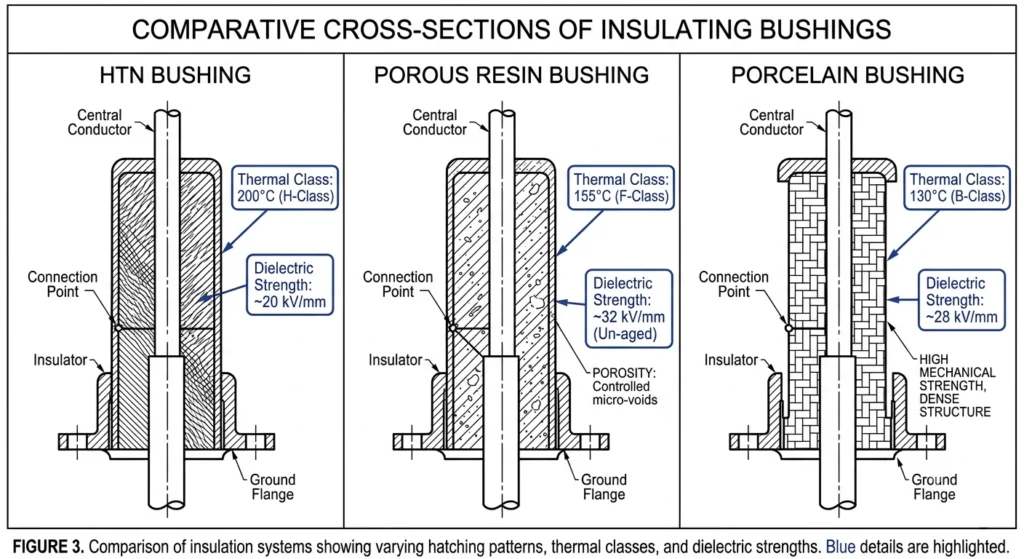
Comparative cross-sections of HTN, porous resin, and porcelain LV bushings with thermal class and dielectric strength callouts.
Thermal Performance Comparison Across Material Types
Comparing the three materials against thermal stability parameters clarifies which fits a given load profile; exact figures should be verified against manufacturer datasheets.
LV Bushing Material Thermal Comparison
Parameter
HTN
Porous Resin
Porcelain
Thermal Class
≥130°C (Class B)
105–130°C
No defined thermal class (inorganic)
Typical Temp. Rise at Rated Load
30–45°C above ambient
35–50°C above ambient
35–55°C above ambient
Dielectric Strength
18–25 kV/mm
15–20 kV/mm
10–15 kV/mm (via wall thickness)
Thermal Cycling Tolerance
High
Moderate
High (mechanically), sensitive to torque loss
CTE Match to Copper
Close
Moderate
Poor — requires stable terminal torque
Temperature Rise and Thermal Cycling Tolerance
These figures assume continuous rated-current operation in a ventilated enclosure; sharp daily load swings place additional cycling stress on the insulation-to-conductor bond regardless of material. HTN’s CTE match generally reduces microcracking risk over thousands of cycles.
Tracking and Erosion Resistance Under Sustained Heat
Porcelain resists surface tracking well, but this depends entirely on installation quality — a loose terminal concentrates heat and erodes any material’s surface over time. Resin and HTN rely more on filler composition to resist tracking under combined heat and contamination.
Thermal endurance testing for these classes generally follows the IEC 60216 series (Electrical insulating materials — Properties of thermal endurance), which defines the Arrhenius-based test methodology used to derive a material’s thermal index and expected service life at a given operating temperature.
Selection Logic: Matching Material to Current Rating and Duty Cycle
Material selection should follow the transformer’s actual duty cycle, not just its nameplate current rating — two transformers with identical rated current can face very different thermal stress depending on load variation.
Continuous vs. Intermittent Load Profiles
A steady industrial process load running near rated capacity for 20+ hours a day benefits from strong sustained thermal performance over cycling resilience; porous resin performs adequately if the rise stays within its 105°C to 130°C class. A variable commercial or residential feeder load, swinging 40% to 100% of rated capacity daily, favors HTN’s closer CTE match for better thermal stability under cycling.
Current Rating Thresholds and Material Implications
At 600 A to 1500 A, all three materials generally perform within acceptable thermal margins. Above roughly 2500 A to 5000 A, heat concentration at the terminal becomes more sensitive to material and connection quality, making terminal torque verification the dominant reliability factor.
When Porcelain Remains the Preferred Choice Despite Weight/Cost
Porcelain is still specified where long-term dimensional stability outweighs installation convenience — high-ambient regions or limited-maintenance sites, where polymer creep or UV degradation over a 20–30 year service life is a greater concern than added weight.
Field Conditions Affecting Thermal Stability
Laboratory thermal ratings assume standard reference conditions; actual field installations rarely match exactly. Altitude, ambient temperature, and enclosure ventilation all shift the thermal margin available to an LV bushing.
Altitude and Ambient Temperature Derating
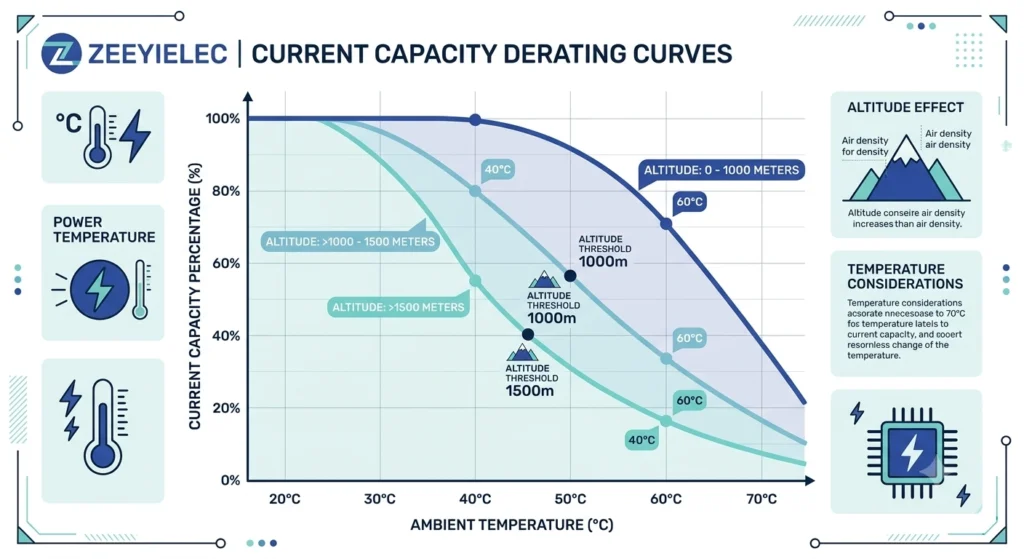
Installations above roughly 1000 m to 1500 m typically require current derating, since reduced air density lowers cooling efficiency. Sustained ambient temperatures above 40°C — common in parts of the Middle East and South Asia — reduce thermal headroom even without a load change.
Enclosure Ventilation and Heat Dissipation
Poorly ventilated pad-mounted enclosures can add 10°C to 20°C to terminal-area temperature rise compared to a well-ventilated cabinet, narrowing the margin for materials already near their thermal class limit.
Contamination and Moisture Exposure
Coastal and industrial contamination, combined with elevated temperature, accelerates tracking risk on any material — heat and contamination should be assessed together, not separately.
[Expert Insight]
Add derating margin above 1000–1500 m elevation, even if the nameplate doesn’t call it out
Enclosure ventilation can swing terminal temperature by 10–20°C
Treat contamination and heat as a combined risk in coastal/industrial sites
Derating curve illustrating how ambient temperature and installation altitude reduce effective LV bushing current capacity.
Installation and Commissioning Considerations for Thermal Reliability
Thermal stability designed into the material only holds up if installation matches it. Terminal torque is the most controllable variable — under-torqued connections commonly cause hot spots of 15°C to 25°C above a properly torqued terminal.
Pre-Energization Checks
Conductor and Terminal Preparation
Verify conductor surfaces are free of oxidation before terminal assembly, and confirm torque against the manufacturer’s specified range — commonly 20 N·m to 45 N·m for standard LV lugs, depending on stud size.
Torque and Seal Verification
Inspect the tank wall seal for proper compression before closing the enclosure; a compromised seal undermines thermal and moisture protection regardless of insulation material quality.
Thermal Imaging Verification
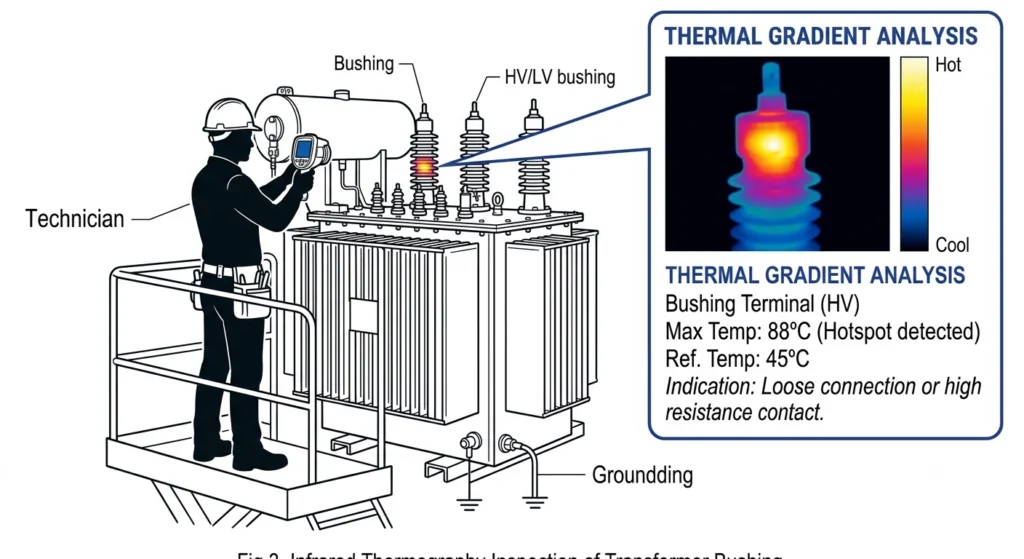
A thermal scan within the first weeks of energization, under representative load, catches connection defects before they progress to insulation damage — this step has repeatedly identified torque or contact issues that a visual inspection alone would miss.
If you’re specifying LV bushings for a new project — comparing HTN, resin, or porcelain against your load profile and site conditions — ZeeyiElec’s technical team can review your nameplate data and environment to recommend the right configuration. Contact ZeeyiElec for technical selection support and RFQ response.
Field commissioning technician conducting a thermal imaging scan on an LV bushing terminal to verify torque and connection quality.
Common Field Failure Patterns Linked to Material Mismatch
When an LV bushing fails prematurely, the cause often traces to a material selected without matching thermal stability requirements to actual operating conditions.
Overheating and Discoloration at the Terminal Interface
Discoloration at the terminal-to-conductor junction on high-ambient installations with resin near its thermal class ceiling typically indicates the thermal margin was consumed gradually, not by a single fault event.
Surface Tracking in Contaminated Environments
Early-stage tracking in coastal or industrial-pollution sites rarely reflects a pure material defect — it more often points to a mismatch between creepage distance and pollution severity, compounded by sustained heat.
Cracking from Cyclic Thermal Stress
Hairline cracking near the conductor embedment after repeated cycling, especially where CTE diverges from the conductor, is distinct from installation-related cracking, which appears within the first commissioning cycle.
If failures cluster by environmental zone rather than manufacturing batch, the pattern points to a material-environment mismatch, and re-specification is usually the correct response — see ZeeyiElec’s field failure diagnosis workflow for a structured approach.
Frequently Asked Questions
What is the best LV bushing material for high-ambient-temperature sites?
Porcelain is often preferred in sustained high-ambient conditions for its long-term dimensional stability, though HTN can perform well if ventilation is adequate and thermal class margin isn’t fully consumed by ambient heat.
Does HTN or porcelain last longer in outdoor installations?
Porcelain generally offers longer mechanical life in harsh outdoor environments due to UV and creep resistance, while HTN performs comparably in moderate climates, so the choice depends on site exposure severity.
How much does altitude affect LV bushing current rating?
Installations above roughly 1000 to 1500 meters typically need a derating adjustment since reduced air density lowers cooling efficiency, though the exact adjustment depends on site elevation and enclosure design.
Can a mismatched bushing material cause transformer failure?
A mismatched material rarely causes transformer failure directly, but sustained overheating or tracking at the interface can propagate into connection degradation over time.
How do I know if a bushing terminal is under-torqued in the field?
An under-torqued terminal typically shows as a localized hot spot during thermal imaging, often 15 to 25°C above surrounding terminals, and should be re-torqued to spec promptly.
Is porous resin suitable for pad-mounted transformers with variable load?
Porous resin can work with moderate load variation, but for sharp daily current swings, HTN’s closer thermal expansion match to copper provides better cycling resilience.
How often should LV bushings be thermally inspected after commissioning?
Thermal imaging is commonly performed shortly after commissioning and then at periodic maintenance intervals, with frequency increased for high-criticality loads or contaminated environments.
yoyo shi
Yoyo Shi writes for ZeeyiElec, focusing on medium-voltage accessories, transformer components, and cable accessory solutions. Her articles cover product applications, technical basics, and sourcing insights for global electrical industry buyers.





 English
 한국어
한국어 العربية
 Español
 हिन्दी
 தமிழ்
தமிழ் Deutsch (Sie)
 Français
 Português do Brasil
 Русский