Loadbreak switch maintenance interval planning sets the review and service timing for a specific installed switch using manufacturer instructions, applicable owner requirements, operating history and observed condition. For oil-immersed transformer switches, a calendar date alone cannot describe maintenance needs. Distinguish external observation, authorized testing and internal service before assigning an interval.
This guide concerns transformer-mounted, oil-immersed loadbreak switches, abbreviated LBS, including two-position and four-position hook-stick-operated designs. It provides a planning framework for qualified engineering and asset-management teams. It does not authorize energized maintenance, opening an enclosure, operating a suspect switch or substituting a general schedule for the equipment owner’s approved program.
Define the Loadbreak Switch Maintenance Scope
Match the plan to the installed configuration
Start loadbreak switch maintenance with the asset identity: model, identification number, drawing revision, circuit arrangement, operating mechanism and insulating liquid. The ZeeyiElec oil-immersed loadbreak switch range includes two-position and four-position families. Their different connection arrangements and mechanisms require the documentation applicable to the installed unit.
Use the actual position diagram rather than a photograph of a similar handle. Four-position configurations can have different contact-transition arrangements; those distinctions do not establish permission to parallel sources. Record which operating and verification instructions govern the equipment before deciding what maintenance task is due.
A manual’s scope matters
The supplied ZeeyiElec FYN33 four-position installation and use manual covers installation, operation, position diagrams, wiring and storage. It does not supply a periodic maintenance timetable or a lubrication interval. Its instructions must not be transferred to a two-position switch solely because both are transformer-mounted.
The FYN33 manual distinguishes rated-current switching from fault-current interruption. It also directs the operator to stop if resistance or obstruction is felt and resolve the cause before further operation. These are task boundaries and response requirements, not reasons to repeatedly cycle a suspect mechanism for maintenance.
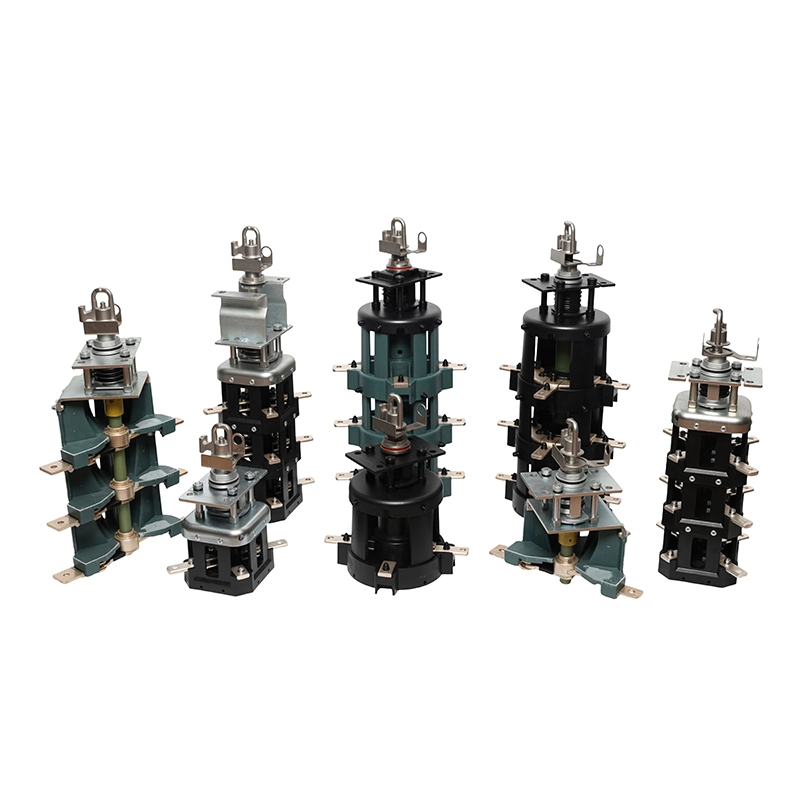
This unaltered two-position product photograph supports configuration identification; visible mounting, operator and terminal features do not establish contact condition, a maintenance interval or permission for internal access.
Establish the controlling maintenance program
NFPA 70B, Standard for Electrical Equipment Maintenance, addresses preventive maintenance of electrical equipment and systems. Its applicability and the adopted requirements must be established for the project. An official standard overview does not establish a universal interval for a particular oil-immersed switch.
Obtain the original equipment manufacturer, or OEM, instructions and the owner or utility program. Applicable required limits remain controlling. An observed improvement does not automatically authorize extending them; missing instructions require documented clarification, not an invented default.
Build the Service History Before Setting an Interval
Calendar age and operation history answer different questions
Calendar age identifies elapsed time. Operation history describes what the switch has done. Preserve dates, authorized switching tasks, intended and confirmed positions, and recorded abnormalities. If an operation count is available, retain its source and definition; do not create a count from incomplete records.
A published mechanical-life figure describes a declared performance characteristic under its stated conditions. It is not automatically a service interval, a remaining-life calculation or permission to operate until that count is reached. Maintenance planning also needs the actual duty and equipment condition.
Add environment and condition information
For loadbreak switch maintenance planning, document exposure relevant to the installation: moisture, corrosion, contamination, flooding history, damaged enclosures and other changes identified by the owner. A storage instruction to keep a spare clean and dry is not a complete maintenance program for installed equipment.
The switch depends on its specified insulating-liquid environment. Review relevant transformer liquid-condition records under the approved equipment program. A satisfactory exterior cannot verify internal contact condition, correct immersion or liquid suitability. Keep observations separate from assumptions about inaccessible parts.
This history belongs with the broader transformer accessory assembly. Changes to nearby bushings, protection, leads or the transformer arrangement may alter the information needed for the switch review without proving the switch itself has deteriorated.
Conceptual planning diagram connects approved instructions, service environment, operating history and condition evidence to a documented review; no universal calendar or operation-count threshold is prescribed.
Expert Insight: Keep Evidence and Missing Data Separate
– Record the source of an operation count and any gaps in the history.
– Describe visible condition without assigning an unverified internal defect.
– Treat an unknown baseline as a review issue, not an acceptable result.
Separate External Observation From Service Work
External condition review has a limited scope
An approved external observation routine may record accessible surface condition, identification, the indicated position and visible liquid around a shaft or mounting interface. Use only the permitted observation points and access arrangements. The observation itself does not require moving the operating handle or opening equipment.
Photographs should include the asset identity and location when they can be obtained within authorized conditions. Compare like-for-like views over time. A liquid mark near a switch can originate elsewhere, and an indicated position does not prove contact state or electrical isolation.
Testing and internal maintenance need separate authorization
Functional checks, electrical tests, liquid handling, internal inspection and component replacement are separate tasks. Each needs the permitted conditions, method, acceptance criteria and responsible personnel. Internal access and intrusive testing require the approved isolation, absence-of-voltage verification and grounding arrangements, with alternative supplies and backfeed addressed.
Do not add routine handle exercise, tightening or lubrication simply because those tasks appear on a generic switchgear checklist. The FYN33 manual does not specify a periodic lubricant or application quantity. Seek model-specific service instructions rather than introducing a product or method into an unverified mechanism.
If cable terminations or joints are included in the same outage, coordinate their work boundaries separately. Shared scheduling does not make valve, cable, transformer and switch acceptance criteria interchangeable.
Events That Bring a Review Forward
An abnormal observation can override the next calendar review
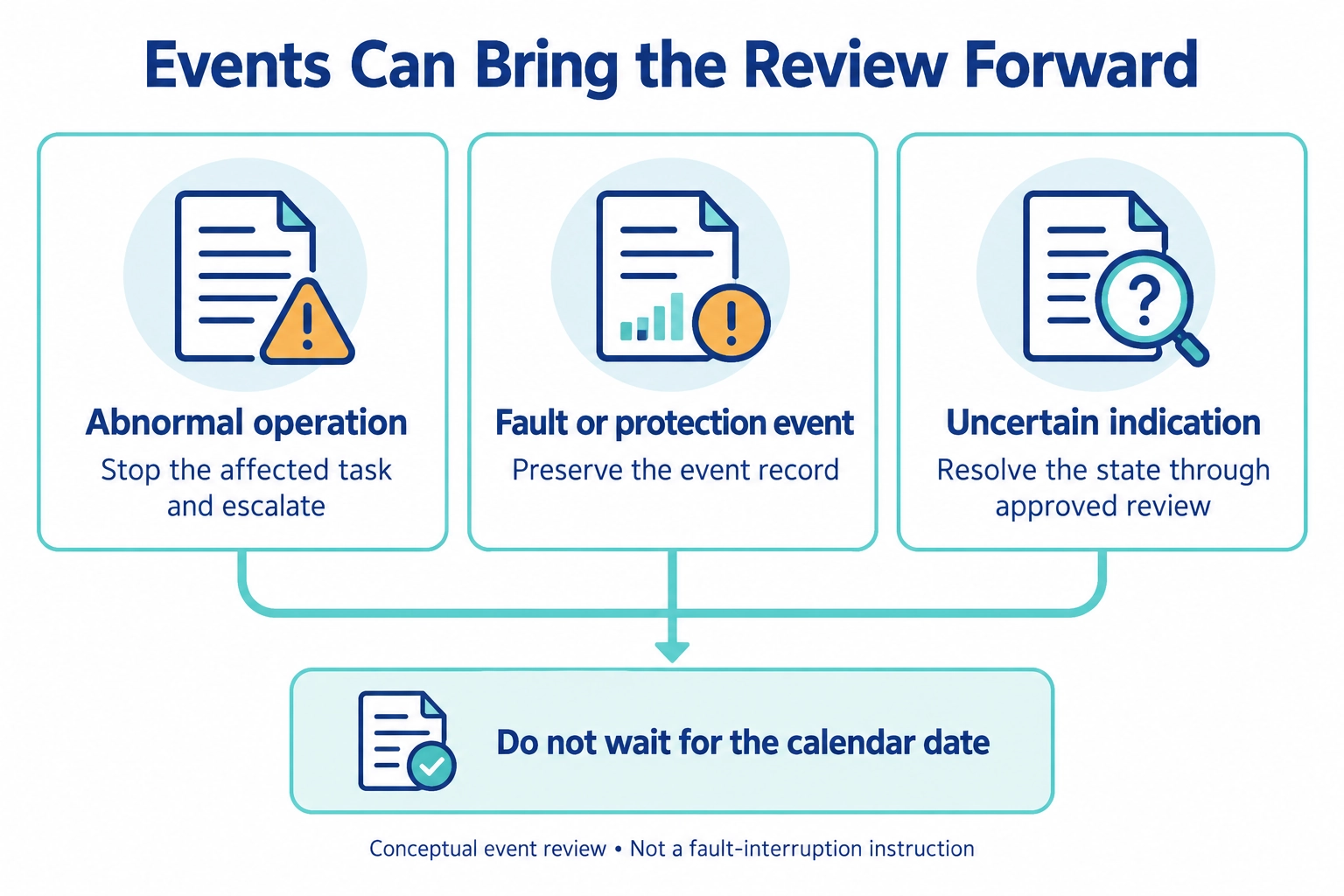
Loadbreak switch maintenance planning needs a route for new evidence between scheduled reviews. Uncertain indication, abnormal movement during an authorized operation, visible damage or suspected leakage should enter the owner’s response process. Preserve the observation and establish who controls the affected task and equipment disposition.
Do not wait for the next planned date when the applicable procedure requires earlier action. Equally, a warning sign does not automatically identify a failed internal switch. The loadbreak switch troubleshooting guide explains how to separate symptoms, hypotheses and verification; the maintenance plan determines how that review is assigned and recorded.
Fault and protection events need assessment
After a system fault, protection operation or unusual electrical event, preserve the event sequence and equipment information for engineering assessment. The initiating fault can lie outside the switch. An event does not establish that the LBS interrupted fault current or that it remains fit for its next operation.
An LBS rated for load switching is not a substitute for a protective fault interrupter. Required post-event checks and any restrictions must come from the equipment owner and the applicable manufacturer instructions. Do not test a suspected fault condition by trying different handle positions.
Conceptual event-review diagram identifies evidence that can bring an assessment forward under the owner’s program; it does not imply that a loadbreak switch provides protective fault interruption.
Changes in duty or service conditions also matter
A revised network arrangement, changed switching duty, liquid replacement or major equipment work can require a plan review even when no symptom is present. Identify what changed and which approval assumptions it affects. An existing maintenance interval should not silently follow a configuration whose documentation has changed.
Set the Loadbreak Switch Maintenance Review Window
Use a documented decision rather than a universal interval
For loadbreak switch maintenance, distinguish the next engineering review from the next service task. A condition review may decide that a defined test or outage is needed; it does not itself constitute that work. Conversely, an outage completed for another component does not automatically close the switch’s pending requirements.
Planning input
Evidence to use
Decision to record
Applicable instructions
Correct model documents and owner requirements
Required task, limit and approval authority
Operating history
Dated operations, duty and identified gaps
Whether the existing plan needs review
Condition
Comparable observations and accepted records
Earlier assessment or a defined follow-up
Service environment
Exposure and documented changes
Relevant inspection scope or clarification
Access and outage
Approved work boundaries and dependencies
Who performs each task and under what conditions
Completion evidence
Required reports and acceptance criteria
How the task and next review will be closed
The transformer accessory selection guide provides equipment-package context. Use the installed switch’s documentation to resolve service-specific questions; a category guide cannot define an asset’s maintenance frequency.
Illustrative planning comparison
Consider two hypothetical switches of similar age. One has a traceable operating history and unchanged accepted observations. The other has a changed transfer duty, incomplete records and a new position-indication concern. Identical calendar ages do not justify treating these evidence packages as equivalent.
The second asset needs an earlier engineering response under the owner’s program; the first still remains subject to its prescribed requirements. Neither example determines a numeric interval or proves that an extension is acceptable. This is a planning illustration, not a reported ZeeyiElec field result.
Expert Insight: Do Not Confuse a Review With an Extension
– Record whether the decision advances a review, schedules a task or changes an interval.
– Retain existing required limits until an authorized decision replaces them.
– Identify the evidence and person responsible for approving the change.
Close the Loadbreak Switch Maintenance Record
Keep findings, disposition and completion traceable
The loadbreak switch maintenance record should state the asset identity, document revisions, reason for review, observations, authorized work, results and unresolved issues. Include report references and photographs where appropriate. Record instrument identity and test conditions if the approved task involves measurements.
Specify the disposition: accepted against defined criteria, awaiting clarification, restricted pending assessment, or assigned corrective work. Do not convert an incomplete inspection into a pass. Repair and replacement decisions must respect the manufacturer’s service policy and the owner’s release authority.
Conceptual record workflow connects asset identity, permitted observations, reviewer disposition and the next action; retained evidence supports accountability without defining a test method or switching procedure.
Assign an owner to the next action
Record the next review date or permitted trigger, the required action and its responsible owner. Where a fixed due date applies, event-based follow-up supplements that date rather than silently replacing it. Preserve the reason for any approved schedule change so the next reviewer can reconstruct the decision.
For ZeeyiElec technical clarification, provide the model identity, applicable manual, circuit drawing, operation history and the specific maintenance question. Request written guidance on any unconfirmed inspection, testing or service requirement before placing it in the asset plan.
Frequently Asked Questions
How often should loadbreak switch maintenance be performed?
Use the installed equipment’s manufacturer instructions and applicable owner or utility program, together with the documented duty and condition. There is no universal calendar interval established by this guide for every oil-immersed switch.
Does mechanical life define the maintenance interval?
No. A declared mechanical-life characteristic is not automatically a service schedule or remaining-life allowance; the applicable instructions, duty history and condition must be reviewed separately.
Does the FYN33 manual specify periodic lubrication?
The supplied four-position installation and use manual does not provide a periodic lubrication schedule or lubricant specification. Obtain applicable service instructions before adding lubrication to the installed asset’s maintenance plan.
Can external observation prove that the contacts are healthy?
No. Accessible surfaces, position indication and visible leakage provide limited evidence and cannot directly establish inaccessible contact or liquid condition; any additional assessment needs an approved method and acceptance basis.
What should trigger a review before the next scheduled date?
An abnormal operation, uncertain indication, damage, suspected leakage, a relevant fault event or changed service conditions can require earlier assessment under the owner’s program. Record the evidence without assuming that every event confirms an internal switch defect.
Can four-position switch instructions be used for a two-position switch?
Only where the applicable manufacturer instructions explicitly support it. Use the exact model’s documentation and circuit arrangement; similar mounting or hook-stick operation does not make the service requirements interchangeable.
yoyo shi
Yoyo Shi writes for ZeeyiElec, focusing on medium-voltage accessories, transformer components, and cable accessory solutions. Her articles cover product applications, technical basics, and sourcing insights for global electrical industry buyers.







 English
 한국어
 العربية
 Español
 हिन्दी
 தமிழ்
 Deutsch (Sie)
 Français
 Português do Brasil
 Русский