A useful loadbreak switch FAQ starts with the circuit duty, contact arrangement, verified ratings and transformer interface. Buyers should request a model-specific drawing, switching sequence, test evidence and complete supply scope before comparing prices. A catalogue family name or current rating alone cannot establish that a switch fits the intended application.
For transformer manufacturers, distributors and project buyers, the difficult questions arise between a product description and a purchase order. Two offers can mention the same voltage class while covering different contact paths, mounting arrangements or accessories. This guide turns those uncertainties into questions that a supplier can answer with documents.
The emphasis is purchasing approval. Installation instructions, operating procedures and maintenance plans remain specific to the supplied equipment. Use this loadbreak switch FAQ to build a clear enquiry and identify unresolved assumptions before an order becomes a manufacturing commitment.
What Should Buyers Specify First?
Define the switching task
A loadbreak switch makes or breaks the specified load-current duty within its verified capabilities. It does not automatically provide fault interruption, protective tripping or an approved isolation function. State whether the project needs transformer connection, feeder sectionalizing or another documented circuit function. Include a single-line diagram so the supplier can understand the connections.
Specify normal service conditions and the duties that matter during abnormal conditions separately. A switch may need to carry load continuously, interrupt load current, make onto a short circuit or withstand fault current while another protective device clears it. Those are different requirements; one current number cannot answer all four questions.
Describe the complete application
Identify the system voltage requirements, frequency, phase arrangement, transformer construction and insulating liquid. Provide the required insulation levels and applicable project standard rather than asking for a generic “medium-voltage switch.” State ambient and liquid temperature requirements, installation environment and any unusual service conditions that require engineering review.
For a coordinated accessory package, the transformer accessories selection guide provides broader interface context. The switch enquiry should still identify its own approved electrical duty and mechanical envelope. Ratings of a neighbouring fuse or bushing are not transferable to the switch.
Which Contact Arrangement Fits the Circuit?
Two positions and four positions describe different choices
Position count describes selectable states, not a universal connection diagram. A two-position design can suit a defined connected/disconnected task. A four-position sectionalizing design can offer additional connection combinations, but the actual combinations depend on the contact arrangement. Request a labelled diagram showing what connects in every position.
The ZeeyiElec loadbreak switch family presents two-position and four-position options for oil-filled transformer applications. Treat that family description as a starting point. Select the exact assembly only after matching its connection table and drawing to the transformer circuit.
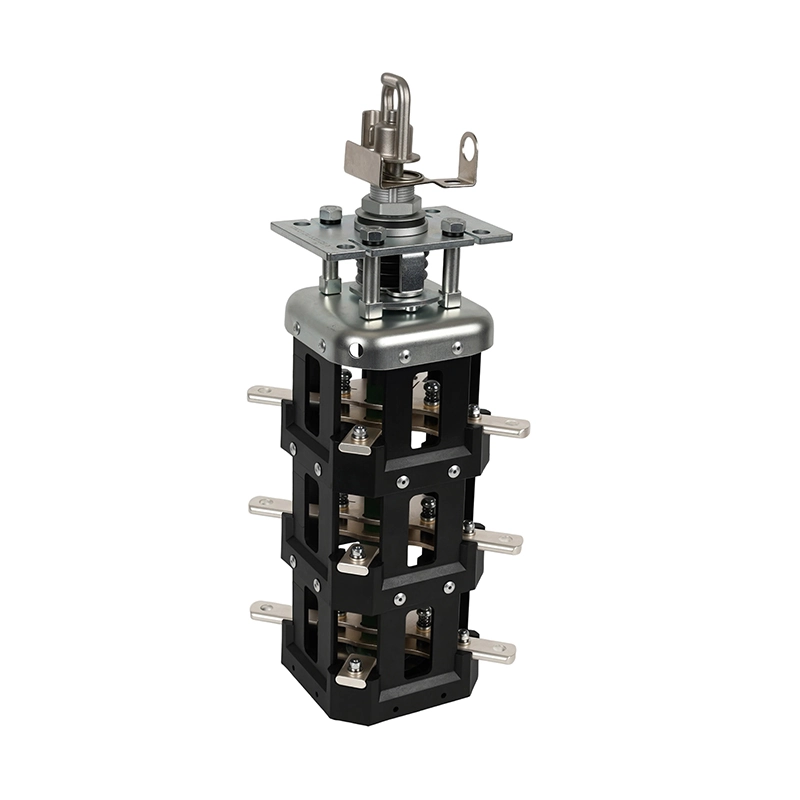
Two-position assembly shown for external structure comparison. Position count and appearance do not establish electrical ratings or replacement compatibility.
Ask about transitions between positions
Break-before-make means the relevant existing connection opens before the next connection closes. Make-before-break means the relevant next connection closes before the existing connection opens. The permitted sequence depends on the design and application; neither label establishes that paralleling two supplies is acceptable.
Ask the supplier to identify the contact transition for every permitted movement, the operating direction and any movement restrictions. Have the project engineer review source compatibility, backfeed possibilities and protection implications. This loadbreak switch FAQ cannot replace that circuit review, and a photograph of a handle cannot prove the internal transition sequence.
ZeeyiElec photograph from the MBB product family. Confirm the actual contact transition table and permitted circuit application; the image is not a switching sequence.
Match the position indicator to the circuit drawing
Handle labels, contact states and the transformer schematic must describe the same arrangement. Request the proposed marking plate with the drawing package. If a project uses different feeder names or position terminology, agree those labels before manufacture. A correct mechanism with ambiguous labels can still create an avoidable handover problem.
Which Ratings and Test Documents Matter?
Separate the electrical capabilities
Start with a written schedule of required duties. Ask for both the declared value and the conditions under which that value applies. Continuous current addresses carrying duty; load-breaking capability addresses specified interruption duty. Short-circuit making and short-time withstand address other stresses. Do not interpret any of these as a fault-interrupting rating.
Procurement explanation of four distinct electrical capabilities. Request model-specific declarations and evidence; no product ratings are assigned in this illustration.
Buyer question
Evidence to request
Approval check
Can it carry the required load?
Model-specific continuous-current declaration
Service conditions and assembly match
Can it interrupt the specified duty?
Applicable switching-duty evidence
Test duty represents the requirement
Can it close onto the specified fault duty?
Short-circuit making declaration and supporting evidence
Required fault duty is covered
Can it withstand a fault until protection clears?
Short-time withstand current and duration
Protection study and declared duration agree
Does the insulation suit the project?
Insulation declarations and applicable test evidence
Required levels and configuration match
This table is a procurement checklist, not a set of product ratings. Enter project values from approved specifications and compare them with evidence for the quoted model. A missing requirement should remain an open question, rather than becoming a guessed value in the purchase order.
Specify the standard and its edition
The official scope of IEC 62271-103:2021 concerns alternating-current switches and switch-disconnectors in its stated voltage range. Whether that document applies to the proposed transformer assembly must be established from the project specification and supplier evidence. A reference to a standard is not proof that every advertised configuration has been tested.
Request the applicable standard and edition, tested model identification, relevant ratings and configuration covered by the report. Ask the supplier to explain differences between the tested sample and offered assembly. This loadbreak switch FAQ uses the published scope for orientation; it does not claim access to the full standard or certify a product.
Distinguish design evidence from shipment records
Type-test evidence addresses the tested design under specified conditions. Routine-test records concern the supplied units and the required production checks. Ask which documents will be delivered, whether records identify the order or batch, and how any project-specific witness inspection will be arranged. Do not accept an unrelated report simply because its cover shows a familiar product family.
How Can Buyers Confirm Mechanical Compatibility?
Approve the tank interface and internal clearance
Request a controlled assembly drawing with mounting dimensions, sealing surfaces, shaft arrangement, contact orientation and required internal clearance. Compare it with the transformer drawing, including nearby leads, barriers and other accessories. A nominal hole size or similar-looking flange is only one part of compatibility.
Specify the insulating liquid and ask for documented compatibility of relevant materials and seals. Confirm the supplier’s requirements for immersion, mounting orientation and assembly conditions. These questions belong in the drawing approval stage; they should not be deferred until a technician discovers that the delivered switch cannot fit the tank.
Confirm external operating access
Check the operating handle, position indicator, locking provision and access space against the enclosure arrangement. Ask whether the quoted package includes the intended operating interface. Hook-stick operation requires an appropriate interface and an approved procedure; the presence of a ring or lever in a photo does not establish the complete operating method.
The transformer accessories range helps identify adjacent components that share the enclosure. Where cable entry and termination affect working space, coordinate that interface with the cable accessories range. These interface checks supplement the switch drawing rather than adding unrelated products to its supply scope.
What Should a Complete RFQ and Quotation Include?
Send a document package, not just a product name
A practical loadbreak switch FAQ should help a buyer produce a quotation request that another engineer can review. Attach the circuit diagram, required rating schedule, transformer interface drawing and intended marking arrangement. Include quantity, required delivery date, destination and any inspection or documentation requirements.
Request an exact model code and drawing revision in the reply. Ask the supplier to list included handles, plates, seals, mounting parts and other accessories. Identify exclusions explicitly. If a document is provisional, label it accordingly and define what must be approved before production starts.
Compare offers against the same baseline
Use this loadbreak switch FAQ as a shared quotation comparison sheet. Record electrical duty, contact states, transition sequence, drawing revision, test evidence, included parts, documentation and commercial terms. Keep unresolved technical differences visible instead of treating them as price differences. A cheaper offer may describe a different assembly or a narrower delivery scope.
Consider a hypothetical replacement enquiry: one offer includes a matching handle and marking plate, while another supplies only the internal switch. The prices cannot be compared fairly until the missing interfaces and parts are resolved. This is an illustrative purchasing example, not a report of a ZeeyiElec installation or customer case.
Illustrative document review workflow before purchase-order release. Resolve discrepancies in the circuit, drawing, test evidence and supply scope before production approval.
Agree acceptance and traceability before ordering
Define the approved drawing, inspection scope, supplied-unit identification and records required at delivery. Request suitable packaging and storage instructions for the shipment. Agree how deviations will be reported and approved. Commercial lead time, warranty and spare-part availability should be confirmed for the actual order rather than inferred from a general website statement.
How Should Buyers Handle Replacements and Handover?
A similar exterior does not establish interchangeability
For a replacement, collect the original model identification, transformer drawings, contact-state diagram and available service documentation. Photographs help show orientation and access, but should accompany measurements and controlled records. Ask the transformer manufacturer or responsible engineer to approve the proposed replacement against the complete application.
Use the loadbreak switch installation checklist to organize installation-related records after selection. This loadbreak switch FAQ focuses on purchasing approval and should not be used as an operating sequence. Installation torque, switching procedure and maintenance limits must come from instructions for the supplied assembly.
Keep unresolved questions out of the release package
Before releasing an order, confirm that the model, ratings, contact table, transition sequence and drawing revision agree across documents. Retain written responses to open questions. At handover, provide the approved manual, applicable test records and clear component identification so the receiving team can connect the physical assembly to its documentation.
To request a ZeeyiElec quotation, prepare that package and identify which questions remain unresolved. A useful loadbreak switch FAQ leads to a documented selection decision: the buyer knows what is being supplied, the engineer can check its application, and the receiving team knows which instructions apply.
Frequently Asked Questions
What information is needed for a loadbreak switch quotation?
Provide the circuit diagram, required electrical duties, phase arrangement, insulating liquid, mounting drawing, position markings, quantity and documentation requirements. Ask the supplier to identify the exact model, drawing revision, included parts and exclusions.
Is a loadbreak switch the same as a circuit breaker?
No. A loadbreak switch performs its specified switching duties within its verified ratings. Do not assume protective tripping or fault interruption unless those functions are explicitly provided and documented for the equipment.
How do buyers choose between two-position and four-position switches?
Compare the required circuit states with the model-specific contact table. Position count alone does not establish connection combinations, transition sequence or suitability for the transformer arrangement.
Does a continuous-current rating prove load-breaking capability?
No. Carrying current and interrupting a specified load duty are different capabilities. Request the applicable load-breaking rating and supporting evidence for the quoted model and service conditions.
Can a product photograph confirm replacement compatibility?
No. Use photographs alongside the original identification, controlled drawings, dimensions, contact-state diagram and required ratings. Obtain approval for the complete replacement application from the responsible engineer or transformer manufacturer.
Which documents should arrive with the supplied switch?
Agree the approved drawing, operating and installation instructions, applicable routine-test records, supplied-unit identification and any project-specific inspection documents before ordering. The required package depends on the contract and equipment.
yoyo shi
Yoyo Shi writes for ZeeyiElec, focusing on medium-voltage accessories, transformer components, and cable accessory solutions. Her articles cover product applications, technical basics, and sourcing insights for global electrical industry buyers.







 English
 한국어
 العربية
 Español
 हिन्दी
 தமிழ்
 Deutsch (Sie)
 Français
 Português do Brasil
 Русский