연락처 정보
지이일렉은 글로벌 유통업체와 프로젝트 계약업체를 위한 변압기 및 케이블 액세서리를 공급합니다. 기술 선택 및 RFQ 지원은 당사에 문의하세요.
주소:
리우시, 웨칭, 원저우, 저장성, 중국
전화 / WhatsApp / 위챗:
+86 150 5877 8024
이메일:
[email protected]


안정적인 품질, 실용적인 리드 타임, 수출 지원으로 공장에서 직접 부품을 조달하세요.
아래 양식을 작성하여 카탈로그와 가격을 받아보세요.

 으로요요시
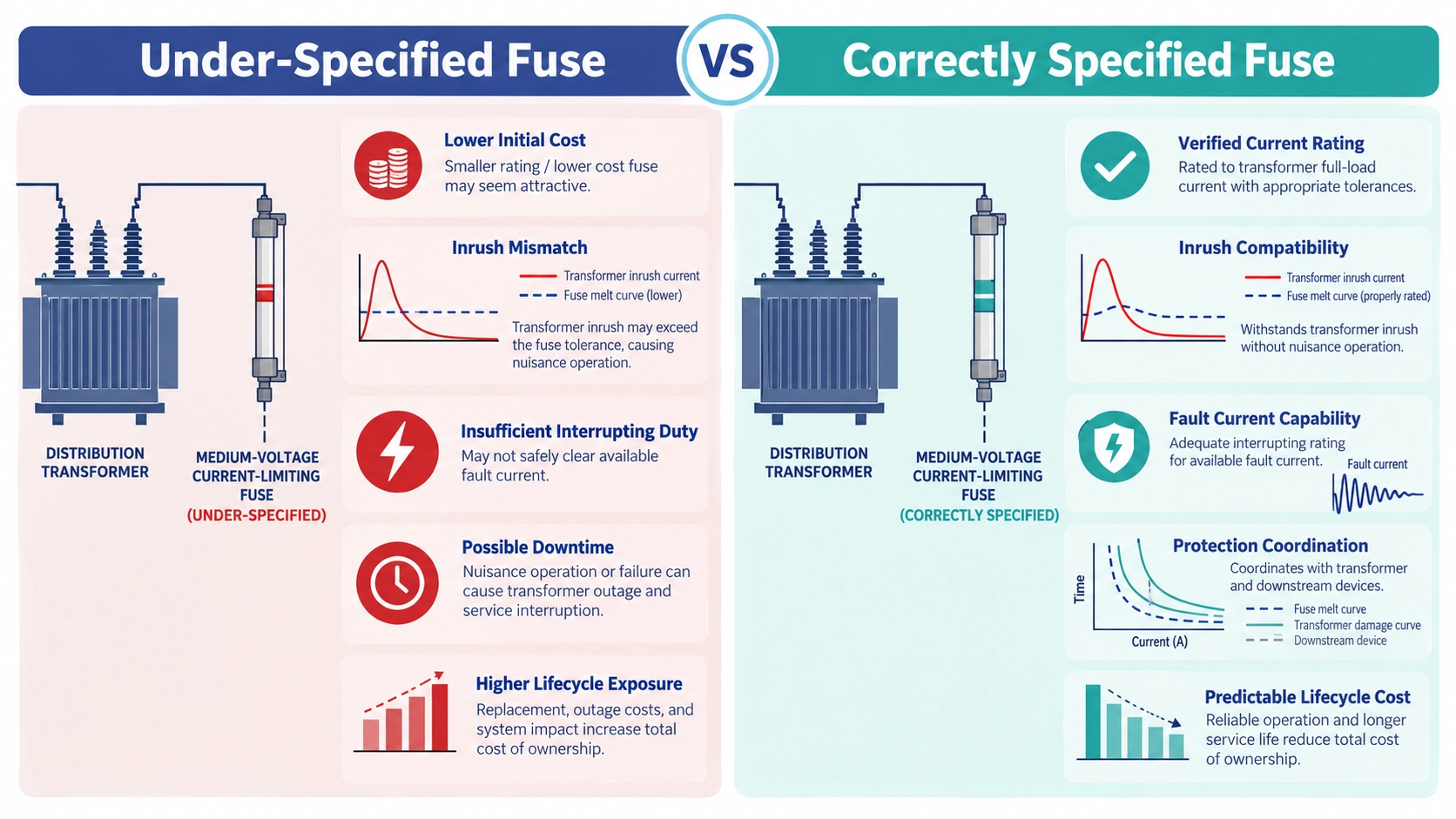
으로요요시An under-specified fuse may reduce initial procurement cost, but the apparent saving can disappear after one nuisance operation, emergency replacement, unplanned outage, or fault event outside the fuse’s intended duty.
The useful comparison is not simply “cheap fuse vs expensive fuse.” It is the difference between an under-specified fuse and a correctly specified fuse, evaluated against transformer loading, energization behavior, available fault current, protection coordination, and the financial consequence of an outage.
Transformer fuse applications commonly include 15 kV, 25 kV, and 35 kV classes, while prospective short-circuit current can range from a few kA to more than 20 kA, depending on source impedance and network configuration. Those values must come from actual project data rather than generic assumptions.
| Cost / Risk Factor | Under-Specified Fuse | Correctly Specified Fuse |
|---|---|---|
| Initial purchase cost | May appear lower | Selected for the required duty |
| Continuous-current suitability | May operate too close to normal load | Matched to transformer load and thermal conditions |
| 변압기 돌입 전류 | Greater nuisance-operation risk if curve is mismatched | Checked against expected energization behavior |
| 중단 기능 | May be insufficient for available fault current | Verified against prospective short-circuit current |
| 보호 활동 조정 | Possible overlap or protection gaps | Coordinated with other protective devices |
| Field replacement | Potentially more frequent | More predictable when application data are correct |
| Downtime exposure | Potentially higher | Reduced by avoiding preventable operations |
| Lifecycle cost | Initial saving may be offset by field costs | More predictable over the application life |
A common field mistake is assuming that physical interchangeability means electrical equivalence. Two fuse cartridges may fit the same holder while having different time-current characteristics, minimum melting behavior, or interrupting ratings. An under-specified fuse can therefore look correct mechanically while remaining unsuitable electrically; a correctly specified fuse must satisfy both requirements.
The ZeeyiElec 트랜스포머 액세서리 range places fuses within the wider transformer protection and switching system. The 케이블 액세서리 pillar follows the same engineering principle: interface components should be selected by electrical duty and application conditions, not dimensions alone.

[전문가 인사이트]
- Treat unit price as only one line in the protection-cost calculation.
- Verify electrical characteristics even when a replacement fuse is dimensionally identical.
- Use actual transformer and system data before comparing competing fuse options.
An under-specified fuse is not simply one with a current rating that is too low. It is a fuse whose characteristics do not adequately match the transformer or network duty.
The fuse must carry expected operating current without unnecessary operation. A transformer primary that normally carries 40 A, for example, may periodically operate around 50 A during peak demand. Ambient temperature, enclosure conditions, and loading duration can further influence fuse temperature.
Selecting from nameplate full-load current alone can therefore be misleading.
Depending on transformer design, residual flux, switching point, and source impedance, initial magnetizing inrush may reach approximately 8–12 × rated current for roughly 100–200 ms in some distribution-transformer applications.
This transient is not the same as a sustained overload. The practical check is whether the expected inrush envelope remains appropriately separated from the fuse manufacturer’s time-current characteristic.
A 15kV fuse should not be substituted into a 25kV application merely because the current rating or dimensions look similar. Likewise, a fuse may have adequate continuous-current capability yet still be unsuitable if available fault current exceeds its verified interrupting duty.
A network may present 10 kA, 20 kA, or higher prospective short-circuit current depending on source capacity and impedance.
IEC 60282-1:2020 — High-voltage fuses, Part 1: Current-limiting fuses applies to high-voltage current-limiting fuses for indoor or outdoor 50 Hz and 60 Hz AC systems with rated voltages exceeding 1,000 V, and covers ratings, characteristics, and test requirements.
A mechanically compatible fuse is not necessarily a coordinated fuse. Time-current behavior must be evaluated with transformer inrush, any Bay-O-Net fuse, and upstream protective devices.
지이일렉의 베이-오넷 퓨즈와 전류 제한 퓨즈 비교: 조정 로직 explains why the two fuse types normally handle different parts of the fault-current range.
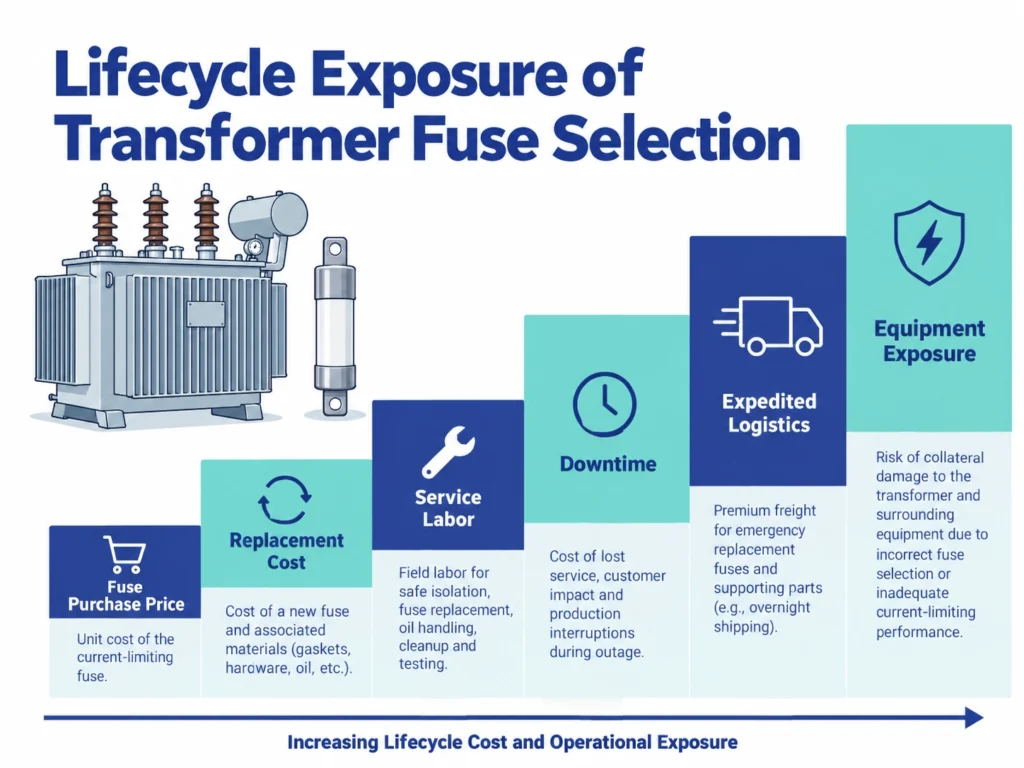
Purchase price is visible immediately. The larger costs often appear only after a protection event.
An unexpected operation can require technician travel, troubleshooting, replacement parts, testing, and recommissioning. A site involving 2–4 technicians 그리고 3–6 hours of diagnosis and restoration can incur significant service cost even when the replacement fuse itself is inexpensive.
A particularly costly pattern is replacing an operated fuse before establishing why it opened. If the actual problem is an inrush mismatch or incorrect time-current curve, installing the same under-specified fuse may simply repeat the event.
A current-limiting fuse also helps control the energy allowed through during a severe fault. Where prospective short-circuit current reaches 15 kA or 25 kA, inappropriate interruption characteristics can increase thermal and electromechanical stress on transformer components.
This does not mean every under-specified fuse will damage a transformer. The outcome depends on fault magnitude, clearing time, system impedance, fuse characteristics, and the rest of the protection scheme.
A fuse protecting a lightly loaded auxiliary transformer and one feeding a production line may cost roughly the same while having completely different outage consequences.
The economic question should therefore be: What would one avoidable interruption cost at this site?
Lifecycle Exposure = Purchase Cost + Replacement Cost + Service Labor + Downtime Cost + Consequential Equipment Risk
그리고 트랜스포머 액세서리 전체 선택 지도 provides a broader selection framework covering electrical ratings, environmental conditions, and mechanical compatibility.
[전문가 인사이트]
- Calculate the consequence of one unnecessary outage before focusing on a small unit-price difference.
- Include troubleshooting, logistics, recommissioning, and lost operating time in the comparison.
- If the fuse opens repeatedly, investigate the electrical duty before assuming a defective fuse batch.
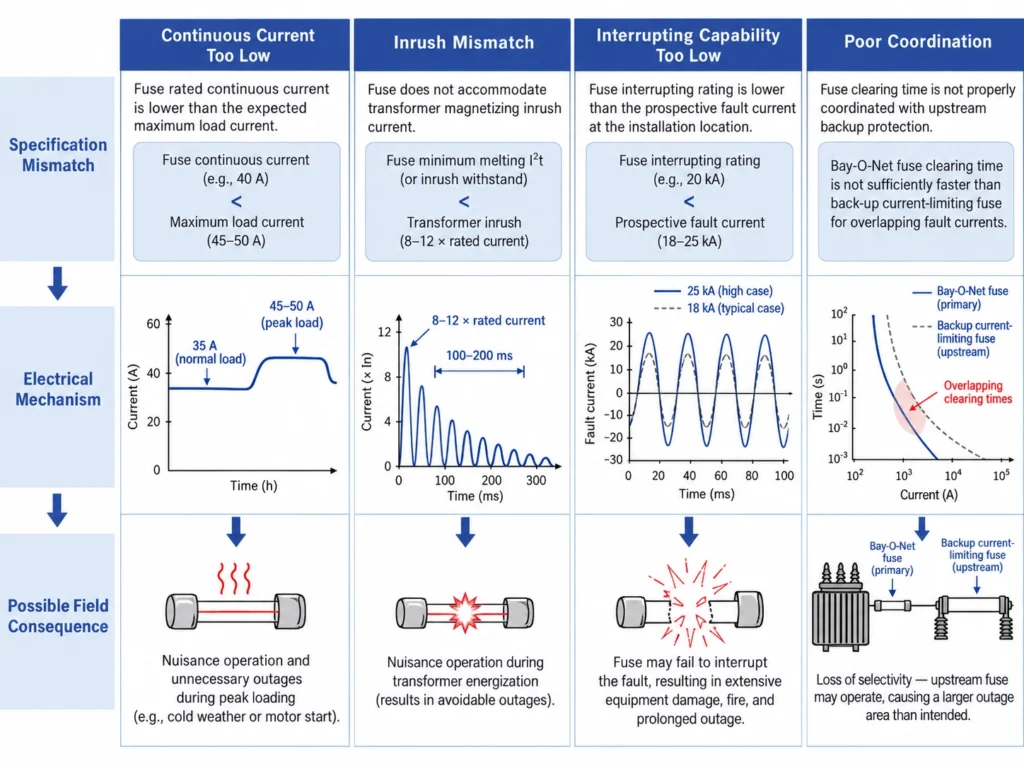
Most fuse-selection risk can be traced to four mismatches.
If normal load is 35 A but peak operating current frequently reaches 45–50 A, a fuse selected too close to nominal current may operate unnecessarily under sustained loading.
The correct response is to compare measured or expected load current against the manufacturer’s time-current information and application guidance.
Transformer energization can produce magnetizing inrush of approximately 8–12 × rated current for around 100–200 ms in some distribution-transformer applications, depending on transformer design, residual flux, switching angle, and source impedance.
When repeated fuse operation occurs immediately after energization, review the inrush envelope before installing another identical fuse.
A system study might identify 18 kA 또는 25 kA of prospective short-circuit current. If the proposed fuse has not been verified for that duty, its low purchase price does not make it a suitable alternative.
In many distribution transformers, the Bay-O-Net device addresses lower-current conditions while the backup current-limiting fuse handles higher fault levels. The precise transition depends on actual fuse curves and transformer design.
ZeeyiElec’s coordination example discusses a region around 3,500 A for lower-to-moderate faults and high-fault protection extending into the tens of kA, but those figures should not be treated as universal design limits.
A reliable comparison starts with the transformer and network—not the supplier’s price list.
Collect rated power, primary voltage, full-load current, connection, and expected loading profile. A 1,000 kVA transformer on a 13.8 kV primary has different current requirements from a 2,500 kVA unit at the same voltage.
Use the project’s short-circuit study or utility fault-level data. Depending on source strength and system impedance, available fault current may be 5 kA, 15 kA, or above 25 kA.
Do not select only from continuous current. Compare the expected energization envelope with the manufacturer’s published time-current characteristic.
Review the fuse together with any Bay-O-Net device, breaker, relay, or upstream fuse. Where selective protection is intended, verify that device curves do not create an unintended overlap or protection gap.
Only after technical suitability is established should price become the deciding commercial variable. This is the practical distinction between accepting an under-specified fuse because it is inexpensive and selecting a correctly specified fuse because its electrical duty has been checked.
그리고 전류 제한 퓨즈 product family provides the relevant product context for this selection stage.
A higher-priced, correctly specified fuse makes economic sense when the cost of an avoidable outage or incorrect protection duty is greater than the price difference between alternatives.
This is especially relevant for production facilities, remote installations, critical loads, or sites where replacement requires 3–6 hours of service work and 2–4 technicians.
The case becomes stronger as fault duty rises. If the calculated available fault current is 20 kA or 25 kA, a lower-cost under-specified fuse with insufficient verified interruption capability should not be treated as an equivalent substitute.
Before requesting a quotation, provide:
For model matching, submit the transformer data and existing-fuse information together. That allows a correctly specified fuse to be compared against the actual electrical duty rather than selected from dimensions or unit price alone.
No. Moving from, for example, a 40 A fuse to a 65 A fuse may improve load-carrying margin but can also alter protection coordination; the correct choice depends on transformer load, inrush, and the manufacturer’s curves.
Use prospective short-circuit current at the actual installation point, which may range from several kA to more than 25 kA in distribution systems. The required interrupting capability depends on network impedance and the specific protection arrangement.
Yes, if the selected time-current characteristic is too close to the energization envelope. In some applications, inrush can reach roughly 8–12 times rated current for 100–200 ms, although actual behavior varies with transformer and switching conditions.
No. Two 25kV fuses can differ in current rating, melting characteristics, clearing behavior, and interrupting capability, so voltage marking should be checked together with the complete electrical data.
Recheck it after meaningful changes to transformer load, system impedance, upstream protection, or fuse model. A load increase of around 10–20% or a short-circuit study showing several additional kA of fault current can justify reviewing the original assumptions.
Compare unit cost together with expected service labor, replacement logistics, downtime, and equipment exposure. Even 3–6 hours of unplanned outage can outweigh a relatively small fuse-price difference, but the actual financial effect is site-specific.

 English English
 한국어
한국어 العربية
 Español
 हिन्दी
 தமிழ்
தமிழ் Deutsch (Sie)
 Français
 Português do Brasil
 Русский