연락처 정보
지이일렉은 글로벌 유통업체와 프로젝트 계약업체를 위한 변압기 및 케이블 액세서리를 공급합니다. 기술 선택 및 RFQ 지원은 당사에 문의하세요.
주소:
리우시, 웨칭, 원저우, 저장성, 중국
전화 / WhatsApp / 위챗:
+86 150 5877 8024
이메일:
[email protected]


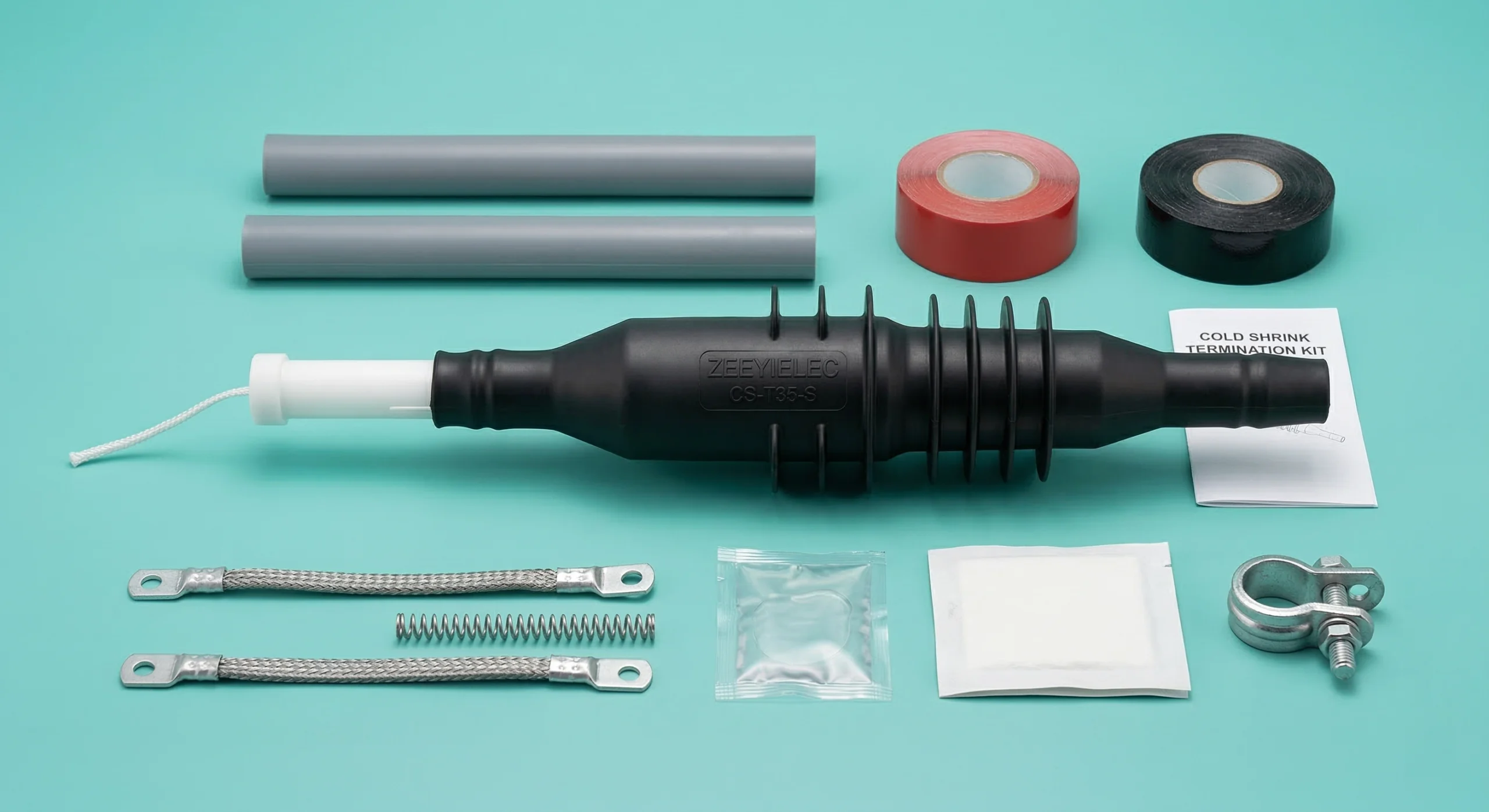
 으로요요시
으로요요시Shipping transformer or cable accessories across international borders involves more than booking freight; it requires a deep understanding of the technical documentation and the physical engineering behind the components. Among the most critical interface points in any power distribution system are the accessories that restore electrical insulation and manage stress fields.
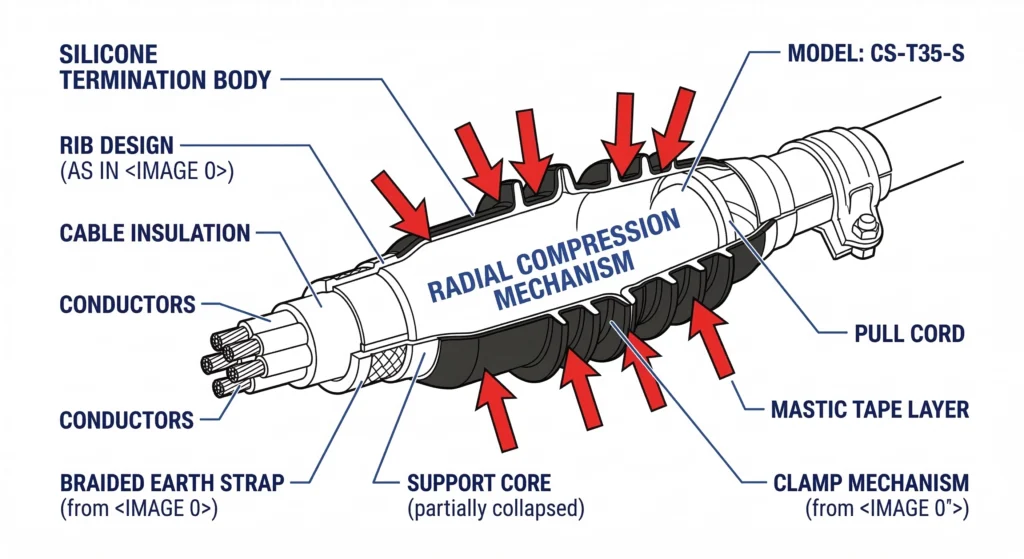
Cold shrink cable accessories are pre-expanded, engineered insulation components designed for medium-voltage cable systems, typically ranging from 8.7/15 kV to 26/35 kV. Unlike heat-shrinkable alternatives that require external thermal energy to trigger recovery, cold shrink technology relies on the inherent elastic memory of high-performance Liquid Silicone Rubber (LSR). The component is factory-expanded and loaded onto a removable, spiral-wound plastic support core. When this core is unwound during field installation, the sleeve collapses onto the cable interface, creating a permanent, high-pressure seal.
At its core, a cold shrink kit consists of the insulation body, geometric or refractive stress control elements, and environmental sealing mastics. These 케이블 액세서리 are engineered to restore the dielectric integrity of a cable after the factory layers have been stripped. The silicone material typically exhibits high dielectric strength, often exceeding 20 kV/mm.
The defining technical advantage is the “active” nature of the seal. Because the silicone is formulated to maintain a constant state of attempted contraction, it exerts continuous radial pressure on the cable. This is critical as power cables reach operating temperatures of 90°C and then cool; the cold shrink sleeve “breathes” with the cable, maintaining an interfacial pressure of approximately 0.05–0.15 MPa.
Cold shrink eliminates the variability associated with torch temperature or tape tension. By providing a factory-defined insulation thickness and automated radial tension, this technology moves quality control from the field back to the manufacturing environment.
[Expert Insight: Material Longevity] * Chemical Stability: High-grade silicone resists UV degradation and chemical tracking better than standard polymers. * Elastic Recovery: Maintains the majority of its original radial pressure even after 20 years of thermal cycling. * Hydrophobicity: Naturally repels water, preventing conductive paths in high-humidity substation environments.
The internal architecture of a cold shrink accessory is designed to solve the primary challenge of medium-voltage cable preparation: the concentration of electrical stress at the shield cutback. When the grounded semiconductor layer of a cable is removed, the electric field lines diverge sharply, creating a localized voltage gradient that can exceed the dielectric strength of air or standard insulation. Cold shrink components integrate specific material layers to manage this gradient, typically designed for system voltages up to 35 kV.
The most critical feature is the stress relief patch. In high-quality 콜드 수축 케이블 액세서리, this component uses a geometric profile to gradually increase the distance between the conductor and the ground plane. Field experience shows that even a 1 mm deviation in positioning can result in premature dielectric breakdown.
Many modern designs utilize refractive stress control through a High-Dielectric Constant (Hi-K) material layer. This material, with a relative permittivity ($\epsilon_r$) ranging from 15 to 30, acts as a buffer that refracts flux lines and smooths the potential distribution across the insulation interface.
While early products utilized EPDM, the industry has shifted toward LSR for high-performance applications. LSR offers superior hydrophobic properties and maintains elasticity across a wider temperature range, ensuring the active pressure seal remains intact from -40°C to 130°C.
[VERIFY STANDARD: IEEE 404 Standard for Extruded and Laminated Dielectric Shielded Cable Joints]
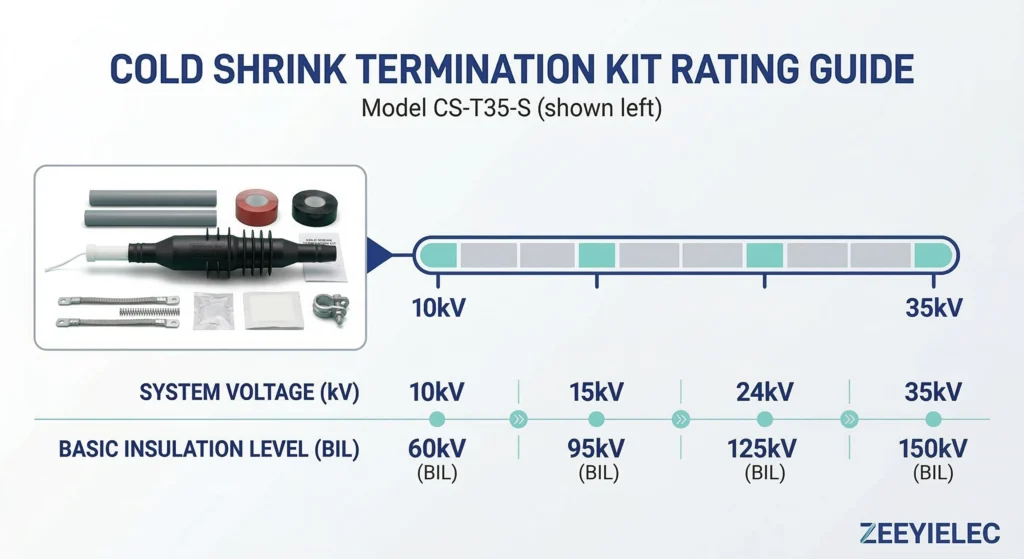
Cold shrink technology is engineered to cover the primary medium-voltage distribution spectrum, specifically supporting 10 kV and 35 kV class projects. Because the material properties of silicone allow for high dielectric strength, these accessories are applicable across a variety of power cable networks, including utility grids, industrial plants, and renewable energy installations. Selecting the correct voltage class is a non-negotiable step in the procurement process, as the insulation thickness and stress control lengths are precision-matched to the system’s BIL (Basic Insulation Level).
ZeeyiElec provides solutions for 8.7/15 kV and 26/35 kV classes. For a typical 35 kV system, the accessory is designed to meet a BIL of 150 kV or higher, ensuring the 콜드 수축 케이블 액세서리 are not the weak link in the infrastructure.
A significant advantage is “range-taking” capability. A single kit can accommodate multiple conductor sizes:
The environment dictates the design. Indoor terminations are compact for switchgear, while outdoor versions include integrated “rain sheds” to increase creepage distance, preventing flashovers during wet conditions.
The reliability of cold shrink accessories is inherently tied to the precision of cable preparation before the core is even pulled. In my experience overseeing substation commissioning, over 90% of “infant mortality” failures in terminations are traced back to preparation errors rather than manufacturing defects. This workflow prioritizes the removal of contaminants and the exact positioning of the stress control interface to ensure the active pressure seal functions as intended across 10 kV to 35 kV systems.
The process begins with stripping the cable to dimensions specified in the drawing. A critical field insight: the semiconductor layer must be removed using a peeling tool to ensure a smooth transition. Any nicks deeper than 0.1 mm can create air pockets that trigger partial discharge once energized.
The sleeve is positioned over the cable end while still on its core. The installer pulls the leading edge of the plastic spiral, unwinding it counter-clockwise, allowing the silicone to collapse onto the cable shield cutback.
The sleeve must overlap the metallic shield for grounding. High-viscosity mastics are applied at the lug end and base to prevent moisture ingress.
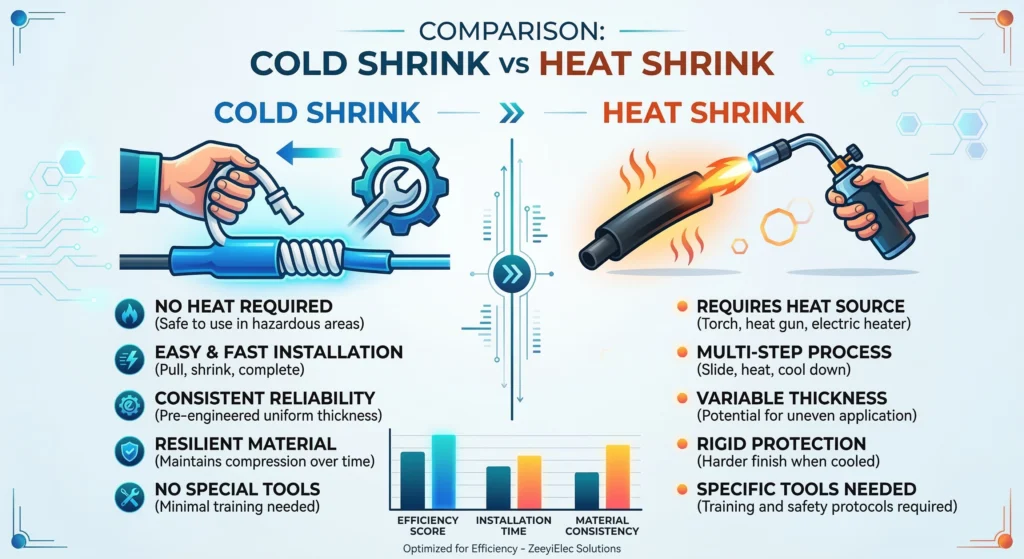
Selecting between cold shrink and heat shrink technologies is not a matter of identifying a “superior” product, but rather matching the accessory to the specific project environment and lifecycle requirements. While both technologies aim to restore insulation integrity and provide environmental sealing, they operate through fundamentally different mechanical principles. In medium-voltage distribution (10 kV to 35 kV), the decision often hinges on installation safety, labor expertise, and long-term thermal cycling performance.
Cold shrink accessories maintain an “active” seal. Because silicone is elastic, it expands and contracts with the cable. Heat shrink materials are “passive”; once shrunk, they become relatively rigid, which can lead to microscopic gaps over years of heavy load cycling.
Cold shrink reduces installation time—often by 50% compared to heat shrink—and requires no specialized heating tools or open flames, making it preferred for “hot work” restricted areas.
| 기능 | Cold Shrink Technology | Heat Shrink Technology |
| Heat Source | Not Required (Tool-free) | Required (Propane Torch) |
| 재료 | Silicone or EPDM | Cross-linked Polyolefin |
| Seal Type | Active (Constant Pressure) | Passive (Static) |
| Installation Time | Fast (5–10 minutes) | Moderate (15–25 minutes) |
| 전압 범위 | Up to 35 kV | Up to 35 kV |
Medium-voltage cable systems rely on the integrity of the interface between the cable insulation and the accessory body. In field assessments across over 150 industrial installations, improper selection and execution account for approximately 35% of cable system failures within the first five years. To mitigate these risks, a structured Quality Control (QC) approach is required, focusing on the prevention of electrical breakdown at vulnerable interfaces.
The most critical point is the semiconductor shield cutback. Even microscopic air gaps can lead to partial discharge (PD), eroding the insulation. Precise positioning of the stress control element is vital.
Environmental sealing is essential. For both cold shrink and 열 수축 케이블 액세서리, transition points must be sealed with moisture-blocking mastics. In coastal areas, moisture leads to “tracking,” resulting in phase-to-ground faults.
[전문가 인사이트: 현장 진단] * Visual Inspection: Check for “tracking” paths or carbonized “trees” on the surface of outdoor terminations. * Audit Mastic Integrity: Ensure the mastic has been squeezed out at the edges, confirming a complete circumferential seal. * PD Monitoring: High-frequency current transformers (HFCT) can detect internal discharge before catastrophic failure.
| Checkpoint | Requirement | Technical Significance |
| Insulation Surface | No nicks > 0.1 mm | Prevents stress concentration |
| Cleaning Protocol | Wipe toward semi-con | Avoids carbon contamination |
| Mastic Seal | 360° coverage | Ensures IP-rated protection |
A well-structured Request for Quotation (RFQ) for cold shrink accessories is essential to prevent procurement delays and technical mismatches. Incomplete specifications contribute to nearly 40% of accessory mismatches during installation projects, often adding 2–4 weeks to procurement cycles. For medium-voltage projects ranging from 10 kV to 35 kV, providing a precise technical baseline ensures that suppliers can quote accurately.
To ensure compatibility, your cable accessories RFQ must include:
At ZeeyiElec, we support OEM/ODM configurations and provide all export documentation, including commercial invoices matched to L/C terms and technical compliance certificates, to ensure your project stays on schedule.
Ready to streamline your medium-voltage procurement? Contact our team today for a comprehensive quote. We provide 24-hour response times and technical model matching for all 콜드 수축 케이블 액세서리 그리고 변압기 액세서리.
A properly installed unit provides a 25–40 year service life, matching the expected duration of most industrial power cable systems. This longevity is supported by the silicone material’s ability to maintain constant radial pressure despite thermal expansion.
Yes, they are engineered specifically for 26/35 kV distribution projects where high-dielectric strength and stable insulation performance are required. At this voltage class, the accessory’s internal stress control must be precision-matched to prevent partial discharge.
No, the technology is completely tool-free and requires no external heat source or open flames. The sleeve is factory-expanded over a removable plastic core that is simply unwound during the installation process.
Cold shrink is often preferred for outdoor coastal environments because silicone is naturally hydrophobic and more resistant to tracking than polyolefin. Its ability to “breathe” with the cable during seasonal temperature shifts also prevents moisture ingress better over decades.
Most failures result from cable preparation errors, such as leaving microscopic nicks on the insulation or failing to clean the semiconductor layer properly. These defects create air voids that lead to localized electrical tracking and eventual insulation breakdown.
Procurement teams should provide the system voltage, conductor cross-sectional area, and the specific diameter over the primary insulation. Defining whether the application is indoor or outdoor is also necessary to ensure the kit includes the correct number of rain sheds.

 English English
 한국어
한국어 العربية
 Español
 हिन्दी
 தமிழ்
தமிழ் Deutsch (Sie)
 Français
 Português do Brasil
 Русский