An off-circuit tap changer changes a transformer’s voltage ratio by selecting a different connection on a tapped winding while the transformer is de-energized. After re-energization, the new connection changes the effective number of turns and therefore the secondary voltage. It is also called a de-energized tap changer (DETC); the terms off-load or no-load tap changer are used in some documentation.
No-load does not mean safe to operate while energized. Disconnecting the secondary load alone does not de-energize the transformer. Tap changing requires isolation from all possible sources, verification of absence of voltage, and grounding as required by the equipment instructions and approved site procedure. This article explains the principle; operation belongs to qualified personnel following the model-specific manual.
How the off-circuit tap changer works
A tapped winding has connection points brought out from different parts of the coil. The selector connects the specified terminals for one operating position. Changing that connection includes or excludes winding turns in the active circuit. It does not physically add wire to the transformer, change supply frequency, or provide automatic voltage regulation.
The basic relationship for an ideal transformer is Vs / वीp = नहींs / एनp, where V is winding voltage and N is effective winding turns. For a fixed primary supply and unchanged secondary winding:
- More effective primary turns produce a lower secondary voltage.
- Fewer effective primary turns produce a higher secondary voltage.
- The ratio remains at the selected setting until the next authorized tap change.
This is a winding-voltage relationship. For a three-phase transformer, the vector group and winding connections must also be accounted for when relating winding voltages to line voltages. Actual terminal voltage under load additionally depends on impedance, load current and power factor. See Hammond Power Solutions: How Taps Work for the connection between winding turns and voltage ratio.
Worked example: a five-position primary tap range
Consider an illustrative 11,000 V / 400 V transformer whose nameplate provides primary voltage taps of +5%, +2.5%, nominal, −2.5% and −5%. Assume the secondary winding and vector group remain unchanged. The calculated no-load output is approximately 400 × actual primary voltage / selected primary tap voltage.
| Primary tap designation in this example | Selected primary voltage rating | Calculated secondary at a fixed 11,000 V supply |
|---|
| +5% | 11,550 V | 381.0 V |
| +2.5% | 11,275 V | 390.2 V |
| Nominal | 11,000 V | 400.0 V |
| −2.5% | 10,725 V | 410.3 V |
| −5% | 10,450 V | 421.1 V |
These are calculated teaching values, not Zeeyi product ratings or a field setting recommendation. At an actual supply of 10,450 V, selecting the example’s 10,450 V primary tap would give approximately 400 V secondary. At a fixed 11,000 V supply, the same setting gives approximately 421.1 V instead.
A +5% label can therefore mean a higher permitted primary voltage, not a command to raise the secondary output by 5%. Likewise, position 1 is not universally the highest or lowest voltage setting. Read the transformer nameplate and terminal connection drawing together. The project engineer must also check permissible voltage per turn, frequency, tap current and transformer capacity at the selected position.
For defining project requirements, see our tap range guide for distribution transformers. Tap ranges vary with design; HPS Transformer Tap Specifications explains why a single tap arrangement should not be assumed for every transformer.
What happens inside the selector?
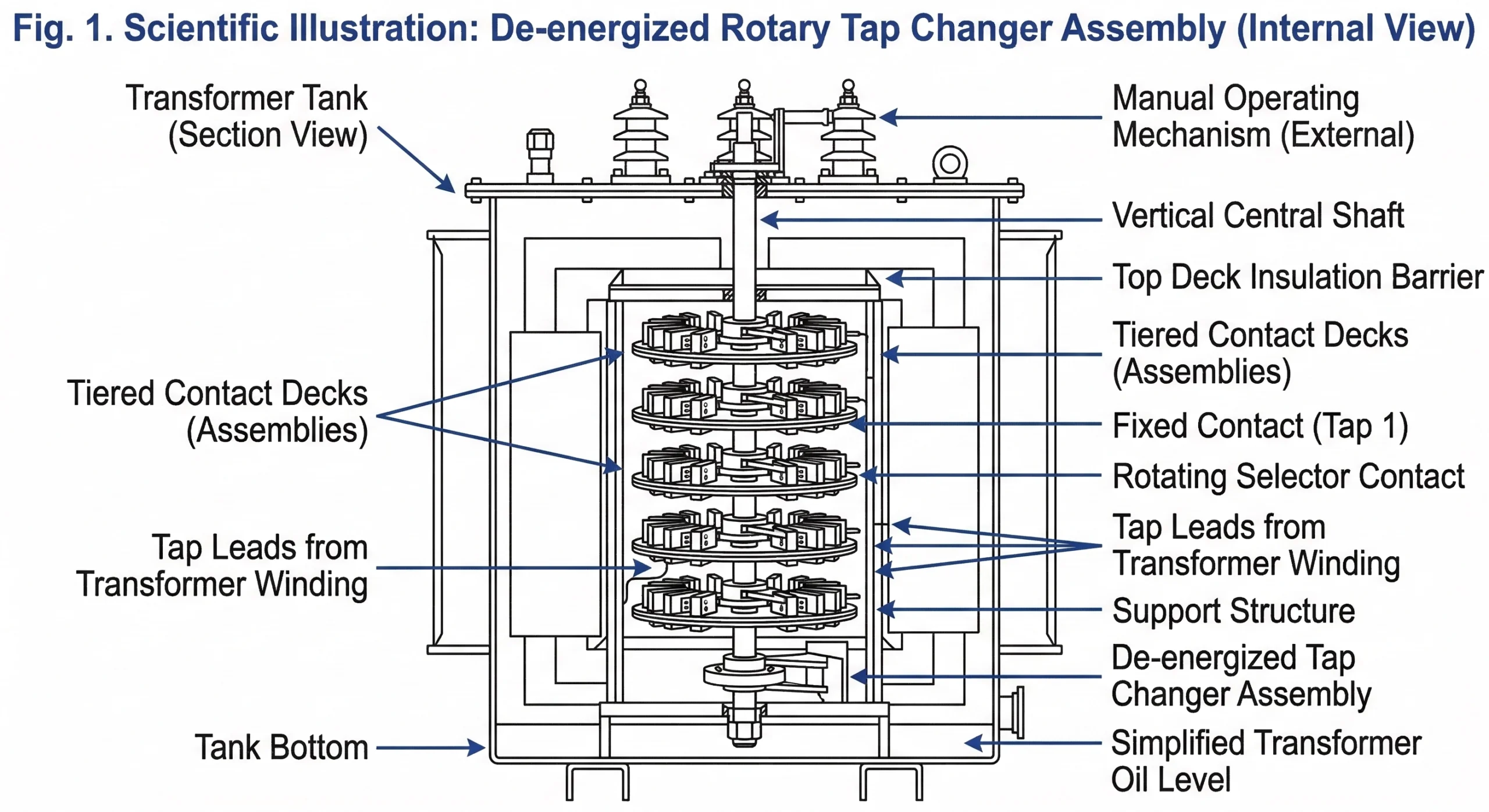
Fixed contacts connect to winding tap leads. Moving contacts establish the circuit associated with the selected position. An insulated drive transmits motion from the operating mechanism, while the locating and locking arrangement retains the final position. The exact terminals connected at each position must come from the manufacturer’s switching diagram.
Rotary designs use rotational movement; linear designs move the selector along a line. Both can be supplied in different phase arrangements, current ratings and mounting formats. Linear does not automatically mean single-phase, and rotary does not automatically mean three-phase. Manual and motor drives are available for some DETC designs; a motor drive does not make a DETC suitable for energized switching. The MR DEETAP brochure illustrates this variety.
Correct contact pressure, alignment and complete engagement matter because increased contact resistance produces additional I2R heating. There is no universal contact-resistance limit, phase spacing, handle travel or tightening torque for every model. Obtain the approved drawing and acceptance criteria for the actual assembly. Our contact design and operation limits guide covers related selection considerations.
Off-circuit tap changer vs OLTC vs loadbreak switch
| Device | Main purpose | Condition for switching |
|---|
| Off-circuit / de-energized tap changer | Select a winding ratio | Transformer de-energized; follow its isolation and operating procedure |
| On-load tap changer (OLTC) | Change winding ratio during service | Designed for on-load transitions within its rated switching duty |
| Loadbreak switch | Connect, disconnect or sectionalize a circuit | Interrupts specified load current within its rating; does not inherently adjust winding ratio |
A DETC is not rated to interrupt load or excitation current. An energized transition can produce arcing, damaged contacts or an internal fault. An OLTC uses a designed transition arrangement to manage current transfer between taps. A loadbreak switch performs a different circuit-switching function; it is not a substitute for either tap-changing device. See Eaton’s transformer fundamentals and our loadbreak switch versus off-circuit tap changer comparison.
Checks before returning a transformer to service
The transformer manufacturer’s procedure governs switching, isolation, testing and return to service. A project review should establish the approved tap setting, identify all potential supplies including secondary backfeed, and specify the required verification by qualified personnel. A visible handle indication alone is not proof of electrical isolation.
Before energization, the selector must be fully in the intended operating position, its indication and locking arrangement must agree with the approved drawing, and any required ratio, winding resistance or other checks must satisfy the manufacturer’s criteria. Do not energize equipment with an uncertain position, abnormal operating resistance, damaged mechanism or unresolved test result. Do not force the mechanism or invent a generic handle sequence.
Maintenance intervals, contact exercise requirements, seal materials, compatible insulating fluids and torque values are model-specific. A planned seasonal adjustment may be appropriate for a particular installation, but it still requires the specified outage and engineering review. A DETC is not intended to track daily supply fluctuations while energized.
Information needed to select an off-circuit tap changer
| Provide with the enquiry | What must be confirmed |
|---|
| Transformer rating, frequency, vector group and tapped winding | Compatibility with the transformer circuit and service duty |
| Tap table, number of positions and switching diagram | Correct terminal connections and ratio at every position |
| Through-current on all taps and short-circuit duty | Continuous, short-time and peak withstand capability |
| Insulation requirements and internal clearances | Applicable dielectric ratings and layout |
| Tank drawing, shaft dimensions and operating interface | Mounting, sealing, indication and locking compatibility |
| Insulating liquid, temperatures and service conditions | Material suitability and documented operating limits |
Review the Zeeyi off-circuit tap changer product page and supply the transformer nameplate, tap connection table and installation drawing with your enquiry. Ask for model-specific dimensional drawings, ratings and test documentation before approving a replacement or new design. A matching handle shape or number of positions alone does not establish interchangeability.
अक्सर पूछे जाने वाले प्रश्न
How does an off-circuit tap changer work?
It selects a different winding connection while the transformer is de-energized, changing the effective turns ratio. Once the transformer is re-energized, the selected ratio determines the approximate secondary voltage for the applied primary voltage.
Can it be operated with the secondary load disconnected?
No. A transformer with an energized primary still has voltage and excitation current even when its secondary supplies no load. A de-energized tap changer requires isolation from all sources and verification under the approved site and manufacturer procedures.
Does a +5% tap raise the secondary voltage?
Not necessarily. If +5% denotes a higher primary voltage rating, that tap uses more effective primary turns and lowers secondary voltage at a fixed primary supply. Use the actual nameplate tap table and connection diagram; position numbers and plus/minus labels are not universal.
Do all off-circuit tap changers have five positions?
No. Five positions with a nominal plus/minus 5% primary tap range are one example. The number of positions, step size, connection arrangement and electrical ratings depend on the transformer and tap-changer design.
What is the difference between an off-circuit tap changer and an OLTC?
An off-circuit tap changer requires the transformer to be de-energized before changing taps. An on-load tap changer is designed to transfer between taps while carrying load, within its rated duty, using a controlled switching arrangement.
How often should a de-energized tap changer be adjusted?
Adjustments are normally planned for commissioning or a justified change in supply conditions. Any periodic exercise, inspection or maintenance interval must follow the equipment manual and service conditions; there is no universal daily, seasonal or annual operating rule.





 English
 한국어
한국어 العربية
 Español
 हिन्दी
 தமிழ்
தமிழ் Deutsch (Sie)
 Français
 Português do Brasil
 Русский