A full port transformer ball valve is a ball valve whose open passage is declared to meet a stated full-bore classification. The declaration concerns an identified configuration and reference basis. It does not establish zero pressure loss, a complete oil-circuit flow rate, or suitability for every transformer duty.
This article explains what the bore claim can establish and where its meaning stops. It does not provide a DN selection chart or repeat the dimensional comparison in the transformer ball valve size worksheet. The question here is whether a full-port description supports the particular conclusion being drawn from it.
Understand the Full Port Transformer Ball Valve Classification
A defined reference is more useful than an adjective
Full port and full bore are commonly used to describe a relatively unrestricted valve passage. A useful classification identifies the reference specification and the configuration to which it applies. The word “full” alone does not tell a reviewer which opening, reference pipe, or acceptance basis the supplier used.
The public scope of ISO 17292:2015 includes full-bore, reduced-bore and double-reduced-bore body seat opening designations for metal ball valves within its stated industrial scope. That establishes that bore categories can have a defined standards context. It does not establish that every transformer accessory falls within that scope or complies with the standard.
Where a contract invokes a standard, obtain the applicable edition and confirm scope with the responsible engineering authority. This article does not reproduce dimensional tables or assign a universal minimum diameter to a nominal valve size. A supplier's declared classification still needs an identifiable basis.
Keep the classification tied to the offered construction
A full port transformer ball valve claim should identify the particular model and relevant options. A family catalogue heading is weaker evidence than a statement tied to the offered configuration. Changes in inserts, seats or end pieces can change the passage that an assembled item presents.
Treat “full flow,” “unrestricted” and “high capacity” as descriptions requiring clarification when their basis is missing. Do not silently convert them into a recognised bore category. The ball valve overview covers the wider function and application choices; the bore label resolves only one part of that discussion.
Understand Why a Smaller Passage Changes Velocity
A simple area example explains the mechanism
For steady liquid flow through a filled passage, continuity relates volumetric flow rate to average velocity and flow area. At the same flow rate, a smaller area requires a higher average velocity through that section. This geometric relationship helps explain why local restrictions deserve attention.
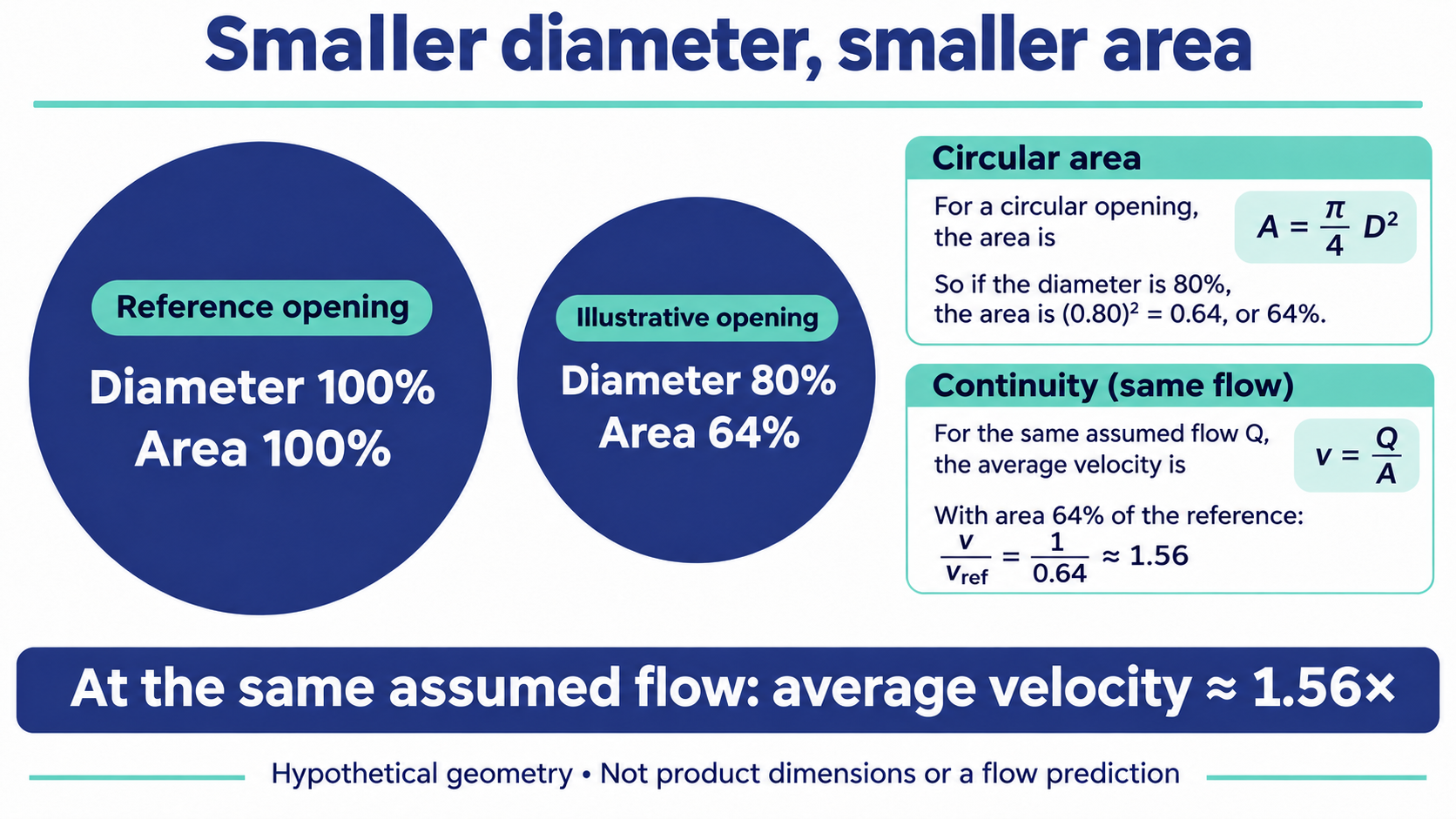
Consider a hypothetical circular passage with a diameter equal to 80% of a reference opening. Its area is 64% of the reference area because area varies with the square of diameter. At an assumed unchanged flow rate, the average velocity is approximately 1.56 times as high. These ratios are arithmetic examples, not dimensions or ratings for a ZeeyiElec product.
The assumption matters: a real circuit may deliver a different flow rate after its resistance changes. The example does not predict pressure loss, noise, erosion or a required pump adjustment. Those conclusions need geometry, fluid properties and operating conditions beyond the diameter ratio.
Flow losses remain even with a generous opening
A fully open valve can still contribute resistance through its internal surfaces, transitions and other passage features. Full port therefore does not mean zero pressure drop. Nor does it mean that two full-port constructions have identical hydraulic behaviour.
Use a full port transformer ball valve description to understand the intended passage category. Use appropriately supported hydraulic information to assess losses at a defined duty. Keeping those purposes separate prevents an attractive geometric label from becoming an unsupported performance guarantee.
AI-generated hypothetical geometry. An 80% diameter gives 64% circular area and approximately 1.56 times average velocity at the same assumed flow; these are not product dimensions or a circuit-flow prediction.
Consider the Complete Oil Circuit Before Predicting an Improvement
Reducing one contribution may leave others dominant
An oil-transfer route may include a tank outlet, valve, adapters, hose, filter and receiving equipment. Each can contribute resistance. Improving the valve passage may have limited effect if another part of that route remains the dominant restriction.
This does not make the valve irrelevant. It means that the likely benefit depends on the original distribution of losses and the complete revised arrangement. A larger valve connected through unchanged restrictive fittings is not enough evidence for a promised transfer-rate increase.
For a proposed full port transformer ball valve upgrade, define the performance question first. Is the concern a specified pressure-loss allowance, transfer duration, or a circuit operating point? Use that question to determine the assessment needed. Avoid choosing a percentage improvement before the supporting analysis exists.
Use a controlled hypothetical comparison
Suppose an engineering team considers replacing a reduced-passage valve in a temporary oil-transfer arrangement. In one hypothetical case, the valve accounts for a substantial part of the assessed resistance. In another, the long hose and filter account for most of it. The same valve change cannot be assumed to produce the same system benefit in both cases.
The appropriate next step is to assess the complete arrangement under consistent assumptions. This is a reasoning example, not a field case or evidence that either configuration achieved a particular result. Coordination with the transformer accessories selection guide keeps the passage decision within the equipment requirements.
AI-generated conceptual transfer route. The generic valve symbol is not a ball-valve construction drawing; changing one component does not remove the other contributions to circuit resistance.
Treat Liquid Conditions and Flow Data as Part of the Claim
Temperature changes the question being answered
Insulating-liquid viscosity depends on the liquid and temperature. The resistance of an oil circuit therefore cannot be evaluated from a bore adjective alone. Identify the specified liquid and the relevant operating conditions, including a cold condition where that condition matters to the intended duty.
A water-based flow coefficient can be useful engineering information, but its use for a different liquid or flow regime needs an appropriate method. Do not apply a generic coefficient as though it directly states transformer oil flow under every temperature condition. Request the assessment basis from the responsible designer or supplier.
Compare the meaning of evidence, not just its number
The following distinctions help keep a full port transformer ball valve enquiry technically clear. None of these descriptions substitutes for all the others.
Statement presented
What it can help establish
What still needs support
Full-port classification with a stated basis
Declared passage category for an identified configuration
Hydraulic losses and application suitability
A documented opening dimension
Geometry of the identified feature
Circuit flow under actual liquid conditions
Flow coefficient with its convention and conditions
A defined representation of valve flow capacity
Applicable method for the proposed oil duty
Assessed circuit operating point
Predicted behaviour for the stated arrangement and assumptions
Applicability after equipment or conditions change
Record whether information comes from testing, calculation or a general catalogue description. Distinguishing those sources makes the remaining uncertainty visible without inventing a universal acceptance limit.
Keep Full-Open Geometry Separate From Operating Permission
A partly open valve presents a different passage
The open ball passage aligns with the flow route at the intended open position. Moving away from that position changes the available opening and the local flow pattern. An open-position bore description cannot characterise every intermediate position.
A full port transformer ball valve should not be assumed suitable for continuous throttling merely because it can be left partly open. Any regulating use needs manufacturer confirmation for the construction and the proposed service. This article supplies no operating sequence or instruction to change a valve position on energised equipment.
Passage evidence does not qualify seals or connections
Full port does not establish seat leakage performance, insulating-liquid compatibility, pressure-temperature capability or suitability for vacuum duty. Those requirements concern different aspects of the valve and need their own supporting information.
Likewise, a bore category does not make a replacement mechanically interchangeable. Use the ball valve connection comparison for the separate interface review. Avoid expanding a passage decision into approval of materials, installation or service conditions that were never assessed.
AI-generated conceptual aperture symbols distinguish a full-open reference from part-open operation; the image does not establish throttling suitability or provide an operating procedure.
Decide What the Bore Claim Changes in the Purchase
Separate a mandatory requirement from an expected benefit
Where the project specification explicitly requires a full port transformer ball valve, retain that requirement and its reference basis. An offer with a different category is a deviation for review, even if it carries attractive general flow claims. A purchasing description should not silently remove an engineering requirement.
Where the project instead specifies a hydraulic duty without mandating a bore category, assess the offered construction against that duty. A reduced-port alternative is not automatically unsuitable, and a full-port alternative is not automatically sufficient. The engineering decision depends on the actual requirements and supporting assessment.
State the conclusion at the level the evidence supports
Useful conclusions include “declared full-port basis clarified,” “hydraulic assessment required,” or “acceptable for the defined duty subject to the remaining service requirements.” Avoid the broader conclusion “better valve” when the review has addressed only passage classification.
Include the accepted configuration and any outstanding technical conditions in the transformer accessories package. This preserves the connection between the bore requirement and its intended purpose. It also prevents an unsupported promise of faster oil handling, improved cooling or reduced maintenance from entering the purchase description.
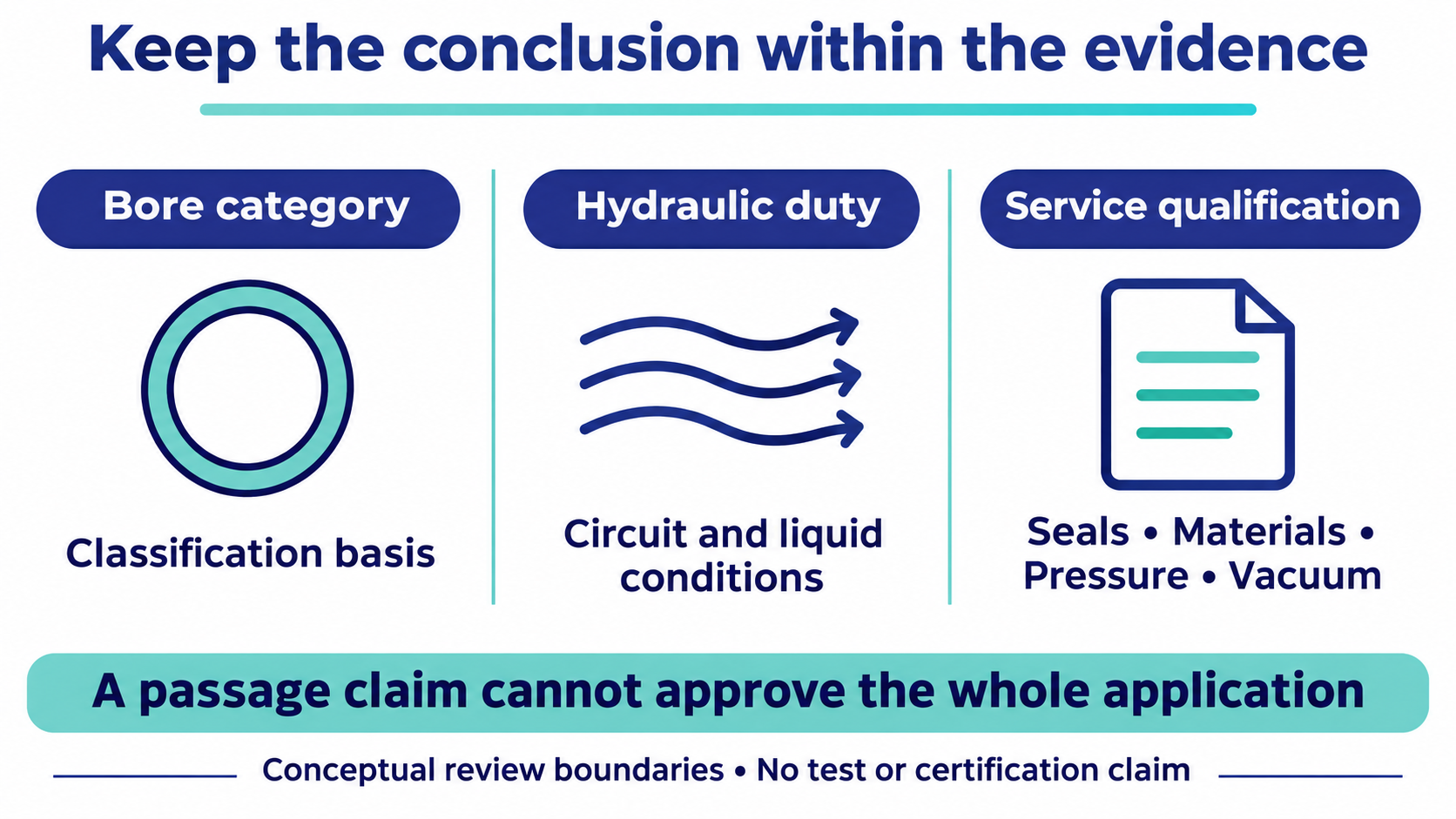
AI-generated conceptual boundaries. Bore classification, hydraulic duty and service qualification need different evidence; the diagram makes no test, certification or application-approval claim.
Frequently Asked Questions
Does full port mean zero pressure drop?
No. A fully open valve still has passage surfaces and transitions that can contribute resistance. Full port describes a bore category; pressure loss needs evidence for the configuration and operating conditions.
Can a full-port label predict how long oil draining will take?
No. Draining depends on the complete arrangement, available driving pressure, liquid conditions and other restrictions. The label alone does not support a transfer-time promise.
Is full flow automatically the same as full bore?
Do not assume equivalence when the description has no stated basis. Ask whether full flow refers to a defined bore category, a flow-data claim or a general catalogue description.
Does the full-port description apply while the valve is partly open?
Do not apply an open-position bore classification to an intermediate position. The opening changes with position, and continuous regulating service requires confirmation for the particular construction and duty.
Will changing only the valve remove a filter-circuit restriction?
It may reduce one contribution to resistance, but it does not remove losses in the filter, hose or other components. Assess the complete revised arrangement before predicting a system improvement.
Does full port establish vacuum-filling suitability?
No. Vacuum duty requires separate confirmation for the complete valve construction, seals and specified service conditions. A passage category does not qualify those features.
yoyo shi
Yoyo Shi writes for ZeeyiElec, focusing on medium-voltage accessories, transformer components, and cable accessory solutions. Her articles cover product applications, technical basics, and sourcing insights for global electrical industry buyers.








 English
 한국어
 العربية
 Español
 हिन्दी
 தமிழ்
 Deutsch (Sie)
 Français
 Português do Brasil
 Русский