Shipping transformer accessories or cable accessories across international borders involves more than booking freight and packing products. The documentation package traveling with your order determines whether goods clear customs smoothly, whether your Letter of Credit gets paid, and whether your project stays on schedule.
A missing test certificate can hold a container at port for weeks. A commercial invoice that doesn’t match L/C terms triggers bank rejection. A wrong HS code classification leads to unexpected duty payments or customs investigations.
This guide provides a complete documentation checklist for electrical accessory exports—covering commercial paperwork, technical compliance certificates, shipping documents, banking requirements, and country-specific variations. Whether you’re ordering transformer accessories for a substation project or cable accessories for a distribution network upgrade, this checklist helps you verify that every required document is prepared correctly before shipment.
Export documentation errors cost real money. In our experience processing electrical accessory shipments to markets across Southeast Asia, Europe, and the Americas, approximately 23% of delivery delays stem from incomplete or incorrectly prepared documentation packages. Average port hold times extend 5–8 business days per incident—enough to derail tight project schedules.
The consequences cascade quickly. Demurrage charges accumulate at $150–300 per container per day at major ports. Storage fees add another layer of cost. Meanwhile, your substation commissioning date slips, and penalty clauses in your project contract start looking very real.
Letter of Credit rejections create a different kind of pain. Banks scrutinize every character on every document. A product description reading “cable termination kit” when the L/C specifies “cable termination assembly” triggers rejection. The shipment sits at origin while you scramble to amend documents, re-present to the bank, and hope your supplier hasn’t already allocated your goods elsewhere.
HS code misclassification introduces customs risk that can follow your company for years. Underpayment of duties—even unintentional—may result in audits, back-payments, and penalties. One importer of medium-voltage accessories faced a $45,000 duty reassessment after customs determined their cold shrink terminations belonged under HS 8547.90 rather than the declared 8546.20.
Mandatory Export Documents for Electrical Accessory Shipments
The mandatory document set for electrical accessories typically comprises five to eight core certificates depending on destination country requirements. Getting these right forms the foundation of successful export operations.
Commercial Invoice Specifications
Commercial invoices must specify product classifications using Harmonized System (HS) codes. Electrical accessories generally fall under HS Chapter 85 (electrical machinery) or Chapter 39 (plastic insulation materials). Accurate HS code assignment directly impacts duty rates, which range from 0% to 12% depending on product category and trade agreements.
Required fields include: complete buyer and seller details, Incoterms 2020 reference (FOB, CIF, DDP, etc.), itemized unit prices, extended totals, and currency denomination. For L/C shipments, every detail must match the credit terms exactly—no exceptions.
Packing List Requirements
Packing lists detail every package’s contents, dimensions, and weights. Each entry should reference specific product codes matching the commercial invoice. Include net weight (product only) and gross weight (including packaging) in kilograms, individual carton dimensions in mm × mm × mm format, and total piece counts for accessories like bushings, fuses, or termination kits.
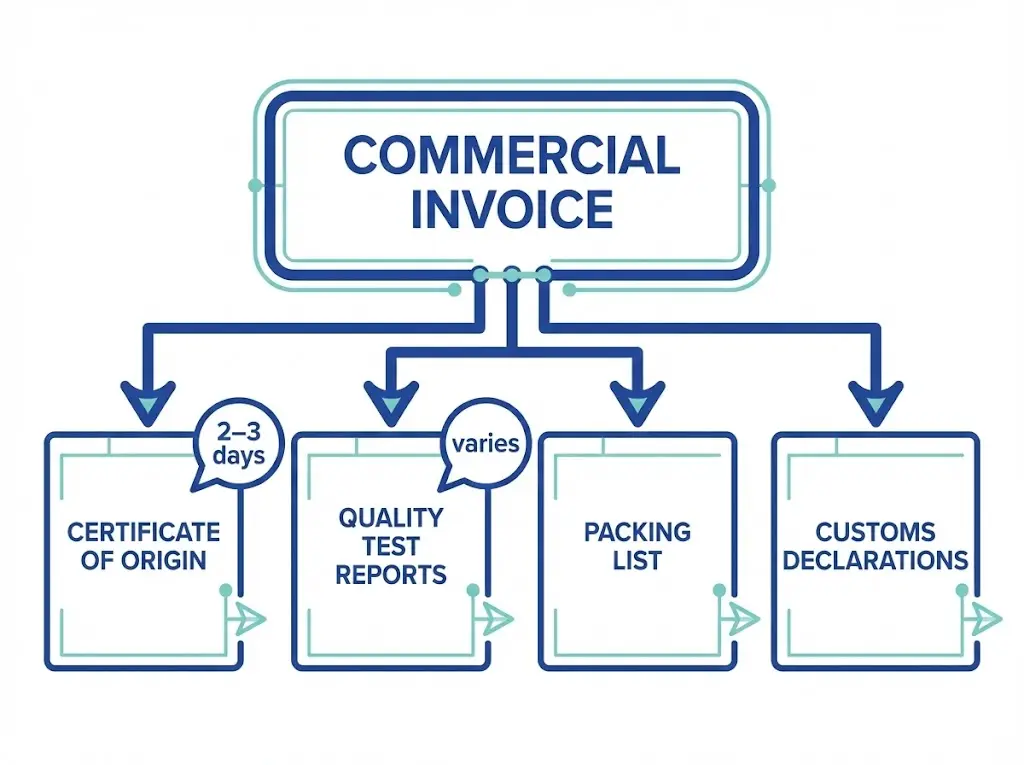
Figure 1. Documentation hierarchy for electrical accessory exports with commercial invoice as the primary reference document feeding certificate of origin, test reports, and shipping paperwork.
Certificate of Origin Variations
Certificates of Origin (CO) verify manufacturing location and enable preferential tariff treatment under agreements such as RCEP or bilateral trade pacts. According to World Customs Organization guidelines, COs must indicate the percentage of local content—typically requiring minimum 40% regional value content for preferential status.
Non-preferential COs are Chamber of Commerce issued and take 2–3 business days to process. Preferential forms such as Form A for GSP beneficiaries require additional manufacturing documentation to substantiate origin claims.
Request draft commercial invoice from your supplier at order confirmation—not at shipment
Cross-check product descriptions against your L/C before supplier prints final documents
Maintain a master product description library to ensure consistency across orders
Budget 5–7 business days for CO processing when legalization is required
Technical Test Documents for Transformer and Cable Accessories
Technical documentation demonstrates that your electrical accessories meet performance standards. These certificates carry weight with customs authorities, project engineers, and end-users alike.
Type Test vs. Routine Test Reports
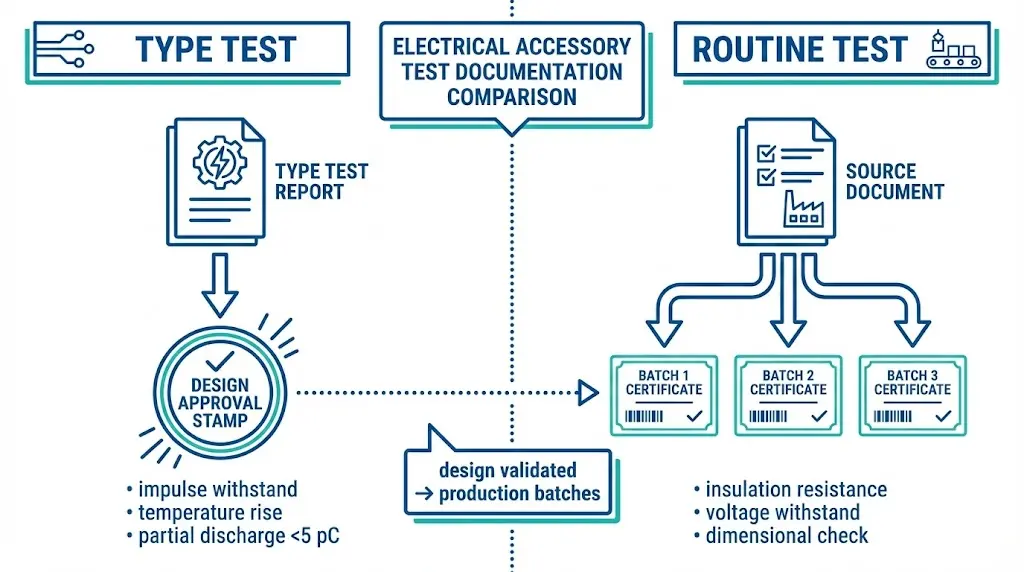
Type test reports verify a product design meets performance standards through comprehensive one-time testing. For transformer bushings, type tests cover impulse withstand voltage, power frequency withstand, and temperature rise under rated current. Cable termination type tests address partial discharge levels (typically <5 pC at 1.5 U₀), AC withstand at 3.5 U₀ for 5 minutes, and lightning impulse performance.
Routine test certificates confirm each production batch passes essential quality checks. These tests—insulation resistance, voltage withstand, dimensional verification—occur on every unit or representative samples from each lot. Buyers should expect routine test certificates with every shipment; type test reports are typically provided once per product design or upon request.
Figure 2. Type test vs. routine test certificate relationship—type tests validate product design once, while routine tests verify each production batch meets specifications.
Material Certifications and Compliance Declarations
For EU destinations, RoHS compliance declarations confirm products meet Directive 2011/65/EU restrictions on hazardous substances. This is typically a manufacturer’s self-declaration rather than third-party certification. REACH compliance addresses chemical substance registration requirements.
Material certificates for metallic components trace copper conductor purity (typically 99.9% for electrical applications) and aluminum alloy grades. These become particularly important for cold shrink cable accessories where conductor compatibility affects long-term performance.
IEC and IEEE Compliance Statements
Manufacturer’s declarations of conformity reference applicable standards: IEC 60137 for bushings, IEC 60282-1 for high-voltage fuses, IEC 60502-4 for cable accessories. [VERIFY STANDARD: Specific clause references for cable accessory partial discharge requirements]
Third-party lab certifications carry additional authority in regulated markets. CE marking with supporting documentation per Low Voltage Directive 2014/35/EU is mandatory for European destinations. North American shipments typically require UL or CSA recognition documentation.
Freight and Shipping Documentation Requirements
Freight documentation forms the operational backbone of successful electrical accessory exports. Incomplete freight paperwork causes 35–40% of port delays, making this category critical for on-time delivery.
Bill of Lading Essentials
The Bill of Lading (B/L) functions simultaneously as a receipt of goods, evidence of the carriage contract, and document of title. For electrical accessories, the B/L must specify accurate gross weight (verified within ±0.5 kg tolerance) and precise package counts.
Ocean freight shipments require clean B/Ls—those free from carrier notations indicating damage or quantity discrepancies—to satisfy letter of credit requirements under UCP 600 banking standards. Air shipments use Airway Bills (AWB), which are non-negotiable and don’t transfer title.
HS Code Classification for Electrical Accessories
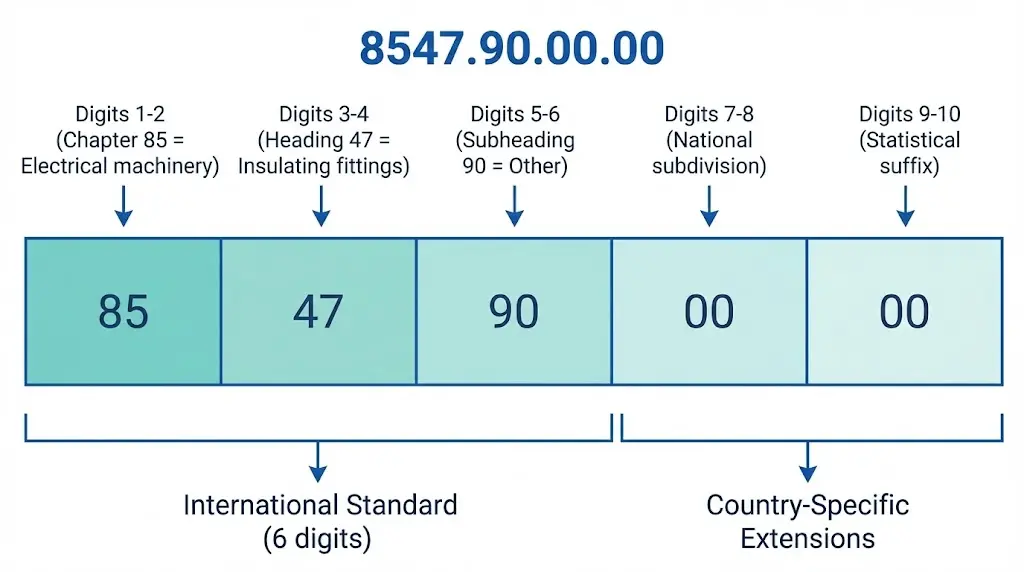
HS codes follow a hierarchical structure: first 6 digits are internationally standardized, while digits 7–10 are country-specific. Electrical accessory classifications commonly include:
Product Category
HS Code Range
Description
Transformer parts
8504.90
Parts of transformers, inductors
Insulating fittings (plastic)
8547.20
Insulating fittings of plastics
Insulators (ceramic)
8546.20
Ceramic insulators
Cable terminations
8547.90
Other insulating fittings
Electrical connectors
8536.90
Other apparatus for connections
Figure 3. Harmonized System code structure for electrical accessories—first six digits are internationally standardized, while digits 7–10 vary by destination country tariff schedule.
Misclassification creates serious risk. Shipments must match HS codes declared on commercial invoice, packing list, and B/L. Inconsistencies trigger customs examinations.
Insurance and Special Handling
Insurance certificates covering CIF terms should specify coverage at 110% of invoice amount—the industry standard for international electrical component trade. Most electrical accessories ship as non-hazardous general cargo. However, products containing lithium batteries or certain insulating compounds require dangerous goods declarations per IMDG Code regulations.
Banking and Payment Document Alignment
L/C transactions demand document perfection. Banks don’t evaluate product quality or delivery performance—they verify documents against credit terms. Period.
Letter of Credit Compliance
Every document in your presentation package must align with L/C requirements:
Product descriptions: exact wording, no paraphrasing
Values: invoice amount within L/C tolerance (typically ±5% or ±10%)
Quantities: as specified or within permitted tolerance
Shipment dates: on or before latest date
Documents: exact titles as listed in L/C
Common rejection causes include: beneficiary name misspellings, port names not matching exactly, late shipment dates documented on B/L, and insurance coverage amounts below L/C minimums.
Pre-Shipment Inspection Requirements
Certain countries mandate Pre-Shipment Inspection (PSI) for imports above threshold values. PSI programs exist in Nigeria (SONCAP), Saudi Arabia (SABER), Kenya (PVOC), and numerous other markets.
Inspections cover quantity verification, quality assessment, and price comparison against international benchmarks. Schedule PSI when production reaches 70–80% completion—inspectors need finished goods to examine but you need time to address any findings before shipment.
[Expert Insight: L/C Document Success]
Review L/C terms within 24 hours of receipt—request amendments immediately if terms are unworkable
Create a document checklist from L/C clause 46A (Documents Required) before production completes
Present documents to negotiating bank within 7 days of shipment for maximum amendment time if discrepancies arise
Keep copies of successful presentations as templates for repeat orders
Country-Specific Import Requirements
Documentation requirements vary significantly by destination. What works for European shipments may fail completely in Middle Eastern or African markets.
Import Licensing
Some countries require import licenses for electrical equipment above certain voltage ratings or value thresholds. These are buyer responsibilities, but shipments cannot clear without them. Request license copies from your buyer before shipment and include license reference numbers on commercial invoices.
Legalization and Apostille
Select markets require document legalization through embassy consular services. The process involves: (1) notarization in origin country, (2) authentication by foreign affairs ministry, and (3) legalization at destination country embassy. Budget 2–3 weeks for legalization processes.
Countries party to the Hague Apostille Convention accept simplified apostille certification instead of full legalization. Verify your destination country’s requirements through the International Chamber of Commerce trade resources or destination customs authority.
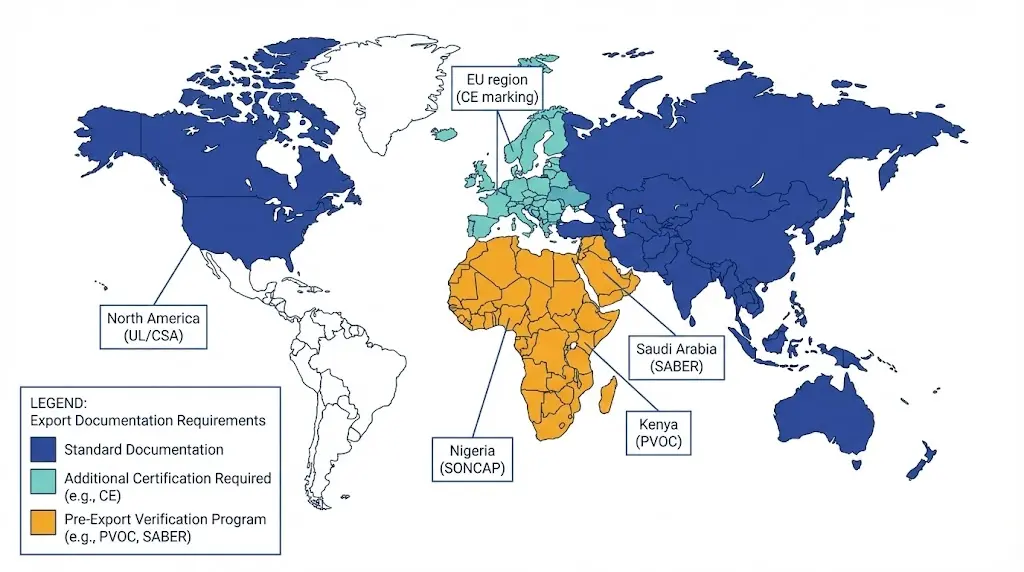
Figure 4. Global documentation complexity map—regions highlighted in amber require pre-export verification programs (SONCAP, SABER, PVOC), while teal regions require additional product certifications beyond standard commercial documents.
Product Registration Schemes
Pre-export verification programs add certification layers. SONCAP (Nigeria) requires product certificates and shipment certificates. SABER (Saudi Arabia) demands product registration in the SABER platform before shipment. PVOC (Kenya and other East African nations) mandates inspection and certification.
Allow 2–4 weeks for initial product registration in these programs. Subsequent shipments of registered products proceed faster.
Master Documentation Checklist for Export Orders
Use this comprehensive checklist to verify documentation completeness before shipment:
Category
Document
When Required
Key Actions
Commercial
Commercial Invoice
All orders
Verify HS codes, Incoterms, L/C match
Packing List
All orders
Confirm weights, piece counts, dimensions
Certificate of Origin
Most orders
Submit to chamber 5+ days before shipment
Technical
Type Test Report
Project orders
Request from manufacturer at order confirmation
Routine Test Certificate
All product orders
Receive before shipment, verify batch numbers
RoHS/REACH Declaration
EU destinations
Obtain manufacturer’s compliance statement
Declaration of Conformity
When specified
Verify standard references match destination requirements
Shipping
Bill of Lading / AWB
All shipments
Verify consignee matches L/C exactly
Insurance Certificate
CIF/CIP terms
Confirm 110% coverage, beneficiary correct
Dangerous Goods Declaration
If applicable
Complete IMDG/IATA documentation
Banking
L/C Compliant Document Set
L/C payments
Cross-check every field against credit terms
PSI Certificate
Select countries
Schedule inspection at 70–80% production
Country-Specific
Import License
Where required
Obtain copy from buyer before shipment
Legalized Documents
Select markets
Begin process 3+ weeks before shipment
Product Registration
SONCAP/SABER/PVOC
Register products before first shipment
Partner with ZeeyiElec for Complete Export Documentation Support
Documentation complexity shouldn’t slow down your electrical infrastructure projects. At ZeeyiElec, we’ve processed thousands of transformer accessories and cable accessories shipments to markets across the Americas, Europe, Middle East, Africa, and Asia-Pacific.
Our standard documentation package includes commercial invoices, packing lists, certificates of origin, and routine test certificates with every order. For project-specific requirements, our export documentation team coordinates type test reports, third-party certifications, and country-specific compliance documents.
Contact our team to discuss your project requirements and receive a quotation that includes complete export documentation support.
Frequently Asked Questions
Q: What documents are absolutely required for every electrical accessory export shipment? A: Commercial invoice, packing list, and bill of lading (or airway bill) form the minimum document set for any international shipment, though most destinations also require certificates of origin and product test documentation.
Q: How do I determine the correct HS code for transformer bushings or cable terminations? A: Transformer bushings typically classify under HS 8535.90 or 8504.90 depending on voltage rating, while cable terminations generally fall under 8547.90—consult your customs broker with detailed product specifications for definitive classification.
Q: What causes Letter of Credit document rejections most frequently? A: Description mismatches between L/C terms and shipping documents cause the majority of rejections, followed by late shipment dates, incorrect beneficiary details, and insurance coverage amounts below specified minimums.
Q: How far in advance should we prepare export documentation? A: Begin commercial and technical documentation 2–3 weeks before planned shipment; add 3–4 additional weeks if destination requires document legalization or pre-shipment inspection programs.
Q: Do all countries require pre-shipment inspection for electrical accessories? A: No—PSI requirements exist primarily in select African nations (Nigeria, Kenya, Tanzania), some Middle Eastern markets (Saudi Arabia, Kuwait), and parts of South Asia; verify current requirements with your buyer or destination customs authority.
Q: What happens if HS codes on different documents don’t match? A: Customs authorities will flag inconsistencies for examination, potentially delaying clearance by 5–10 days while discrepancies are resolved—ensure HS codes align across commercial invoice, packing list, bill of lading, and certificate of origin.
Q: Can test certificates from the manufacturer be used, or is third-party certification required? A: Manufacturer test certificates are acceptable for most markets and applications; third-party lab certification becomes necessary for CE marking in Europe, UL/CSA recognition in North America, or when specified in project tender requirements.
yoyo shi
Yoyo Shi writes for ZeeyiElec, focusing on medium-voltage accessories, transformer components, and cable accessory solutions. Her articles cover product applications, technical basics, and sourcing insights for global electrical industry buyers.



 English
 한국어
한국어 العربية
 Español
 हिन्दी
 தமிழ்
தமிழ் Deutsch (Sie)
 Français
 Português do Brasil
 Русский