A cold shrink rework decision should identify the affected function, the condition of the cable and the recovery method permitted for the exact accessory. A surface repair, a replacement accessory and a rebuilt cable end solve different problems. Neither a small visible defect nor an available spare determines which route is acceptable.
This guide concerns medium-voltage cable accessories after a component is damaged, incorrectly positioned or found unsuitable. It is a disposition review for authorised personnel working on an isolated, made-safe installation, not a removal or live-work procedure. The practical question is what can be restored and verified without carrying an unresolved defect into the next assembly.
Identify the affected function before choosing a remedy
Describe the defect without diagnosing from appearance
Replace “the joint is scratched” with an observation that identifies the component, location and condition: a mark on an outer protective covering, a split in a recovered body, an uncertain interface position or damaged cable insulation. Record what can actually be seen and what remains concealed. A photograph of the exterior does not establish the condition of every internal interface.
The cold shrink product family includes different termination and joint arrangements. Similar-looking sleeves may perform different duties. Establish the exact kit reference and instruction revision before treating one component as a substitute for another.
Separate protection, sealing and electrical duties
Outer protection, environmental sealing, insulation and stress control are distinct functions even where a design integrates several into one body. A method intended to restore an outer covering cannot automatically restore an electrical stress-control interface. Conversely, an issue confined to an approved replaceable protective component does not by itself prove that every part of the installation must be discarded.
For cold shrink rework, the first useful boundary is the affected function, not the apparent size of the blemish. If that boundary cannot be established, retain the uncertainty in the disposition rather than labelling the damage cosmetic.
Original local product image showing cold shrink bodies on support cores and a separate demonstration section. Product identification only; not a failed joint or an approved bill of materials.
Check whether an approved repair route actually exists
A repair needs a defined scope
The existence of tape, mastic or a spare sleeve on site is not a repair specification. A usable instruction identifies the applicable product, permitted defect, required materials, preparation conditions and completion checks. A general catalogue description or an instruction for another accessory does not establish those limits.
Ask whether the proposed cold shrink rework method addresses the affected function and whether the actual condition falls within its scope. Where no applicable method is available, keep the item on hold while the responsible technical authority determines the next route. Do not convert a convenient material choice into an assumed repair approval.
Recovery and re-entry are product-specific
A conventional pre-expanded body is supplied on a removable support core. Removing that core allows the body to recover onto its intended interface; the installation sequence does not establish a method for expanding it again. Do not assume that pulling, rotating or repositioning a recovered body recreates the specified installation condition.
Some purpose-designed assemblies have disconnectable or re-enterable interfaces. That feature belongs to the particular design and instructions. Permission to open a separable connection is not permission to reuse every recovered sleeve or consumable around it. Identify exactly which parts the procedure permits retaining and which require renewal.
Engineering review point: A repeatable installation method and a permitted re-entry method are different documents. Confirm which one covers the proposed work before choosing a route.
AI-generated conceptual function map. Functions are shown separately; actual construction may integrate them. A surface intervention does not establish restoration of an electrical interface.
Establish whether replacement can stop at the accessory
Review the cable interface after removal
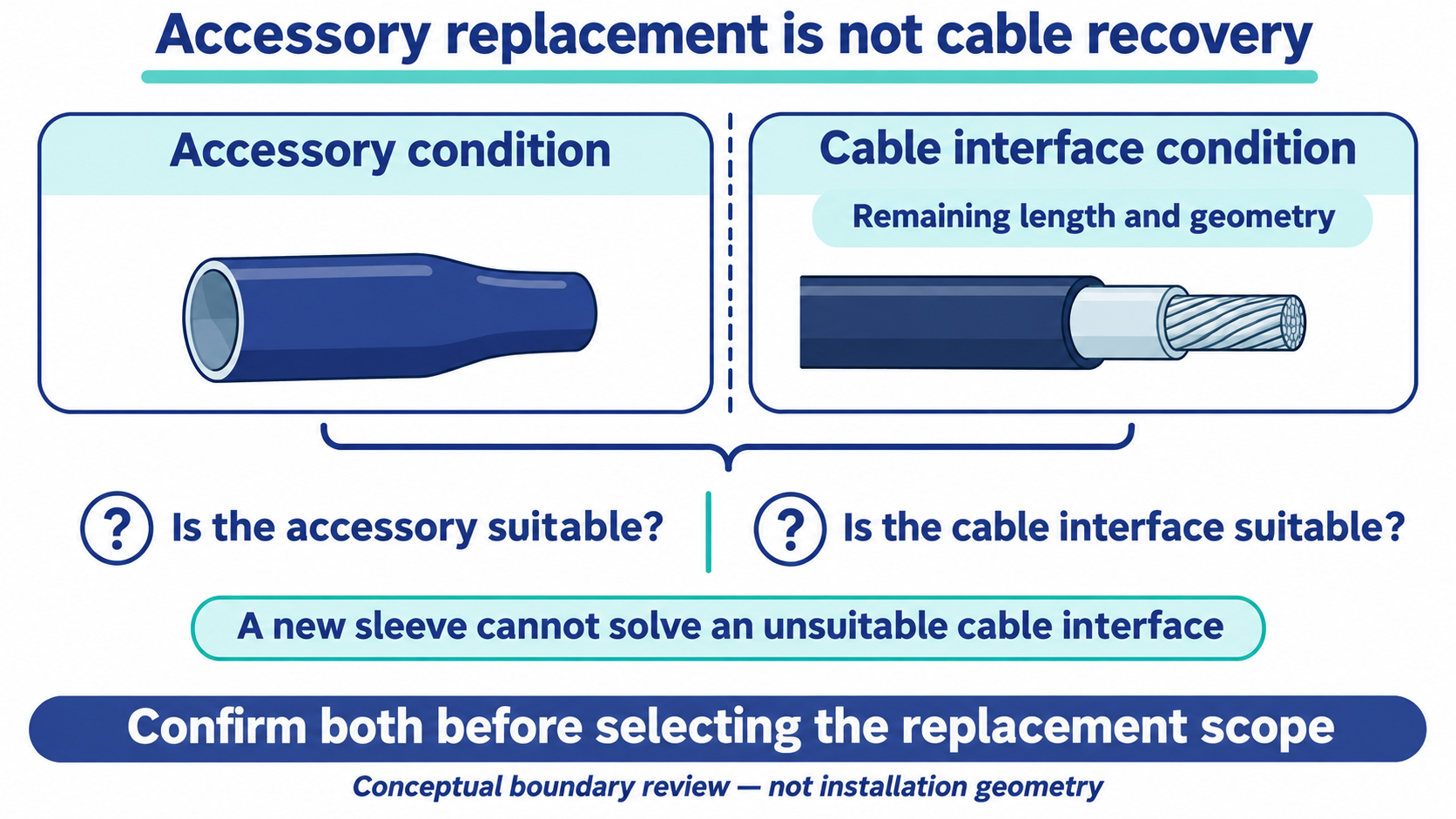
Accessory replacement and cable recovery are separate decisions. A replacement body cannot correct cable insulation damage, unsuitable preparation geometry or an unresolved contamination condition beneath it. The removal process also has its own risks to the cable; use the applicable product procedure rather than treating removal as an unregulated preliminary step.
The cold shrink rework boundary may therefore expand after access is gained. An initial plan to replace a sleeve can become a cable-end recovery review if the underlying interface is unsuitable. Preserve this possibility in the outage and material plan instead of promising an accessory-only replacement before the cable can be assessed.
Check the geometry of the proposed new arrangement
If cable cutback or a new connector is proposed, confirm the resulting preparation geometry, available cable length and connection arrangement. Record dimensions from the actual assembly and the relevant drawing datums. Insulation diameter, connector envelope and cable construction must fit the replacement system; a matching conductor cross-section alone is insufficient.
There is no universal cutback length that makes every damaged cable end reusable. A short remaining length, changed conductor position or restricted connection space may prevent the original arrangement from being recreated. Escalate that constraint before ordering a nominally identical kit.
Where the cable meets transformer accessories, identify the connected equipment interface as part of the boundary. Rebuilding the cable end must not silently change the required connection position or equipment arrangement.
AI-generated conceptual review boundaries. Accessory condition and cable interface suitability need separate assessment; this is not installation geometry or an acceptance result.
Use tests to answer their defined questions
A test result is evidence with a boundary
A satisfactory result does not demonstrate that every proposed repair material, interface position or reused component is acceptable. Identify what the specified test assesses, under what conditions, and what it leaves unresolved. For example, missing product identity or an unapproved substitution is not resolved merely by obtaining a reading.
IEC 60502-4:2023 specifies type-test requirements for defined medium-voltage accessory configurations. Its product qualification scope should not be treated as automatic approval for an improvised field modification. A proposed change still needs an applicable technical basis and the project’s required verification.
Close the cause as well as the replacement work
If an earlier problem arose from incorrect selection, preparation or positioning, fitting another body without correcting that condition can repeat the problem. Keep the confirmed cause separate from an initial suspicion, and identify what changes in the revised work.
Use the project’s installation quality-control checkpoints to organise the required checks. For a cold shrink rework decision, distinguish completion of the replacement activity from evidence that the specified installation requirements have been restored. Neither a new kit nor a test report should leave a known exception hidden in the release record.
Compare the feasible routes before committing the outage
Work through conditional examples
The following are hypothetical review situations, not reported ZeeyiElec failures or approved repair instructions. Each shows why a cold shrink rework choice depends on more than whether a component can physically be removed.
Observed situation
Question that controls the route
Decision consequence
A mark appears limited to an outer protective component
Is that function and defect covered by an applicable repair or component-renewal method?
A limited intervention can be considered only within that documented scope.
A recovered body is incorrectly positioned
Does the exact design permit correction or re-entry in its present condition?
Do not assume that sliding the body back restores the intended interface.
Cable preparation is damaged beneath the accessory
Can an approved cable recovery produce suitable geometry and remaining length?
Replacing only the accessory leaves the cable issue unresolved.
The kit reference cannot be established
Can identity and compatibility be confirmed before work proceeds?
Keep the assembly on hold rather than guessing from appearance.
Compare complete recovery packages
Compare the work required for each technically feasible route: access and removal, cable assessment, replacement materials, specialist personnel, required tests and release responsibilities. A cheaper sleeve does not make a route feasible if suitable cable geometry cannot be recovered. An immediately available kit can also be the wrong configuration.
Retain the removed material and relevant observations as the investigation requires, with traceable identification. Procurement can then distinguish a confirmed replacement requirement from a contingency. This prevents the outage plan from relying on a repair option that no responsible party has actually accepted.
AI-generated hypothetical review situations distinguish repair applicability, permitted correction and cable recovery feasibility. They are not reported failures or repair instructions.
Request a decision for the exact configuration
Ask a bounded technical question
Send the kit and cable identities, installation stage, affected component or function, relevant dimensions, photographs and applicable instruction revision. State the proposed route and the unresolved point: limited repair, component renewal, complete accessory replacement or cable-end recovery. Request the method, conditions and verification required for that specific proposal.
For cold shrink rework enquiries, ZeeyiElec can review the supplied product and cable information to support configuration matching. Use the cable accessory selection guide to organise the starting information. Product matching support is not a substitute for the responsible site authority’s approval of a field intervention.
Keep technical disposition and release distinct
Record who accepts the technical route and who authorises return to service under the project procedure. If a reply covers only supply of a replacement kit, do not interpret it as approval of cable condition, removal work or an exception to installation requirements.
Engineering review point: A useful decision names the retained boundary, the replacement boundary and the conditions that must be satisfied before release. “Repair agreed” leaves too much unresolved.
Frequently Asked Questions
Does a disconnectable joint permit reuse of every sleeve?
No. Identify which interface is designed for re-entry and which components its instructions require renewing. A disconnectable connection does not establish permission to re-expand or reinstall every recovered sleeve around it.
Can a repair instruction for a similar-looking product be used?
Do not transfer a repair method solely on appearance. Confirm the exact accessory, affected function, permitted defect and specified materials; an instruction for another construction may not cover the proposed intervention.
Can a spare from another kit revision be used for cold shrink rework?
Only after the component relationship and substitution have been confirmed for the proposed work. A familiar part name or nominal voltage does not demonstrate that a spare from another kit revision is compatible.
Must a replacement preserve the original connector envelope?
Preserve the specified arrangement or obtain an approved revised one. A different connector envelope can affect preparation dimensions and available assembly space, so check the complete cable-and-accessory configuration rather than the voltage label alone.
Does replacing an accessory always require cable cutback?
Not as a universal rule. The applicable removal method and the assessed cable condition determine whether cable recovery is needed and feasible; do not adopt a fixed cutback length from an unrelated product or job.
Does a supply quotation approve the proposed removal work?
No. A quotation confirms a supply proposal within its stated scope; it does not automatically assess the installed cable or authorise removal and re-entry. Obtain the applicable technical method and project acceptance separately.
yoyo shi
Yoyo Shi writes for ZeeyiElec, focusing on medium-voltage accessories, transformer components, and cable accessory solutions. Her articles cover product applications, technical basics, and sourcing insights for global electrical industry buyers.







 English
 한국어
 العربية
 Español
 हिन्दी
 தமிழ்
 Deutsch (Sie)
 Français
 Português do Brasil
 Русский