Cold shrink joint inspection should connect the installed joint to its approved kit, cable details, installation records and specified tests. A finished outer surface cannot confirm concealed preparation or connection work. Build a traceable evidence pack, record unresolved questions, and obtain the responsible review before treating a completed joint as accepted.
This article focuses on evidence review and handover for cold shrink cable joints. It does not prescribe cable preparation dimensions, test settings or energization steps. Start with the cable accessories selection framework when the accessory scope is still uncertain; acceptance review begins after the intended assembly and governing documents are identified.
Define the Cold Shrink Joint Inspection Scope
Separate completion from acceptance
A completed assembly, a witnessed inspection and an accepted handover are different states. Completion describes the work reported by the installer. Inspection records what was examined against stated requirements. Acceptance is the disposition made by the person or organization authorized under the project arrangements. A checklist should preserve those distinctions rather than hide them behind one tick.
Define the joint location, circuit reference, cable identifiers and kit reference before collecting evidence. The same project may contain different cable constructions and accessory variants. Records that identify only the project name cannot reliably show which assembly was reviewed or whether an instruction applied to that assembly.
Establish the governing references
For cold shrink joint inspection, use the applicable kit instructions, accepted cable information and project inspection and test plan. Record their revisions. A hold point is a specified stage that cannot proceed without the required release; a witness point provides a defined opportunity to observe. Their actual conditions come from the project plan, not from this article.
The official public description of IEC 60502-4:2023 concerns accessory type-test requirements. A design-level type-test reference does not establish that a particular installed joint has met its project acceptance requirements. Keep design qualification evidence separate from the records for the actual joint and its specified site tests.
Link Kit Identity to the Installed Assembly
Reconcile the records before judging appearance
Check that the recorded kit designation corresponds to the intended joint type and cable construction. Retain relevant batch or traceability information where provided. Connect the cable data, approved accessory selection and installation instruction in one record. The earlier cable accessory enquiry checklist identifies information to carry forward from procurement. If identifiers disagree, assign a clarification rather than choosing whichever label seems most familiar.
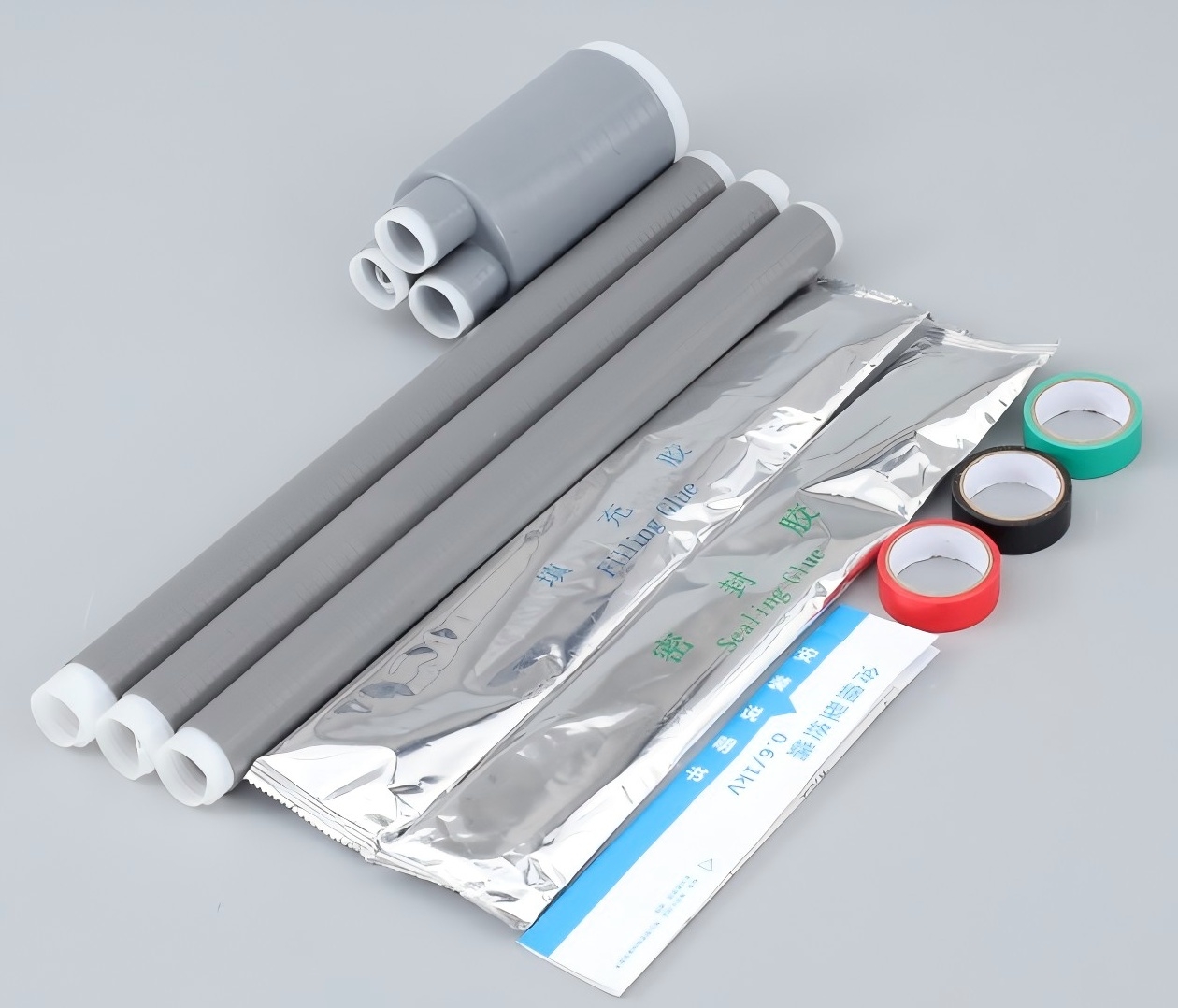
The cold shrink accessory family includes different applications. An assortment photograph can help identify components but cannot confirm the exact contents, ratings or suitability of an offered joint kit. A termination kit and a joint kit must not be treated as interchangeable because both contain similar-looking sleeves or sealing materials.
Original local product-component photograph, reproduced without AI alteration. This assortment is recognition context only; it is not the bill of materials, rating evidence or acceptance record for a cold shrink joint.
Preserve an index rather than a loose folder
A useful cold shrink joint inspection pack links each record to the joint identifier and relevant stage. Include the document reference, record date, responsible person and file location. An index lets a reviewer distinguish missing evidence from evidence that exists but has been filed under a different location or contractor reference.
Avoid rewriting an uncertain identifier to make two documents appear consistent. Record the discrepancy and retain the original. Corrections should identify their source and remain traceable. That approach protects the review from an apparently complete pack assembled from records belonging to different joints.
Preserve Evidence Before Work Becomes Concealed
Match each record to the stage it can demonstrate
Once internal work is covered, the final outer view cannot directly show the earlier condition. The inspection plan should therefore identify which records need to exist before concealment. Depending on the applicable instructions and project requirements, these may concern cable preparation, the conductor connection, component positioning, screen continuity arrangements or sealing details.
This is an evidence-planning issue, not permission to expose or dismantle a completed joint. Qualified personnel must follow the approved work arrangements. Where a required stage was not witnessed or recorded, the reviewer should identify the gap and use the agreed technical disposition route rather than create a retrospective observation.
Make photographs interpretable
For cold shrink joint inspection, a photograph is stronger when its location, stage and subject are identified. A close view can show a specific detail, while a contextual view links that detail to the joint. Record the relevant instruction or inspection item so the reviewer understands the question the image was intended to answer.
A picture without scale or a defined reference should not be used to certify a dimension. Likewise, a final surface image cannot prove the condition of a concealed interface. The broader MV accessory installation QC checklist addresses workmanship checkpoints; this evidence pack links the resulting records to the particular joint under review.
AI-generated conceptual record sequence. No actual installation, witnessed stage or completed inspection is represented.
Review Visible Condition Within Its Limits
Record the observation and its reference separately
A cold shrink joint inspection record should state what was observed, which requirement was used and what conclusion the observation supports. Review accessible exterior condition, component identification and the documented assembly arrangement against the applicable instructions. Avoid replacing a specific observation with broad wording such as “installation good.”
Record the location and nature of an apparent irregularity without diagnosing its cause from appearance alone. A visible mark, unexpected position or incomplete identification may require clarification. A photograph can support that query, but the responsible reviewer needs the relevant requirement before deciding whether it is acceptable or requires further action.
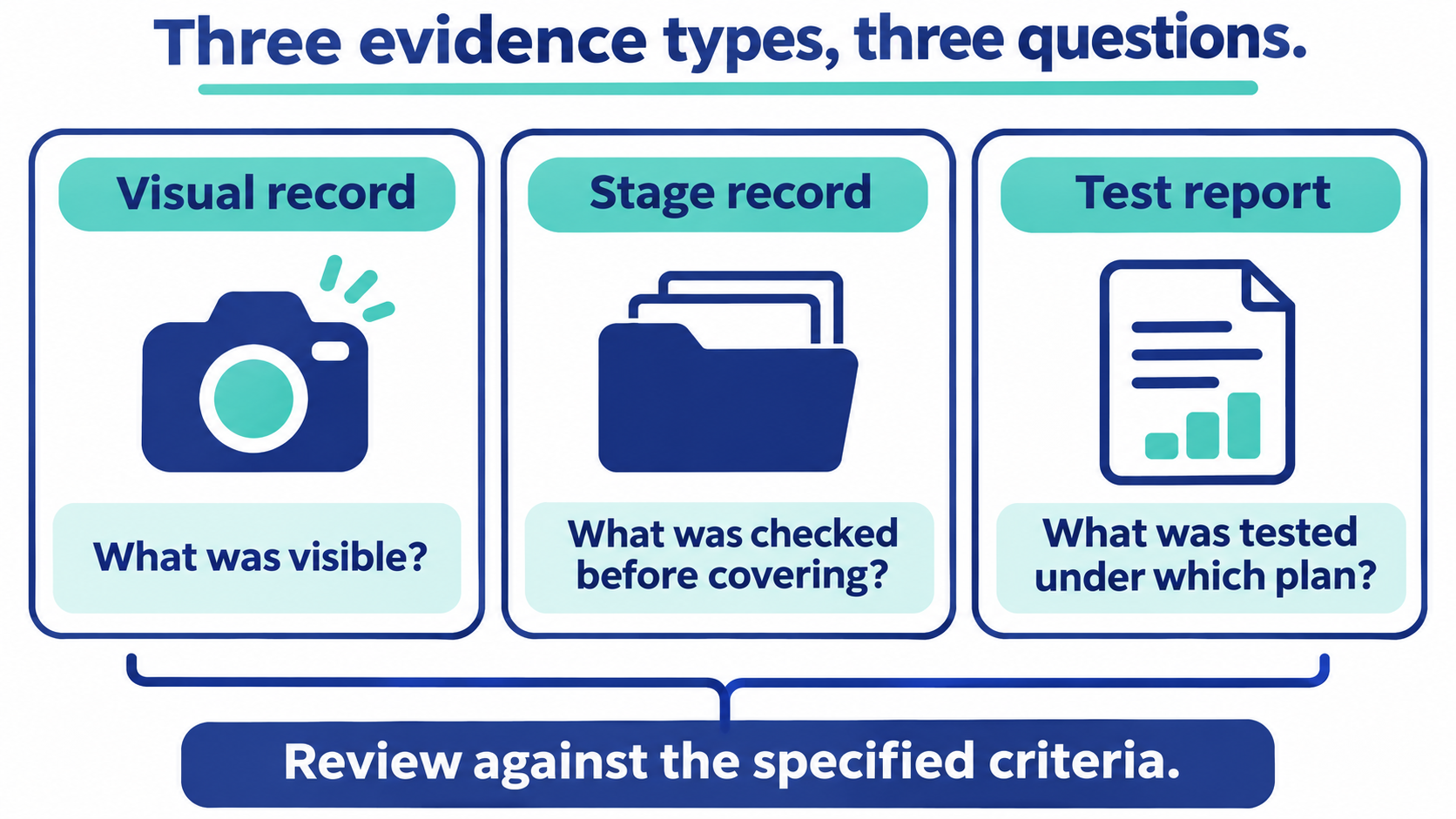
Keep evidence types distinct
Use the following matrix as an empty review template. It does not supply acceptance limits or imply that every listed record is mandatory for every project. The inspection plan and equipment-specific requirements determine the necessary evidence and who can close each item.
Review question
Evidence to link
Limit of the conclusion
Is this the specified assembly?
Kit identity, cable data and instruction revision
Appearance does not establish selection compatibility
Was concealed work checked?
Applicable stage and witness records
A final photograph cannot recreate an earlier observation
What exterior condition was observed?
Located photographs and inspection notes
Visible condition does not prove every internal interface
Were the specified tests completed?
Identified reports and governing test plan
A result applies to its stated method and scope
Who resolved an exception?
Issue reference and authorized disposition
Filing an issue does not mean it was accepted
AI-generated comparison of evidence types. Icons and report graphics are illustrative; no measurements or successful tests are claimed.
Reconcile Test Reports Without Inventing Criteria
Check scope before reading the outcome
When reviewing cold shrink joint inspection evidence, first confirm that a test report identifies the relevant circuit or assembly and the approved test basis. Check the stated method, date, responsible organization and applicable equipment identification or calibration references required by the plan. A report headed with the project name alone may leave the actual tested scope unclear.
Do not import a voltage, duration or numerical limit from a generic checklist. Site testing requirements depend on the cable system, accessory, project specification and applicable procedures. This article provides no universal settings. The responsible technical personnel must establish and assess the appropriate test program within their authorization.
Treat a test result as one part of the pack
A recorded result cannot retroactively prove that every concealed installation step followed its instruction. Conversely, a complete photographic record does not replace specified electrical testing. Read the evidence together and retain the limits of each source. If a report excludes part of the circuit or an accessory, make that exclusion visible in the index.
The project file should also distinguish a manufacturer's type-test report from a site report for the installed system. Both may be relevant, but they answer different questions. Keep their identifiers and intended uses explicit so a copied certificate cannot accidentally become the apparent release evidence for an unrecorded installation.
Close Exceptions With a Bounded Disposition
Assign an owner to every unresolved item
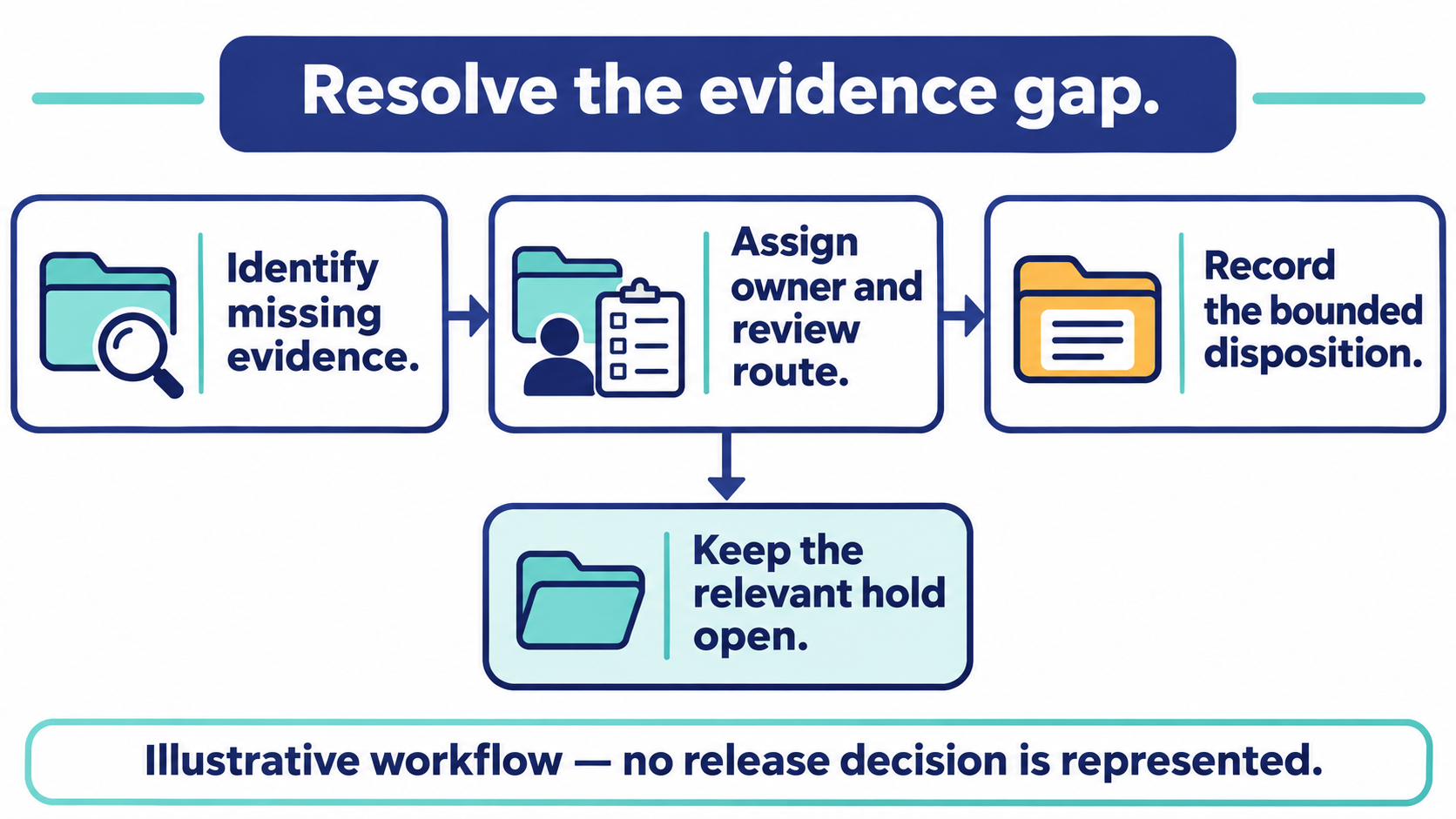
For cold shrink joint inspection, separate an absent document, an observed discrepancy and a failed specified requirement. These conditions may require different responses. Record the issue, affected joint, governing reference, responsible owner and review route. Keep the relevant hold open where the project arrangements require it; an empty field is not a resolution.
Consider a hypothetical handover pack containing a final photograph and a test report but no required pre-covering witness record. This is an invented document-review example, not a reported project. The reviewer should identify the missing evidence and obtain the authorized disposition. Adding a later signature that implies an observation occurred would misrepresent the record.
AI-generated illustrative issue workflow. No acceptance, repair instruction or release decision is represented.
State exactly what has been accepted
A final disposition should identify the joint, reviewed evidence, resolved exceptions and any remaining limitations. Preserve the record of who made the decision under the project arrangements. “Evidence pack reviewed” should not silently become “authorized for energization”; the latter depends on the applicable commissioning and operational release process.
Retain the cold shrink joint inspection pack with the as-built asset information so subsequent reviewers can locate the accepted configuration and its evidence. The cable accessories overview provides the wider product context. The deliverable here is a narrower, traceable record connecting one installed joint to the requirements and decisions used to assess it.
Frequently Asked Questions
Can a finished joint photograph replace a required witness record?
No. A final image cannot demonstrate an earlier concealed condition. Identify the missing record and obtain a disposition through the project's authorized review process.
What if the kit batch is readable but the joint location is missing?
Retain the batch information and resolve the location link before applying the record to a specific joint. A batch identifier alone may cover multiple installed assemblies.
Does a type-test certificate release an installed joint?
No. Type-test evidence concerns the qualified design within its stated scope. The installed joint still needs the project-required installation, inspection and site-test evidence.
Should an unclear photograph be marked as a failed installation?
Not automatically. Record that the image cannot establish the required detail, then request suitable evidence or an authorized technical disposition without inventing an observation.
Can a later checklist revision be applied without review?
Record the revision change and assess which requirements apply to the completed work. Preserve the original records rather than silently rewriting them against a different basis.
Who may close an unresolved acceptance item?
The person or organization assigned that authority by the project arrangements. The record should identify the decision maker, evidence considered and scope of the disposition.
yoyo shi
Yoyo Shi writes for ZeeyiElec, focusing on medium-voltage accessories, transformer components, and cable accessory solutions. Her articles cover product applications, technical basics, and sourcing insights for global electrical industry buyers.







 English
 한국어
 العربية
 Español
 हिन्दी
 தமிழ்
 Deutsch (Sie)
 Français
 Português do Brasil
 Русский