What Buyers Need to Decide Before Specifying a Bay-O-Net Assembly
Specifying a Bay-O-Net fuse assembly involves more decisions than picking a voltage class off a datasheet. Buyers consistently ask the same handful of questions during the RFQ stage — rating selection, mounting compatibility, certification, and lead time — and getting these wrong early creates change orders later, not just a slower purchase order. This guide answers the top Bay-O-Net buyer questions — the ones that come up most often before a purchase order is placed.
Across multiple RFQ cycles handled for utility and industrial distribution projects, the same pattern shows up repeatedly: a buyer specifies voltage class and current rating correctly but skips the dimensional compatibility check against the actual tank cutout, discovering the mismatch only after the assembly arrives on-site. This guide answers the questions that come up most often before a purchase order is placed — voltage class selection in the 8.7 kV to 38 kV range, current ratings from roughly 6.3 A to 140 A, dimensional compatibility, and documentation expectations.
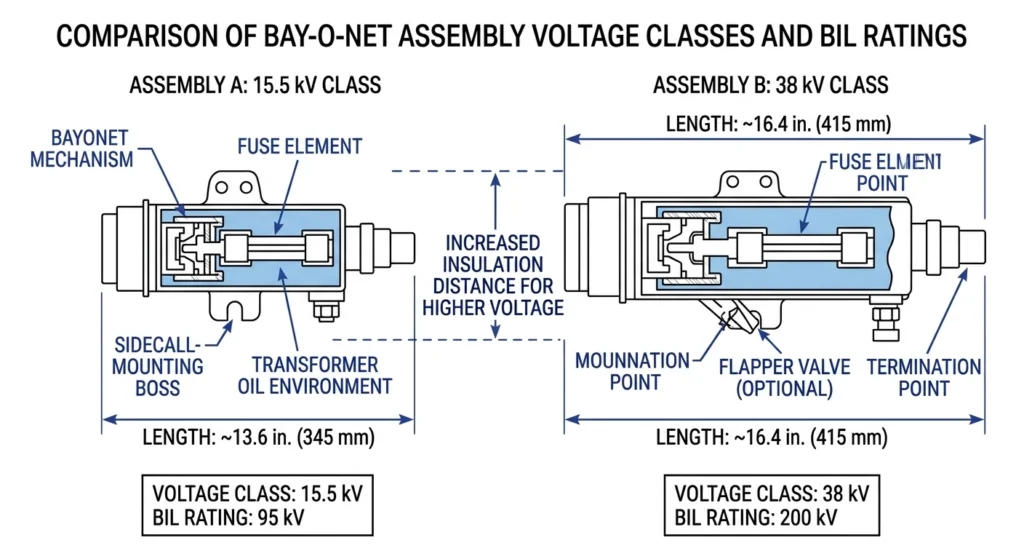
Bay-O-Net sidewall assemblies are commonly specified in two families: an 8.7/15/25 kV class carrying a 150 kV BIL rating, and a 38 kV class carrying a 200 kV BIL rating. The voltage class needs to match the transformer’s system voltage, not just be “high enough” — over-specifying voltage class typically means a physically larger, more expensive assembly that may not fit the intended tank cutout, and in some cases isn’t even available in a form factor compatible with existing sidewall hardware.
Does Higher BIL Mean Better Protection?
BIL (Basic Insulation Level) is a withstand rating tied to the voltage class and the applicable lightning/switching surge exposure on that specific system — it is not a general quality indicator. Specifying a 38 kV-class assembly with 200 kV BIL on a 15 kV system doesn’t improve reliability; it typically means unnecessary cost and a mounting footprint that may not match the tank design. [VERIFY STANDARD: exact BIL test withstand voltage duration and waveform parameters per voltage class beyond the manufacturer-published rating table]
The dimensional and BIL specifications referenced throughout this guide align with the scope of IEEE C57.19.00, the general requirements standard for power apparatus bushings rated 110 kV BIL and above — both Bay-O-Net voltage classes covered here (150 kV and 200 kV BIL) fall within that scope.
Two Bay-O-Net assemblies side by side labeled 8.7/15/25kV (150kV BIL) and 38kV (200kV BIL) showing the size difference between voltage classes.
Current Rating Selection: Matching Fuse Links to Load
Fuse links in this product category are commonly available across a wide continuous current range — roughly 6.3 A through 140 A — so the selection question isn’t “which rating is standard” but “which rating matches actual and near-term projected load on that specific feeder.” Undersizing leads to nuisance fuse operation under normal load conditions; oversizing delays protective action during an actual fault, potentially allowing fault current to persist longer than the coordination scheme assumes.
[Expert Insight: A Common RFQ Mistake]
Buyers sometimes copy the current rating from a previous purchase order without re-checking it against present-day load on the new installation — feeder load can drift by 20% or more over a multi-year procurement cycle
When in doubt, request the current rating options table from the supplier rather than estimating from a partial datasheet
Standardization and correct sizing solve different problems — fleet-wide voltage class/series standardization reduces SKU count, but current rating still needs to track each feeder’s actual load individually
Sidewall Mounting: Dimensions and Compatibility Questions
Wall Hole and Cutout Compatibility
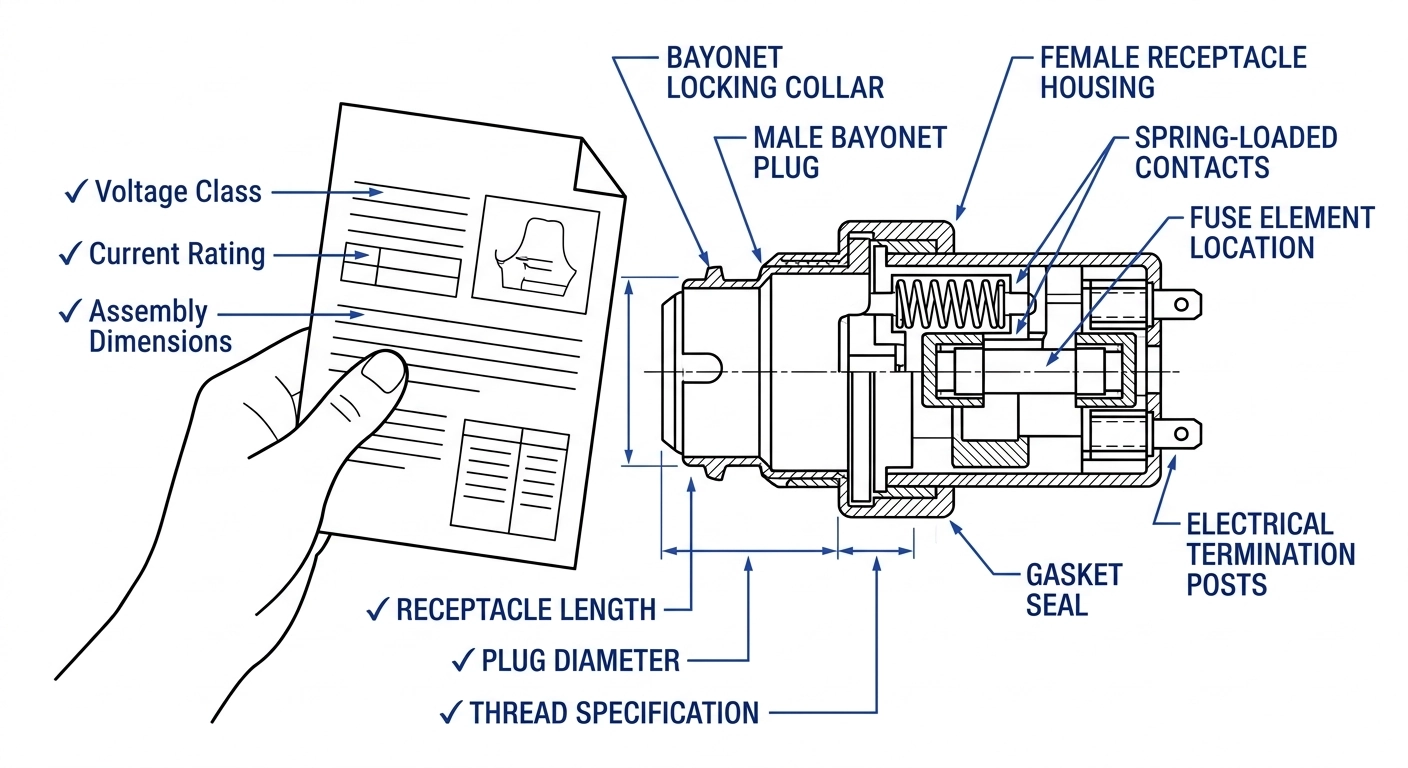
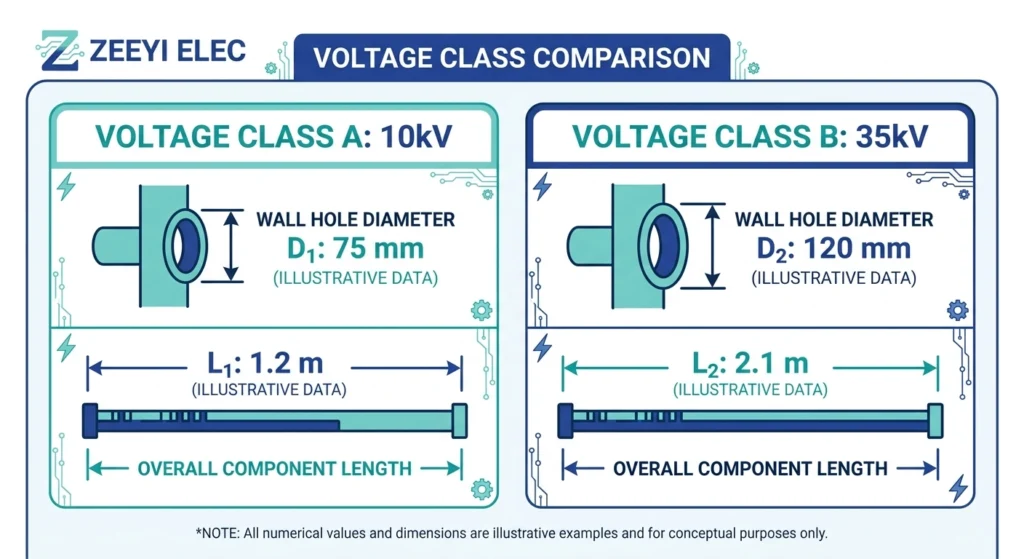
Whether a Bay-O-Net assembly fits an existing tank cutout depends on the wall hole dimension, which is a fixed spec per voltage class — ZeeyiElec’s 8.7/15/25 kV sidewall assembly uses a wall hole machined to ø57 ±0.1 mm. Buyers replacing an existing unit should confirm this dimension against the original tank drawing rather than assuming compatibility from voltage class alone, since different manufacturers’ assemblies aren’t always dimensionally interchangeable even at the same voltage class and BIL rating.
Comparison table graphic showing wall hole diameter and overall assembly length dimensions across the 8.7/15/25kV and 38kV classes.
Physical Size Difference Between Voltage Classes
The 38 kV class assembly runs longer overall than the 15/25 kV class — roughly 396 mm versus 371 mm in overall length on ZeeyiElec’s documented sidewall assemblies — which matters for buyers working with tight tank clearances or retrofitting into an existing enclosure originally designed around the smaller assembly. Overall assembly dimensions on these drawings typically carry a general reference tolerance in the range of ±5 mm, which is worth confirming against the specific manufacturer’s drawing rather than assumed as universal.
ZeeyiElec’s Bay-O-Net fuse assemblies are built across these documented voltage classes and current ratings, with dimensional drawings available to cross-reference against an existing tank cutout before specification is finalized.
Certification, Documentation, and Lead Time Questions
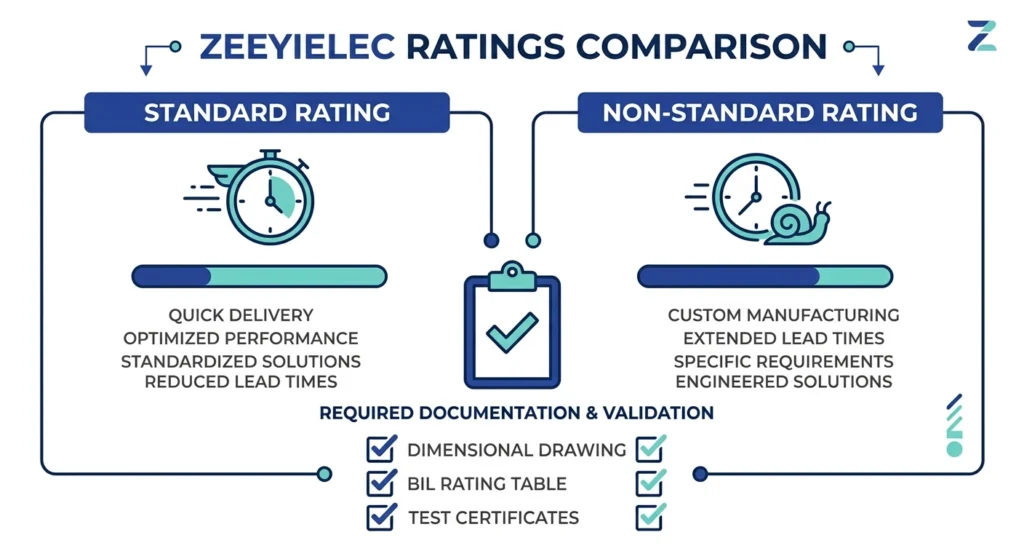
Buyers should request the manufacturer’s dimensional drawing (wall hole size, overall length, BIL rating table) and relevant test certificates as part of the quotation package, not as an afterthought after the purchase order is placed. This avoids the documentation gaps that commonly delay customs clearance or project handover on international orders — a missing test certificate at the wrong stage of an L/C-backed transaction can hold a shipment for weeks rather than days.
Standard vs. Non-Standard Current Ratings
Common current ratings within the standard range typically ship faster than less-common ratings at either end of the spectrum, since standard ratings are more likely held in regular production runs rather than requiring a dedicated batch. Buyers with a firm project deadline should confirm lead time for their specific current rating early in the RFQ process — lead time differences between a standard and a non-standard rating can run to several weeks, which is often enough to affect a project’s critical path if discovered late.
Comparison graphic showing expected lead time and required documentation checklist items for standard versus non-standard current ratings.
[Expert Insight: Reading a Quotation Package for Completeness]
A complete quotation should include the dimensional drawing, BIL rating table, and relevant test certificates together — not just a price and lead time
For export orders, confirm which certificate types are needed before the L/C is opened, since amendments after opening add delay and cost
For export-heavy procurement, ZeeyiElec’s related documentation guidance on transformer accessory RFQs outlines the specific certificate types that most commonly appear in a complete quotation package.
When to Talk to Engineering Before Placing an Order
Talk to engineering or the supplier directly, rather than finalizing a purchase order independently, when: the tank cutout dimensions don’t clearly match either documented voltage class, the required current rating falls outside the commonly available 6.3–140 A range, or the project involves retrofitting into an installation originally built around a different manufacturer’s assembly.
ZeeyiElec’s transformer accessories range covers the full Bay-O-Net product family alongside bushings and switches built to consistent specifications, and our team can help cross-reference an existing tank drawing before you finalize a specification. For broader accessory selection support, see the transformer accessories selection guide.
Frequently Asked Questions
What’s the minimum information needed for an accurate Bay-O-Net quote?
Voltage class (or system voltage), required current rating, and the tank wall hole dimension if replacing an existing unit — these three data points typically let a supplier quote accurately without back-and-forth clarification.
Is a 38 kV-class Bay-O-Net assembly ever appropriate on a 25 kV system?
Generally no — the voltage class should match the system voltage, and specifying a higher class typically means unnecessary cost and a larger physical footprint without a corresponding reliability benefit.
Can current ratings be mixed within the same voltage class across a fleet?
Yes, and this is usually the recommended approach — voltage class and mounting series are good standardization candidates for procurement simplicity, while current rating should still track each feeder’s individual load.
How is dimensional compatibility confirmed when replacing another manufacturer’s assembly?
Request the wall hole diameter and overall assembly length from both the original installation drawing and the new supplier’s datasheet, then compare them directly rather than assuming compatibility from matching voltage class alone.
Does a longer lead time apply to non-standard current ratings?
Often yes — ratings outside the commonly stocked range may require a dedicated production run, so buyers with fixed project deadlines should confirm lead time for their specific rating early rather than late in the RFQ process.
Who typically reviews the Bay-O-Net specification before purchase order approval?
This usually sits with whoever owns transformer accessory specifications for the project — engineering or procurement, depending on the organization’s structure — with the specification routed through a documented review before approval.
yoyo shi
Yoyo Shi writes for ZeeyiElec, focusing on medium-voltage accessories, transformer components, and cable accessory solutions. Her articles cover product applications, technical basics, and sourcing insights for global electrical industry buyers.





 English
 한국어
한국어 العربية
 Español
 हिन्दी
 தமிழ்
தமிழ் Deutsch (Sie)
 Français
 Português do Brasil
 Русский