Current limiting fuse storage should preserve the fuse’s documented condition, identification, packaging, and suitability for its intended application. There is no single shelf-life number that applies to every fuse design. Use the exact manufacturer’s storage requirements, retain traceable records, and quarantine damaged or undocumented stock before deciding whether it can be released for installation.
A spare fuse is useful only when its identity and condition remain trustworthy. A clean carton does not establish electrical suitability, while an older manufacturing date alone does not establish failure. This guide focuses on uninstalled transformer backup fuses and warehouse handling, separating inventory decisions from installation and post-fault replacement work.
Does a Current-Limiting Fuse Have a Fixed Shelf Life?
The first current limiting fuse storage question is usually how many years a spare may remain on a shelf. The defensible answer comes from the product documentation or a written manufacturer response for the exact catalog number. A warranty period, recommended inspection interval, and storage-life limit describe different things and should not be treated as interchangeable.
Separate storage life from service history
Storage life concerns an uninstalled item kept under defined conditions. Service history concerns exposure after installation, including loading, faults, vibration, and the operating environment. A fuse removed from equipment should therefore enter a separate review route rather than being mixed with unused spares.
A current-limiting fuse limits the magnitude and duration of sufficiently high fault current. A backup current-limiting fuse has a minimum interrupting current, so its application requires coordinated protection at lower currents. Neither description provides a storage expiration date.
For a specific primary source, Eaton’s ELSP installation instructions, MN132001EN call for clean, dry storage that minimizes physical damage. The cited handling-and-storage section does not assign a numerical shelf life; that omission is not a guarantee of unlimited storage.
Ask a model-specific question
When documentation is silent, provide the manufacturer with the catalog number, date or lot code, packaging condition, and known exposure history. Ask whether the stock remains eligible for use and what inspection or disposition is required. Record the answer against the affected inventory rather than treating an informal statement about another fuse family as approval.
Establish a Controlled Storage Environment
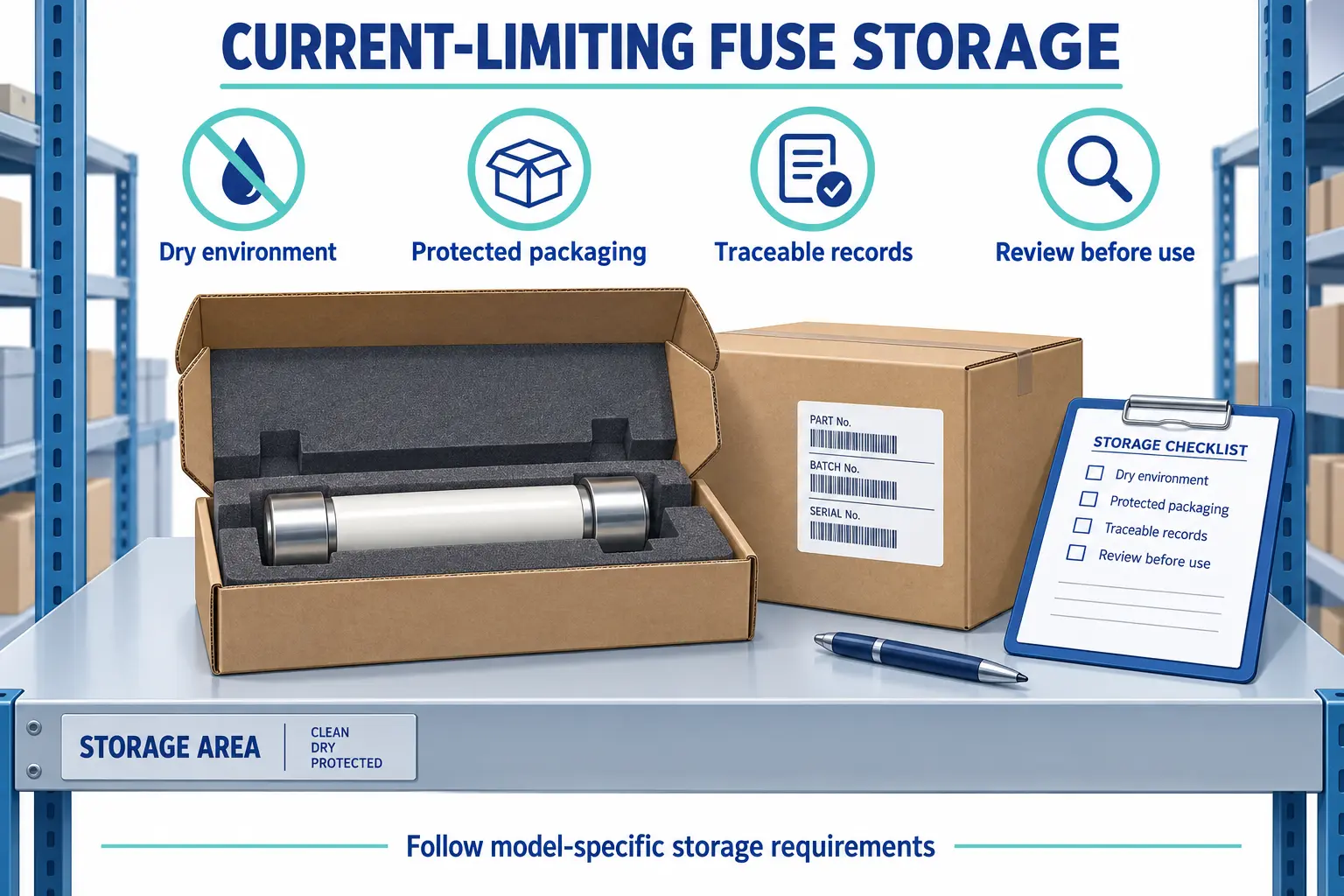
Effective current limiting fuse storage starts with a designated area where water, mechanical damage, and contamination can be controlled. Retain the supplier’s packaging and protective features unless its instructions require another arrangement. Keep identification visible without repeatedly exposing the component to unnecessary handling.
Manage moisture and temperature changes
Protect stock from leaks, washdown, wet floors, and condensation. Relative humidity describes moisture in the surrounding air; condensation occurs when a surface falls below the local dew point. Consequently, a room humidity reading alone does not prove that a recently moved package stayed dry.
Use the manufacturer’s specified storage temperature and humidity limits where available. If those limits are missing, request them rather than assigning an arbitrary range to all transformer fuses. Set warehouse alarms and inspection actions through the site’s approved storage procedure, and distinguish those internal controls from product certification limits.
Consider a sealed shipment transferred from a cold loading area into a warm, humid store. As a practical handling scenario, keep the package protected and follow the approved acclimatization procedure before opening it. The appropriate waiting period depends on actual conditions and packaging; a fixed number of hours cannot be inferred from the fuse rating.
Protect packaging and segregation
Use stable shelving and preserve the package’s intended support. Keep heavy items from crushing cartons, prevent loose hardware from contacting fuse terminals, and follow any orientation or stacking instructions supplied with the shipment. Repacking should retain equivalent protection and the original identification trail.
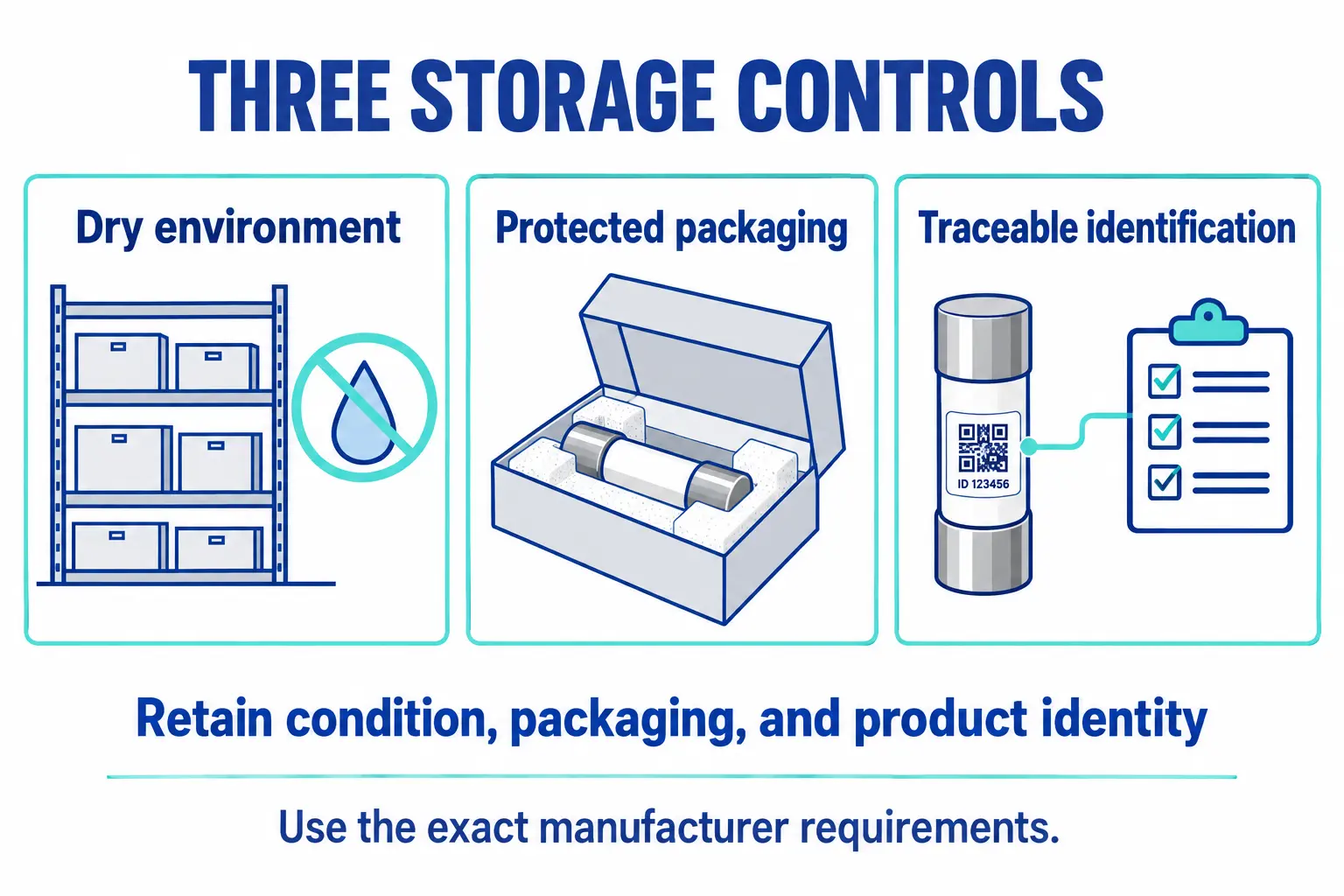
Dry surroundings, protective packaging, and traceable identification form separate storage control points. Any temperature, humidity, or expiration requirements must come from the exact product documentation.
Record where moisture was found: outside the transport wrap, on the carton, or on the component.
A dry outer surface after wiping does not resolve an unknown exposure history.
This is an illustrative inspection scenario, not a claimed ZeeyiElec customer incident.
Handle Fuse Bodies and Terminals Without Damage
Current limiting fuse storage procedures should cover every movement from receiving to final issue. A component can remain undamaged for years on a shelf and still be mishandled during the last transfer. Assign a protected staging surface and keep the inspection route separate from routine metalworking or dirty assembly operations.
Support the component during movement
Follow the manufacturer’s handling method and use packaging or supports that distribute the load appropriately. Do not use threaded terminal holes, indicator mechanisms, or other projections as improvised lifting points. Avoid rolling cylindrical fuses across a bench or placing them where another item can strike the end caps.
Inspect for cracks, chips, dents, loose parts, damaged threads, and unusual contamination. Do not shake or strike the component to investigate a suspected internal problem. Preserve photographs of both the component and its packaging when reporting a transport or handling incident.
Keep terminals in their supplied condition
Protect contact surfaces from dirt and accidental abrasion. Do not polish plated terminals, apply an unapproved solvent, add grease, or attempt to straighten a damaged connection merely to make the spare look serviceable. A cleaning or repair method acceptable for one material may damage another.
Before installation planning, match the stored item’s interface to the approved equipment drawing. The transformer accessory selection guide helps organize the surrounding interface questions. This warehouse review does not authorize work on energized equipment or replace the manufacturer’s installation instructions.
The handling sequence preserves packaging, supports the component, protects terminals, and records inspection results. Uncertain condition or exposure requires review before the item returns to available stock.
Build a Storage Record That Survives Staff Changes
A current limiting fuse storage record should let another person reconstruct what happened to the item without relying on memory. Separate the manufacturer’s identification from your internal stock number, and retain the relationship if items move between bins, warehouses, or project allocations.
Minimum inventory evidence
Use this record structure as an administrative checklist. The entries identify information to retain; they do not impose universal electrical acceptance limits.
Record field
What to retain
Why it matters
Product identity
Manufacturer, catalog number, rating label
Prevents look-alike substitution
Traceability
Lot or date code and supplier document
Connects stock to its origin
Receipt condition
Packaging and component observations
Establishes an initial condition record
Storage location
Bin, warehouse, and movement dates
Supports exposure investigation
Environmental events
Leaks, condensation, or alarm records
Identifies stock needing review
Handling incidents
Drop, impact, repacking, or contamination report
Preserves damage evidence
Disposition
Reviewer, decision, and supporting instruction
Controls release or rejection
Application release
Equipment reference and approved fuse pairing
Confirms suitability before issue
Where the manufacturer specifies an expiration date, manage stock by that date. Otherwise, first-in-first-out can support inventory organization, but it is not proof that the oldest item is acceptable. Quarantine status must override the normal picking sequence.
Avoid mixing service returns, unidentified loose fuses, and unused traceable stock in the same bin. A purchase invoice may establish provenance, but it cannot replace a missing rating label or resolve an undocumented impact. Keep component-level records where individual items within a shipment have different histories.
[Expert Insight: Mixed-Bin Inspection Scenario]
Two similar-looking fuses may belong to different catalog numbers or have different histories.
Reconcile identity and condition separately before returning either item to available stock.
This hypothetical example illustrates a control point; it is not field failure-rate evidence.
Decide When to Release, Quarantine, or Reject Stock
The practical goal of current limiting fuse storage is controlled release, not keeping every spare indefinitely. Use three distinct decisions: release against documented requirements, quarantine pending review, or reject following an authorized disposition. Do not let a warehouse label become a substitute for technical approval.
Apply condition-based hold points
Observation
Immediate inventory action
Release evidence needed
Intact identification and known compliant storage
Continue the normal inspection route
Completed checks and application match
Wet package or unexplained moisture
Quarantine the affected stock
Manufacturer or authorized engineering disposition
Cracked body, displaced end cap, or damaged terminal
Prevent issue and document damage
Approved disposition; replacement may be required
Missing label or uncertain catalog number
Separate from available stock
Reliable identity established through an approved route
Dropped package without visible damage
Record the incident and hold for review
Handling-damage assessment appropriate to the product
Removed or operated fuse
Route as a service item, not new stock
Manufacturer’s replacement or repair instructions
A continuity reading only indicates an electrical path under the measurement conditions. It does not establish dielectric integrity, mechanical soundness, correct interrupting characteristics, or suitability after water exposure. Do not introduce a generic resistance threshold or high-voltage test as a warehouse shortcut.
If a test is required, use the manufacturer’s specified method, limits, equipment, and personnel. Do not dismantle a sealed fuse or perform improvised drying to return questionable stock to service. For a documented condition investigation, the electrical accessory diagnosis workflow provides a broader evidence-gathering framework.
Release, quarantine, and rejection are distinct inventory decisions supported by identity, condition, and authorized instructions. A continuity reading alone does not establish fitness for installation.
Prepare a Supplier Review Before Issuing Older Spares
For current limiting fuse storage questions involving older or uncertain stock, send a concise evidence package instead of asking only whether the fuse is “still good.” Include clear label photographs, catalog number, lot or date code, purchase and receipt information, storage history, packaging condition, and any known incident. State whether the item has ever been installed or energized.
Ask ZeeyiElec to confirm the applicable product documentation, any stated storage-life limit, and the review route for the specific stock. Request a written disposition for unresolved exposure or damage. Preserve that response with the inventory record and complete the application check before issue; a favorable storage review does not independently establish compatibility with a different transformer design.
Frequently Asked Questions
How many years can a current-limiting fuse remain in storage?
There is no universal number applicable to every fuse family; the cited ELSP storage section gives handling conditions without a numerical shelf-life limit. Obtain model-specific guidance and review condition and traceability rather than treating an absent expiry date as unlimited approval.
What temperature and humidity should a fuse warehouse maintain?
Use the limits specified for the exact product and packaging, with a storage procedure that addresses condensation as well as room conditions. If numerical limits are unavailable, request them from the manufacturer instead of substituting a generic range.
Can a fuse from a wet carton be installed after drying?
Quarantine it until the exposure and component condition have been evaluated through an authorized review. Drying the carton does not demonstrate that the fuse remained unaffected or restore a documented storage history.
Does a continuity test prove that an old spare fuse is usable?
No; continuity alone does not verify insulation condition, interruption performance, or mechanical integrity. Any required acceptance testing must follow the specific manufacturer’s procedure and complement identification and condition checks.
Should the oldest fuse always be issued first?
First-in-first-out is an inventory method, not a technical release rule. Apply any manufacturer expiry requirement and quarantine restriction before considering receipt order.
What should be supplied for a current limiting fuse storage review?
Provide the eight record categories in the inventory table, emphasizing identification, exposure history, handling incidents, and intended application. The manufacturer may request additional evidence before giving a disposition for the particular stock.
yoyo shi
Yoyo Shi writes for ZeeyiElec, focusing on medium-voltage accessories, transformer components, and cable accessory solutions. Her articles cover product applications, technical basics, and sourcing insights for global electrical industry buyers.






 English
 한국어
한국어 العربية
 Español
 हिन्दी
 தமிழ்
தமிழ் Deutsch (Sie)
 Français
 Português do Brasil
 Русский