Finding reliable transformer accessories suppliers in China starts with a shortlist pulled from trade directories or referrals — the harder part is knowing which names hold up once specs, certifications, and lead times are checked.
Why China Leads Global Transformer Accessories Manufacturing
Sourcing decisions for transformer accessories increasingly start in Wenzhou and the broader Zhejiang manufacturing belt, not because of price alone but because of concentrated supply-chain depth. A single procurement cycle for transformer accessories — bushings, tap changers, fuse assemblies — can be sourced from suppliers within a 20–30 km radius, cutting component lead times that would otherwise stretch across multiple countries.
Wenzhou and the Liushi Electrical Cluster
Liushi Town, part of Wenzhou, is often called China’s “Electrical Appliance Capital,” a designation built over three decades of specialization in low- and medium-voltage electrical components. In field sourcing experience, raw material suppliers — epoxy resin, silicone rubber, copper stock — often sit within the same industrial park as accessory manufacturers, shortening quoted lead times to a common 15–35 day range for standard bushing and switch orders, depending on volume and customization.
This density lets factory visits or video audits cover several supplier tiers — raw material, sub-component, final assembly — in a single trip, rarely possible in more fragmented supply regions.
Certification coverage varies across suppliers in this region. ISO9001 quality management certification is close to baseline among established exporters, while CE marking and RoHS compliance are typically required for EU-adjacent or environmentally regulated markets. Suppliers targeting North American utility and EPC buyers may reference UL or ANSI-aligned testing, though full ANSI compliance documentation should be verified directly rather than assumed from marketing material — [VERIFY STANDARD: specific ANSI test report scope per product line].
A valid ISO9001 certificate confirms process control exists, not that a specific product batch meets a target voltage class or fault-current rating — treat certification claims as a starting filter, not a final qualifier.
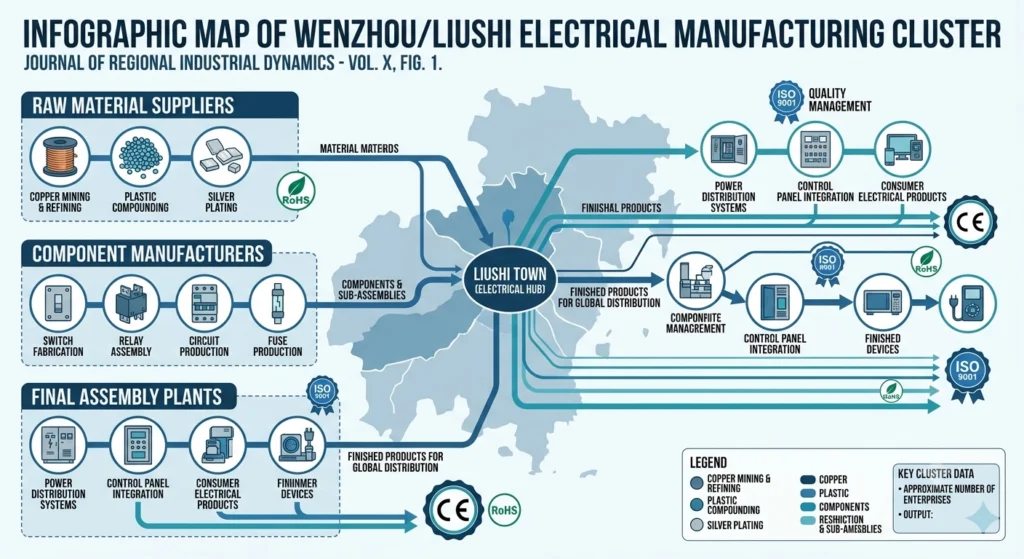
This infographic maps the Wenzhou/Liushi electrical manufacturing cluster, illustrating supplier proximity and certification coverage relevant to transformer accessory sourcing.
Expert Insight
Ask for the factory’s business license address, not just the sales office address — they’re often different.
A supplier unwilling to schedule a live video walkthrough within a week is a soft red flag.
Check that ISO9001 and CE documentation hasn’t lapsed since last renewal.
How to Evaluate a Transformer Accessories Supplier
Evaluating transformer accessories suppliers in China requires more than comparing unit prices. Four criteria consistently separate reliable partners from suppliers who struggle once order complexity increases.
Product Range and Voltage Class Coverage
A supplier’s stated voltage range should match actual production capability, not catalog breadth. Medium-voltage bushings are commonly manufactured across a 12 kV–52 kV class range, while low-voltage bushings typically cover 1.2 kV–3.0 kV with current ratings from 600 A up to 5000 A or higher. A supplier claiming coverage across the full medium-voltage bushing range should provide test reports or drawings for each class on request — vague documentation here is a warning sign, not a formality to skip.
Technical Support and Drawing Response Time
Response speed on drawings and specification clarifications is a practical proxy for engineering depth. Established suppliers typically return marked-up drawings or dimensional confirmations within 24–48 hours for standard products, while custom configurations reasonably take longer. A supplier that cannot answer basic dimensional questions without escalating internally often lacks in-house engineering support.
OEM/ODM and Customization Capability
Buyers requiring private labeling or non-standard configurations should confirm OEM/ODM capability early, since retrofitting a standard line mid-order frequently causes schedule slippage. New tooling can add 3–6 weeks to a production timeline depending on part complexity, so raise this in the first RFQ round.
Export Documentation Readiness
Export-ready suppliers should produce commercial invoices, packing lists, certificates of origin, and test certificates without delay. Gaps here tend to surface only at the shipping stage — a cable accessories or transformer accessories quotation should reference documentation lead time alongside production lead time from the outset.
Core Product Categories to Check Before Shortlisting
Before comparing suppliers side by side, it helps to understand the core accessory categories, since supplier strength often varies by product family rather than being uniform across a catalog.
Bushings (LV & MV)
Bushing design and testing commonly reference IEEE/ANSI C57.19.00 and C57.19.01 for power transformer bushing performance, though the specific clause applicable to a given voltage class should be confirmed against the current standard edition and each supplier’s test documentation.
Tap Changers and Loadbreak Switches
Off-circuit tap changers adjust transformer turns ratio only while de-energized, typically in the 15/25/35 kV class with current ratings around 63 A–125 A. Loadbreak switches interrupt current while the transformer stays energized, with ratings commonly around 630 A across 15/25 kV and 38/40.5 kV classes. Confusing these two device types during specification is a common and costly error, since operating an off-circuit tap changer under load can damage internal contacts.
Fuse Protection (Bay-O-Net & Current Limiting)
Transformer protection typically layers two fuse technologies. Bay-O-Net fuses clear low-to-moderate faults up to roughly 3,500 A, while current limiting fuses handle high-magnitude faults exceeding 50,000 A, interrupting within a half-cycle. This two-stage coordination is standard on oil-filled distribution transformers — each fuse type protects a different segment of the fault-current spectrum.
Typical LV bushing current rating range: 600 A – 5000 A+; MV bushing dielectric class: 12 kV – 52 kV.
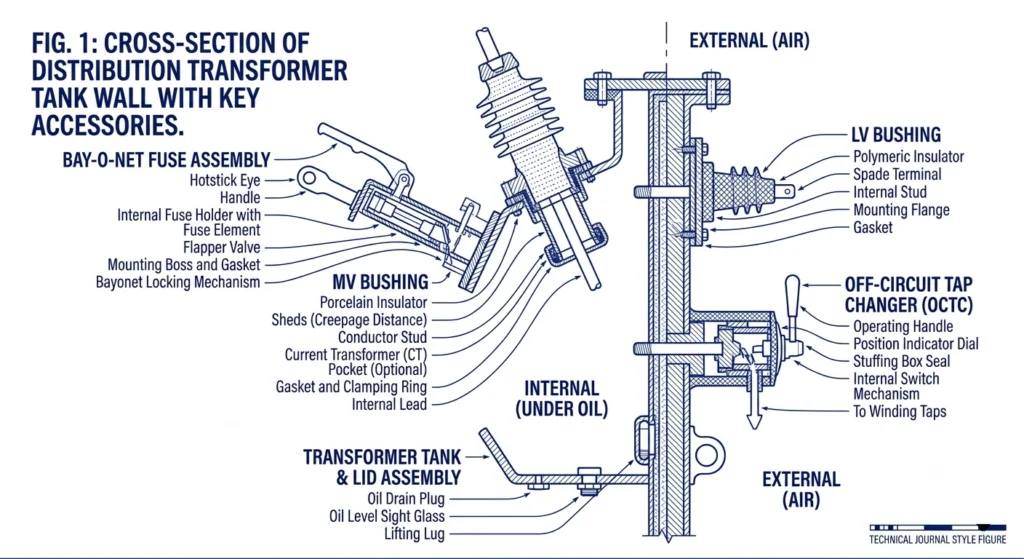
This line-art cross-section compares an LV bushing, MV bushing, off-circuit tap changer, and bay-o-net fuse assembly as mounted on a distribution transformer tank wall.
Top 10 Transformer Accessories Suppliers in China (Comparison Table)
Ranking specific named suppliers requires verified, current data — certifications, product range, MOQ, factory location — that changes often enough to make a static “top 10” list go stale quickly. Instead, this section gives you the evaluation table structure to populate through direct RFQ and factory verification, keeping the comparison accurate to your own sourcing research.[NO MATCH IN LLMS.TXT — supplier-specific data not available in source library]
Supplier Comparison Table Structure
Evaluation Criteria
What to Verify
Product Range
Bushings, tap changers, fuses, switches — full line or partial
Voltage Class Coverage
e.g., 12 kV–52 kV MV bushings, 15/25/35 kV tap changers
Commonly 15–35 days depending on volume and customization
Export Documentation
Certificates of origin, test reports, commercial invoice turnaround
Technical Response Time
24–48 hours for standard drawing confirmations is a reasonable benchmark
Buyers who run this table against 8–10 shortlisted suppliers typically eliminate half the list after the first RFQ round, once documentation gaps or vague voltage-class claims surface. ZeeyiElec operates within this framework as a Wenzhou-based manufacturer covering the transformer accessories series above, alongside cold shrink and heat shrink cable accessories for buyers consolidating both categories under one supplier.
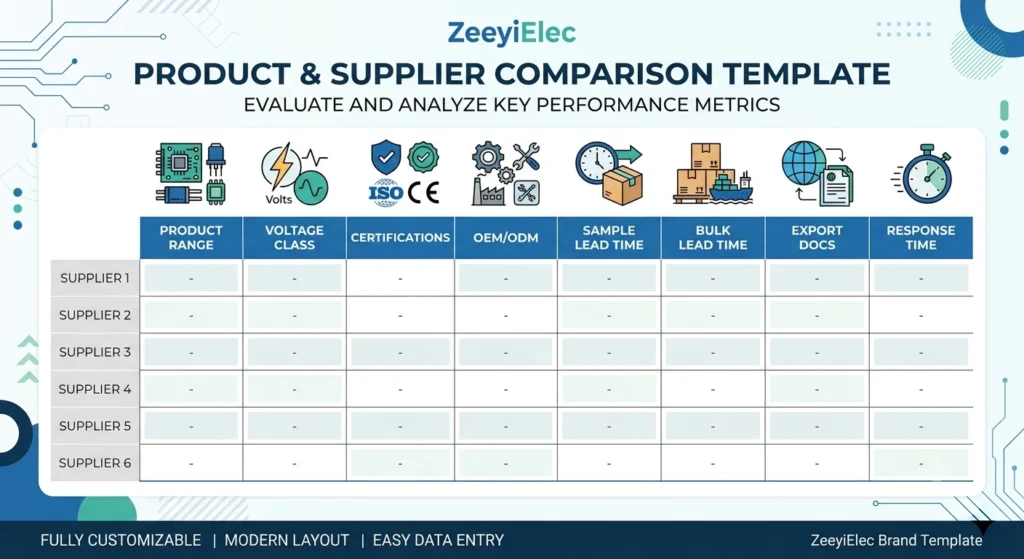
This template graphic lays out the eight evaluation criteria — product range, certifications, lead times, documentation — buyers should verify when comparing suppliers.
Field Lessons and Red Flags When Sourcing Overseas
Sourcing transformer accessories from overseas suppliers surfaces problems that spec sheets rarely reveal. A few recurring field patterns are worth flagging before a first bulk order.
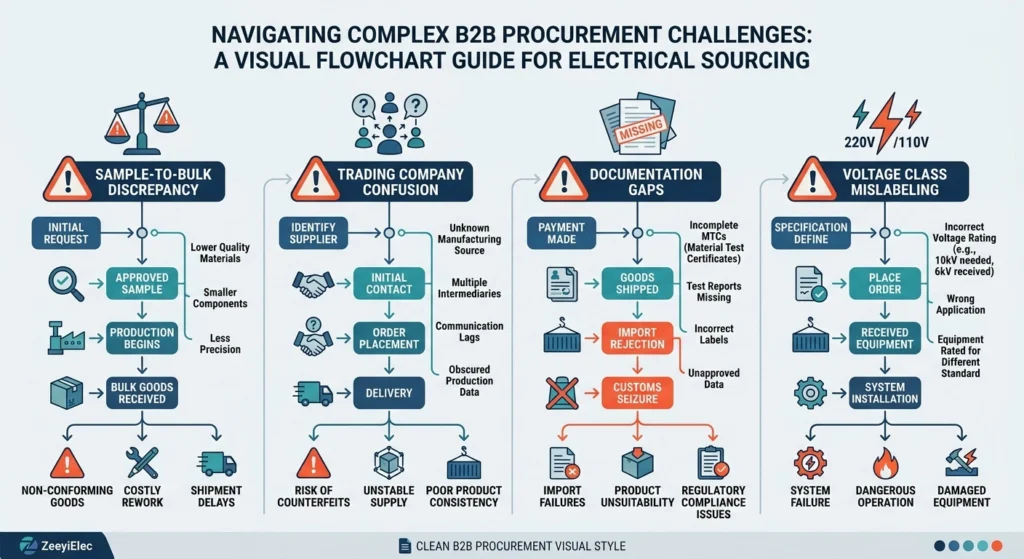
Sample-to-Bulk Discrepancy
A sample can pass inspection while the bulk production run — manufactured weeks later, sometimes from a different material batch — shows measurable variation in fit or dielectric performance. This is more likely with suppliers lacking in-house material testing. Requesting a pre-shipment inspection report referencing the same batch as the bulk order, rather than a generic factory certificate, reduces this risk meaningfully.
Trading Company vs. Factory Confusion
Suppliers presenting as manufacturers are sometimes trading companies reselling from two or three actual factories, switching between them without notifying the buyer. This shows up as inconsistent technical answers between quotation rounds, or a deflected factory audit request. Video audits or production photos with visible date-stamped batch numbers help confirm actual manufacturing origin.
Documentation Gaps at the Shipping Stage
Export documentation problems tend to surface after production is complete and the shipment is booked. A missing or mismatched HS code, or a certificate of origin that doesn’t match the commercial invoice, can hold a container at port, adding 1–3 weeks of delay in typical cases. See ZeeyiElec’s export documentation checklist for the full paperwork sequence. Confirming documentation scope during the RFQ stage is the more reliable order of operations.
Voltage Class Mislabeling
Accessories rated for one voltage class are occasionally marketed loosely for an adjacent one, particularly around the 15 kV/25 kV boundary in tap changers and loadbreak switches. Cross-referencing the supplier’s stated rating against the transformer’s nameplate parameters, rather than catalog category names alone, prevents downstream compatibility issues during commissioning.
This flowchart highlights four common overseas sourcing red flags: sample-to-bulk discrepancy, trading company confusion, documentation gaps, and voltage class mislabeling.
Expert Insight
Cross-check batch numbers on sample and bulk shipment paperwork before acceptance.
Confirm nameplate-based specifications, not just catalog category names, before finalizing switch or tap changer orders.
Build a 1–3 week documentation buffer into project timelines.
Sample Evaluation, RFQ Process, and Next Steps
Moving from a shortlist of transformer accessories suppliers in China to a confirmed order works best as a staged process.
A well-structured RFQ should specify voltage class, current rating, mounting configuration, and target certification up front, since incomplete specifications are a common cause of quotation delay. Bulk lead times generally run 15–35 days depending on customization and volume — build this into project timelines early.
For buyers evaluating transformer or cable accessories from Wenzhou-based manufacturers, sharing target specs, drawings, and destination market details in the first inquiry typically shortens the technical response cycle. ZeeyiElec supports this with drawing-based selection guidance and export documentation coordinated alongside production.
Buyers ready to move from evaluation to quotation can share required specs and target voltage class directly for technical feedback and sample coordination.
Frequently Asked Questions
How many transformer accessory suppliers should I shortlist before requesting samples?
Most buyers narrow to 8–10 candidates from directory or referral research, then reduce that list by half after the first RFQ round once documentation and response-time gaps become clear.
What certifications should a Chinese transformer accessories supplier hold?
ISO9001 is close to a baseline expectation, while CE and RoHS typically matter for EU-adjacent markets, and UL or ANSI-aligned testing may apply for North American projects, though exact scope should be confirmed per product line.
How long does sample evaluation typically take for transformer accessories?
Standard bushings, tap changers, and fuse assemblies are commonly sampled within 7–15 days, though custom configurations with non-standard tooling can extend this timeline.
Can one supplier provide both bushings and switching devices?
Many manufacturers in the Wenzhou cluster cover multiple accessory categories, but voltage-class depth often varies by product family, so it’s worth verifying test reports per category rather than assuming uniform capability.
What is the typical MOQ for transformer accessory export orders?
MOQs vary widely by product and customization level, often ranging from a few hundred to several thousand units, and are usually negotiable for first orders paired with a sample evaluation stage.
How do I verify factory capability versus a trading company?
A live video factory walkthrough or dated production photos with visible batch numbers is a practical way to confirm manufacturing origin, since inconsistent technical answers across quotation rounds often signal a trading intermediary.
What documentation should accompany a transformer accessories export shipment?
A typical package includes the commercial invoice, packing list, certificate of origin, and relevant test certificates, with HS code accuracy being one of the more common points of customs delay when mismatched.
yoyo shi
Yoyo Shi writes for ZeeyiElec, focusing on medium-voltage accessories, transformer components, and cable accessory solutions. Her articles cover product applications, technical basics, and sourcing insights for global electrical industry buyers.





 English
 한국어
한국어 العربية
 Español
 हिन्दी
 தமிழ்
தமிழ் Deutsch (Sie)
 Français
 Português do Brasil
 Русский