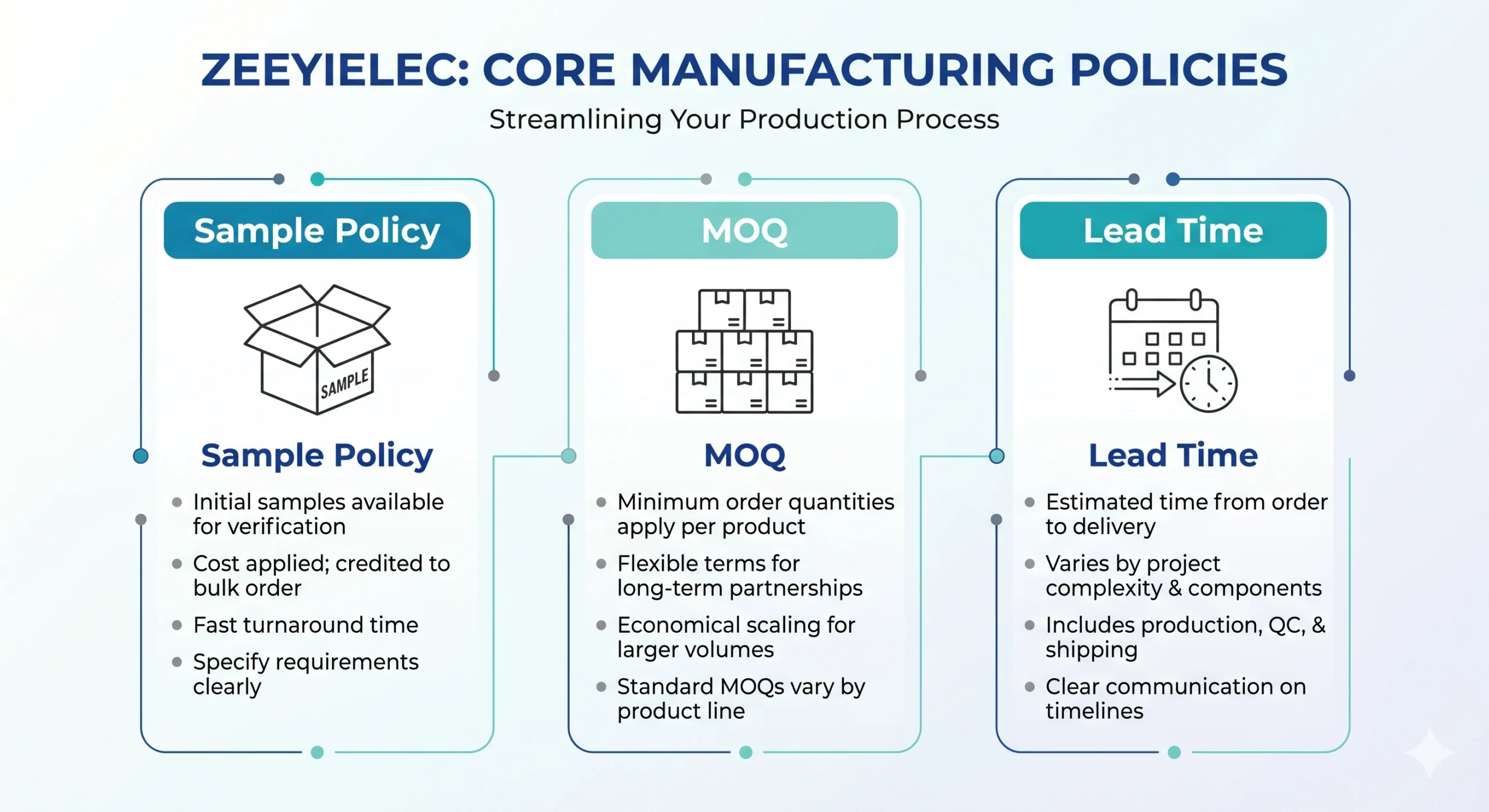
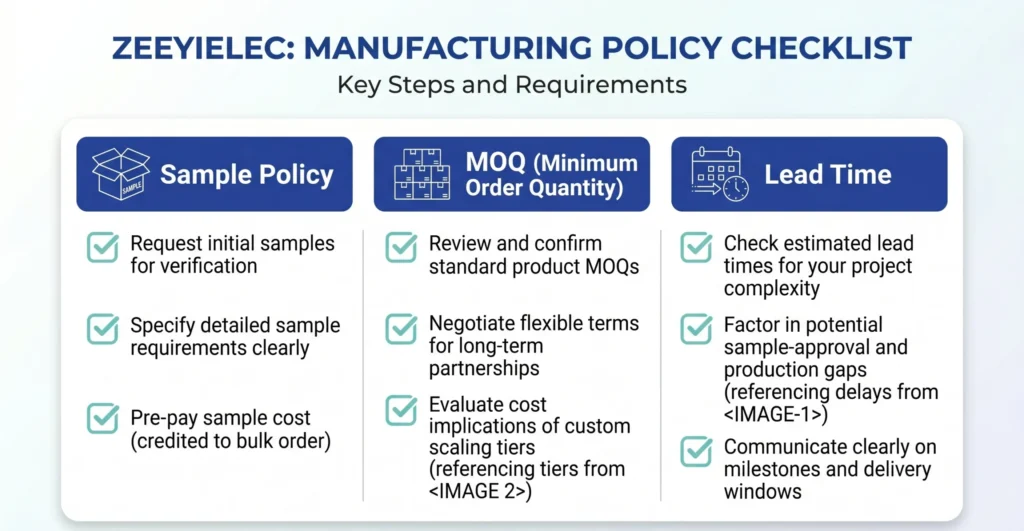
Sample policy, MOQ, lead time — these three procurement levers decide whether a transformer or cable accessory order ships on schedule: sample policy (the terms under which a supplier provides a physical sample), MOQ (minimum order quantity, the smallest batch a factory will produce), and lead time (the total interval from confirmed order to shipment).
Late clarification is the most common cause of stalled accessory procurement. A buyer locks a project timeline against a quoted lead time, then discovers the figure excluded the sample-approval loop or assumed a quantity above the actual MOQ. The order returns to engineering for re-quotation, and a two-week RFQ cycle stretches toward six. On a substation package with eight or ten line items spanning bushings, fuses, and cold-shrink kits, every unconfirmed parameter compounds the risk.
What matters most is how the three levers interact, not any single value. A favorable unit price loses meaning if the MOQ sits at 500 pieces when the project needs 60. A short headline lead time misleads if sample approval adds three to four weeks on top. In field experience, the orders that energize on schedule are the ones where sample terms, batch minimums, and stage-by-stage lead time were fixed in writing on the proforma invoice. The same discipline governs both product systems, the transformer accessories range of bushings, tap changers and fuse assemblies, and the cable accessories range of cold-shrink and heat-shrink terminations and joints. Custom-configured items in either family follow different sample, MOQ, and lead-time logic than standard catalog SKUs, which is exactly why the questions below belong at the front of the conversation.
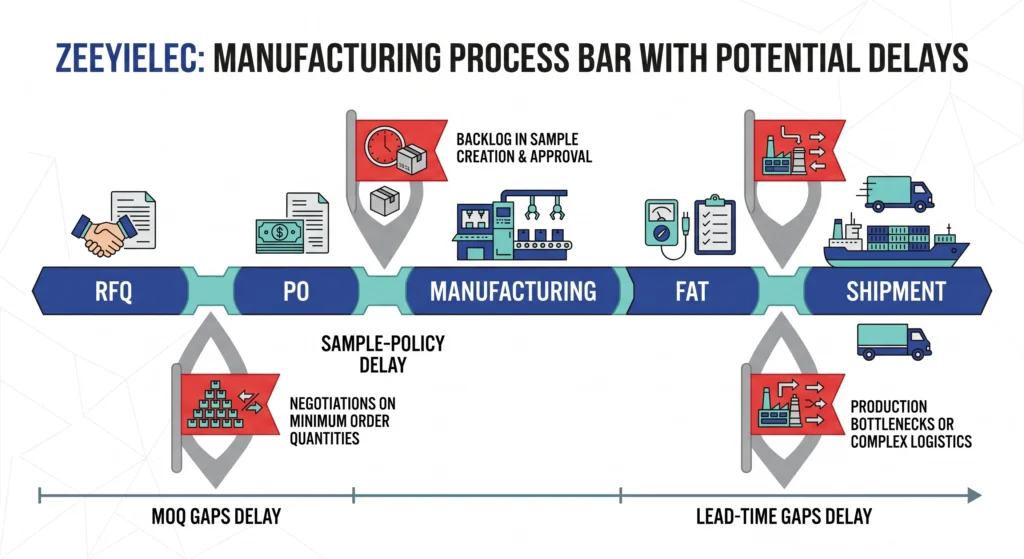
The RFQ-to-shipment chain, marking the three points where unconfirmed sample, MOQ, and lead-time parameters most often inject re-quote delay into accessory procurement.
Sample Policy: What to Clarify Early
A sample request feels routine, but the terms attached to it shape both cost and schedule. The core questions are who pays, how long the sample takes, and whether it genuinely represents the bulk run.
Paid vs. free sample conditions and credit-back terms
Suppliers handle sample cost according to the item’s value and tooling needs. Low-value standard parts are sometimes free, with the buyer covering only freight. Higher-value or custom-configured items, a molded medium-voltage bushing, a non-standard fuse assembly, usually carry a sample charge that may be credited back against a later bulk order above a stated quantity. Confirm the credit-back threshold and whether courier freight (often 30–80 USD per small parcel) and import duty fall to you, since ambiguity here is a frequent source of post-shipment disputes.
Sample lead time vs. bulk lead time
These are separate numbers, and conflating them distorts planning. An in-stock standard sample may dispatch within 2–5 business days, while a custom sample requiring a short tooling or casting run can take 2–3 weeks before it even ships. Ask explicitly whether sample preparation and bulk production run in parallel after approval, or whether bulk only starts once the sample is signed off, that single distinction can move the final delivery date by weeks.
Ensuring sample-to-production spec parity
The most consequential clarification is parity. On one project, a 15/25 kV medium-voltage bushing sample arrived with a different terminal stud configuration than the production drawing specified, because it came from existing stock rather than the quoted build. Confirm in writing that the sample’s voltage class, current rating, creepage distance, material grade, and terminal interface are identical to the production item and that it carries the same routine-test basis the bulk order will.
[Expert Insight]
Treat the sample charge and the credit-back threshold as two separate negotiation points; a “free” sample with non-creditable freight can still cost more than a credited paid sample.
Always request the sample from the quoted production line, not from stock, when spec parity is critical.
Pin sample approval to a fixed review window (e.g., 5 business days) so it cannot silently extend the bulk start date.
MOQ: How Minimum Order Quantity Is Actually Set
Minimum order quantity is not an arbitrary barrier. It reflects the real economics of setting up a production run, and it varies sharply between a stocked standard and a configured custom build. Knowing the drivers lets you negotiate from an informed position rather than accepting a headline figure.
MOQ drivers by accessory family
The figures below are representative ranges; confirm against the specific configuration and packaging unit.
Accessory family
MOQ driver
Representative MOQ
Standard cold-shrink termination kits
Stocked / catalog SKU
10–50 pcs
Standard LV/MV bushings (catalog)
Batch packaging unit
20–100 pcs
Custom-molded or non-standard items
Dedicated tooling / mold setup
200–500 pcs
Heat-shrink tubing & joint sets
Extrusion run / reel length
100–300 pcs
How tooling and molds drive MOQ thresholds
The single largest driver is whether the item needs dedicated tooling. A standard cold-shrink cable accessory drawn from an existing catalog requires no new setup, so minimums stay low often 10–50 pieces. A custom-configured part may need a new mold or casting fixture whose setup cost only amortizes across a few hundred units, pushing MOQ to 200–500 pieces. Heat-shrink products tie to extrusion-run length and reel economics rather than mold setup. Ask which category your item falls into before assuming the MOQ is negotiable.
Negotiating MOQ across mixed-SKU orders
When per-SKU quantities are low, MOQ can sometimes be satisfied at the order-value level rather than the line-item level. A substation package combining 60 medium-voltage bushings, 40 fuse holders, and several cold-shrink kits across the 8.7/15 kV to 26/35 kV range may clear a supplier’s minimum order value even though no single SKU reaches its standalone minimum. This works only when the items share production lines or consolidated shipping, so confirm whether MOQ is evaluated per line or per order before structuring the request.
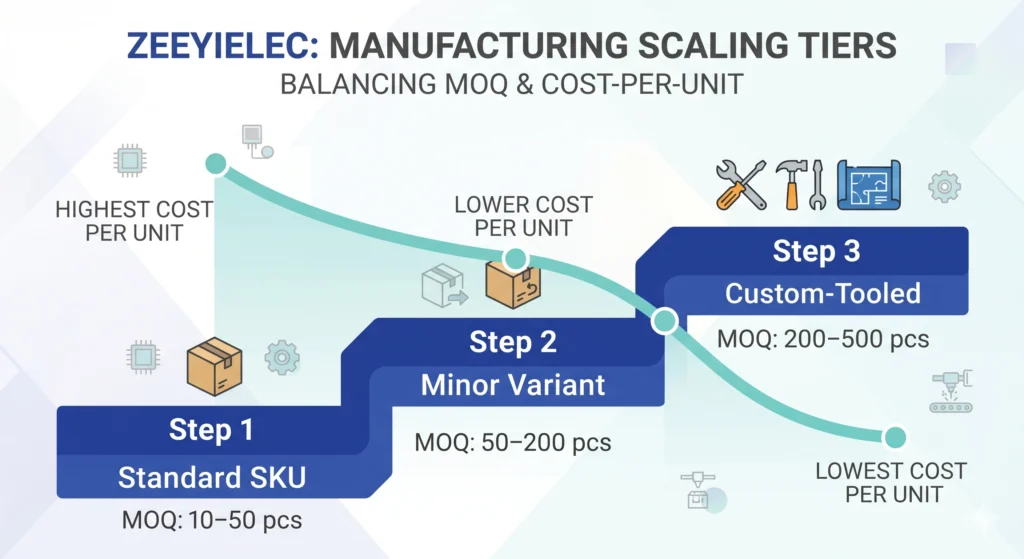
A three-rung MOQ ladder showing how minimum order quantity rises from standard catalog SKUs to custom-tooled items, while unit cost falls along the opposing curve.
Lead Time: Decomposing the Quoted Number
A single quoted lead time hides four or five distinct work packages, each with its own duration and its own risk of slipping. Buyers who plan against the headline number are often surprised; buyers who ask for a stage breakdown can see exactly where delay accumulates and where parallel work is possible.
Lead-time stage breakdown
Ranges are representative and shift with configuration, order size, and season.
This is the stage most often omitted from a headline figure. If bulk production cannot begin until the sample is signed off, the 1–3 week approval loop sits in series ahead of everything else. Asking whether material procurement can start in parallel, at the supplier’s risk can compress the critical path materially.
Production and factory acceptance testing (FAT)
Production scales with quantity and complexity, typically 2–4 weeks for a distribution-accessory batch, with routine testing adding 3–7 days. Buyers underestimate this window because it produces no visible movement, yet it gates shipment: material cannot leave until routine tests pass.
Logistics, documentation, and transit
The final window spans 1–6 weeks depending on shipping mode and paperwork readiness. Sea freight dominates transit, but missing or mismatched documents can hold a container at port regardless of how fast production finished. Aligning the document set early using the export documentation checklist protects the schedule at the most expensive point to lose time.
[Expert Insight]
Ask whether the quoted total assumes stages run in series or partly in parallel; this one assumption can shift delivery by several weeks.
Treat routine testing as fixed, non-compressible time, it is a release gate, not a buffer.
Lock the document list into the RFQ so paperwork is prepared during production, not after.
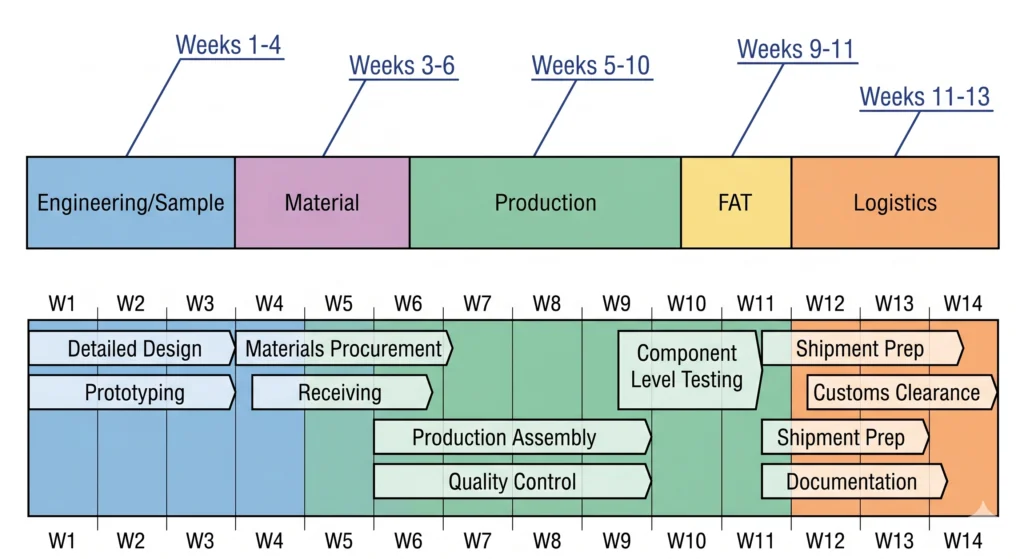
A quoted lead time decomposed into its constituent stages, with a parallel-path variant beneath illustrating how concurrent procurement compresses the critical path.
How Product Construction Influences MOQ and Lead Time
The figures a supplier quotes are downstream of physics. How an accessory is built, what it is made of and how it is formed, determines whether tooling is needed, how long curing or assembly takes, and which tests must pass before release. The construction explains why two items of similar price can carry very different minimums and schedules.
Cold-shrink and heat-shrink construction
A cold-shrink termination is a pre-expanded silicone or EPDM elastomer body held open on a removable support core; relaxation onto the cable provides constant radial pressure without applied heat. Because the elastomer is molded, a non-standard inner diameter needs a dedicated mold, the root cause of higher custom MOQ. Heat-shrink products are crosslinked polyolefin extrusions that recover when heated, so their economics track extrusion-run length rather than mold setup.
Bushing and fuse construction
Medium-voltage bushings are formed by casting epoxy or firing porcelain around a central conductor, with stress grading shaped into the geometry. Casting and curing cycles add fixed time regardless of quantity. Fuse elements are precision-assembled and calibrated, which is why their routine testing is non-negotiable before shipment.
Construction also sets the test envelope. A distribution bushing rated 12 kV–52 kV must demonstrate adequate creepage (commonly ≥ 25 mm/kV in polluted environments) and survive a power-frequency withstand test, while elastomeric cable accessories are qualified across an operating range of roughly −40 °C to +90 °C. These routine and type tests sit on the critical path: material cannot ship until they pass.
Standards that gate release
Type and routine testing for these products follows IEC frameworks, bushings under IEC 60137 (insulated bushings for AC above 1 000 V) and MV cable accessories under IEC 60502-4:2023, which sets the type-test requirements for accessories on cables rated 6 kV (Um = 7,2 kV) up to 30 kV (Um = 36 kV), with the corresponding test methods defined in IEC 61442. Confirming which standard your order is tested to, and requesting the corresponding certificates, ties directly back to lead time, because the testing stage is real work rather than a formality. These construction and testing realities are exactly why sample policy, MOQ, lead time should be confirmed per item rather than assumed from product category.
Master Clarification Checklist: Sample Policy, MOQ, Lead Time
Use this consolidated question set in your next RFQ so sample terms, MOQ, and lead time are fixed before the purchase order rather than renegotiated after material is committed.
Sample policy questions
Is the sample paid or free, and what is the credit-back threshold against a bulk order? Who covers courier freight (typically 30–80 USD per small parcel) and import duty? Does the sample match the production drawing exactly, voltage class, current rating, creepage, terminal interface and carry the same routine-test basis?
MOQ questions
Is MOQ evaluated per line item or per order value? Does this item need dedicated tooling, and if so what is the resulting minimum (custom-molded parts commonly run 200–500 pcs versus 10–50 pcs for catalog kits)? What is the packaging unit, since the real minimum may round to the nearest carton or reel?
Lead-time questions
Can engineering, material procurement, and bulk production run in parallel, or strictly in series? What is the stage-by-stage breakdown, including the 3–7 day routine-testing window? Which test certificates ship with the goods?
Capturing these answers in writing on the proforma invoice is what separates a clean delivery from a re-quote loop. ZeeyiElec’s engineering team responds to spec-and-drawing submissions with stage-level lead time, applicable MOQ, and sample terms in one structured reply, share your voltage class, quantities, and target market to get a quotation you can plan against. The companion transformer accessories RFQ checklist provides the full parameter set to attach.
A single-page clarification card grouping the sample, MOQ, and lead-time questions an engineer should confirm in writing before issuing a purchase order.
Frequently Asked Questions
Common questions buyers ask about sample policy, MOQ, lead time before placing a transformer or cable accessory order:
Is a sample charge usually refundable on transformer and cable accessories?
Often it is partially or fully credited back once a bulk order passes a stated quantity, but the threshold and whether freight is included vary by supplier and by whether the item is catalog-standard or custom-tooled.
How far ahead of my project deadline should I start the RFQ?
For configured accessories, allowing roughly 8–14 weeks before required-on-site date is prudent, though the figure depends on quantity, testing scope, and shipping mode and should be confirmed stage by stage.
Can I order below a supplier’s stated MOQ?
Sometimes, by paying a small-batch surcharge or by reaching the minimum at order-value level across several SKUs, but this depends on whether the items share a production line and on the supplier’s policy.
Why do two similar accessories have very different lead times?
The difference usually comes from construction, a cast or molded item carries fixed curing and tooling time, while a stocked catalog item skips those stages, so configuration drives the gap more than price does.
What documents should I confirm will ship with the goods?
Routine and type test certificates, packing list, commercial invoice, and any required certificates of origin or compliance are typical, though the exact set depends on destination market and contract terms.
Does a custom configuration always raise both MOQ and lead time?
Frequently yes, because custom items add tooling and approval steps, but a minor variant of an existing design may add little if it reuses current molds, confirm per item rather than assuming.
How can I keep sample approval from delaying bulk production?
Ask whether material procurement and production can begin in parallel at the supplier’s risk and fix a short, defined sample-review window, recognizing that parallel work shifts some risk back to the buyer.
yoyo shi
Yoyo Shi writes for ZeeyiElec, focusing on medium-voltage accessories, transformer components, and cable accessory solutions. Her articles cover product applications, technical basics, and sourcing insights for global electrical industry buyers.





 English
 한국어
한국어 العربية
 Español
 हिन्दी
 தமிழ்
தமிழ் Deutsch (Sie)
 Français
 Português do Brasil
 Русский