A well-structured Request for Quotation for transformer accessories directly impacts procurement success, equipment compatibility, and long-term system reliability. Incomplete specifications account for approximately 40% of accessory mismatches and costly change orders during transformer installation projects—delays that add 2–4 weeks to procurement cycles before manufacturing can even begin.
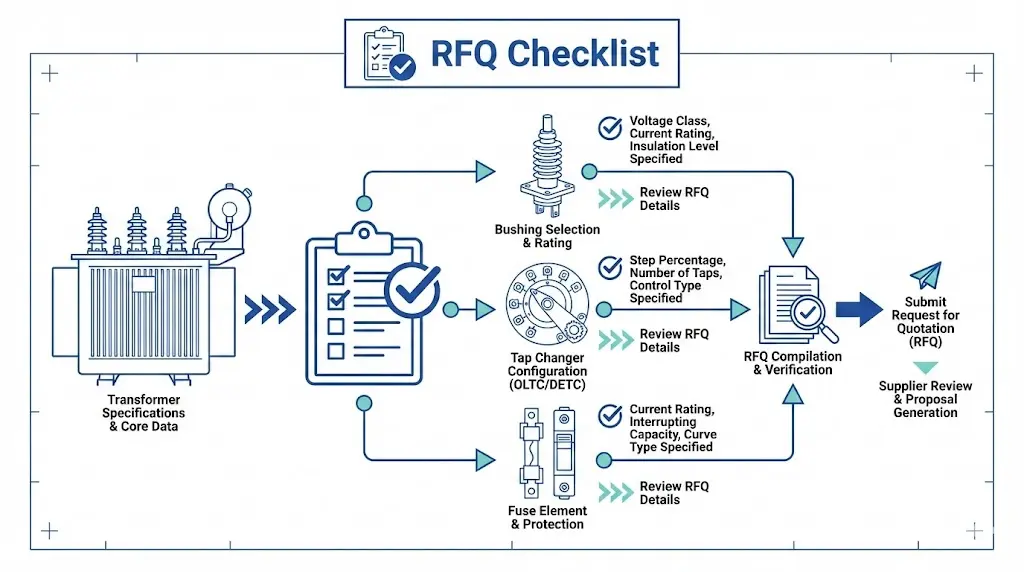
This checklist covers the critical accessory categories: bushings, tap changers, fuses, bushing well inserts, and protective devices. Each component requires specific technical parameters matched to the transformer’s voltage class, power rating, and operating environment. For distribution transformers rated 10–35 kV, accessory compatibility verification typically involves cross-referencing 15–25 distinct parameters before purchase order approval.
The methodology presented here ensures systematic coverage of electrical, mechanical, and environmental requirements—enabling accurate supplier quotations and correct manufacturing the first time.
Why a Structured RFQ Checklist Prevents Transformer Project Delays
Transformer accessory procurement rarely receives the same attention as the main transformer unit—until missing specifications halt production or cause site rework. The pattern repeats across projects: a procurement engineer submits an RFQ for bushings, tap changers, and fuses, but omits critical details. Voltage class appears without BIL rating. Mounting configuration stays undefined. The governing standard switches between IEEE and IEC references within the same document.
Each missing parameter generates a technical query. Each query requires internal coordination at the buyer’s organization. Each response adds 5–10 business days to the procurement timeline.
Three root causes drive most RFQ delays:
Specification gaps: Electrical ratings receive attention, but mechanical interface details—mounting angles, bolt patterns, below-cover dimensions—get overlooked. These gaps surface only when accessories arrive at the transformer manufacturer’s facility.
Environmental assumptions: Standard designs assume sea-level installation in temperate climates. Projects at high altitude or in heavily polluted coastal zones require adjusted creepage distances that must appear in the original RFQ.
Standards ambiguity: IEEE C57 series and IEC 60076 series define similar but not identical requirements. An RFQ referencing both without clarification forces suppliers to guess—or request clarification.
Field observations from substation commissioning projects reveal that accessories specified without environmental considerations frequently require replacement within the first operational year. Complete specifications enable accurate quoting, correct manufacturing, and on-time delivery.
What Technical Data Every Transformer Accessory RFQ Must Include
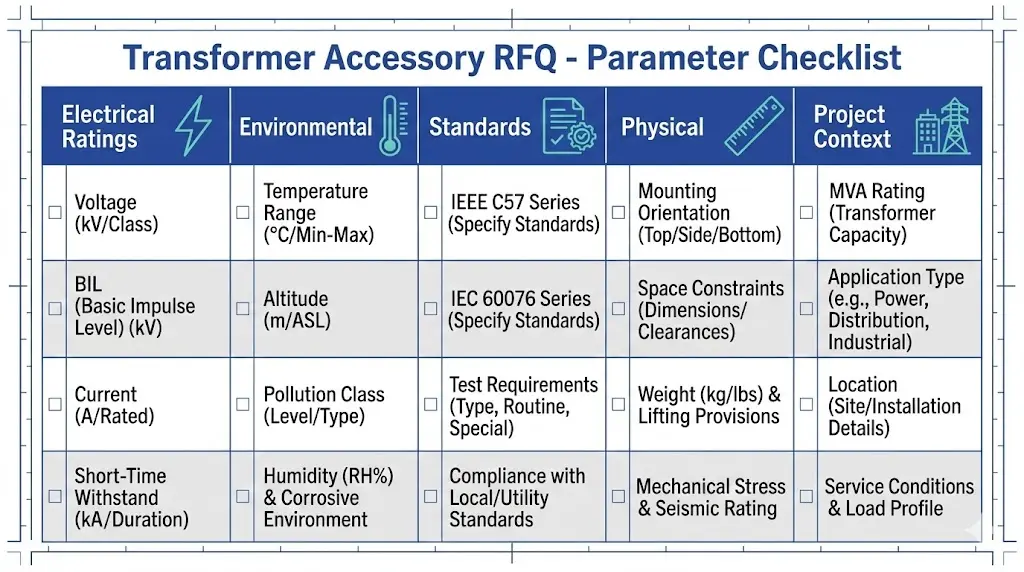
Regardless of accessory type, certain baseline parameters apply universally. Missing any of these triggers clarification requests that extend procurement timelines.
Figure 1. Essential specification parameters required in every transformer accessory RFQ regardless of component type or voltage class.
Electrical Ratings
System voltage (kV) and highest voltage for equipment (Um)
Basic Impulse Insulation Level (BIL) in kV
Continuous current rating (A) at specified ambient temperature
Short-time current withstand (kA for 1–3 seconds)
Environmental Conditions
Ambient temperature range (minimum and maximum)
Installation altitude (meters above sea level)
Pollution severity class per IEC 60815-1 (light, medium, heavy, very heavy)
Indoor or outdoor installation
Humidity and rainfall exposure
Standards Framework
Governing standard: IEEE C57.xx series OR IEC 60076/60137 series
Test requirements: type tests, routine tests, special tests
Application type (utility distribution, industrial, renewable generation)
Expected commissioning date and site location
Critical RFQ parameters include: rated voltage (Um) in kV, rated current in amperes, thermal current rating at 40°C ambient, partial discharge level ≤10 pC at 1.1 × Um/√3, and creepage distance ≥25 mm/kV for medium pollution environments per IEC 60815-1.
The IEEE Standards Association maintains the C57 series covering transformer and accessory requirements—a valuable reference when determining which test protocols to specify.
How BIL and Creepage Distance Affect Accessory Selection
Two parameters cause more RFQ confusion than any others: Basic Impulse Insulation Level (BIL) and creepage distance. Understanding the physics behind these values enables correct specification.
BIL: Impulse Withstand vs. System Voltage
BIL represents the peak voltage a component must withstand during lightning impulse events—not the continuous operating voltage. The relationship follows standardized coordination:
System Voltage Class
Typical BIL Rating
15 kV
95 kV or 110 kV
25 kV
125 kV or 150 kV
35 kV
150 kV or 200 kV
Higher BIL ratings apply to equipment with greater lightning exposure or more conservative utility specifications. Always verify the transformer’s BIL before specifying matching accessories—mismatched ratings create weak points in the insulation coordination chain.
Creepage Distance: Pollution and Altitude Effects
Creepage distance—the shortest path along an insulating surface between conductive parts—prevents surface flashover under contaminated or wet conditions. IEC 60815-1 defines specific creepage requirements based on pollution severity:
Light pollution: 16 mm/kV minimum
Medium pollution: 20 mm/kV minimum
Heavy pollution: 25 mm/kV minimum
Very heavy pollution: 31 mm/kV minimum
Altitude compounds the challenge. Air density decreases above 1000 meters, reducing dielectric strength. Standard practice applies correction factors that effectively increase required creepage by approximately 1% per 100 meters above 1000m elevation.
Coastal installations, industrial zones near cement plants or chemical facilities, and desert environments with salt-laden dust all demand heavy or very heavy pollution ratings—regardless of what “standard” accessories might suggest.
[Expert Insight: Field Specification Lessons]
Specify BIL explicitly—never assume suppliers will match transformer nameplate ratings automatically
For altitudes above 1500m, request manufacturer confirmation of derating calculations
Coastal sites within 10 km of saltwater typically require very heavy pollution creepage regardless of local appearance
Document pollution class justification in RFQ notes to prevent value-engineering substitutions
Bushing and Tap Changer RFQ Specifications
Bushings and tap changers represent the highest-value accessories in most transformer procurement packages. Incomplete specifications here generate the longest clarification cycles.
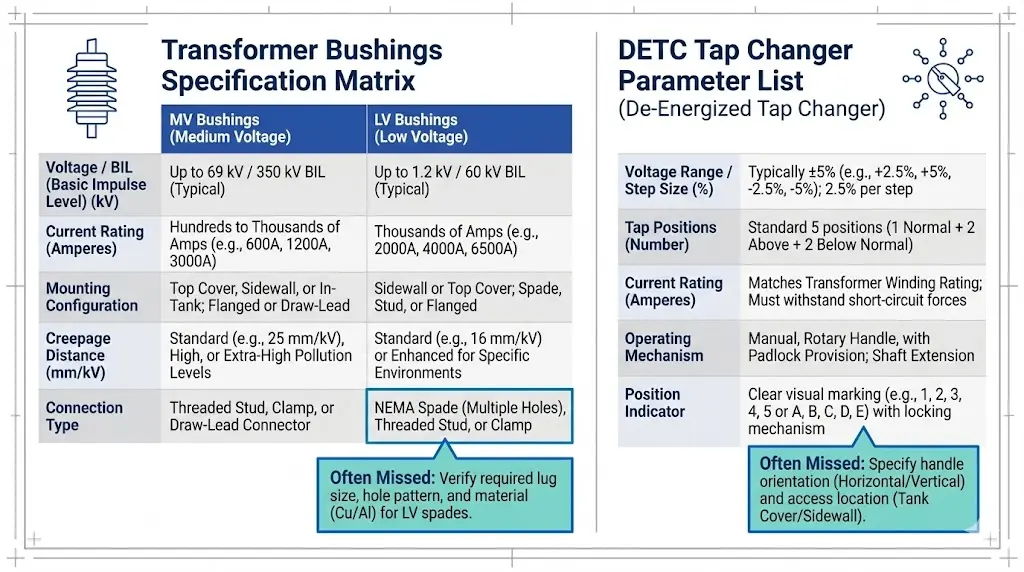
Figure 2. Critical specification parameters for transformer bushings (MV and LV classes) and off-circuit tap changers with commonly overlooked items highlighted.
Medium Voltage Bushings (1–38 kV Class)
Parameter
Required Data
Voltage class
System voltage and Um rating
BIL
Lightning impulse withstand (kV)
Current rating
Continuous current at 40°C ambient (A)
Mounting angle
0°, 15°, 20°, or horizontal
Creepage distance
Minimum mm/kV based on pollution class
Bushing length
Above-cover and below-cover dimensions
Connection type
Spade terminal, threaded stud, or draw lead
Material
Porcelain, silicone rubber, or epoxy
For applications requiring specific bushing configurations, medium voltage transformer bushings must match both electrical ratings and mechanical interface dimensions.
Low Voltage Bushings (≤1 kV Class)
LV bushings often receive less specification attention despite carrying the highest currents. Critical parameters include:
Current rating: Typically 1000 A to 6000 A for distribution transformers
Terminal configuration: Single stud, dual stud, or bar type
Mounting hole pattern and thread size
Plating specification: Tin or silver for contact surfaces
Field note: Verify operating handle accessibility in confined installations. Position indicators should remain visible from ground level for routine verification.
Fuse and Protective Device RFQ Requirements
Protective devices require precise coordination with both upstream and downstream equipment. Underspecified fuses create protection gaps; overspecified units may not coordinate properly with system protection schemes.
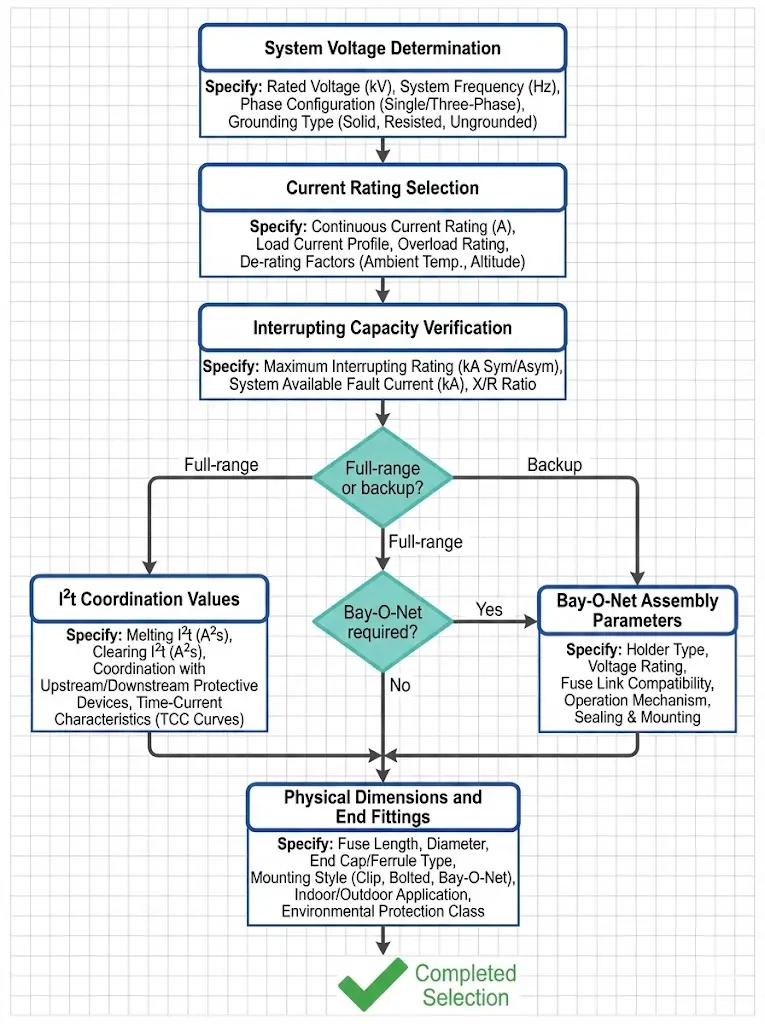
Figure 3. Decision flowchart for specifying current limiting fuses and Bay-O-Net assemblies with key selection parameters at each step.
Current limiting action depends on rapid arc voltage rise within the fuse element. Specify full-range fuses for standalone protection or partial-range units when coordinating with upstream circuit breakers.
Bay-O-Net Fuse Assemblies
Fuse holder voltage class
Compatible fuse link current ratings
Mounting style: Under-oil or sidewall mounting
Arc snuffer requirements for oil preservation
Spare fuse link specifications (recommend 10–20% spares)
Specify packaging requirements for the intended transport mode. Sea freight demands more robust moisture protection than air shipment. Include inspection hold points if witness testing is required before shipment release.
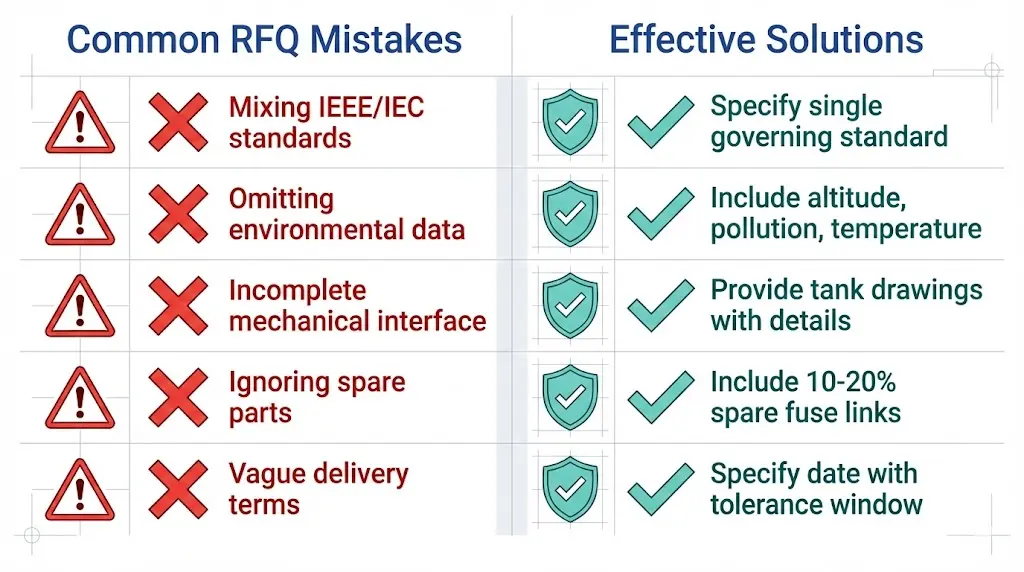
Five RFQ Mistakes That Cause Costly Delays
These specification errors appear repeatedly in RFQs we process. Each one triggers clarification cycles that extend procurement timelines.
Figure 4. Five common specification mistakes in transformer accessory RFQs that cause procurement delays, with recommended solutions.
Mistake
Consequence
Solution
Mixing IEEE and IEC standards without clarification
Dimensional and test requirement conflicts
Specify single governing standard OR provide explicit equivalency table
Omitting environmental conditions
Insufficient creepage for actual site
Always include altitude, pollution class, temperature range
Incomplete mechanical interface data
Bushings arrive but mounting holes don’t align
Request or provide transformer tank drawings with accessory mounting details
Ignoring spare parts requirements
Expensive one-off orders for future maintenance
Include spare parts list: 10–20% spare fuse links, gasket sets
Vague delivery terms
“ASAP” creates scheduling conflicts
Specify required-on-site date with acceptable tolerance window (±1 week typical)
Standards Alignment Note: If your project references multiple standards, create a compliance matrix showing which standard governs each parameter. This eliminates interpretation ambiguity that causes manufacturing delays.
Partner with ZeeyiElec for Your Transformer Accessory Requirements
Preparing complete RFQ documentation takes time—but incomplete specifications cost more in delays, rework, and compatibility failures. The checklist framework presented here systematically addresses the parameters that matter for bushings, tap changers, fuses, and protective devices.
ZeeyiElec supplies transformer accessories to utility and industrial projects across Asia, the Middle East, and Africa. Our engineering team reviews RFQ documents before quotation, identifying specification gaps that could cause downstream issues.
Ready to streamline your next procurement?
Submit your RFQ for technical review and competitive quotation
Request product datasheets for specific voltage classes and configurations
Consult with our applications engineers on challenging installation conditions
Complete specifications lead to accurate quotes, correct manufacturing, and on-time delivery—without mid-project surprises.
Frequently Asked Questions
What is the typical lead time for transformer accessories?
Standard transformer accessories generally ship within 8–16 weeks from order confirmation; custom specifications, large quantities, or specialty ratings for extreme environments may extend to 16–24 weeks depending on manufacturer capacity and material availability.
Should I specify IEEE or IEC standards in my RFQ?
Select the standard that matches your project’s governing specifications and state it explicitly throughout the RFQ—mixing standards without a clear equivalency table creates dimensional and testing conflicts that delay both quotation and manufacturing.
How do I determine the correct BIL rating for transformer bushings?
Match the bushing BIL to the transformer’s nameplate BIL rating; for example, 15 kV class systems typically require 95 kV or 110 kV BIL depending on lightning exposure level and utility-specific insulation coordination requirements.
What spare parts should I include in a transformer accessories RFQ?
Request 10–20% spare fuse links, one complete gasket set per accessory type, and spare position indicator contacts for tap changers as a practical baseline; adjust quantities based on site accessibility and maintenance response time constraints.
Why does altitude matter for transformer accessory specifications?
Air density decreases at higher elevations, reducing dielectric strength and flashover voltage; accessories installed above 1000 meters require increased creepage distances or enhanced insulation—typically applying correction factors of approximately 1% per 100 meters above the 1000m threshold.
Can I use the same RFQ template for different transformer voltage classes?
The parameter categories remain consistent across voltage classes, but specific values for BIL, creepage distance, current ratings, and interrupting capacity must be recalculated and verified for each application—never copy specifications without confirming suitability for the actual system voltage.
What documentation should I request from transformer accessory suppliers?
Require type test reports per applicable IEC or IEEE standards, routine test certificates for delivered units, material certificates with traceability, dimensional drawings for fit verification, and installation manuals; for critical accessories, specify factory acceptance test protocols with witness provisions.
yoyo shi
Yoyo Shi writes for ZeeyiElec, focusing on medium-voltage accessories, transformer components, and cable accessory solutions. Her articles cover product applications, technical basics, and sourcing insights for global electrical industry buyers.





 English
 한국어
한국어 العربية
 Español
 हिन्दी
 தமிழ்
தமிழ் Deutsch (Sie)
 Français
 Português do Brasil
 Русский