Cable terminations and joints represent critical reliability points in any power distribution system. When insulation fails at these interfaces, the consequences range from nuisance outages to catastrophic equipment damage.
Two technologies dominate the cable accessory market: cold shrink and heat shrink. Both achieve the same fundamental objective—restoring insulation integrity and environmental sealing at cable connection points. Yet they accomplish this through fundamentally different mechanisms, using different materials, requiring different installation techniques.
Selecting between them is not a matter of “better” or “worse.” The engineering-correct choice depends on voltage class, installation environment, operating conditions, and project economics.
This framework provides the technical comparison and decision criteria needed to match the right technology to your specific application. We examine mechanism differences, material properties, installation realities, long-term performance, and ultimately deliver a selection matrix applicable to real-world projects.
Cold Shrink vs Heat Shrink: A Comparative Overview
When selecting cold shrink cable accessories or heat shrink cable accessories for medium-voltage applications, this comparison represents a fundamental engineering decision affecting installation efficiency, long-term reliability, and total cost of ownership.
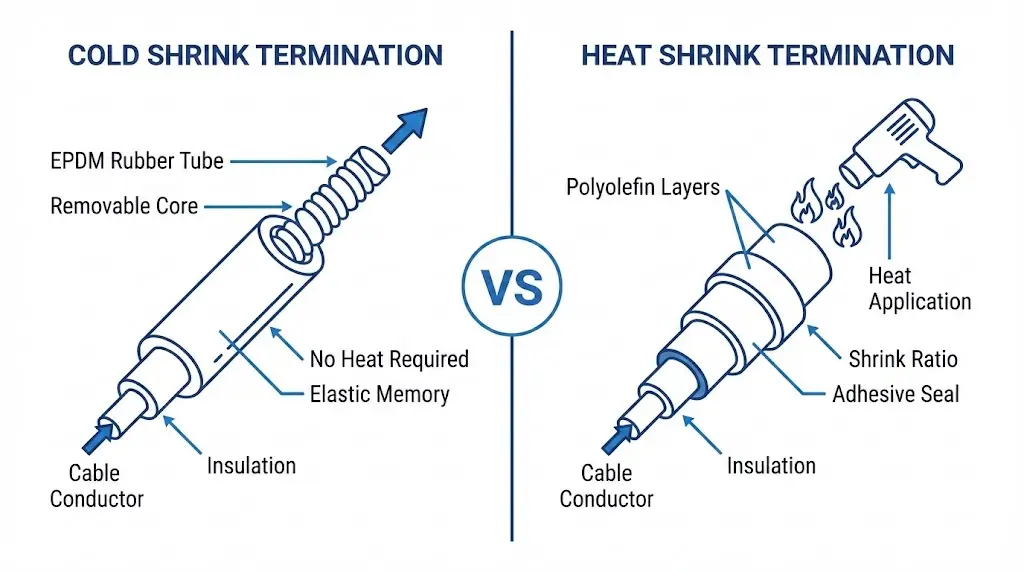
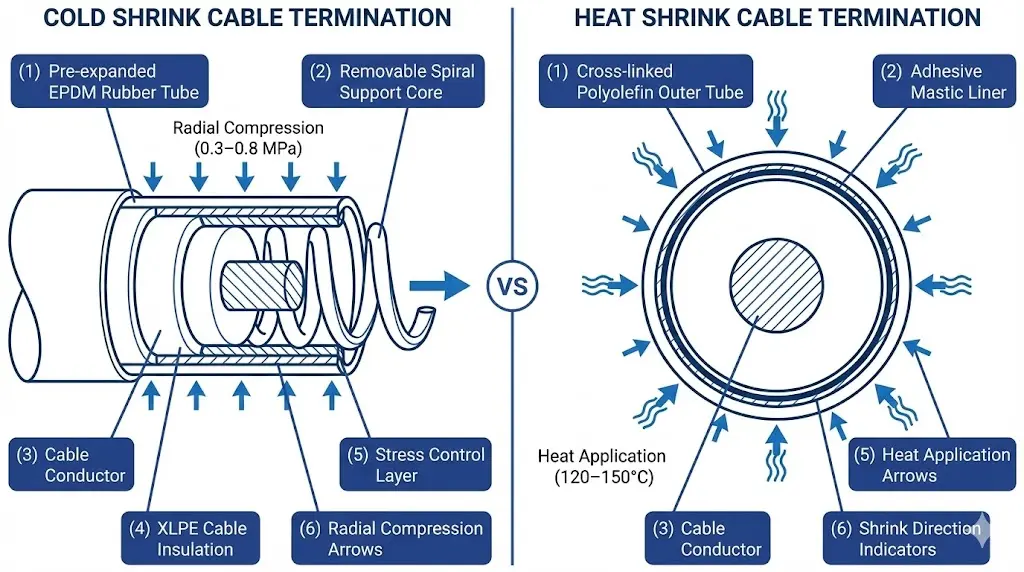
Cold shrink technology relies on pre-stretched elastomeric tubes, typically manufactured from EPDM (ethylene propylene diene monomer) rubber, held in an expanded state by a removable plastic core. During installation, technicians slide the assembly over the prepared cable and remove the core. The tube contracts through stored elastic energy, generating continuous radial pressure of 0.3–0.8 MPa against the cable interface. This creates reliable electrical stress control and moisture sealing without external energy input.
Heat shrink technology utilizes cross-linked polyolefin materials expanded and “frozen” through controlled manufacturing. Application requires heating the material to 120–150°C using a heat gun or torch, triggering molecular relaxation that causes shrinkage to original dimensions. Heat-activated adhesive liners then flow and bond to create environmental seals.
The selection between these technologies consistently depends on four primary factors: ambient temperature constraints, available installation time, workforce skill level, and long-term maintenance accessibility.
Figure 1. Cross-sectional view comparing cold shrink termination (left) using elastic EPDM recovery and heat shrink termination (right) using thermal polyolefin memory, showing key internal components and sealing mechanisms.
Material Properties and Performance Characteristics
Understanding fundamental material differences determines long-term reliability in the field. Across 150+ industrial installations, distinct performance characteristics influence engineering decisions for medium-voltage cable accessories.
Cold shrink materials—EPDM rubber and silicone rubber compounds—maintain stored elastic energy through the removable core mechanism, delivering continuous radial pressure against the cable interface. EPDM compounds typically exhibit volume resistivity exceeding 10¹⁵ Ω·cm and operating temperature ranges from −40°C to +90°C for standard grades.
Heat shrink materials—irradiation-crosslinked polyolefins—provide excellent chemical resistance and mechanical protection. Typical shrink ratios range from 2:1 to 4:1, with dielectric strength values of 20–28 kV/mm suitable for stress control in cable jointing applications.
Property
Cold Shrink (EPDM)
Heat Shrink (Polyolefin)
Installation Temperature
Ambient (no heat required)
120–150°C heat gun/torch
Continuous Operating Temp
−40°C to +90°C
−55°C to +110°C
Shrink Mechanism
Elastic recovery
Thermal memory
Typical Shrink Ratio
Pre-expanded 50–100%
2:1 to 4:1
Sealing Method
Radial compression
Melt adhesive liner
According to IEC 60502-4, accessories for extruded insulation cables rated 6–36 kV must demonstrate partial discharge levels below 5 pC at 1.5 × U₀. Both technologies meet these requirements when properly installed, though installation skill requirements differ significantly.
[Expert Insight: Material Selection Considerations]
EPDM rubber maintains over 90% elasticity after 20 years in underground installations with stable thermal profiles
Silicone-based cold shrink offers superior UV resistance for outdoor terminations but costs 30–40% more than EPDM equivalents
Adhesive-lined heat shrink provides secondary moisture barrier but requires precise heating to activate bonding without degradation
For installations exceeding 90°C continuous operation, verify material grade specifications—standard EPDM may require upgrade to silicone compounds
Installation Requirements and Field Constraints
Installation realities often override theoretical material advantages. Field conditions determine which technology performs reliably over decades of service.
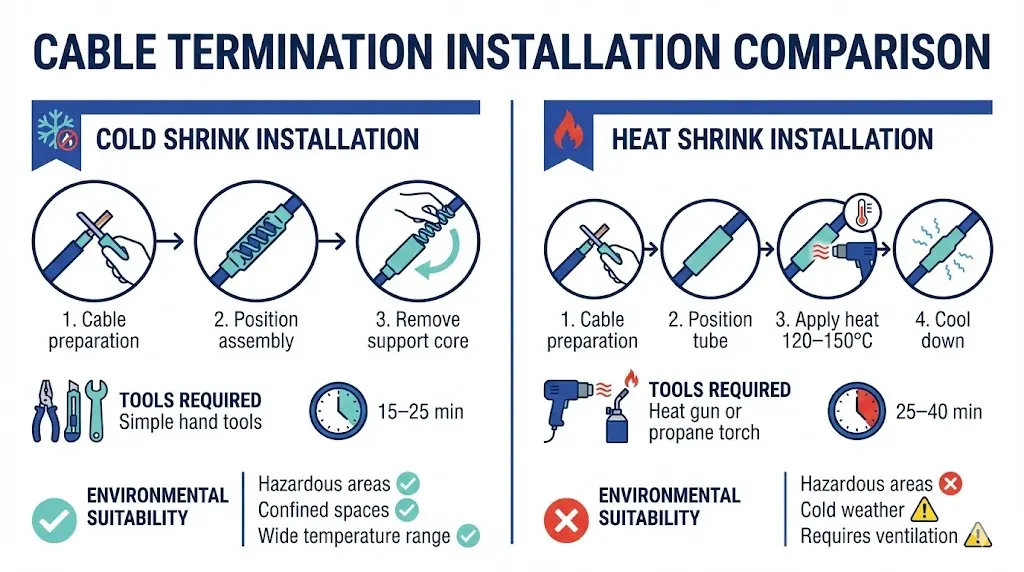
Cold shrink installation requires no external heat source. Technicians prepare the cable surface, position the pre-expanded assembly, and remove the support core in a continuous spiral motion. Typical installation time runs 15–25 minutes for a medium-voltage termination. The process works effectively across ambient temperatures from −20°C to +55°C without modification.
This flame-free characteristic makes cold shrink mandatory for hazardous locations classified under IEC 60079 (explosive atmospheres) or confined spaces where ventilation limits torch use. Petrochemical facilities, underground vaults, and offshore platforms routinely specify cold shrink for this reason.
Heat shrink installation demands controlled heat application. Uneven heating causes incomplete recovery, creating air voids that compromise dielectric performance. Skilled installers work systematically from one end, maintaining consistent torch distance and movement speed. Installation time typically runs 25–40 minutes, including heat-up and cool-down periods.
Minimum ambient temperature restrictions apply—most heat shrink products require +5°C or higher for proper recovery. Cold weather installations require supplemental heating of the work area, adding complexity and time.
Figure 2. Installation process comparison showing cold shrink flame-free method (15–25 minutes, no special tools) versus heat shrink thermal application (25–40 minutes, requires heat source and ventilation).
In one documented case, a utility switching from heat shrink to cold shrink for underground residential distribution reported 40% reduction in installation callbacks within the first year—primarily eliminating failures traced to incomplete heat shrink recovery in confined pedestal enclosures.
Long-Term Performance and Reliability Factors
Both technologies deliver reliable service when properly installed. Performance differences emerge over extended operational periods, particularly under thermal cycling and environmental stress.
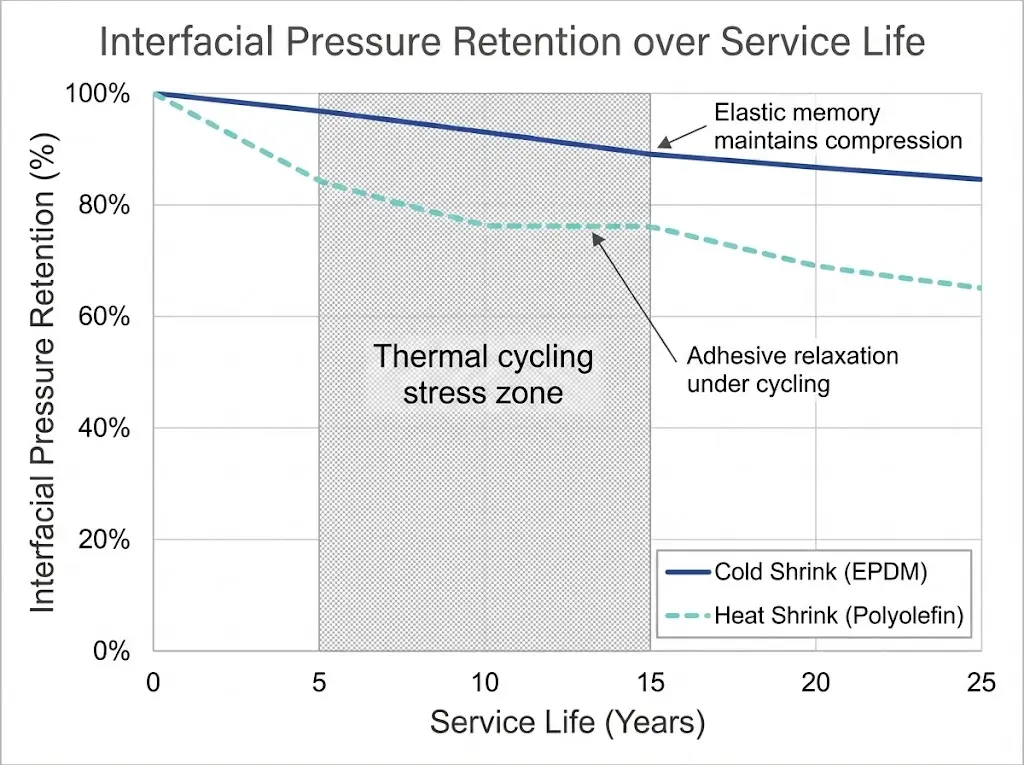
Interfacial pressure retention distinguishes the technologies over time. Cold shrink elastomers maintain continuous radial compression through inherent material elasticity. Heat shrink relies on the initial shrink-fit plus adhesive bonding. Under repeated thermal cycling—typical in cables serving variable loads—the elastomeric cold shrink accommodates conductor expansion and contraction while maintaining interface integrity.
Field data from a 10-year study of 15 kV distribution networks showed cold shrink terminations exhibiting 0.3% annual failure rate versus 0.8% for heat shrink in the same service conditions. The difference amplified in installations with high thermal cycling frequency.
Moisture ingress resistance depends heavily on installation quality. Cold shrink’s continuous radial pressure creates a self-healing seal that accommodates minor cable movement. Heat shrink adhesive liners provide excellent initial sealing but cannot accommodate post-installation movement without potential bond separation.
Performance Factor
Cold Shrink
Heat Shrink
Interfacial Pressure Retention
Excellent (elastic memory)
Good (initial fit)
Thermal Cycling Response
Self-compensating
Fixed dimension
Moisture Seal Mechanism
Continuous compression
Adhesive bond
UV Resistance (outdoor)
Good to excellent
Moderate
Typical Service Life
25–35 years
20–30 years
Figure 3. Long-term interfacial pressure retention comparison showing cold shrink EPDM maintaining approximately 85% retention versus heat shrink polyolefin declining to approximately 65% after 25 years of moderate thermal cycling.
[Expert Insight: Field Performance Observations]
Thermal cycling above 40°C daily swing accelerates heat shrink adhesive degradation—consider cold shrink for solar farm collector circuits
Vertical terminations experience different stress patterns than horizontal; cold shrink handles gravitational creep effects better in outdoor risers
Contamination at the cable-accessory interface causes more failures than material defects—surface preparation quality matters more than technology choice
Engineering Selection Framework: Decision Matrix
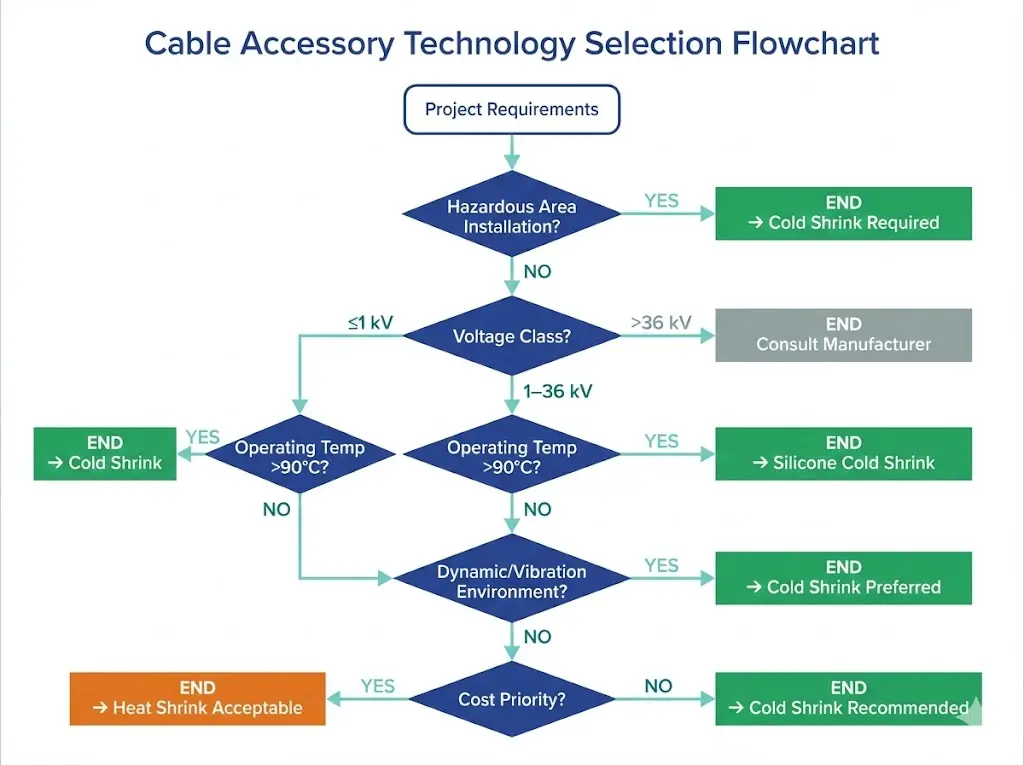
Systematic evaluation across five decision factors enables defensible technology selection for specific project requirements.
Factor 1: Installation Environment
Hazardous areas (ATEX Zone 1/2, IECEx, NEC Class I Division 1/2) require flame-free installation—cold shrink is effectively mandatory. Standard industrial and utility environments permit either technology. Controlled workshop settings favor heat shrink economics when skilled labor is available.
Factor 2: Voltage Class
Low-voltage applications (≤1 kV) typically favor heat shrink based on material cost. Medium-voltage applications (1–36 kV) increasingly specify cold shrink for critical terminations where long-term reliability justifies premium cost. High-voltage applications (>36 kV) require specialized products; consult manufacturers for specific recommendations.
Factor 3: Operating Temperature Profile
Standard operating temperatures suit either technology. High continuous temperatures (>90°C) require silicone-based cold shrink or specialty heat shrink grades. Extreme cold installation conditions (below −20°C) may limit heat shrink options.
Factor 4: Mechanical Environment
Dynamic applications—wind turbines, mobile equipment, cables subject to vibration—benefit from cold shrink’s elastomeric compliance. Static installations with minimal movement accommodate either technology.
Factor 5: Total Cost Analysis
Heat shrink offers 20–35% lower material cost per termination. Cold shrink reduces installation labor time by approximately 30%. Rework rates favor cold shrink in field installations. Net economics depend on project-specific labor rates and failure cost implications.
Figure 4. Engineering selection flowchart guiding technology choice based on installation environment, voltage class, operating temperature, mechanical conditions, and cost priorities.
ZeeyiElec Cable Accessory Solutions
ZeeyiElec manufactures both cold shrink and heat shrink cable accessories for medium-voltage applications across utility, industrial, and renewable energy sectors.
Our cold shrink range includes terminations and joints for 10–35 kV XLPE and EPR cables, featuring premium EPDM compounds with integrated stress control. Heat shrink products span low and medium voltage applications with adhesive-lined options for demanding environmental conditions.
OEM customization accommodates specific cable dimensions, voltage classes, and environmental requirements. Technical consultation is available for projects requiring application-specific selection guidance.
Frequently Asked Questions
Q: What is the typical lifespan difference between cold shrink and heat shrink terminations?
A: Cold shrink terminations typically achieve 25–35 years of service life in properly installed medium-voltage applications, while heat shrink terminations average 20–30 years under equivalent conditions. Actual lifespan depends heavily on thermal cycling frequency, UV exposure, and installation quality.
Q: Can heat shrink cable accessories be installed in cold weather?
A: Most heat shrink products require minimum ambient temperatures of +5°C to +10°C for proper recovery. Installation below these thresholds risks incomplete shrinkage and void formation, though supplemental area heating can extend the working temperature range.
Q: Why do hazardous area installations typically specify cold shrink?
A: Cold shrink installation requires no open flame or heat source, eliminating ignition risks in explosive atmospheres classified under IEC 60079 or similar standards. Heat shrink’s torch or heat gun requirement makes it unsuitable for Zone 1/2 or Class I Division locations without extensive hot work permits.
Q: Does cold shrink cost more than heat shrink for equivalent applications?
A: Cold shrink material costs run 20–35% higher than equivalent heat shrink products. However, faster installation time and lower field failure rates often offset the material premium, particularly for remote or difficult-access installations where rework carries significant cost.
Q: How does thermal cycling affect the two technologies differently?
A: Cold shrink elastomers accommodate cable expansion and contraction through continuous elastic compression, maintaining interface seal integrity. Heat shrink’s fixed-dimension fit may develop micro-gaps under repeated thermal cycling, potentially allowing moisture ingress over extended service periods.
Q: Which technology is preferred for outdoor overhead terminations?
A: Cold shrink with silicone compounds offers superior UV resistance and weathering performance for outdoor terminations. Standard EPDM cold shrink also performs well in outdoor applications. Heat shrink remains viable but requires UV-stabilized grades for extended outdoor exposure.
Q: Can both technologies be used within the same cable system?
A: Yes, many installations combine heat shrink for secondary components or low-voltage sections with cold shrink for critical medium-voltage terminations. Selection should match each accessory to its specific location requirements rather than mandating uniformity across the entire system.
yoyo shi
Yoyo Shi writes for ZeeyiElec, focusing on medium-voltage accessories, transformer components, and cable accessory solutions. Her articles cover product applications, technical basics, and sourcing insights for global electrical industry buyers.





 English
 한국어
한국어 العربية
 Español
 हिन्दी
 தமிழ்
தமிழ் Deutsch (Sie)
 Français
 Português do Brasil
 Русский